I purchased a SkyRC Ultimate B6 200W charger over the Christmas break. Their manual specs LiIon nominal = 3.6V, Max = 4.1V and Min = 2.5V. However, The battery specs call out nominal = 3.7V, Max = 4.2V and Min = 2.5V.
Should I do my discharge w/the LiIon chemistry and charge w/the LiPo chemistry which calls out nominal = 3.7V, Max = 4.2V and Min = 3.0V or should I use the LiIon chemistry routine per the paragraph above?
Stick with the 3.7/4.2V menu, which is in your case, LiPo.
The 3.6/4.1 voltages were for old rechargeable lithium chemistry cells a couple of years ago, and all current 18650’s for flashlights are fully charged at 4.2V.
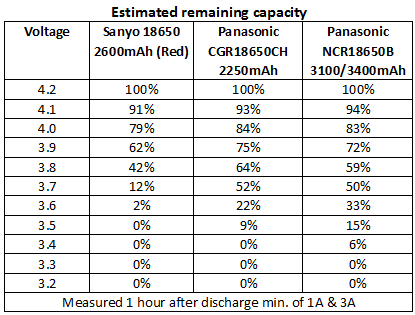
Here’s a reference to the Ouchyfoot’s capacity guide:
Here is open circuit “Resting” Voltage for Li-ion:
4.3 volts = OVER CHARGED!!! (WARNING: Defective charger, discontinue it’s use!)
4.2 volts 100%
4.1 about 90%
4.0 about 80% (I usually top them up back around here)
3.9 about 60%
3.8 about 40%
3.7 about 20%
3.6 empty for practical purposes
<3.5 = over-discharged
it’s little bit confusing for me … if i take some good protected 18650 cells, e.g. NCR18650A/B , is it Ok to use them in flashlight till light fade off (discharge completely), i mean, would PCB do the job and cut off the current while still is safe for the cell ?
Generally it is best to charge when the light starts to dim or before. Especially on low levels it can be important to charge before the light starts to dim.
The protection will protect the battery from being killed, but discharging down to the protection kicks in might add extra wear to the battery (Again it is low brightness that is worst).
Also note that the above tables with charge state is measured without load, the actual voltage when loading the battery will be considerable lower.
thanks HKJ… considering that you’re more expert than me , can you tell why most of the PCB and PCB chargers / balancer electronic boards which are available online have overcharge protection in range od 4.325 - 4.375v and discharge protection 2.320 - 2.480v.
It is a protection and for this reason it is placed outside the normal operating range of the batteries, I do not know if your specified range is correct for the common used chips.
Theoretically you can get chips with closer tolerances, but I would guess that the cheapest chips are used, i.e. the same chips as is used in phones and other equipment with LiIon batteries.
You can see a datasheet for a protection ship here, notice the many different voltages that is possible. Most of these combinations probably requires that you buy 100000+ chips to get them at a reasonable price.