Nitecore decided to update the LR50 camping lantern, released a couple of years ago, (see review). Despite the fact that the brightness has increased by only 20 lumens, the light has become warmer and more comfortable. In addition, the flashlight now supports 21700 batteries and charge-discharge power inreased significantly, up to 18w!
I propose to compare both models and see if there is or may be some other changes.
What is unexpected - the price tag of the new item is quite comparable to the old model.
Specifications
Max Output: 280 Lumens
Max Beam Distance: 28m
Max Beam Intensity: 54 cd
Max Runtime: 150 h 0 m / 6.25 d
LED: HIGH CRI LED
Battery: 1×21700, 2×21700, 1×18650, 2×18650, 2×CR123, 4×CR123
Special Modes: Location Beacon, SOS
Beam color: (actually neutra)White light, High CRI
Weight: 136 g / 4.80 oz
Dimensions: 129.3mm×60.7mm×31.2mm (5.09"×2.39"×1.23")


PACKAGE AND APPEARANCE
Quite the usual yellow and black carton packaging, typical of all mid-range Nitecore products. In general, everything is decent. The design, however, has slightly improved relative to the old version.


Kit includes: the LR60 itself, a manual, a Type-C charging cable, a pair of 18650 -> 21700 adapters and a bag with an O-ring.


Since the flashlight is powered by 21700 batteries now, it has grown somewhat in size, just 1 cm longer and a couple of mm wider and thicker. And except for that, the look has remained completely unchanged - it's all the same. Of course, nothing creaks, no backlash. To the touch and outwardly - a normal branded thing. In principle, everything here is at the usual level for a Nitecore.


Since the Nitecore LR60 is also a charger, it is logical that it has easy access to the batteries. You need to squeeze out two latches to get to remove the diffuser. Here, again, no changes.

The diffuser is thick and will not be punctured no matter how hard i press it. LR50 fell on concrete from a height of two meters, a symbolic crack appeared on the side of attachment to this latch. Taking into account the height of the fall, I think the result is good. The fastening structure is primitive and reliable, I don't see any way to break something by negligence. On purpose, foolishly, of course, the diffuser can be pulled out. But fool can break anything. As we say in Russia: "if you give a glass dick to fool, he will break dick and cut his hands".
The diffuser is held securely and firmly. No backlash and gaps. There, on both sides of the case, there are all the same two buttons.

And here is a T-shaped structure covered with LEDs, into the sides of which the batteries are inserted. Just in case - they are not included in kit by default. And another important point - flat-headed batteries will not work, you will need to install a magnetic spacer. But there is a good point as well - i`m talking about regular batteries, not expensive proprietary ones.

On the top of it, among the mass of main LEDs, is a lone blue indicator dot. It blinks off the voltage and, in case of need, works as a small locator, helping to determine where the LR60 is


The batteries are held firmly there. If there is no 21700, then you can use adapters with 18650. Batteries are easy to install and keep securely inside. What else do you need?


There is the most common suspension eye on the bottom.

Wow, Nitecore, made the base rectangular (it was oval), which allowed for the installation of larger and more powerful magnets. If earlier it was impossible to keep the Nitecore LR50 with two batteries in a horizontal position, now the much heavier LR60 keeps a full horizontal position!


It holds, by the way, even on thin metal siding. But this metal is already to thin to hold the full horizontal "-"

In the same place, behind a thick and reliable (it comes in tight, with a clap) yellow plug are 2 connectors - Type-C (there was micro-USB) for the input and standard USB-A for the output. Unfortunately, Type-C is not dual way, it will work only for charger, not for discharge ... Here, in fact, you can see the difference in the base area. By the way, no matter what power source (i have many) i used, i never say stated 12V. But there is no difference, since the LR60 takes 9v, but with a large current and still draws in the same 18 watts. so that is no problem at all.


So, for a 2 * 5000mah 21700 battery, the capacity will be 37W * hours. In power bank mode at 18 watts, the LR60 delivers 26 watts * hours, turns off with 3.3v battery voltage. But you can reduce the load to standard 5v2a and at these 10 watts the power bank will work a little more. Then you can reduce the load to 0.5V and in this way get about 27 watts * hours. The efficiency is quite acceptable, 27 \ 37 = 72%.
The stated standards are honestly supported. It's a shame, again, that there is no PD.

The tension sags a little.

And at 18 watts of load, 27.3 watts * hours can be drained

But if from the very beginning you lower the load power to 5 watts (modest 5v1A), then you can drain that way by 10% more.

The manufacturer promises that there is support for working on the go. So yes, it is.
The question is, the LR50 worked even without batteries. Bad at minimum brightness, so-so at average and no complaints at maximum. It was logical to expect the same from the LR60 as an updated and more advanced model. But...you just won't get anything. The flashlight somehow blinks at the minimum brightness and almost immediately turns off at the middle one. Sorry. Uncool, frankly. The ability to power from a power bank or a stationary charging unit would help out great in a some of situations.
I have nothing to complain about besides this , everything is fine. What was worth improving relative to the previous model has been improved (magnet, type-C, transition to 21700). The model worsened only in the impossibility of working from external power supply.
UI
Extremely simple and unchanged. In order to turn on the flashlight, you must simultaneously hold down both buttons, i.e. chances of accidentally turning on the lamp are completely excluded.
Then u just press button to change brightness or hold button to change direction of light.
There is no mode memory - it is always turned on in LOW (which is, undoubtly good for camping lantern), but there is a memory for the selected direction of light.
HOW NITECORE LR50 ILLUMINATES
The light, in my opinion, has definitely become more pleasant in tint, acquired some nichia-like pinky tone. In general, to be frank, I see few sense of HiCRI here. I think it would be more practical to install a more energy efficient version of the LEDs, increasing the brightness due to the loss of the color rendering index. This is, of course, a matter of taste.
Nevertheless, in total majority of models, big manufacturers sacrifice everything for the sake of higher brightness and throw, just to add more WOW for promo pics and impress unexperienced users. So it's surprising that Nitecore (try to find non-Cold White Nitecore model), somehow remembered about HiCRI LEDs ...


Despite the fact that the specification claims 12v charging, the Nitecore LR60 only took 9v from my powerful 65W charging (see review). In principle, the difference is zero - 18 watts the flashlight takes in any case.
Not bad, but Nitecore LR60 with a pair of 5000mah 21700 batteries will charge significantly faster than the LR50 with a pair of some 3200mah 18650 batteries. Unfortunately, while charging, I constantly had a bluetooth connection break. So I cannot illustrate with a graph. Just take it on faith that it has 18 watts of charging versus 10 watts of the previous version.
Stabilization and runtime
The flashlight is only 30 lumens brighter, which is quite a homeopathic increase over the past 250 lumens. Although separately taken 30 lumens is also far from useless mode ...
Well, 280 lumens is really not weak brightness, which is especially evident in a closed room.
so look how the turbo was holding on all 9 LEDs of LR50
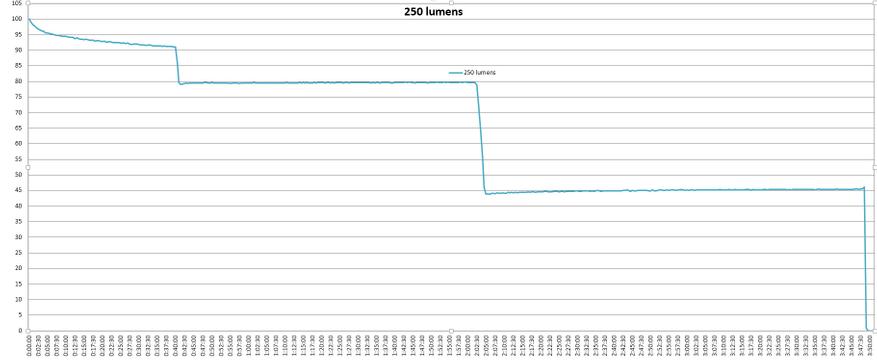
And look at LR60 - there is no stabilization of the maximum brightness here, the brightness starts to drop immediately. On the other hand, I use camping lamps quite actively and I can say that the brightness will drop for so long that, undoubtedly, the eye will adapt to this drop and visually it simply looks the same until point of deep discharge. The point that turbo mode doesn`t reach as it stabilizes far higher it.
And so, I'll tell you frankly - far away, you don't always need maximum brightness at all.

I did not check the brightness for all modes, as it takes a very, very long time. So and I made additional measurements only for the middle mode. And here everything is already stable and very long-lasting.
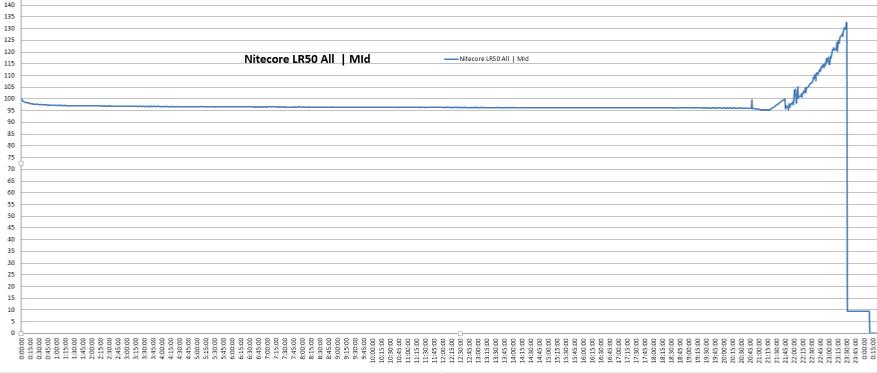
but Nitecore LR60 - privides you with 7 hours more. Which is, in fact, runtime throughout the whole night.

Naked numbers will not make it clear how Nitecore LR60 illuminates. So, look at the photos. Of course, light seems to be brighter indoor. For example, there will be photos with full light and light from the top, without the side one, the yellow square in the upper left corner will make it clear which type of light is on. Well, for comparison, there is the previous model added to pic.


Top LEDs only. It seems to be not an impressive maximum brightness, if you look only at the numbers. But everything turns out to be completely different in reality .


And the side LEDs


OVERALL IMPRESSION
I'm a big fan of camping lanterns and I find the LR60 a good upgrade from a previous version that I really liked.
This is the same successful combination of charging, power bank and travel light source. The price tag of the new version remained at the same level as the old one. And by itself, it does not represent some astronomical amount.
Of course, you can sacrifice functionality and take something significantly cheaper. Or you can pay a a way more and take a much larger and brighter lamp. The only question is that these will be completely different models, both in terms of batteries used and versatility. The latter is what makes the Nitecore LR60 stand out from its competitors.
To be fair, charging functionality for me will be secondary and for home use I would prefer a stationary charger. But if you go camping / fishing / hunting and you need all in one to save space and weight , then you can certainly consider the Nitecore LR60.
Pros in general:
+ HiCRI light
+ Ability to flexibly adjust the direction of light and brightness
+ Full functional fast and powerful charging
+ Work in 18-watt power bank mode
+ The brightness is stabilized after stepdown,
+ Magnet
+ 21700 batteries
+ Price tag at the level of the previous version
+ Convenient and logical UI
Pros relative to the LR50
+ Better tint of light
+ 21700 batteries with 1/3 increase in total capacity
+ 18 watts charge / discharge versus 10 watts passed version
+ The magnet has become much stronger, fully keeps the horizontal
+ Increase in brightness
Cons in general:
- Still no red light
- Separately, each of the directions of light is not that brightn outside the maximum mode.
- It would be worth releasing a more energy efficient non-HiCRI version for those who are ready to sacrifice the quality of light for the sake of its quantity. I mean i vote for brighter non-HiCRI version.
- It would be possible to set an additional mode between between mid and high (now it can be done by setting the maximum brightness to "1 side + 1 top light")
- There is no side light mode, if it is on the table, then it shines with an aimlessly going upward light. I can do without red light, but this should be fixed!
- Do not work with flat-headed batteries solved by a magnetic spacer.
Cons regarding the LR50
- No support for external power supply without using batteries