They’re right there next to the things that you might need but probably aren’t going to use for a long time.
Next to the place where the box of things were that you got rid of recently, because you’ve not used them in forever, but will inexplicably need one next week
That is one of life’s strangest truisms, guys know that it is a real fact.
A question I have of you guys is about the charger described in the first post, the Bevigor 16 Bay Battery Charger AA AA for NiMH Rechargeable Batteries.
I bought that because I like to charge my batteries twice a year just before big American holidays of July 4th and Thanksgiving/Christmas, and since I have started accumulating the off brand batteries like Bevigor, Granicell and others, because the sales make them so cheap and I figure they are too cheap not to make a backup pile of emergency extras, and I want to charge them in huge batches, not in my 4 bay quality chargers that I use for my name brand batteries, the question is, would you use this charger like that? Having extra chargers that hold a lot of batteries is also useful if there is a situation where you only get power for a few hours a day, which happens in some countries, you can be charging dozens and dozens of batteries at once.
Would you use this charger for your second tier batteries, and would you use it on your eneloops?
If it works properly, especially at 0.5 amps, it should be fine for any cell. The question is, does it do what they say it does? The only way to know that is to test it to verify the performance. Monitor the cells that you charge with it, in including voltage when charging terminates and temperature during charging. Or find a review by a trusted reviewer and go from there.
PS I notice that there are no reviews for the charger on Amazon, nor can I find any anywhere else. So it is a bit of a crapshoot… so test test test.
USB-C has achieved the impressive feat of making one connector look simple while the labels read like alphabet soup. The missing detail is the input profile: 5V × 2A is only 10W, while 12V × 2A is 24W. Sixteen slots at 0.5A need roughly 12W at the cells before conversion losses. A reputable single-port 30W PD adapter plus a good C-to-C cable should provide enough headroom,but only if the Bevigor negotiates one of the adapter’s listed voltage/current profiles. Check the charger label or manual for the exact 5V/9V/12V requirement first.
2 Thanks
After reading all of the above help on this topic and reading the Amazon stuff and asking Alesa some questions…She states that this charger is not a full “in-compliance” USB C type Power Delivery item…I guess…It requires a solid 12 VCD input with a USB C type connector…so she gave me a few wall chargers that will work with this charger…How about the following…
This is a dedicated 12VDC output with capability up to 3 amps…Not that your charger is gonna us all 3 amps…it just has that capability..
Does that match this description of the battery charger about the PD?
- QC/PD FAST CHARGING TECHNOLOGY: Equipped with a modern Type-C input, these household battery chargers support QC/PD quick charge protocols up to 24W. Unlike standard devices, it delivers a full-speed 500mA current to every single slot without dropping power—even when fully loaded. (Note: A 2A adapter is recommended for optimal performance).
Yes it specifically say NO PD… And does not mention QC… So it probably is not what he needs…
Yes there is more to it than just voltage and current… The correct protocol must be supported so that it can be negotiated between the source and the sink… THIS One sounds like it will do what he needs…and reviews look pretty good.
I bought that 70w wegear that I had mentioned up the thread since it looked workable and I had a coupon for $25.00, and I found my 240 watt C cable that I had bought a long time ago.
I haven’t used the battery charger yet but think it should all work.
1 Thank
What’s really screwy is that the battery charger ships with the USB to USB-C cable.
Then they talk about needing a 2 amp adapter. And the specs say that it has a 12 volt input.
I believe what they mean is it needs a power supply that will provide two amps at 12 volts.
And the math works out for that.
The problem is you’re not quite going to get enough power out of most USB (rectangular port) power supplies out there. So that one just recently posted above probably would work but it’s not the best choice. The power supply that you just bought with a c to c cable is your best choice.
And don’t believe Alyssa or her sister Alexa.
If you use the enclosed USB A to USB C cable, this unit won’t give enough output for the battery charger…I believe it’s only 18 watts out of the USB A output…And then that leaves you the USB Type C output which negotiates with the battery charger using USB C Type Power Deliver specification…I don’t believe that the port on the battery charger is a full type C power delivery spec…I did try to find a manual on this this battery charger but did not find one…
I just bought this one for $6.29 with a coupon, I have the one I mentioned above in the thread but it didn’t mention QC although it did mention PD.
60W USB C Charger Block, Versatile iPhone Charger, Yellow
5 Ports PD 3.0 25W Single Max Fast Charger, QC 2A USB Wall Charger
https://www.amazon.com/gp/product/B0G4WGMHNV/ref=sw_img_1?smid=&th=1
this looks very questionable.
Only low quality effort 3d render and no real pictures while being very cheap for “60w”
I bet it wont handle true 60W for long and i would not trust its isolation…
i have taken to many cheap no name PSUs like this apart. extremely rear to fined one thats at least “ok” but “scary” is way to common.
1 Thank
What about all the ratings and reviews?
I don’t trust the majority…the big majority, of reviewers. Many seem to be pretty ignorant.
Besides that, there are not many long term reviews. So, perhaps, they work short term, maybe for light loads and intermittent use…But what about failures after that?
I tend to agree with @six7 they are cheap for a reason. Which becomes even more of an issue if you want to use one regularly for hours at a time to power something like a battery charger. Probably better to pay more up front for a brand name… and hope you have better chances of getting something that works long term. Maybe one that doesn’t catch your charging station on fire… 
What about them?
Does not Burn the house down for 98% of the uses = 4.9 stars awesome product
Does not Electrocute users in 80% of Cases = 5/5 stars (because the 20% it does can no longer give a negative review :D)
But seriously, what do you expect from Amazon reviews?? even if they are not bought and cherry-picked (what they are)
and even if the product for the listing and reviews is not silently changing (what happens often enough)
How many of the reviewers do you think have the knowledge and equipment to test and review a product like this properly?
let alone the motivation?
how many reviewer go to this level of effort?
and even if they give the worst rating. how mush would it tip the scale?
if 99% just test if there phone charges
2 Thanks
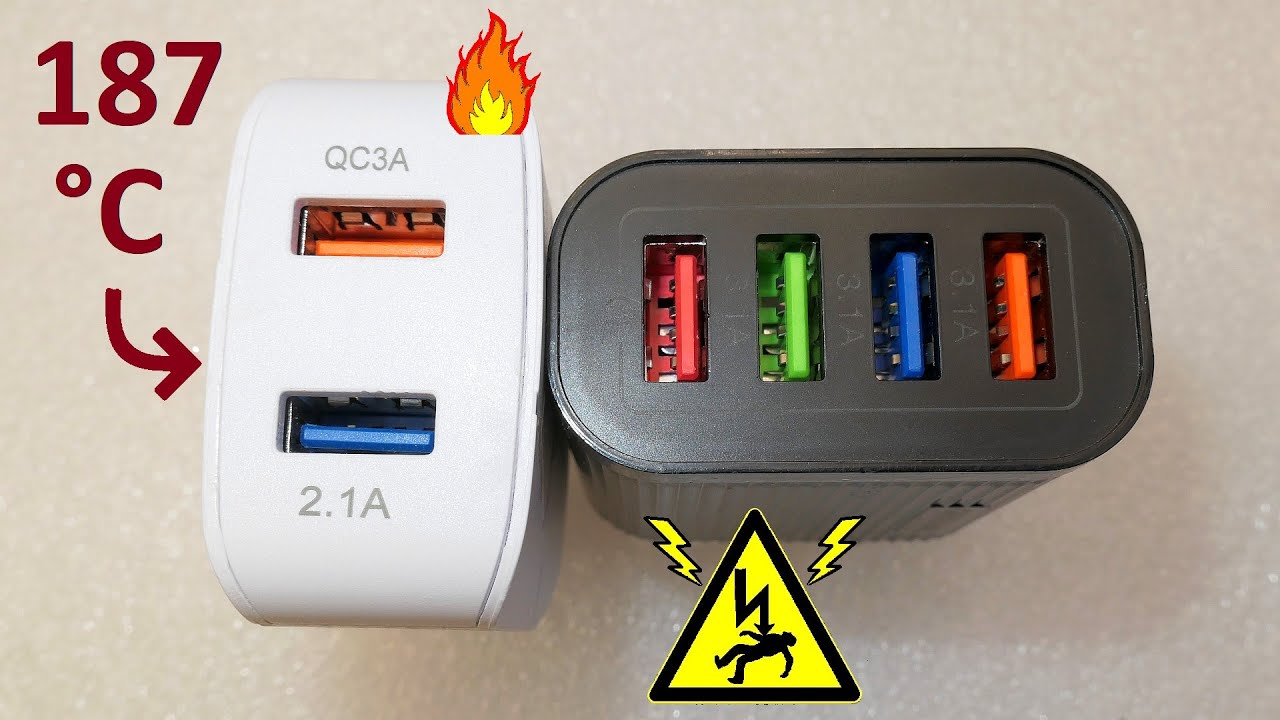
Just as I’d hesitate to buy Li-ion batteries from unknown suppliers, I’d hesitate to buy no-name USB power supplies without a technical review. They usually don’t perform as advertised, and may be a fire or shock hazard.
I actually did try one once, “Pxwaxpy” brand with claimed 128W output. It wouldn’t power my laptop, despite claiming double the power output of the factory power supply.
Smaller brands I’ve had good results with include Baseus, INIU, and Voltme. Chargerlab has decent teardowns for some of them.
1 Thank
The 60w yellow got lost in shipment and refunded, so I still have the Wegear mentioned up thread.
I tried alexa on the product and it said it has what I need, and I also now know what PD and QC means, all the input on this thread has helped me understand about these chargers after me thinking that any 5v usb port would suffice and that a 2.1 one was pretty modern over the old 1.0,
Yes, the wegear 70W Charger supports both PD (Power Delivery) 3.0 and QC (Quick Charge).
Port breakdown:
USB-C1 & USB-C2: PD3.0, QC5, QC4+, QC3.0, QC2.0 (plus other protocols)
USB-A: QC3.0, QC2.0
1 Thank
I looked up Wegear and found this, so I assume that Wegear has some level of basic quality intended for an enduring place in the marketplace, whether they are great products or not.
The trademark WEGEAR is held by Lenovo (Singapore) Pte. Ltd., with the application originally filed on September 25, 2025.