I was thinking of rigging up auxiliary motorcycle lights using flashlight components. Even if it is a good idea, how do I even start to deal with converting the 12-14 V to a more suitable value?
Not an expert on the subject here, but could it be feasible to use LEDs that are 12V-configurable, like Cree’s XHP series?
1 Thank
You’d need to do 2 things: step down to the appropriate voltage and regulate the current. A super hack way of doing it would be to get a stepdown regulator to feed 4v to a flashlight driver, then use that to power the LED. There’s some dedicated “DC-DC constant current stepdown drivers” you can get, but they’re usually from AliX and are of questionable quality/reliability. That’s the term you would search for if you want to look. You can toss in “LED” in there to help narrow it down.
edit: apparently i can’t spell current
1 Thank
I wonder what the input voltage tolerance for a regular buck or boost flashlight driver may be? Normally they won’t see any more than 4.2 V. Can that be higher?
Also, are there flashlights that use 3 li-ion cells in series?
Cool idea. That would require a special MCPCB to wire it this way? In a motorcycle, the voltage can be over 14 V when charging/riding, i.e. when the lights are needed.
I looked at @koef3 test of XHP 70.3 in 6 V configuration and I wonder if, without converter, it has a chance to work - if directly connected (is that the idea?).
I own a TrustFire TR-3T6 that uses 3 LiIon cells in series. What I don’t know if the 3 mounted XM-L T6 leds are also in series or that another type of driver is used.
Because it has a two part tube shaped body, making the light useable for 2 cells and for 3 cells.
1 Thank

You have a bit of wiggle room. Can’t say for sure because I haven’t checked what parts they use but most LDOs, mosfets and passives have a fairly wide range of voltages.
You should be able to run it in 12V, but you need a 12V MCPCB to make it work. The wiring configuration is different

It might work at 14V or you might damage it. EIther way, you still need a way to regulate the current.
Yea, that would work up to 42W. Mount it on something that lose the heat.
1 Thank
I’ve done this recently to the bike.
The hard part (i.e. the wiring) is done, but I’m not too happy with actual lights, hence the question.
That’s really cool! Got any pics of it all running?
Thinking about it again, I’d make sure to put a fuse on the regulator setup it just in case.
Including the horn? Don’t want to brag, but it’s possibly the biggest in Thailand. :-)
I’m not much of an electrician, but the main point of pride is that I managed to synchronize horn and aux lights and high beam and aux lights - 2 relays and 4 diodes.
That’s a good way to get people to move out of the way! That’s clever. Horn turns on light, but the lights don’t turn on horn. Very cool!
1 Thank
Yes–there are 2 ways to get a special MCPCB for serial connection. You can get one from mtnelectronics like this, or you can modify a stock Convoy MCPCB by cutting and rearranging the traces.
14V in such a configuration is 3.5V per die, which should be okay provided adequate heatsinking (and resistive losses or some sort of current regulation).
Direct-driving a 6V LED off a 14V source won’t do, but XHP70.3 has split solder pads that allow you to rewire as 12V with a special MCPCB.
1 Thank
Here’s an optin
32mm 5050 series mcpcb (MR11)
33mm 8-50V 4A boost driver with eswitch and decently programmable
Not a cheap solution but it should kick some butt. Just slap some Ledil Cute 3 optics on.
Should get you around 72W max on 18V rig.
go on ebay, type in DC Dc converters, and get yourself something like this. it cost 3-5 bucks.
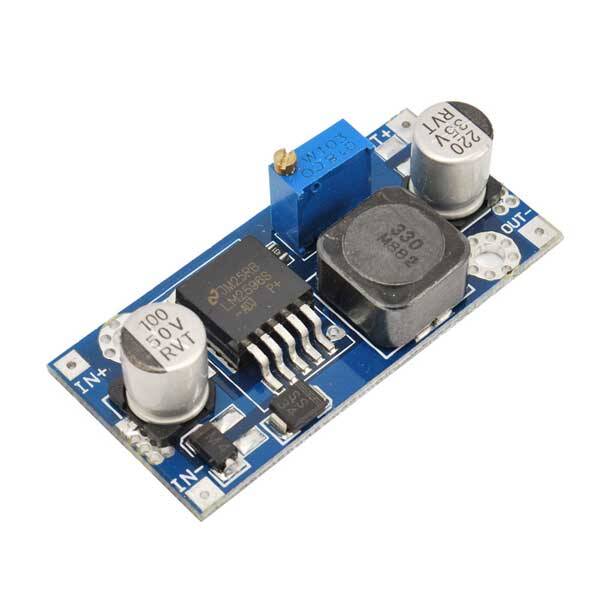

I used those things in cars dozens of times, never had a single issue.
I’ve used the LM2596 module shown above many times to regulate voltage input to LEDs used for Christmas lights in blow molds and inflatables. I looked up the last time I bought them on eBay from China in 2024 and back then 10 of them cost me a bit more than $10 including tax. The price has gone up a bit but they are still a bargain. The voltage can be set by hooking the module up to a voltmeter and then attached to the LEDs after you set the voltage. You can buy a similar module with built in voltmeter but they cost a bit more and only seem worth it if you are buying a couple at a time given the shipping cost from China these days.
1 Thank