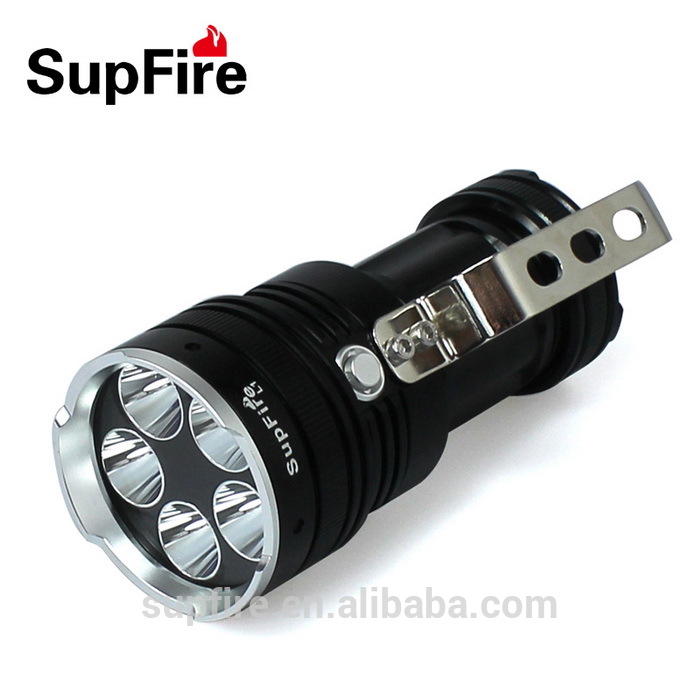
My Supfire M6 came today (Yay!) but in a plain white cardboard box and no instructions (Boo!). I’ve been searching and got answers to some things (like battery direction) but on the whole I’m not too certain what I shouldn’t do with it.
So here goes.
*Should I try to avoid using it when it gets to some level of high temperature?
*One review said the batteries are connected in parallel. Does that mean I can run it on less than 4 x 18650’s if I chose the right battery compartment(s)? (Don’t laugh!)
*Is it rain proof? (thinking about the on / off switch).
*Having only ever used things like old maglites is there anything else I should know to avoid doing that you folks would take for granted but I may have no clue about? (I have protected Panasonics to help save my bacon on the battery front).
*One review on BLF had the Supfire labelled with its emittors written on the side (T6) and I’ve found another since (L1) eg:
.
My unit is like this, so does this prove its XM-L2:
Taken me along time to get this far and I’m itching to put the batteries in but don’t want to do something ‘dumb’ so a day or two wait is OK.
Should be marked in the battery compartment as far as which end is up, but the positive end faces up. The negative end goes down inside. You can use 1,2,3 or 4 batteries in it.
Look for the sticky about leds. It shows pictures. If it's XM-L2, then the square area just around the led dome will be silver. If it's XM-L, it will be green.
If it's too hot to hold comfortably, turn it off or go to a lower mode.
What OL said… :bigsmile:
If you don’t come right, you can always send it my way…
I want one of these, but the price is still a bit high… Missed that sweet group buy awhile back…
If your light is the standard one, it will have xml’s in, not xml2’s….
Not quite sure how waterproof it is,especially around the switch, should be adequate for a bit of rain, but I have no actual experience of the light…
Enjoy it,
Anton
+1 +1.. Probably 2-3 cells would be fine, just less runtime. One cell, it may be less bright, but still should be safe. Parallel is safer then in series because the cells will self-balance in discharging.
To determine the emitter type, just look at the LEDs. If it has a green border, three wires, and six parallel sections, it’s XM-L. If it has a white border, two wires, and looks smooth aside from a subtle polka-dot pattern, it’s XM-L2.
Thanks for the replies ladies and gents. I have another *question too - if what I’m thinking is true!
Old-Lumens is that turn it off because it will be getting damaged (a bit like over revving an engine - it will do it but its not good) or turn it off because handling in difficulty may make me drop it?
Thanks for the pics CRX. It explains what ToyKeeper said but I’m not too sure about a polka dot pattern? Is it present in the XML-2 pic above? (Yes its looking like that pic too btw).
*In bed last night I realised something - the positive battery terminal is a circle to accommodate cells of different length. Ha! Now I know my cells are long (Panasonic protecteds) so this means screwing the battery and ‘head’ (?) together is unlike any torch I’ve used (where you just screw till there is no more travel available). I’m supposing here if I did that I may damage the little protection circuit by applying too much force on the batteries? Is there a rule of thumb or a way to determine how far I screw the battery compartment in? Or is this not an issue I should be thinking about?
In a C8, and nearly all lights, screw the parts together until they stop. They should have enough room inside to avoid crushing the battery. Especially if you have anodized threads, the light won’t even work unless it’s tightened all the way. The contact ring inside needs to touch, and when it does, it won’t let you tighten any more.
Don’t worry about the polka-dot pattern. It’s pretty subtle and may be hard to see.
About turning it off when it’s too hot to hold, that’s because that is usually the point at which the LED inside reaches its thermal limit. They’re generally rated to run at 85 degrees C, and can have their life greatly reduced if they run too hot. Some lights are capable of damaging their own emitter, others aren’t. A C8 should be pretty good at handling heat though, so it might not ever get to that point.
You can't really make it out in the above pic but its easy to see in real life.
See the samsung 3535? You can see the polka-dots on it, IRL the XM-L2 looks very similar.
However the simple way to tell is just by color, no gen2 cree emitter will be green and no gen 1 cree emitter will be silver, no need to count bond wires or look for the pattern vs parallel lines, the color won't lie and is all you need to determine. The same is true for XP-G vs. XP-G2 and XP-E vs XP-E2.
Thank you but ToyKeeper this is a M6 and you were mentioning a C6?
Good to know they can get too hot for their own good. I will certainly try to use the appropriate power output with this.
Anyway after sleeping on this for a second night I think another thing dawned on me (about the battery and screwing it fully together stressing the protected circuits) “Ha! The springs were long for a reason!” I think my glass half empty expecting something bad to happen head worked a little overtime inside the box?
Oh, sorry, I got two threads mixed up and was thinking you were the person who just got a Convoy C8. I probably shouldn’t post when I’m just stopping briefly by the computer on my way somewhere else.
I don’t have a Supfire M6, but I hear it’s a great host and handles heat well and can be hot-rodded pretty significantly. I’d still suggest locking it out while it’s not in use though, if it supports that (loosen the body from the head a little so the light physically can’t turn on). Wouldn’t want it burning up inside a backpack or something, due to accidental activation. And make sure the four cells inside are used as a set, always charged at the same time and kept together, to make sure they won’t have to equalize much when they are connected in parallel. If one was low while the others were full, connecting them in parallel could result in Bad Things.
Thanks ToyKeeper. I just have the four cells so doing that will be straight forward.
Put the cells in today - bright in daylight so should be super in the dark.
You know I really need to screw the body in all the way for it to light up. If I unscrew it by about 1cm 1.5cm at the circumference it turns off. So lock out is simple but I didn’t expect it to be so tight on tolerance that turn must be iro 5 degrees of turn, if that, which would be a tiny amount of battery to head movement. Looks like 1mm or less. I may ask about this on an M6 thread.
This is the anodized threads. The batteries are making full contact with the springs and the underside of the driver when it is 1mm loose, but there is a break in the system/circle/loop w/e… The top party of the battery tube (silver flat area) is what actually completes the connection. So if it’s not making contact with that driver retaining ring then you don’t get light. Working as designed.
Tried it at night. Now want to got out ‘painting with light’ and a stills camera. So bright there is nothing in the back garden area that isn’t well lit when its aimed at.
Yeah I’m not gonna lie the M6 is a bit too powerful for light painting in most circumstances. If you want to use it, drop the ISO down as low as it will go, close up the aperture, and maybe try using a filter on the flashlight. Shooting in RAW if your camera supports it will also make a huge difference, since JPEG (by the nature of file compression) will reduce detail in shadows and highlights. I’ve had very good luck with pen lights for basic light paintings!
I took this one with a P&S camera and used my cell phone flash LED as the light source.
Ah not light trails. Was just looking for an example I did in an engineering room to show you as part of my photography but I can’t find it. I mean find something in the dark, and then light it with the torch moving it to get the exposure you want. Like ‘burning in’ in the dark room, but here you are ‘burning in’ on the DSLR sensor / film. It can give you results that cannot be Photoshopped (say because of the angle of the light on the subject(s)). I could take on an entire tree with this thing.

 .