This UltraFire model# RUV3 365nm light was offered to me by UltraFire (UF) free of charge in return for an honest review. I have no other relationship with UltraFire of any kind.
Executive summary:
The UF RUV3 is a relatively powerful (claimed 10W) 365nm UV light of substantial length and heft.
Onboard charging worked flawlessly, terminating at 4.18v with the included 5,000 mAh 21700 UF-branded cell that tested 5,146 mAh @ 1A on an Opus 3100 charger.
The UV beam that passes through the ZWB2 filter is a very tight and even spot with essentially no spill, resulting in substantial range and coverage.
The light’s UI is H / L, with last mode memory.
Physical lockout appears to be unreliable, as noted by random flashing of the battery indictor in the side switch while screwing the battery tube into the head. This manifests as the ability to energize the UV LED while the battery tube is often a full turn (sometimes more) away from fully seated.
Threads on the tube and head are unusually short, enough so to make note.
Full review:
The RUV3 arrived from China in a typical brown cardboard box bearing the UltraFire brand name. It was very well sealed for shipping. It contained the light, a charging cable and a warranty card. No manual, O-rings or lanyard. That’s in line with the manifest indicated on the UF retail site, sans the complimentary UV glasses which I’d recommend anyway, especially due to the powerful output. More on that shortly.
I’ll not waste everyone’s time rehashing lots of basic info in this review (dimensions, weight, routine stuff, etc.) that’s available on the UltraFire site anyway:
Operating instructions and some tech details on the UF site page below. There’s also a nice spectral output analysis:
An unprotected flat top 21700 cell with a labeled capacity of 5,000 mAh was inside the light with the usual plastic insulating disc on the (–) terminal.

The cell voltage was 3.73v on arrival. I don’t have any button top 21700’s, so can’t say if longer cells would fit the RUV3. Testing the cell with a DMM immediately after onboard charging terminated saw 4.18v; after resting 45 min. it was still 4.18v.
The tail end has a slight, round recess, and is not a removable tail cap in the conventional sense, but is an integral part of the battery tube. The light will tailstand as long as the surface is level; the large, heavy head makes the light top heavy. A (-) contact spring is self-retained at the bottom of the tube.

No magnet. Overall external machining and anodizing of the tube is quite nice, except for the threads mentioned above. No sharp edges, and comfortable to hold while offering fine grip. The only slot for included 2-way pocket clip is at the base of the tube. A hole for a lanyard ring is present.

One polarity icon is at the threaded end of the tube. Tube treads were sparsely lubed, with what appeared to be some tiny debris (perhaps from machining) in the them. Sometimes, audible squealing could be heard when rotated for dis / re-assembly. Clean & lube solved that. Mostly. The single O-ring arrived dry. Threads are quite short at 3 count (generously), same as in the head. For all practical purposes, there’s only 2 1/2 threads that engage head–to–tube.

Perhaps of more concern is what appears to be a very thin, difficult to photograph, ¼ ~ ½ lead-in thread at the end of the tube, on which the crest of the thread appears to be sans anodizing on my sample.

That likely is what causes intermittent, random flashing of the battery indicator in the side e-switch as the tube is turned into the head, indicating continuity head-to-tube repeatedly being made & broken before fully tight.
I was sometimes able to energize the LED with the tube in random engagement anywhere from just started, to slightly more than a full turn short from fully seated. A ¼ turn loosened is not always sufficient for physical lockout on my sample.
The head is long and heavy. A side e-switch with red / green charge indicator and USB-C charging port w/rubber flap are in the head. I did not test for parasitic drain when assembled. The recessed ZWB2 filter appears to be retained by a threaded ring.

The (+) terminal in the head is solid-mount.

Moderate disassembly effort did not budge either the ZWB2 filter or the internal driver retaining rings. This light will be useful to me in daylight outdoor environments, and I didn’t want to irreparably damage it, so I can’t say if anything is glued.
A query to UF re: LVP and reverse polarity protection was answered that both are built in electronically. I didn’t try challenging reverse polarity protection by inserting a cell backwards.
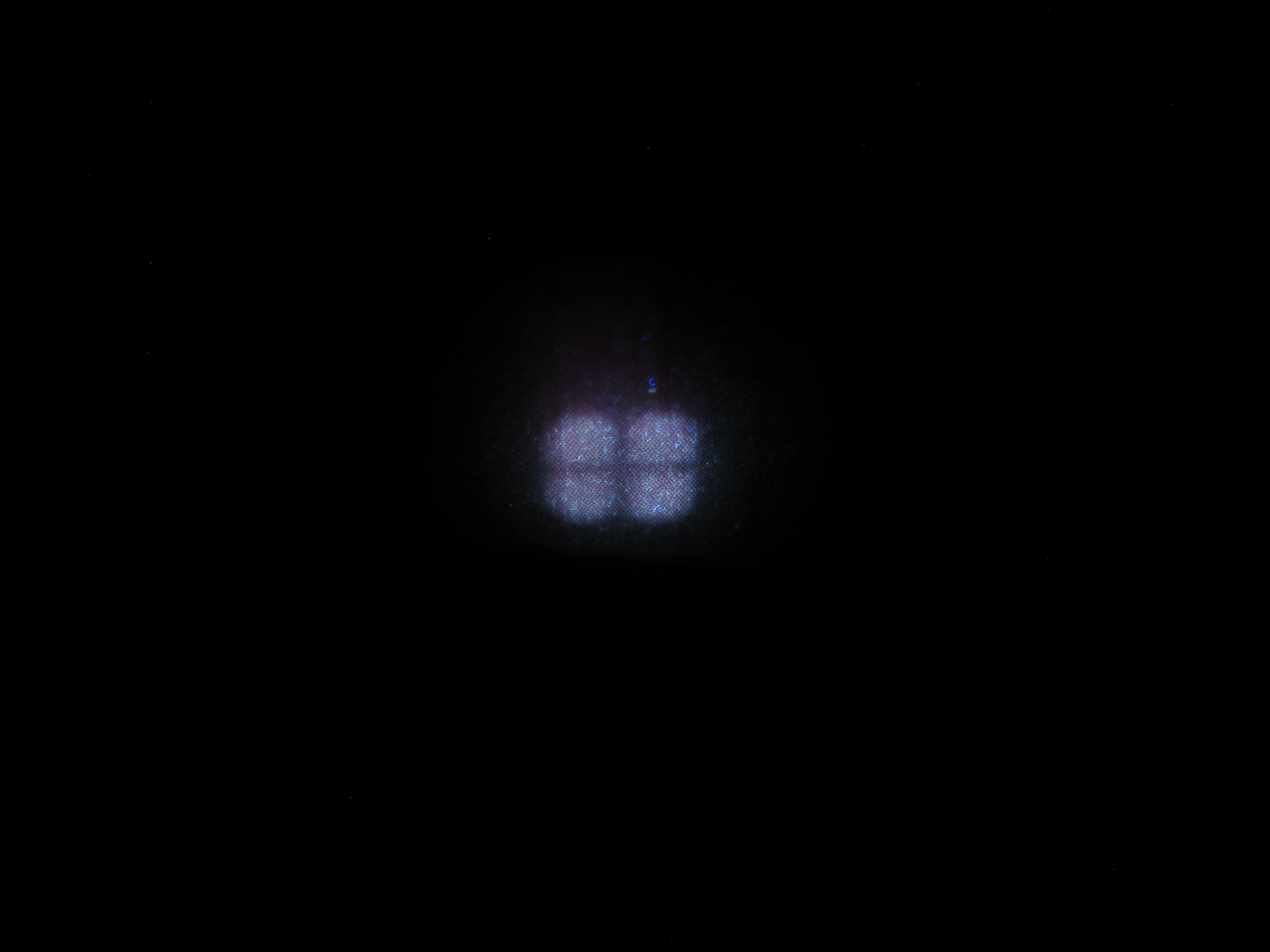
When asked what UV LED is within, UF declined to ID it. The die appears to have 4 emitters when viewed very close to a surface. The fluorescing specs in the first pic are from the target, not the LED.

The UI is H / L, and has last mode memory. When OFF, a short press for ON, short press to switch H>L>H etc. long press OFF. The difference H vs L can be seen but, not having anything else comparable in terms of beam pattern or power, I cant say how much difference it would make in real-world use.
UF specs 10W output. The light ran noticeably warm, but never became uncomfortably hot.
When I first saw the tight, solid spot of the RUV3, I felt compelled to test it’s beam profile compared to my other 365nm lights, all w/ZWB2 filters:
Lumintop Tool AA UV
Nightool EH-6 UV
Convoy S2 UV
Sofirn SF-16 UV
YJT-D62-365- 02
Comparisons:
The UV corral size comparo, L to R:
UF RUV3
YJT-D62
SF-16
S2
E-H6
Tool AA

Beam shots – blank paper:
All were done with the ZWB2 filter 8 ½“ from a blank, 95 white cardstock target. I had to diddle (a technical term, dontcha’ know…) ISO exposure massively for different lights, as the flourescing hotspot that renders as white in the pics would wash out spill detail otherwise.
Tool AA

E-H6

S2

SF-16

D-62

RUV-3

The whole ~14" spot of the RUV3 must be seen to be appreciated. The lens is 22" from the cardstock in this pic. There is no spill to speak of:

Beam shots – U.S. paper currency:
After white paper testing, each light was subsequently adjusted for distance closer or farther to the bill, so the edge of the spill fell at the edges of the bill.
There are some features in US paper currency that are quite subtle compared to the orange vertical strip on the test bill when under 365nm UV illumination. Those subtle features are very difficult to see (if at all) in the pics with some of the lights tested due to dim spill, unless greatly magnified.
Tool AA

E-H6

S2

SF-16

D-62

RUV-3

Observations and Conclusion:
I was surprised at how some lights that performed well on blank paper did much less well on paper currency. The RUV3 was far superior to all others in that respect.
The UF RUV3 offers a powerful, remarkably-tight, very even UV spot with near-zero spill. It’s like no other UV light in my collection. Outdoor range testing is not practical from a photography perspective due to the limitations of my camera. However, my seat-of-thee-pants, naked eye judgment is that the RUV-3 offers range unmatched by any of the other lights used for this review.
The randomly-energizing behavior of the battery indicator when the tube is being rotated in the head is worth noting. I’ll leave the tube separated from the head when stored, not ¼ turn lockout. Too, the short thread count is notable. I don’t know if that would impact long-term durability.
Onboard charging of the fine 21700 included cell worked perfectly.
Overall, the RUV3 offers outstanding performance at an economical price for a user who is well versed in safe LiIon light usage. The questionable behavior of the battery indicator when the battery tube is being rotated within the head due to anodizing missing from the crest on 1/2 of the top lead-in thread is the only thing that would keep me from wholeheartedly recommending the RUV3 to anyone, be they enthusiast or muggle. It’s a fine, powerful 365nm light for an experienced user. A muggle would benefit from some safety instruction prior to ownership on my sample.
Thanks for reading.
slmjim