Revisiting the Wavien Collar - 8 million candela SFT-42R

TLDR;


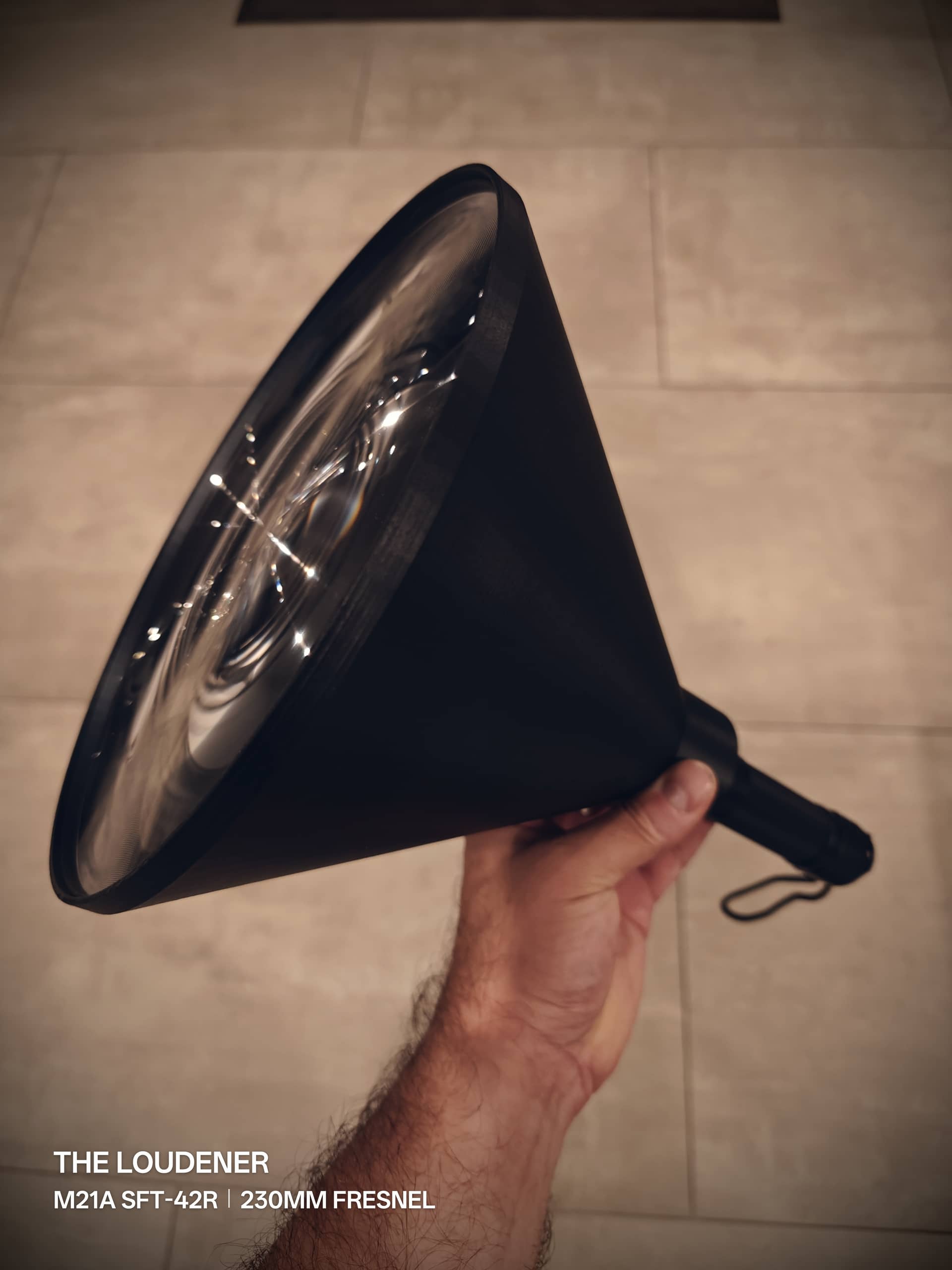
After I finished the loudener V1 M21A/SFT-42R/230mm fresnel, @contactcr was kind enough to send me his original Marinebeam Wavien collar (from the 2018 groupbuy).
Installed in that host, focused within the limits of my capability the wavien collar achieved an increase of

+45.8% intensity.

Upping the candela from 5.49Mcd to 8.00Mcd.
Is it perfectly focused? probably not - but I gave it my best shot.
Installation

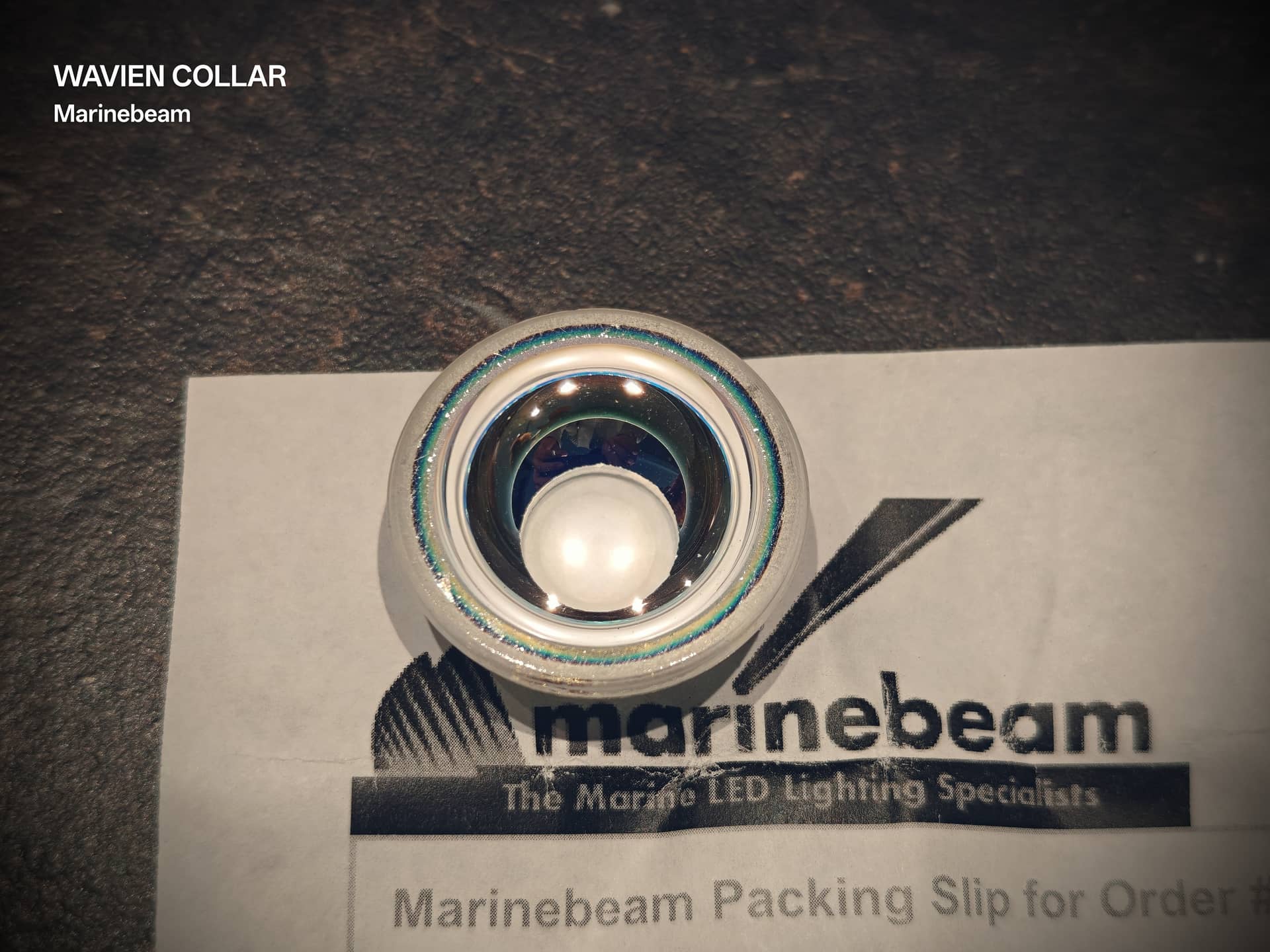
The wavien collar itself (reflective side up):


I installed a drop of hot-glue to pick it up with tweezers, since its hemispherical and fragile:

Placing it inside the host by itself did not focus the beam back towards the emitter, but towards the MCPCB.

The height was too low, and this gave a (mirrored) projection of the entire PCB:

So I had to design a “couple” of wavien collar collars, to shim the height and center it perfectly.
Ofcourse, the one I needed was the last iteration: approximately 0.3mm thick for this host
Measure one, cut thrice!

I had to use grinding/torch glasses to look at the beam, even at 0.1% from the 3V10A convoy driver.
It was too intense too look at with bare eyes.

Since I cant post vids here, here is a low quality GIF that shows the focus shift with very small movements of the collar.
We want to get a small hotspot on the emitter itself (recycling the lost side emission).
The collar secured in place with a couple of drops of hot-glue, which worked great.
8
The beam pattern is not perfectly round on a white wall, but it never was too begin with - this isn’t due to the collar but due to my imperfect DIY optics.
the hotspot is as round as it gets though. The blue/purple chromatic abberation gives me the best indication the beam is at it’s highest intensity.

It’s not dark yet, so real beamshots will have to wait - but they’ll probably look similar to the shots @ loudener V1 M21A/SFT-42R/230mm fresnel

So, is it worth it? Yes, definitely - if it was publicly available at a certain price, which it is not.
Therefore I refer to it as "Ancient Alien Tech :alien: " until the patent runs out.
It’s an easy mod after some tinkering.
There aren’t that many aspheric/fresnel flashlights being produced in 2026 (and it’s a useless mod for anything reflector/tir related).

I do wonder however, what would happen if this was a LEP? Would the phosphor be saturated at that point?
That might be my next experiment, but I have a hard time finding a >3K lumen LEP module at an acceptable price.

Added some more images from different viewpoints:
Daytime:


Nighttime:

gif11


Beam comparison, 3X21A F150R: cool white / M21A wavien SFT42R: warmer white

15 Thanks

Thanks for posting this followup! Very cool to see the collar focusing in action.

After seeing this photo I’m quite convinced that the collar’s top opening is too narrow for your Fresnel lens, which means only part of the lens is effectively being used. Do you have a sideways photo of the lens while the light is on, to see how much of it is lit?

If this is indeed the issue, getting a lens with longer focal length should push intensity over 10Mcd.

2 Thanks

I definitely agree. Will have to find an appropriate new lens or alternative optical solution for V3 :grin:!

I will post some pics later today of the lens after dark.

2 Thanks

Holy special beam cannon…

Would there be any point to applying anti-reflective coating to the inside of the fresnel?

Also, just because the whole fresnel isn’t being utilized, does that necessarily mean it isn’t optimally effective? I.e., if you placed another optic to flare the beam to “fill” the fresnel surface, would that be more or less efficient than widening the wavien aperture, thus resulting in less retroflected light?

3 Thanks

To the AR coating, I don’t think so - I’m not getting anything unexpected. A much higher quality optical lens would be my choice. This PMMA lens is sold for 15-25$ on alieX, so can’t complain.

Yeah seems plausible! I think it’s easier to find a different, compatible lens.
The wavien collar did increase intensity by 47% vs the non wavien, even with the choked aperture, so I would still call it a successful experiment.
Another idea we had was using a Convoy Z1 as precollimator (but would decrease brightness IMO because of lens losses).

2 Thanks

Agreed. I measured the transmission of acrylic sheet to be 94%, so 3% loss per air-surface interface. So one can expect to gain 3% output/intensity coating a single side of the lens.

You could measure the angle of the spill cone with the collar but without the lens, which can give a pretty good estimate of the ideal diameter-to-focal-length ratio. This Z1 review estimates spill angle by putting dots (length markings) on a wall at a specified distance, which you might find useful.

Indeed. While the Z1 improves collection efficiency compared to a bare LED, it does nothing to change the luminance of the emitting source, so the intensity of the resulting beam is capped by the Brightness Theorem. The special thing about the reflecting collar is that it doubles luminance at the source, and thus the upper bound imposed by the theorem.

1 Thank

That’s a really interesting question!

My guess is that phosphor saturation won’t be a huge issue because the reflected light from the collar contains mostly non-blue wavelengths. This should mean that most of the light simply reflects off the phosphor without undergoing conversion, which is what causes saturation.

My concern is that LEPs have such a small LES (on the order of a few 0.1mm^2 compared to several mm^2 of an LED) that it is virtually impossible to focus the collar well enough to significantly boost intensity. However, if you acquire a very powerful LEP that dumps a lot of power onto a relatively large emitting surface, this should be no problem. These LEPs would probably feature a rotating phosphor wheel that distributes the heat along a circular track, lest a stationary point get burnt straight through.

2 Thanks

You can see around 2-3 cm of the edge not being lit fully. IRL it is more obvious, but I think it does show it.

Yes I cleaned the lens after this :sweat_smile: the large surface is hard to keep clean lol.

Edit:
Another one which shows it better imo (ceiling shot without lens)

2 Thanks

I wonder if this patent could be circumvented by using a retroreflective material instead of a spherical reflector.

With microprisms, spheres, or any other type of retroreflector, the shape (and alignment) would matter much less, as the light would be automatically reflected back toward its source.

If no such solution already exists, consider this a public disclosure of a novel idea, so future patent trolls can’t patent it.

2 Thanks

so…anti reflective spray, AND anti static spray! lol…That pmma must be a dust magnet…If you could somehow remove all the dust, at least from the inside, you might get another few% more candela, lol…Minmax time!

1 Thank

retroreflectives aren’t as reflective as a mirrored finish…but at those close distances, maybe it doesn’t matter?

** #OpenSourceEverything

1 Thank

I think you can use a xmass bauble (ball) cut in half, with an aperture drilled in the top. There is no infringement if you do it for DIY and non-commercial purposes AFAIK. That would be the easiest way.

But aspheric/fresnel throwers have gone out of style (except for LEP) so we are just chasing numbers here :grin:.

2 Thanks

I cut a ping pong ball in half and coated the inside with chroming paint

2 Thanks

Thank you very much, this is extremely informative! The loss is a bit less than I expected. Interesting to note the warmer CCT due to secondary conversion of backreflected blue light.

I share the same concern–in my experience, retroreflective materials still scatter much more compared to a smooth mirror reflector.

I wonder what is the extent of the patent–the exact construction or just any enclosure that backreflects light? If the latter, then the retroreflector solution does not circumvent it. If the former, one can easily circumvent the patent by using the standard reflector coating on aluminum, rather than the dielectric coating on glass used by Wavien.

If parabolic reflectors aren’t patented, I don’t see why one couldn’t just make the paraboloid into a hemisphere. When installed backwards, the bottom hole for placing the emitter instead becomes the aperture.

2 Thanks

I didn’t know that was a thing, it’s very noticeable outside on the daytime clouds! Thanks for the explanation.

3 Thanks

WOW! If I didn’t know any better I’d say the only way to get a more coherent beam would be to trigger all the quantum streams associated to that trajectory LOL

2 Thanks

Maybe. The waivien collar patent specifically refers to using a “curved surface” to reflect light. However, using a retroreflector is Probably not worth the effort since the Waivien collar patent might expire in less than a year.

Making a Waivien collar using traditional methods should be cheap. Really cheap. Probably costing less than a dollar per collar. The geometry is very simple and could be made by any manufacturer capable of building an aluminum flashlight reflector.

Making a hemispherical inward-facing retroreflector sounds a lot more complex. The manufacturing and software needed might be non-standard. It would likely need to be made from acrylic, which would require manufacturing an expensive mold. I have no special knowledge about manufacturing, but suspect this could be more expensive.

3 Thanks

I recall seeing an earlier, more detailed post of yours on this subject–it is all very good news. I was under the mistaken impression that the patent doesn’t expire till 2031.

I think $1 per collar is a good estimate, considering that Convoy sells small parabolic reflectors for around this price. A spherical surface should be much, much easier to manufacture than a paraboloid.

I really hope that Simon/Convoy would consider making these when the patent expires. One can argue that LEDs will never come close to LEPs and HIDs in luminance, but LED-based lights are much cheaper and have much better color properties than LEPs, while being much more reliable and versatile than HIDs. For these reasons, I believe the collar+Fresnel thrower format is far from obsolete and will remain so for many years.

3 Thanks

From what you linked, it looks like the Waivien collar patent might still have another 5 years. That might be more accurate than the results I got from my Google search.

2 Thanks

I assume this might be the patent you saw, which does expire in 2027. I really hope your original impression is right.

I only had a brief skim of the technical description because the writing is utter garbage and feels intentionally engineered to be as vague and obfuscating as possible. I don’t yet see what the distinction is between this and the collar, other than perhaps being a more general idea of which the collar is a specific instance.

Really, every single teacher I’ve had would fail me for writing this:

4 Thanks