I’ve always loved lightweight polymer lights. I wonder why they are not a whole lot more popular since they show scuff marks and wear much less. Any thoughts on why this is so?
1 Thank
Maybe heat dissipation is not so great on high powered lights?
4 Thanks
Most lights are polymer.
its just in the enthusiast market where most of them are from more fancy materials.
Most of it is marketing. Heat dissipation is also a good argument.
Generally speaking, you can’t run a polymer light over with a truck and have it still function, and that seems to be a “huge” selling point. Ultimately, I feel like it’s probably production setup costs, general perception of aluminum/metals vs. polymer, etc.
With injection molding, you have a specific die for a specific model, vs. with aluminum, you have a CNC that can make most, if not all models. I don’t remember the exact numbers, but an injection die for a simple design can cost upwards of $5k, whereas a cnc costs an average of $300k. it’s 60x more expensive for a CNC, but if you plan on cycling out models, it will not only cost control the quantity per model, (injection is kinda fixed per die), but over the course of x# models it will have paid for itself in dies.
**edit to add
Unless you plan on mass MASS producing with “cheaper plastic” like dorcy, rayovac, etc, (talking millions upon millions, not tens or even hundreds of thousands), then you won’t get too much awesome stuff like the suefeuer g2 nitro nor the stream polytac 1x. Surely the g2 dies are sitting in a vault somewhere, but the exact polymer formula is probably hidden even deeper than that.
1 Thank
Most metal lights use the body itself to conduct the electrical current from the tail to the head. In a single cell (or any single stack of cells) polymer light it needs added parts, wires, or a metallic strip to get the power from the tail end battery terminal up to the head where the driver usually sits. So it adds complexity, cost, and is a major failure point.
1 Thank
A lot of well designed and comfortable feeling little plastic 2 and 3 AA battery flashlights were made for consumers years ago, real cuties, they just needed better LEDs, the little AA diving lights for example, plastic or polymer is a warm and friendly material, nice for the kitchen drawer or glove compartment, or backpack.
4 Thanks
Besides what’s already been said, size matters.
If it is going to be made of some type of polymer or composite it’s going to have to be slightly thicker and larger than an equivalent aluminum material. And at that point are they really lighter? By a measurable amount?
I don’t see any advantage for most applications.
I had plenty of pistol grip type spotlights way back when but I don’t have use for any of them today. For things that large and oddly shaped some sort of plastic or other material makes sense.
Edit. I don’t suspect that this is a consumer versus “enthusiast” models whatever that means. But that’s a whole other discussion.
Maybe for for what I’ll call cheaper models that don’t have turbo where heat is not an issue it would be okay but still not really an advantage.
1 Thank
One of my favorite camping lights is an old Coleman plastic thing. Always worked, nice and warm and easy on the teeth.
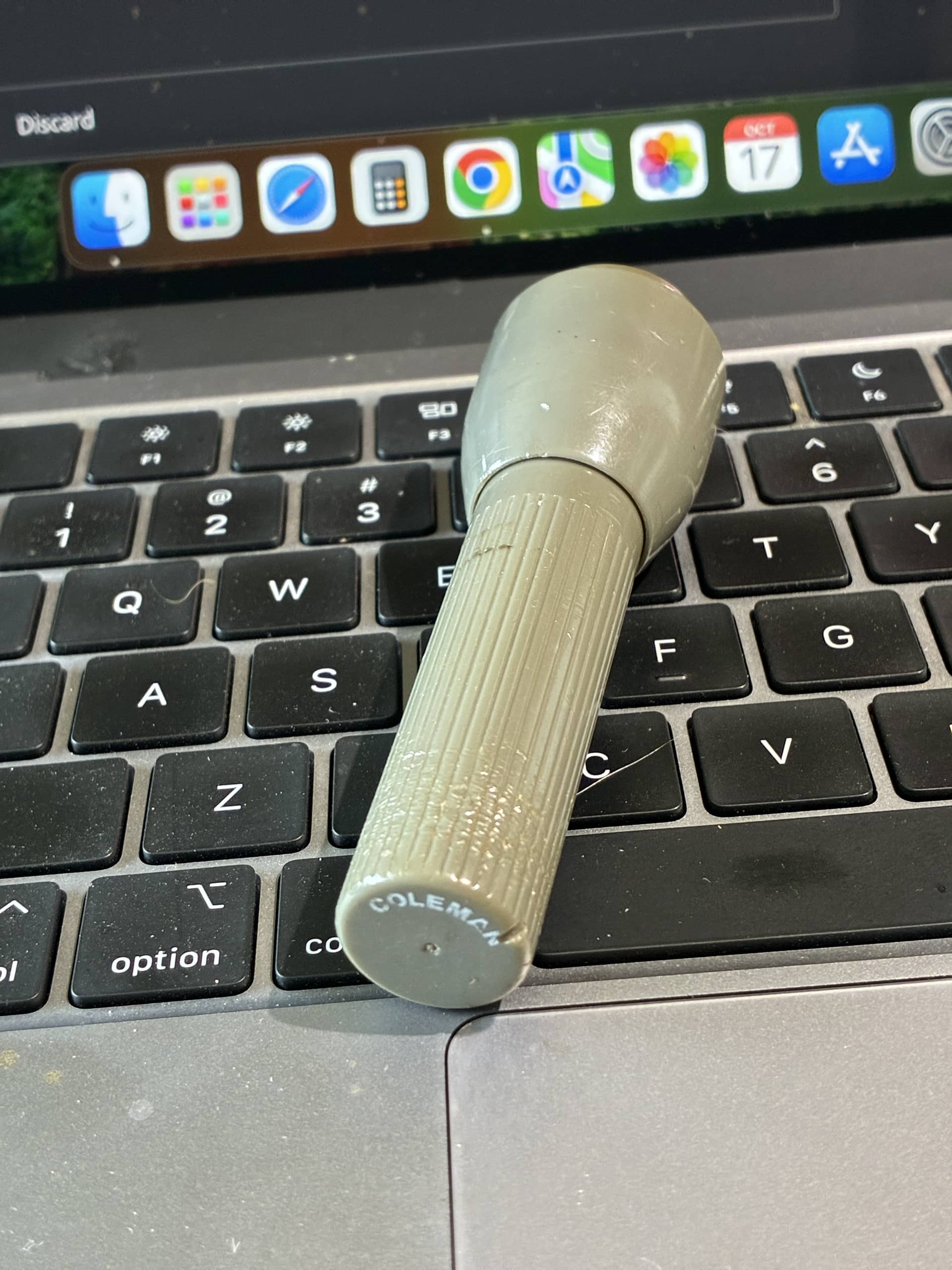
3 Thanks
I like plastic flashlights in the cold…It’s why I put resistance wraps on some of the metal ones; helps the grip, reduces the “grabbing-an-icicle” feeling in winter…
I’m also shopping for a lower output intrinsically safe pocket light…been hovering between pelican and nightstick for the 2aa versions…
1 Thank
looking at the tail end, that butt looks mighty well nibbled…
1 Thank
I get what everyone has said. There’s just something unappealing about using a steel light and seeing it get forever scratched and dinged with just being in a pocket. Whereas I’m not going to be putting any light of mine under a MAC truck.
1 Thank
I forgot the model, but there is a standard(?) issue head/helmet light used by US military. Special modes like IR etc., modest output, but light, reinforced nylon casing and simple rotary switch - given that it’s hard to accuse soldiers of being delicate with field equipment, they may be onto something.
The only plastic light I have is the Nitecore EDC07 flat light. I like it a lot!
Super light but still feels high quality. It’s not a lumen monster but can sustain almost 400 lumens for ~100 minutes or so, which isn’t bad at all.
But for anything in 18650 class or bigger I think Aluminum works better for all the reasons mentioned. One thing I’m not sure if people have noted but plastic threads seem like a failure point to me.
Streamlight sidewinder series?
1 Thank
If your flashlight feels cold, it’s not bright enough 
3 Thanks
Because everybody and his grandmother is looking for a 99,000lm light-cannon that’d melt most polymers in seconds.
I got a Nextorch nylon D26 drop-in host that came with I think a 80lm hotwire blub, which I dropped in a 1A so maybe 3W module. Decent light in a pinch, forever runtime, low stress, but I’d still be concerned about heat buildup.
Thinking about it, it might’ve been a 700mA module, don’t recall.
1 Thank
I’ll bite. You don’t have to use the term lower output and intrinsically safe light in the same sentence as it is redundant.
I’m going to guess that you have natural gas in the residence or other building that you frequent and want to be prepared. In the US alone there are 125,000 natural gas leaks with emergency responses per year. Although some of those may be propane.
80 plus house explosions per year.
When you hear about them on the news the news outlet will sometimes say that it was caused by natural gas and other times they will say authorities are investigating the cause. It’s almost always gas.
I would feel pretty safe turning on either of the lights that I carry in an explosive environment because they’re both pretty dang waterproof down to multiple feet. Although I’ll hopefully never have the chance to try it.
Fun fact.
An aluminum light technically can create a friction spark if scraped against Rusty steel.
You could probably drop your aluminum light on clean steel or cement all day and never cause an explosion.
So don’t think that it has to be some sort of a polymer light to be pretty safe in an explosive environment.
If I missed with my guess tell us why you want an intrinsically safe flashlight.
Could just use a diving light with magswitch…
That may it! Not too keen on militaristic stuff, but I’m obsessed with dials, low weight, and reliability (or at least an impression of it). Interestingly those headlamps are 50-100 lm on white, and that’s enough.
2 Thanks
So we need copper flashlights. i think they would be save 
Making injection mold is also very expensive and takes some development. so it only makes sense if you late sell real high volumes of this flashlight.
Our fancy toys are not “high volume”.
So injection molded lights exist. but they are what comes bundled with a pack of battery at the gas station and so on.
1 Thank