【Updated】 Device Compatibility: Alkaline, Ni-MH or Rechargeable 1.5V Li-ion AA Battery
You may have noticed that some electronic devices still recommend alkaline or other primary batteries in their manuals, while rechargeable batteries are not recommended. Why? Part of the reason comes down to how these devices were originally designed.
For many years, 1.5V alkaline batteries were the standard power source for AA-powered electronics. Rechargeable batteries available at the time were mainly 1.2V Ni-MH cells, whose voltage also drops more noticeably during discharge. For devices designed around the voltage profile of alkaline batteries, this could result in lower performance, shorter usable runtime, or inaccurate battery-level readings when Ni-MH batteries were used.
Battery technology has evolved since then. Today, 1.5V rechargeable lithium batteries can provide a regulated and stable 1.5V output while offering hundreds or even thousands of charge cycles. This makes them a practical alternative for applications where stable voltage, longer service life, and reduced battery replacement are important.
There is also an interesting point when it comes to professional audio equipment. Some wireless transmitters, receivers, intercom beltpacks, and headphone amplifiers allow users to select the battery type, typically Alkaline, Ni-MH, or Lithium (non-rechargeable type). However, many of these devices were not specifically designed around the discharge characteristics of 1.5V rechargeable Li-ion batteries. If you are using XTAR 1.5V Li-ion AA batteries in compatible equipment, we generally recommend selecting Alkaline mode, when the device provides this option.
Because the voltage profile of a rechargeable 1.5V Li-ion battery is closer to what the device expects from an alkaline battery. This can result in a more consistent and practical battery-level reading throughout the discharge cycle. Sometimes, getting the best performance isn’t only about choosing the right battery, it’s also about understanding how the device interprets that battery.
Good information. But I am skeptical of the curve you have for NIMH cells. They typically stay close to 1.2 volts for a majority of their discharge curve. They also sag much less under load than do any alkaline cells. In fact, with significant load the NIMH will spend more of its discharge curve at or above 1.2 volts than the alkaline cells will.
This is a more representative discharge curve for NIMH cells:
In applications requiring anything over ~0.5 amps I get better runtime out of NIMH cells.
Anyway, I get your point and thanks for the reminder. I have been slowly trying Xtar 1.5 V LiIon cells in different applications. The only downside I have noticed is the requirement to recharge more often than when using NIMH. As they generally have equivalent or better rated capacity, I can only conclude that this is due to their self discharge characteristics. I would like to see some studies on this aspect, or at least an official statement from Xtar so we can set expectations on this aspect of performance.
I have been keeping some 1.5V LiIon in my car this summer. They have been in the car for 2 months and the Voltage has not shown any significant drop at all.
here is the data, the test will continue for 2 more months:
start test fully charged, all measurements on DMM
July 9th…
White Eneloop: 1.42V
Xtar 3000mAh 1.5V LiIon: 1.54V
Sept 9:
White Eneloop: 1.34V
Xtar 3000mAh 1.5V LiIon: 1.53V
The 1.5V LiIon Im using for the test are the XTAR LR 3000mAh version with declining voltage (red line on chart), so I can track voltage change over time:
I have …I think, 2 different models. I will have to check. I also am using AAAs in a few places. Applications vary. Some remote controls, some remote weather station sensors, a couple of portable radios and a few flashlights. The remote weather sensors are a decent application to judge longevity with. They just sit and send out equal power RF pulses at regular intervals.
Keep in mind, with the internal regulator, measuring the voltage does not tell you much about useable capacity. Even with the chart you show it is not enough to show with any precision the self discharge rate. Notice that there are not any capacity numbers even listed for that curve. Meaning, it can’t be used to accurately measure self discharge of the internal cell. The only way to do that would be to do discharge capacity testing at intervals over specific periods of time. This would document the changes in available capacity and show the self discharge rate.
In any case, I think it is telling that they recommend recharging cells that are in storage every 6 months.
I am sure that Xtar has this data, I would just ask that they publish it as many rechargeable cell makers do.
Absolutely. But I have over 10 years of experience with these sensors.. SO I have a pretty good idea of how often I have to replace/recharge different kinds of cells. SO far it is a matter of a week or so difference. But certainly I will keep monitoring.
Accurate self discharge data would help in revealing the root cause though.
The xtar 1.5V AA/AAA Li-ion battery integrates an efficient charge and discharge management chip, and uses 1.5 MHz synchronous buck converter to provide the 1.5V output. As for the self-discharge rate, when the cells are stored in the fully-charged state, the self-discharge rate typically remains below 5% per month. If the internal cells are stored with the voltage below 3.6V, the self-discharge rate is less than 3% per month. You can rest assured that these 1.5V Li-ion batteries won’t get over-discharged within one year of your purchase.
Actually, the self-discharge rate of batteries could be influenced by many factors, such as ambient temperature, state of charge, battery construction, charging current… The breakdown of organic electrolytes is a common source of self-discharge in Li-ion batteries. The self-discharge tends to occur more quickly at higher temperatures and excessive humidity. So, when your xtar 1.5V Li-ion batteries are not used for a long period, please keep them in a cool and dry place. Besides, please remember to charge these batteries at every 6 month during long-time storage.
Thank you very much for that information !!
It is good information for low drain devices such as my weather sensors where I typically get a over year of operation on a set of lithium primaries. For this application a loss of ~20% in 4 months can be significant.
I am testing this though…
I guess I will use them in applications where they can be topped off easily and regurlarly.
How “electrically quiet” are they at low currents?
I just mentioned in a different thread that my clock-thermometer shows a faded display with NiMH cells because of the lower voltage, but when I tried using different-brand 1.5V Li cells, the clock and thermometer both worked (kept time after starting from 12:00), but the buttons didn’t work. Couldn’t set the time, c/f select, alarm set, nothing.
Back to hateful little alkaleaks, and everything worked fine.
I figured that a noisy voltage rail kept the buttons from being sensed correctly (software debounce, etc.).
Also, things like wx remotes might be affected or interfered with as well, jiggling the transmitter output just enough to make it not be a clean signal.
It’s like the old days where a noisy alternator and weak battery could affect a cars radio reception.
I dont have any experience with battery powered clocks.
the testing I have done in flashlights shows the sustained 1.5V produces LESS Lux Ripple than Eneloop.. I think this is because the higher Voltage helps the flashlight circuit work better to produce light.
Eneloop Lux Ripple Increases as their Voltage drops.
From my experience, 1.5V LiIon produce lower Flicker Index than Eneloop.
otoh, 1.5V LiIon are not as good as Eneloop, at flashlight outputs above 200 lumens. The 1.5V LiIon generate more heat, and triggers my D3AA flashlight to thermal step down the output to less than 100 lumens.
otoh, in my Zebralight, the 1.5V LiIon will sustain 250 lumens longer than Eneloop with.. but the Zebra gets Hot.. It does not have as sensitive a thermal sensor as the D3AA.
In my flashlights, 1.5V LiIon are best suited for outputs below 200 lumens, to avoid excess heat produced during higher lumen levels, by the chip that changes the voltage to AA range.
I have the Xtar AAAs in a couple of my remote sensors (IIRC 400mHz old Oregon Scientific system). They seem to be working normally.
I also put a pair of Xtar CLR AAs in an “Atomic” (RF WWV auto set) clock. It also connects to a remote temp sensor. SloScan branded. This one seem to be working fine. Keeping time and all of the buttons work. It is seeing the remote sensor as well.
FWIW. But that could possibly be dependent on what frequency your system works on.
I’ve been wondering, @xtarflashlight Is there a reason the discharge portion PAST the constant current 1.5V doesn’t reciprocate the portion before it? If it’s the same base cell, why is the area under the graph not more similar to the triangle region above that discharge plot?
i.e., if you took the area under the 1.5 constant graph, and the area under the 3000mAh graph, the constant 1.5 actually shows more power being delivered?
Field tests - XTAR 1.5V AA Li-ion Batteries for Trail Cameras
For trail camera users, battery choice usually comes down to three options: alkaline (cheap but drains fast in the cold), NiMH (rechargeable but runs at 1.2V), or non-rechargeable lithium (stable but expensive to keep replacing). Rechargeable XTAR 1.5V AA lithium-ion batteries are a newer alternative that aims to solve all these problems.
There is a table from some trail camera users who tested xtar 1.5V AA Li-ion batteries across different cameras, climates, and shooting modes.
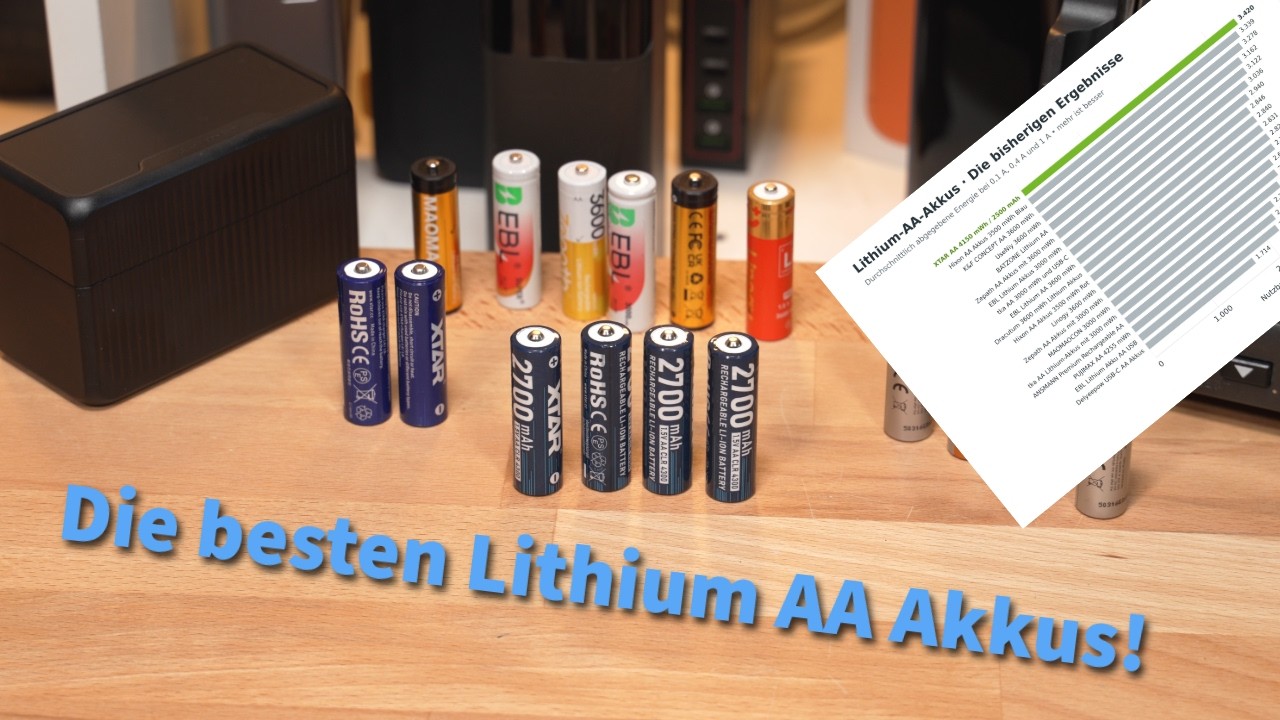
【Updated】 XTAR AA CLR 4300 Tested: Highest Measured Energy Among 20 Lithium AA Batteries
According to the tests from Techtest.org, the XTAR AA CLR 4300 ranked No. 1 in measured usable energy among the 20 tested models.
A few other findings:
Its average measured energy was approximately 8.3% higher than the XTAR AA 4150 model.
It delivered around 11% more energy than the Hixon 3500mWh model in the comparison.
Results were consistent across the three discharge currents. Less than 1% variation in average energy.
This AA CLR 4300 battery could maintain stable 1.5V performance while providing a longer and more recognizable low-battery warning period before shutdown.
【Updated】 XTAR CLR 4300 AA Runtime Tests on Different Audio Transmitters
Slovak audio creator Jaroslav Pešek put XTAR CLR 4300 AA Li-ion batteries to the test across wireless audio equipment from Wisycom, Shure, Sennheiser, and Audio Ltd, comparing runtime under different transmitter power levels and settings. Check out the test results below.
As Jaroslav shared after extensive testing, “ I need power I can trust. XTAR batteries and chargers work as a complete system, and on a professional set that reliability is everything. No surprises, no excuses.”
@xtarflashlight Is there a more reliable way to match 2 cells together that are as close as possible in capacity/performance? When I use them in series, when the “weaker” cell dies first, the whole circuit is “dead”. The second cell still might have ample power reserves, but becomes useless in the series because the dead cell is “open”.
At least for NiMH cells, I stick em in my tester and do a capacity test.
First I’ll stick cells A and B into slots 1 and 2, then swap into slots 2 and 1 for another test. First to make sure the results for each cell are consistent regardless of the slot, and then to rule out “slot bias”, eg, slot 1 giving slightly better results than slot 2.
Rinse, repeat for other cells.
Tedious, but I only have to do it rarely, only when I get arsed enough to check.