What is the source of this? I haven’t been able to find any spectral information on the XP-E cyan.
Seems there ain’t any. Just goggled “cyan xp-e led” and got 2 .pdf files for XP-E and XP-E2. No cyan. Closest is blue that centers about 460nm or so.
Royal blue is bluer and green is, well, green. No cyan, apparently.
I tested it with my eyes. With XP-E cyan, I can only see from green to blue. With CSLPM1.F1 (phosphor-converted green), I can see all the way from red to purple. XP-E cyan is very likely not phosphor-converted.
A true Cree XPE or XPE2 cyan doesn’t really exist, Cree never made it. What exists is a direct emission cyan LED that happens to be in a green 3535 package similar to the XPE/XPG package, and in other times it is packaged in any other generic 3535 package. People just call them XPE cyan for convenience.
It’s most likely not phosphor converted. There’s also some phosphor converted ice blue XPE lookalike out there that are also called XPE cyan, so there’s always a very small possibility of it being a PC LED. Again, not a legitimate Cree.
480nm is a really niche wavelength that’s for sure. The only way to be sure is to read its output spectral data.
How about these “Lake Blue” LEDs? The 5050 one is interesting if it is not phosphor-converted. It should have higher output than the XP-E cyan, should work well with 5A buck driver.
Unfortunately both are phosphor converted. It’s hard to find direct emission cyan LEDs over 3W, they are either multi die 5050 LEDs or “100W cob” LEDs.
I have conclusive evidence this is false. Using LEE Filters 026 Bright Red, XP-E cyan cannot penetrate, while CSLPM1.F1 becomes bright red.
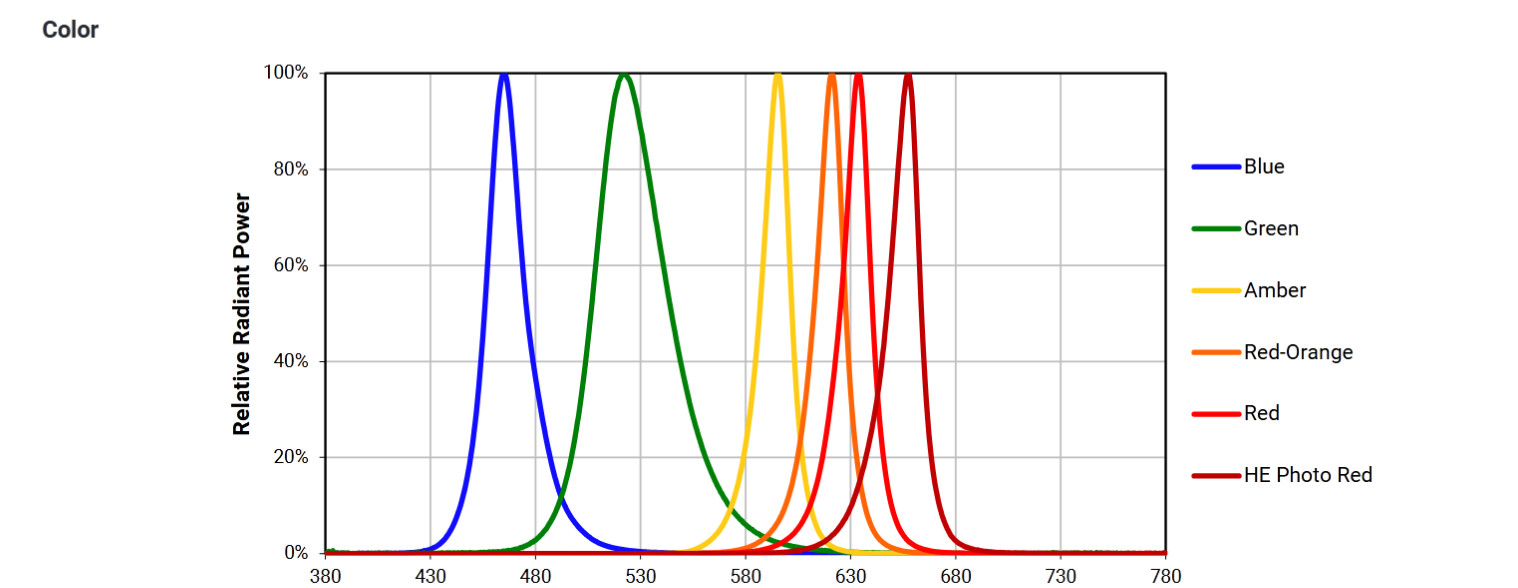
The XPE Blue/Cyan does have a slightly wider bandwidth, but the problem is that no one knows what the tolerances are, and what the spectrogram of that product actually is. 
Technical characteristics:
– red light – wavelength 630 nm
– blue light – wavelength 480 nm
– nominal light intensity 200 kcd/m2
- automatic light switch-off after 25 seconds
– includes a rechargeable battery (7.4 V Li-Ion, 800 mAh) and charger
– dimensions L 190 x W 86 x H 45
translated spec from:
medical-centar[.]hr/proizvod/instrument-za-pregled-mreznice-i-ocnog-zivca-iris-vet/
There’s a few 480nm filters on AliExpress, I don’t know if they’d help cleaning up the output of the reccomended LEDs? Seems to be a common option for hair removal laserz.
Searching around I found one with specs of 480nm with 10nm bandwidth, but writing a post here I’ve managed to lose it on AliExpress app. It was expensive ($150ish) and there was no dimension given?!
Interesting “conclusive evidence”, why do you assume there has to be red light coming from a cyan LED? I even said there will hardly be any red wavelengths in there at all 
Now why Osram has some reddish phosphor in their PC green emitters I don’t really know, because honestly I don’t quite understand what they are used for commercially/at large scale. I guess it is preferable to have a bit wider spectrum in that use case rather than only having a bit of blue and a huge bump at green.
Anyway, I do have actually conclusive evidence Hank’s cyan “XP-E” emitters are phosphor converted by looking at the actual emitters. The rough phosphor surface underneath the clear dome is obvious, they also glow green under UV, and if people still don’t believe me or are really curious I could measure their spectrum as well. But it’ll very likely look like other PC cyan LEDs out there, with the usual blue pump peak and then just a plateau at the greens, dropping off before reaching orange ^^
The filter allows light 590 nm and above, not just red. If you look at the spectrum of direct emission XP-E green, there is some light above 590 nm, so at least it can penetrate. The cyan being unable to penetrate means it is shifted even more towards shorter wavelengths, as one would expect from direct emission. Phosphor converted will have a wider spectrum and there will be light above 590 nm, like in lake blue or azure LEDs. With lake blue, you can see from red to blue. Azure also emits light above 590 nm.
Which binning/order code has the “XP-E cyan” mentioned here?
I cannot find any official information from Cree regarding a XP-E or XP-E2 cyan. Also there was no mention in the older datasheets as well. The XE-G cyan (which has true cyan color and is advertised as that) has dominant wavelength at around 490-505 nm, the PC variant has also much higher green in the spectrum.
I have the feeling that these XP-E “cyan” are (if these are indeed real Cree ones) in reality just regular blue LEDs with very high wavelength binning since they can go up to 485 nm maximum, or maybe even green LEDs with very low wavelength binning. But this is more unlikely since they are specified as 520 nm minimum.
1 Thank
There ain’t any, at least not acto the Cree datasheets for XP-E and XP-E2.
I think others are referring to other-mfr LEDs in XPish packages.
Yeah, this is the most interestng thing about it…
I found an image of a allegad “XP-E cyan” by JLHawaii808

It does not look like a genuine Cree LED, and also not like a Luminus LED. It looks like these random chinese ones you can sometimes find on Aliexpress or Kaidomain.
And the pink one looks even more weird:

It is - how should I say - somewhat problematic to name these as “Cree XP-E” if these are not genuine Cree emitters, especially since we are discussing things about these which can cause misunderstanding if someone believes these are Cree ones, which is not.
I asked him for order code/part number of these emitters.
1 Thank
I wasn’t aware that this is such a complex / controversial topic but I am happy I started a rather intense debate 
I thought I am smart and tried to contact Eickemeyer (the company producing the product) and just ask to see what they will reply. Thats what I got:
The LED light sources are monochromatic with wavelengths at 480 nm +/- 3 nm and 630 nm +/- 3 nm per diode manufacturer specifications. Since the initial tests that we have conducted in 2003 this has been a guiding principle for all generations of instruments developed. Nearly all experimental and clinical veterinary cPLR studies published so far, used our cPLR Tester . For more in-depth description of the principle of testing, you can use the attached document.
They also send me the original paper:
The pupillary light reflex was evaluated using Melan-100 testing unit (BioMed Vision Technologies, Ames, IA)
Melan-100 is an instrument built to match spectral properties of canine visual pigments. It is a portable instrument and has powerful diode-based light sources with very narrow wavelengths for blue and red light, which fit to spectral sensitivity curves of melanopsin (480 nm) and rod-cone opsins (630 nm). The blue and red light stimuli of identical luminance (200 kcd/m2) were used for testing the PLR in all patients as previously reported and according to the manufacturer recommendations
And that is where it kind of ends. This Melan-100 is sooooo old you cant find anything substantial on it. The only thing I found was this https://cahfpets.ca/wp-content/uploads/2008/11/CAHF.WISH_.MELAN_.100.pdf
So I think I am kind of giving up at this stage as it seems indeed difficult to find a true (or at least narrow) source of monochromatic 480nm (peak) light.
If someone actually had a convincing idea and I overlooked it (I do apologize, you guys lost me somewhere inbetween due to the lack of background knowledge on my side)
Simon
1 Thank
I order odd wavelength LEDs regularly. My supplier carries narrow-ish (half width 26nm) bandwidth 480nm (470-490). I’d want to take a spectra to confirm, but the other emitters I use from them have been true to wavelength.
They also have 630’s.
Attached is spec for the 480’s.
1 Thank
This is very interesting, thank you.
Like as usual they never give any exact information on which LEDs are used. Maybe to keep this as confidential. At least this is what I would expect from a medical equipment manufacturer.
This Melan-100 does not look too old, more like a device from 2000-2005. Here is a much more modern version shown, although I am not sure, if this is really a Melan-100. I am pretty sure the LEDs are used are NOT phosphor converted ones with broader spectral bandwidth, but real monochromatic ones like the ones linked by @blwilli

These seem to be quite rare since there is no phosphor (or maybe very special phosphor, could tell more if I have some real photos of these or even samples) used to get this narrow-band monochromatic light.
@blwilli Where I can buy these Yingfeng LEDs? (From Germany)
1 Thank
The sales contact is named Happy. I don’t know what the shipping for you will be like, but for me in the US there is a $40 USD flat rate, so if you’re only buying a couple emitters it’s not practical.
1 Thank