I love that idea!
Thank you for the insite and it makes sense to me. Which scare me enough knowing how far down the rabbit hole I am now these days.
I absolutely like the idea as well. But first things first. I want to build the two the two channel boards first just to get myself up and running. In theory it should just be a matter of adding all the components and flashing “off the shelf ”[D4]” Andúril.
Here is an Osh board that would support the hardware requirement for a quad channel implementation.
My desire is for the top most LEDs to still function as a lantern and thus they get 2xAMC7135 when every other channel gets 1xAMC7135.
I also added some helpful silk notes and/or hints. I would imagine building this against the TK-saber hwconfig
Nice idea 
After what felt like an around the world trip with the USPS the first PCBs have landed!

Going to try and build at least one today. It depends on my patience level.
It is alive!

nice! 
looking forward to a video next.

Video
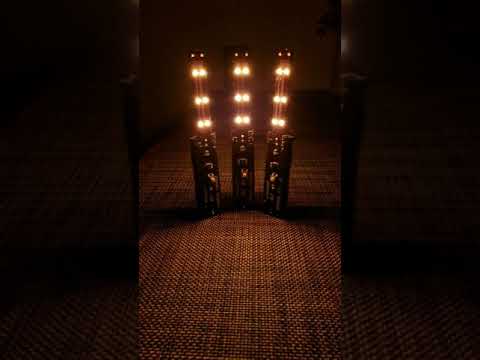
Congrats, very nice!
Well done!
It’s probably worth mentioning that the 4th PWM channel is a dirty hack and doesn’t perform as well as channels 1/2/3. The tiny85 doesn’t actually support four PWM channels, so it’s implemented in software using interrupts… but the timing can be off, at random, so the 4th channel tends to be noisy.
cool project!
Interesting. In your opinion given this way would be there best “channel” to run this output on? The “turbo” LEDs?
I’m not really sure which channel would work best for that. On my lightsaber, it ended up being the yellow channel, and it’s mostly only noticeable when using relatively dim non-yellow modes. Sometimes it’ll have a brief flicker of yellow when it’s not supposed to.
When I get things running on attiny841 or attiny1634, it should be able to handle four PWM channels without this type of issue… but tiny85 is a bit kludgy.
This is a cool project, I always wondered where LEDs might end up next, this is a candle I would buy.
In that case I would think the highest level of candle ramp would be best served with this software PWM since it is most likely to do be flickery anyways.
Ah, I wish I could even being to attempt to code even remotely on your level but that isn’t likely to happen so I am looking forward to you porting everything to the more powerful MCUs. I will surely update the PCBs then for everyone.
I do have a question though for you. Since this is based upon Anduril, what is the best way to support the needed open source requirements? Right now all that I have changed is the ramp in the cfg.
Ill likely make some to sell eventually. Just enjoying the first effort for a while first
The idea for this was eventually for everyone to build their own.
Basically, if you distribute the code in compiled form, like as a download or embedded into hardware, you’ll need to distribute the code in source form too, under the same license. And have a conspicuous notice somewhere that it uses free software. That’s the GPL in a nut shell.
Fortunately, there are a variety of ways to do that. It’s usually pretty easy.
Where can I find the lantern branch? I don’t see it in the repository.