The Harbor Freight meter never went on sale so I never bought it… I’m not near any stores, so I couldn’t possibly go down to a store and play with it. I also (guess that) I wouldn’t use much of the sound, temperature, and lux. Or maybe only for the first few times after I got it, and the excitement I expect to die down.
Happy with my UNI-T now, use it to measure batteries voltages and that’s pretty much about it, don’t even measure much of currents. So probably the meter with so many functions is an over-kill for me; in fact the main attraction for me is not the usual functions but those added functions. May still get it though when I feel I have the extra cash
Oh, so when you were "checking it out" you weren't at a store looking at it in person - I see. I'll see how long mine lasts. My homemade Elenco (a kit I built in high-school electronics class) has lasted me 21 years now (though it never saw heavy use). It's just a cheap plastic case on it too. It finally started giving me wacky current readings even with a new battery installed.
I’ve got a generic Chinese meter I bought probably 8 years ago. I needed to do some logging and it has an RS232 output. So far it has done a good job for me.
I also managed to pick up a Fluke 123 Scopemeter for cheap as the LCD had some issues. They’re irritating, but the scope works fine. Very handy to be able to do triggering, and display multiple things at once (current + voltage, etc).
Garry, oh I meant checking it out online (as in visiting the website and looking at it). You might have thought “checking it out” meant check out at the counter, or check out using credit card. Haha.
Garrybunk I did the same thing I couldn’t wait any longer for it to go on sale.
I just wanted to tell you don’t take the meter outside in the hot sun for any length of time if you plan on trying to use it.
I had my AC unit stop working, so I went outside to test the dual run capacitor. It was only about 75 degrees outside, but hot enough for the wife to complain about the AC unit not getting cold. I took the mastech with me pulled the cover off and removed some wires to the capacitor for testing. It tested bad, but by the time I had two screws removed and the capacitor in my hand the display on the mastech was half blacked out. I picked it up and watched it to see what was going on.
The display completely blacked out within a minute. I took it back in the house out of the sunlight and the display slowly came back. Working fine now but doesn’t seem to like the hot sunlight at all. Just thought I would let you know.
Pretty good meter for the money and measures very close to my 87v as long as its not in the hot sunlight. :bigsmile:
Does anyone have experience with Bside multimeters? I’ve tried googling but there is little info about them. Feedback I find is not bad for budget auto-range multimeter. This is the one I’m interested in:
Screen Size
4.5 x 1.8cm
Max. Display
1999
DC Voltage
200mV/2V/20V/200V±(0.5+2) 600V±(0.8+2)
AC Voltage
2V/20V/200V/600V±(1.0%+3)
DC Current
0.2mA/2mA/20mA/200mA±(1.0%+3)
AC Current
0.2mA/2mA/20mA/200mA±(1.2%+3)
Resistance
200/2k/20k/200k/2M±(0.8+2) 20M±(1.0+2)
Transistor Test
No
Temperature Test
Yes
Frequency Test
No
Power Consumption Test
No
Short-Circuit Protection
Yes
Short Curcuit Buzz
Yes
Auto Power Off
Yes
Powered By
9V / 6F22
Battery Number
1
Battery included or not
Yes
Certification
IEC61010-1, CAT II 600V
Dimensions
14.4 cm x 7.2 cm x 4.5 cm
Weight
110 g
I can get it for less than $10 using a discount code and points. It’s at least $16 everywhere else I’ve looked. And $10 is all I would like to spend really. For now I’m only checking voltages of li-ion batteries, car alternator etc. So I guess it’s already a lot more functional than I really need. Leads seem better than most cheapest DMM, it has auto-range, back-light, buzzer and even measures temperature.
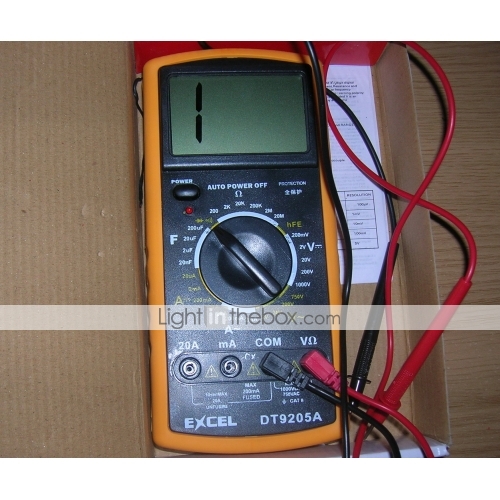
Will probably get booed here. Accidentally found out about $5 coupon at lightinthebox.com yesterday. So ordered a cheapie Excel DT9205A there. After applying the coupon it only cost me $1.99 J) European warehouse stock too. From what I read wires are quite rubbish but usable for “noobish duties”. No backlight too, but screen is huge so probably won’t have problems reading the measurements. At that price I won’t complain and can always easily get rid of it and come back to that Bside auto-range one.
Forgive me for not having read the whole thread which is usually done but...on youtube there are a couple of guys who are very learned about electronics and especially testing tools like Digital Multi-Meters. They have posted many, many reviews about many DMMs. After having viewed almost all of them one can get a good idea of how to choose a good one in one's price range.
The two guys on youtube are Dave Jones from EEVblog. The link is for his "Digital Multimeter Buying Guide for Beginners". The other guy is Martin Lorton and one of his videos is here entitled "Review: Mid Range / Priced Multimeter Shootout / Buyers Guide".
It is kind of funny but Dave makes his videos as if he just drank a gallon of fierce Turkish Coffee and Martin makes his as if he needed about half the coffee Dave just drank. No offense intended to either since they are both VERY insightful but two notably different styles of presentation. Both recommended.
EDIT: If anyone is about to buy any meter then after watching those two videos you will definitely spend more money on safety after you do.
I have a variety of meters, fairly expensive to cheap, but what I use the most are nothing like those shown in this thread.
I have a Craftsman 82369 DMM with a AC/DC current clamp, and a Mastech pen probe meter. DC clamp (most cheap ones are AC only) is so much safer and easier to use than breaking the circuit and putting a meter in series.
None of the cheap meters have decent reliable leads, plan on spending another $5 to $10 on better leads.
I have the BEST variant of the DT9205, and after about a 200 or so switch presses it started to give out :( Still I couldn't go wrong for $6. I may get one of the UNI-T meters on FT after this meter craps out.
They do have a very different background and knowledge. Dave knows a lot about electronic and he prefer expensive multimeters. Martin does not know much about electronic, but is learning.
The other issue with cheap meters is that they often don’t have the proper affordances for testing mains/line voltage, and up. Not a big deal though if you are just using them for a flashlight with 1-4 cells in series.
If someone uses a DMM only for low voltage like under 10 volts DC and not much current then the safety factor increases but the problem with the cheapies is if someone uses the DMM on some other test even if the settings indicate it can measure it. On some DMMs the distance between certain points inside is not enough to isolate the circuits and a very serious accident can occur.
This safety issue is brought out in some of Dave Jones's videos. Many DMM reviews are taken apart and examined inside with commentary so please have a basic look at least at those two videos I posted above.
Best wishes and do not be sorry for buying a inexpensive unsafe unit. This does not mean a safe unit must cost a lot but there are safety issues to consider and are expounded in those videos in order to know what to look for and what is safe and what is not.
Testing mains is many things. Inside your living room is not a problem, it is usual CAT II 300V, but outdoor or in an industrial environment the meter must be much better protected (CAT III / CAT IV). The difference is how large transients you can get and how much current, a transient to ignite a spark and enough current to maintain it and you have an explosion.
HKJ - How accurate do you think the cheap DMMs are for flashlight driver testing? Do you think they are good enough for those who do more than measure batteries?
We have a better quality one here so I am just asking for the readers in general.
Usual even the cheap meters have good accuracy on DC voltage and DC current.
But, there is a bigger risk for getting a meter that is not calibrated correctly or that the meter will drift out of calibration over time. For higher resolution the ambient temperature may also affect the reading (It does that on all meters, but more expensive meters uses more temperature stable components).
I have not checked it, but I have always wondered how temperature stable the 10A shut is on the cheaper meters, i.e. will the reading change if you measure a couple of amps over 10 minutes, because the shunt gets warm.
AC on cheaper meters will not be rms and will probably only be accurate around 50 to 60hz. If the meter has trimcaps inside, they are for adjusting the frequency response of the meter, i.e. make it precise at more AC frequencies.