The same driver does not drive every emitter equally. Factors like emitter Vf and battery type significantly affect/constrain the driver’s output current.
Is F150R the one?
Is there any more info on how it performs at 10 or 20 amps?
The name is new but it looks like it. There’s no info about performance except Simons expects it to be similar to Luminus SFT-90/SBT-90.2. Hopefully he’ll squeeze some more in the last months (Simon told me we’re still 3-6 months from the launch, he told ‘bartek’ 2-3 months) because NBT160 on which this emitter is based off was reportdly up to 15% more efficient than SBT90.2 which makes sense as it has 20% larger LES. What I’m worried about is that the cool white variant has visibly green phosphor layer on top, typical for low quality chinese LEDs with ugly tints.
2 Thanks
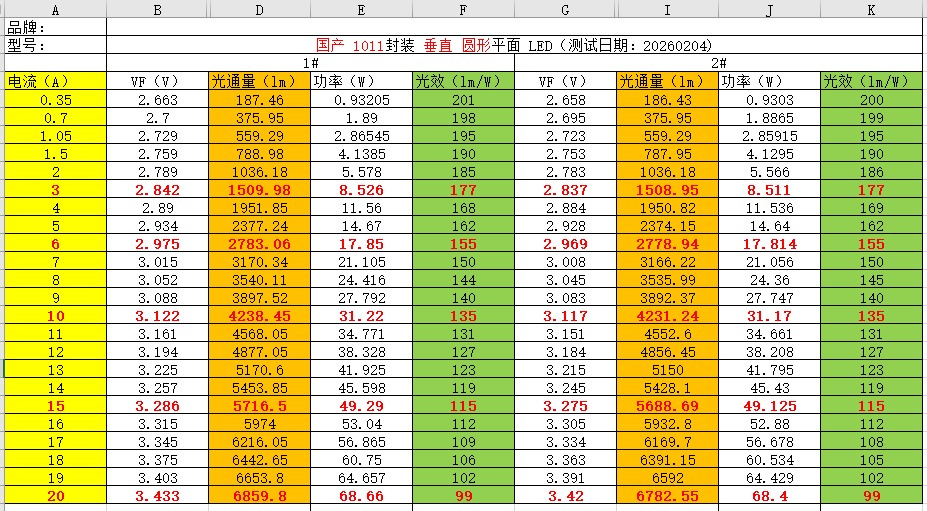
Where did you get that from? If that’s the new round LED then it’s just a sgood as LHP73B and much better than LHP531 despite smaller LES. It says 1011 package, that’s fishy…
The Man himself. With permission.
What does it mean?
No clue, definitely not 7070. If that’s true it’s really impressive especially at lower amps - over 4000 lumens at 10A is no slouch. Once it comes out LHP531 becomes irrelevant (unless it turns out to have ugly tint).
So throwy M21H with 6000 lumens incoming? Yikes!
Good news - Simon said he requested those new emitters to be at or below BBL, as usual. If those brightness numbers are true SBT-90.2, SFT-90, LHP531 and partially LHP73B will instantly become obsolete.
4 Thanks
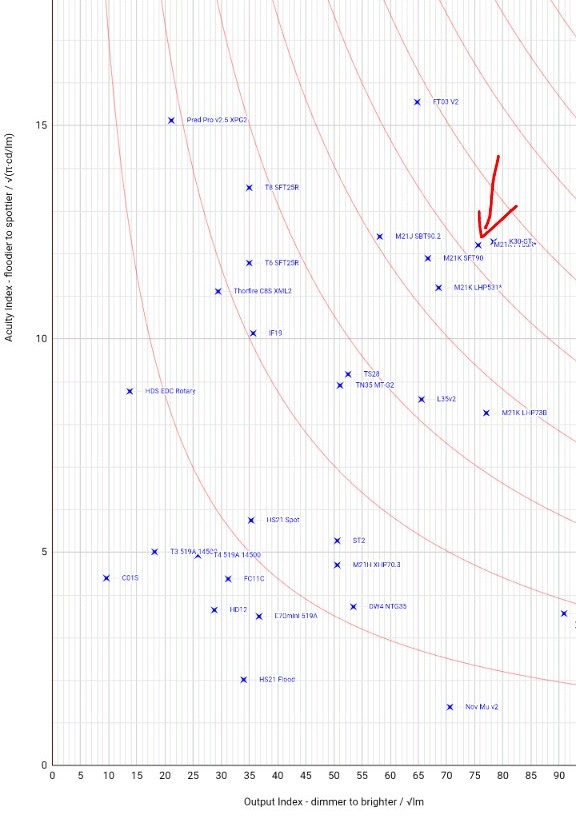
I tried to predict what the F150R in M21K could do, and I put it on the Map. It’s up there near Acebeam K30-GT.
1 Thank
F150R is going to be a hit in the M21K!
Not only there, imagine M21B or M21H that put out 5500lm-6000lm but they’re not floody like LHP73B.
1 Thank
Is there an estimate of how large the F150R LES is?
If the F45R is meant to be an SFT42R substitute, it seems reasonable to guess that the 45 indicates 4.5mm^2, and that the F150R may have 15mm^2. I previously eyeballed 12mm^2 from the photo.
If the 15mm^2 guess is accurate, then it ends up being floodier than the LHP531 at 13.5mm^2. Even with the increased output, it still is not quite as intense as the SFT90 at the same current–the only way to get more throw is by overdriving beyond 20A.
In this case, the estimate posted on the map seems a bit too optimistic. Also, since the LES is larger than SFT90, it must stay below the M21K SFT90 in the vertical coordinate (beam concentration).
I’m pretty positive NBT160 (and FFL909MX) LED it’s based on has 12mm² LES. It about equals SBT-90 when it comes to throw, it has basically the same beam profile but brighter. I already posted a link to the comparison here:
It should outsine and outthrow the LHP531.
2 Thanks
Assuming the 12mm^2 is accurate (feeling good about my eyeballing), and assuming that the datasheet is believable, then it should out-flood and out-throw both SFT90 and LHP531.
However, the estimate posted in the map above still requires correction for sake of consistency: the F150R has larger LES than SFT90 and therefore must achieve lower cd/lm in the same light.
Yes but it’s also brighter so the actual density/intensity may be similar.
I was told that F150R uses 150 mil chip, which I think makes LES of some 11.4 mm².
On the Map the uncertainties of both indices are probably at least ±0.5 so reporting and comparing whole numbers makes sense (e.g. for LHP73B the Acuity Index is probably somewhere between 8 and 9 based on 3 reviews and levels within them).
I fixed the predictions on the Map based on 1Lumen measurements for LHP73B as basis, but scaled it so that the measured (by PD) SFT90 falls in (Grzybek’s measurements places it a bit higher up). Thank you!
Visually they may look better, but those clustered within a few index values may not be as different as we would like them to be :-). Detecting it is the main value of the Map, I think.
1 Thank
No; that’s not how the physics works. The unit cd/lm is a measure of beam shape; on its own, it has nothing to do with brightness or even intensity. You can drive the same light on turbo or on moonlight, and it has the exact same cd/lm.
Another way to see this is to just simplify the units: cd/lm = (lm/sr)/lm = 1/sr. It literally reads “inverse of beam spread angle”; nowhere in this quantity does brightness appear.
Excellent, great to have a concrete figure!
I see the update! Brighter than LHP531 and SFT90, with cd/lm between the two. I think this is also where I’d predict it to land. Incidentally, the LES size at 11.4 is quite close to the geometric mean of SFT90 and LHP531: sqrt(9.6*13.5) ~ 11.4.
Agreed. Also, the precision of the values on the map is arguably greater than the precision of some measurements the data is drawn from. Measuring total output (lm) is extremely hard to do accurately, and measuring candela is also bit of an art, many make the mistake of measuring throwy lights at too short a distance, which results in an underestimate of intensity.
1 Thank