I have noticed the discussion about this, but unfortunately I currently have no plans to produce a dedicated 6V PCB for this. The main reason is that it would add complexity to inventory management.
9 Thanks
What about just selling the MCPCB alone, without soldering a LED or installing into flashlights? Most modders will be able to do it themselves, including soldering a bypass wire around.
1 Thank
That still means one inventory slot for an item that will never be used in any flashlight.
3 Thanks
But it could be used an may of flashlights that come with a 6V driver option.
And you could potential have only a single MPCB in stock that can be configured by cutting/bridging a jumper/ solder pad
1 Thank
Of course I’d love for Simon to offer these 6V MCPCB but I don’t think he will. He has expressed in the past the intention to phase out 6V drivers and LEDs in his lights. In a few years I doubt we will have new 6V options.
2 Thanks
I hope by then we have more comparable options to Convoy that will still offer this option.
Not a fan of the FET/linear drivers and Hotrod lights.
And buck-boost converters are more expensive and physically bigger, and less efficient than boost converters.
6V/12V emitters are an easy and elegant way to get a fully regulated driver over the full battery range in a single-cell light.
8 Thanks
Most people even on here are not modders but buyers.
Then there is a big group that can change drivers and LEDs on MCPCB with basic soldering skill and tooling
Then there is a tiny group that is able to solder LEDs onto MCPCBs themselves.
The market wouldn’t be big, it’s not worth the hassle, as he stated.
I agree that it would be nice if, but Simon keeps prices low by ordering and selling a lot of his products and building and making just a few hundred MCPCBs would probably end up in a way higher price than his other MCPCBs
9 Thanks
@ebastler designed a MCPCB specifically with the 73B in mind:
Maybe someone could start a group buy?
6 Thanks
I am also a “regulated driver fanboy”. But the LHP73B is one of the few LEDs that works really well with a one cell buck because of its low Vf even at high currents. A 6V configuration for this LED would be obsolete in my opinion.
What do FET/linear drivers have to do with this?
Convoy released a new 20A buck driver specifically for high-current 3V emitters such as the LHP73B.
And buck-boost converters are more expensive and physically bigger, and less efficient than boost converters.
And buck-boost is a different topology from buck, so the disadvantages of buck-boost compared with boost don’t apply to a 3V emitter running from a single cell through a buck driver.
You can’t run a 3V LED trough a buck driver and get Full regulation over the full battery voltage range.
You get some longer Regulation down to lower voltages from a Linear driver. But of causes at lower efficiency.
So Sure you could uses a Buck Driver with comparable efficiency then a boost driver.
But with the Buck driver and a single cell you wont get the full capacity out of the cell (in a regulated way)
1 Thank
Look at the runtime graphs of some Convoy lights with buck drivers. Perfect regulation basically to the end.
4 Thanks
Some of them yes, but there are notable counterexamples among throwers. The old batch SFT25R is infamous for having a Vf so high that it fails to draw 8A even on a full battery, and the W5050SQ5 falls out of regulation quite a bit sooner than the new-batch, lower-Vf SFT25R. (Note that under 100% draw without thermal stepdown, the difference in regulated runtime would be more pronounced, and only ~half of the battery’s total energy ends up as regulated output.)
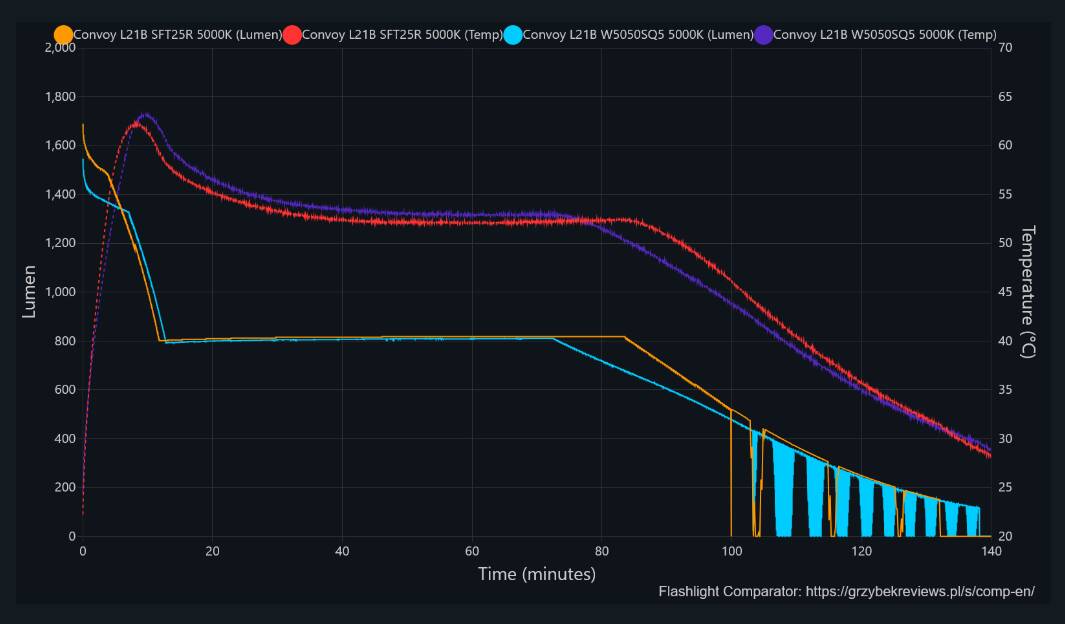
Not that this is particularly relevant to the discussion about discontinuing boost drivers (since multi-die emitters will never out-throw monolithic ones), but I think the existence of these high Vf LEDs should motivate the development of buck-boost combination drivers. Either that or wait for these high-Vf emitters to become obsolete, which could take a long time.
As long as LEDs like SFT70 and XHP70.3 remain irreplaceable, chances are that the production of 6V drivers will continue.
4 Thanks
Yes, the graphs look perfect, but this is not the point. I want my lights to be able to give 100% power bursts even with battery <50% SOC, or even <30%.
Most runtime graphs look like this: Start with full battery at 100% power, then a drop to a lower, thermally stable output level, then stay there. At this lower level the Vf is also lower, so the buck can work easily.
I would like to see graphs with some short 100% output attemts from time to time to see how a light can handle full current at lower SOCs.
1 Thank
With the upcoming release of the high-CRI LHP73B and LHP531, I believe the SFT70 and XHP70 will also be phased out in the future.
8 Thanks
Only if the luminaire has excellent heat dissipation performance and effectively distributes the single-cell operating current through multiple batteries in series and parallel, can the expected results be achieved.
1 Thank
This is the second AI scam I’ve encountered this year. The two photos below were provided by an AliExpress buyer; they were taken from the same angle, but the deformation flaws on the flashlight are different. Ah! This is really testing my eyesight and IQ. (For entertainment purposes only)
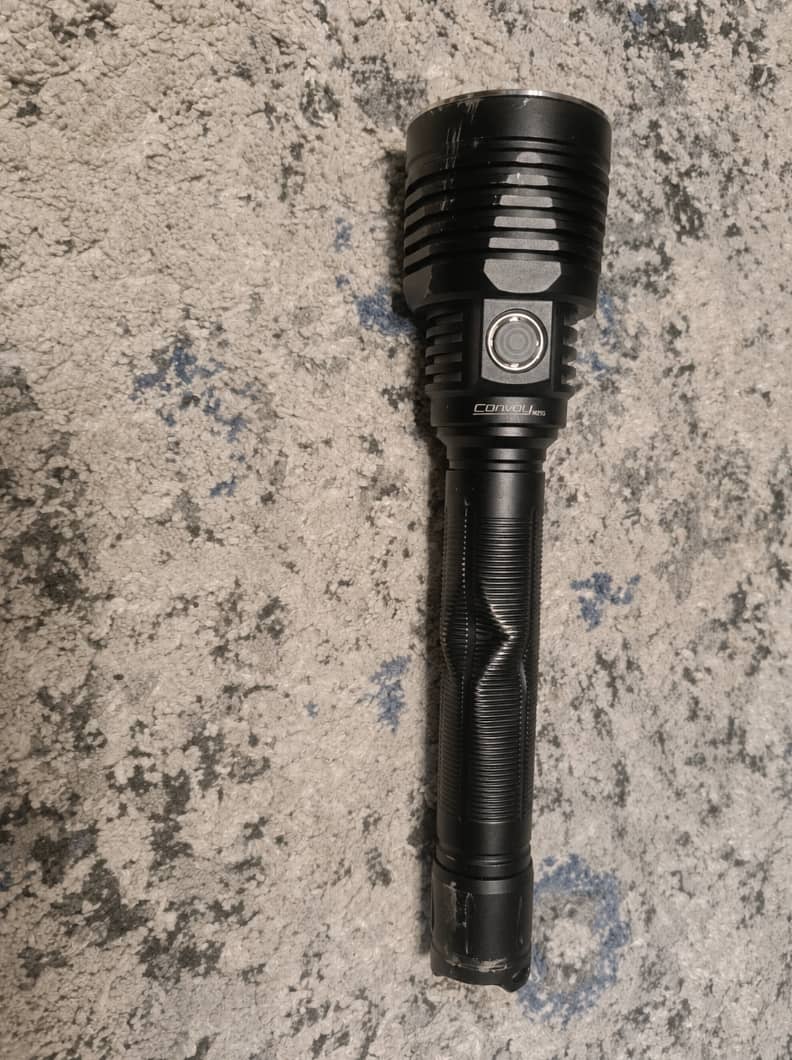
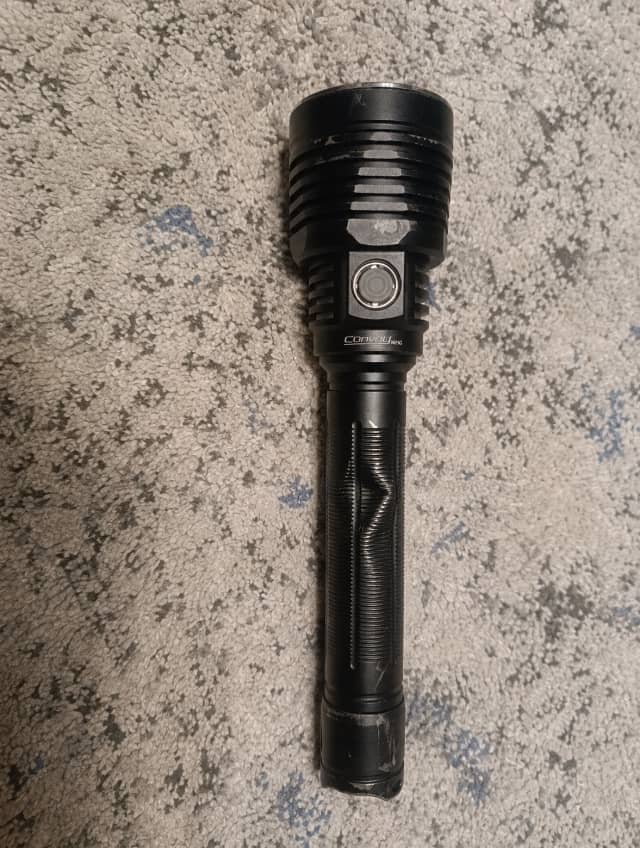
25 Thanks
Maybe I didn’t make my point clear.
Most graphs take the temperature into account. So far so good.
But the “full-power-abilities” of a driver/light depending on different SOCs is also very important (starting with a cold light every time).
For example: My light has only 30% battery SOC left. I put it out of the pocket, it is cold, is it still possible to get 100% power out of it in this moment? What is the SOC or voltage threshold the (cold) light can’t reach its 100% power anymore?
2 Thanks
That’s not even possible unless ran over with a tank or shot at. Even thin SK68 was quite hard to deform with a hammer. LOL
6 Thanks
Assuming a battery has 30% capacity remaining, its open-circuit voltage is around 3.6 to 3.8 volts. During high-current discharge, the operating voltage drops rapidly; once it falls to about 3.0 volts, the flashlight triggers a low-voltage warning. Because of this, many buyers wonder: “The battery clearly measures 3.8 volts and seems to have plenty of power left, so why does the flashlight trigger the warning so early?” Under low-current discharge, the difference between the operating voltage and open-circuit voltage is much smaller, which is precisely why I recommend using multiple batteries to share the load.
4 Thanks