Thank you for clarifying. Any index that is a one-variable function of cd/lm should be consistent. I’m a believer in Occam’s razor and would simply stick with cd/lm (to simplify all computations) and let people choose their own scale!
I agree. I find cd/lm to be perfectly adequate.
For most (practical) flashlights it ranges from 1-1000.
- A Mule (e.g. Nov Mu v2) is <1, usually around 0.5
- Most EDC lights are around 10 ±50%
- Most throwers around 100 ±50%
- A small LEP or a big dedicated thrower (e.g. W3+, K1 NM1) reaches close to 1000.
An even more intuitive figure would be the hotspot size at a given distance, accompanied by hotspot and spill angles. Armytek does this wonderfully. See slide 3 on their product pages:
1 Thank
Another benefit of cd/lm is that for a given lumen output, it scales linearly with respect to the emitter area or reflecor area.
2 Thanks
Excellent summary!
Hotspot + spill angles would indeed be a complete set of parameters for a reflector-based beam, though TIRs could make things trickier. For somewhat throwy lights, small-angle approximation kicks in and hotspot diameter at distance D is given by θD, where θ is hotspot angle (radians). Good on Armytek for giving this data.
Excellent point–linearity of scaling makes things easier to work with, especially for folks who haven’t dealt with serious mathematics in decades. And the scaling between cd/lm and reflector area (resp. emitter area) is indeed very close to linear (resp. reciprocal) for the range of values commonly encountered in flashlights.
Same reason why I find cd (equivalently, lux @ 1m) a better notion of throw than ANSI meters: it is linear/additive in brightness, so when you have two lights, you can simply add their cd values, rather than computing their “Pythagorean sum”, the square root of the sum of their squares, which is necessary for ANSI m. It also happens to be much easier to interpret and avoids confusions like “so does the beam just stop after 500 meters?”
2 Thanks
Also good point on the ANSI throw being not additive wrt lumens. To build on that, cd & lm make a great measurement pair, but ANSI throw needs another measure than lumens. Something that depicts human brighness perception - as throw depicts perceivable range of illumination. If Irecall right, perceived brightness doubles roughly every time that lumens are quadrupled, so one could use log2(lm) as approximation. However this will likely not hold for all types of vision (scotopic, photopic, mesopic), and be further dependent on the cct.
Anyhow, does such a measure already exist?
I think you meant that the perceived brightness goes up by an additive constant when the lumens changes multiplicatively–this is the Weber-Fechner logarithmic law, which is an immediate mathematical consequence of the belief that “the least perceptible change is proportional to existing quantity”, which is a reasonable belief in many settings.
A version of this measurement already exists in astronomy, in the form of apparent magnitude, which is essentially some scaled version of -log(lux). The log transform is also necessary in that context for practical reasons, since the intensity of starlight spans many, many orders of magnitude, which is often an indication that log is the appropriate scaling–see Benford’s law.
Anyhow, I find it easiest to just stick with physics and leave human perception out of the picture. Once empirically/psychologically derived quantities come in, things become difficult to interpret, define, and calculate.
1 Thank
Thank you for this brain twister early in the morning  . I don’t know if I even understand this sentence correctly.
1mm2 LED, cd/lm=20 for example
2mm2 LED, same lumen output, same host
2mm2 LED will have larger hotspot, since the same amount of “light” spread over a larger area will look less bright, the throw will be less. Hence: 2mm2 LED, will have cd/lm=10, inversely proportional?
3 Thanks
Thank you for the nice explanation. Although this is the first time I hear the term “solid” angle, I actually understood the concept, the third time around, generally. So the person I quoted from knows his stuff, quoting minimum cd/lm exactly at the allowable minimum 0.1 value?
@koef3 's tests include “luminance” value cd/mm2, as in SBT90.2 below. What makes that number for any particular LED high or low? It is not just how bright the LED is per area right? There must be some forward directivity characteristic of the LED involved as well, as a result of its design or construction?

5 Thanks
Yes, and it is refreshing to see!
Very good questions–ones that took me a good while to make sense of.
As you suspected, it is not quite just “brightness per area”–that would me lm/mm^2, not cd/mm^2. And indeed as you said, cd/mm^2 takes into account directionality of the emission: if an emitter with the same emitting area can confine its emission into a narrower beam, it will achieve the same lm/mm^2 but higher cd/mm^2, and be more suitable for a thrower.
For an ideal Lambertian emitter, cd/mm^2 and lm/mm^2 are equivalent up to a constant factor of π; however, some emitters are not quite perfectly Lambertian, which makes cd/mm^2 sometimes more informative and easier to measure.
Most of these complications don’t matter most of the time, other than people pursuing extreme throw. For some emitters, the light distribution is more concentrated toward the front than a Lambertian emitter, and the cd/mm^2 would be disproportionately higher than the lm/mm^2, and the higher cd/mm^2 can only be achieved by a convex lens, not a reflector, due to their collecting different parts of the beam…but all of that really doesn’t matter for most of us.
The cd/mm^2 measurement is also neat because it is, in a sense, an “intrinsic property” of the emitter that survives transformation by a secondary optic. If you put a magnifying lens (or reflector) around an emitter that increases its intensity at 1m by a factor of N, it does so by magnifying the emitter N times, from the perspective of the observer at 1m. Thus both cd and mm^2 increase N-fold, and the net cd/mm^2 ratio is preserved.
4 Thanks
Yes, you got the idea!
1 Thank
I get the intention, and I’m with you on the simplicity and (a bit less) on mathematical purity, but just start with lumens: it’s already ‘polluted’ with the committee-approved luminosity curve. :-). Why not to try to correct for brightness perception as well just as it was done for colors?
2 Thanks
As it turns out, cd/lm unit is not “polluted” at all by the definition of what a lumen is. It simplifies to 1/sr, which is reciprocal angle, a purely mathematical quantity. You could have chosen an arbitrary luminosity (weight) function in the definition of a lumen, and that would not change the cd/lm measurement.
I was never a huge fan of the “lumens” unit myself, but it is difficult to work without it given how ubiquitous it is. We work with it not necessarily because we approve of this unit, but because there does not exist a widely-recognized, better-substantiated quantity that captures the notion of “amount of visible light”. So between using it and not having such a quantity at all, the former is the lesser evil.
Brightness perception is also more or less standardized–the Weber-Fechner log law follows immediately from reasonable assumptions, and the log scale is indeed already used for apparent magnitude.
1 Thank
I’m gonna toot my own horn here, and slightly deviate to a related topic, “integrating spheres”. If you take a flashlight with a known/verified lumen count, you could put it through a series of diffusers. One to diffuse the beam, the second to scatter the diffused beam. Then, place all of that into a dark box painted with the darkest non reflective paint you can find, with a lux meter set up affixed to an adjustable platform. Tune the number readings to show what the lumen value is, and you will essentially have a pretty good integrating plane.
The logic is that if you take a cross section of luminous flux, you can accurately tell how many lumens came from a source.
The issue with light is that the quantity (i.e. the integrated volume) actually changes, like water in its fluidic state. Given a set standard of where and when a particular state of light is in, then the lumen value would generally hold. After all, light is both fluidic AND crystalline in nature.
Now this is a separate thread I feel less bad posting in it- are you guys aware of the Parametrek beam profiler?
Thread on BLF:
Their site:
2 Thanks
Sure, but the measure is an approximation of the narrowness of the beam, or that’s how we use it. Inverse of the included solid angle may not be that intuitive, albeit easy to calculate. There is nothing wrong with it and I developed intuition for the values, but it produces less than ideal scale, I think.
Halving the cd/lm or doubling the solid angle would quadruple the illuminated area, distance and flux being kept constant. The illumination of the target should fall by the factor of 4.
Similarly, if one models the beam of light as a cone, doubling the apex double angle (the intuitive planar beam angle often quoted) about quadruples the solid angle included by the cone (the quadratic approximation error should be less than 10% for double angles up to 120° or so, I recall).
The square root of cd/lm, for reasonably small angles, linearises both of them. Up to this point it’s just making the scale easier to comprehend and align with, or make it proportional to, common metrics that we already use: throw and apex planar angles. No perception involved.
But then, on the perception of brightness front, the Steven’s power law has been wildly used to approximate it. While nature has no obligation to follow any simple equations, it has proven successful.
Think of photography: recorded Raw values, roughly proportional to illumination, are taken to the power 1/gamma to get pixel values, only for the screen to inverse this (in order for our eyes to do something close to power 1/gamma again). Typical gammas are not that far from 2.2, which makes its inverse not that different from 0.5 or square root.
So that’s my case for sqrt(cd/lm) type of scale, with coefficients that make zero and one physically based and easy to visualize as a reference. The absolute range is not important - it’s the relative positions on such a scale that I find illuminating.
On the other hand, this may be a prime example of a solution looking for a problem.
2 Thanks
I think the issue is when we conflate objectives with perceptions…I made this statement a little while back, but not everyone agrees for some reason.
“Every single person can look at the exact same apple. Regardless of individual perception, if we all had perfect eidetic memory, we would recognize that same apple and its colors out of a batch. If someone is partially colorblind, that image would forever be burned into his or her memory.”
However, as human brains seem to be designed to process our environments in a reactionary and perceptive state, your objective methodology of quantifying/qualifying light seems appropriate.
1 Thank
I just want to quote the latest version of the beam shape index proposed:
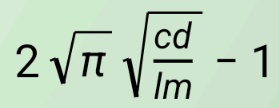
2√π is about 3.5
It’s a pretty compact (not to mention good-looking) transformation and not more difficult than calculating ANSI throw or range from max candelas. The index is similar to throw in meters except it decouples the beam shape from the amount of light that’s being pumped into it.
It returns 0 for omnidirectional light (theoretical minimum, or no beam), and it returns 1 for a Lambertian emitter - the widest beam a practical flashlight can have - similar to a Mule. Lanterns should fall between zero and one.
It coincidently has a nicely and practically spaced scale:
Bare bulb - 0
Mule - 1
Floody - <5
Balanced - <10
Quite Throwy - >20
V. Throwy - >40
LEP territory - >80
The scale is proportional to other familiar metrics: the Index value doubles when the ANSI throw doubles (for the same light source). It also doubles if the beam cone apex angle is halved.
Not unlike the throw in meters, it appears closer to be equidistant w.r.t. perception of brightness, light focusing and reach than the untransformed cd/lm value.
It can be argued that since halving the beam apex angle quadruples the illumination (lux) of the target, we will definitely not perceive the target as 4 times as bright but maybe twice as bright or close to it, which also scales about proportionately with the Index.
Illustrative values:
HS21 Flood - 2
HD12 - 6
HS21 Spot - 11
IF19 - 20
T6 SFT25R - 20
3×21D - 43
Rough numbers & calculation of my most often used lights, next to that classification on reddit HERE.
0.1 cd/lm: light bulb
1-3: flooder Convoy M21H 24°TIR 219b sw45k = 3.5
5-15: balanced EDC-style beam;
30: compact thrower Firefly X1L w/ FFL707 = 27
100: dedicated thrower; Wurkkos TS30S Pro w/ SBT90.2 = 90
500+: extreme thrower;
10000: laser
That range of cd/lm 20-30 seems to make the perfect all-around, walk, or gift light. My other favorite walk light: Firefly E04 w/ FFL505 = 29. Fun and useful thread!
1 Thank
There seems to be some misconception: sr is solid angle, which means “amount of area on the unit sphere taken up by the beam”. Thus: when flux is fixed constant, cd/lm = 1/sr varies inverse-linearly with illuminated area and linearly with lux on target. No squares or square roots anywhere in sight, no need to “linearize” something already linear.
Unrelated point, but
What is the mathematical justification for Steven’s power law, or for the power chosen? In comparison, the Weber-Fechner log law for brightness is justified in at least 2 ways:
Unless a convincing argument can be made otherwise, this is a real possibility.