This will help you a ton and save you some headaches

Or maybe even get soldering paste with lower melting point of 138°C (Sn42 Bi58)
This will help you a ton and save you some headaches
Or maybe even get soldering paste with lower melting point of 138°C (Sn42 Bi58)
Kapton tape it off anyway, just in case
I bought this flux for hot air rework soldering, but have found it works pretty good for general soldering as well. AMTECH NC-559-V2
It does not spatter at all, even when VERY hot. I’ve been using it lately for most of my solder work with hot air and irons.
Curved hemostats are great for holding wires deep inside the head, like you have there with the C8.
Once the wires are tinned, you can pre bend them so they are at a good angle for when you solder them to the mcpcb. Again, be careful not to get spatter on the emitter.
I mostly use 0.6mm and 0.8mm solder.
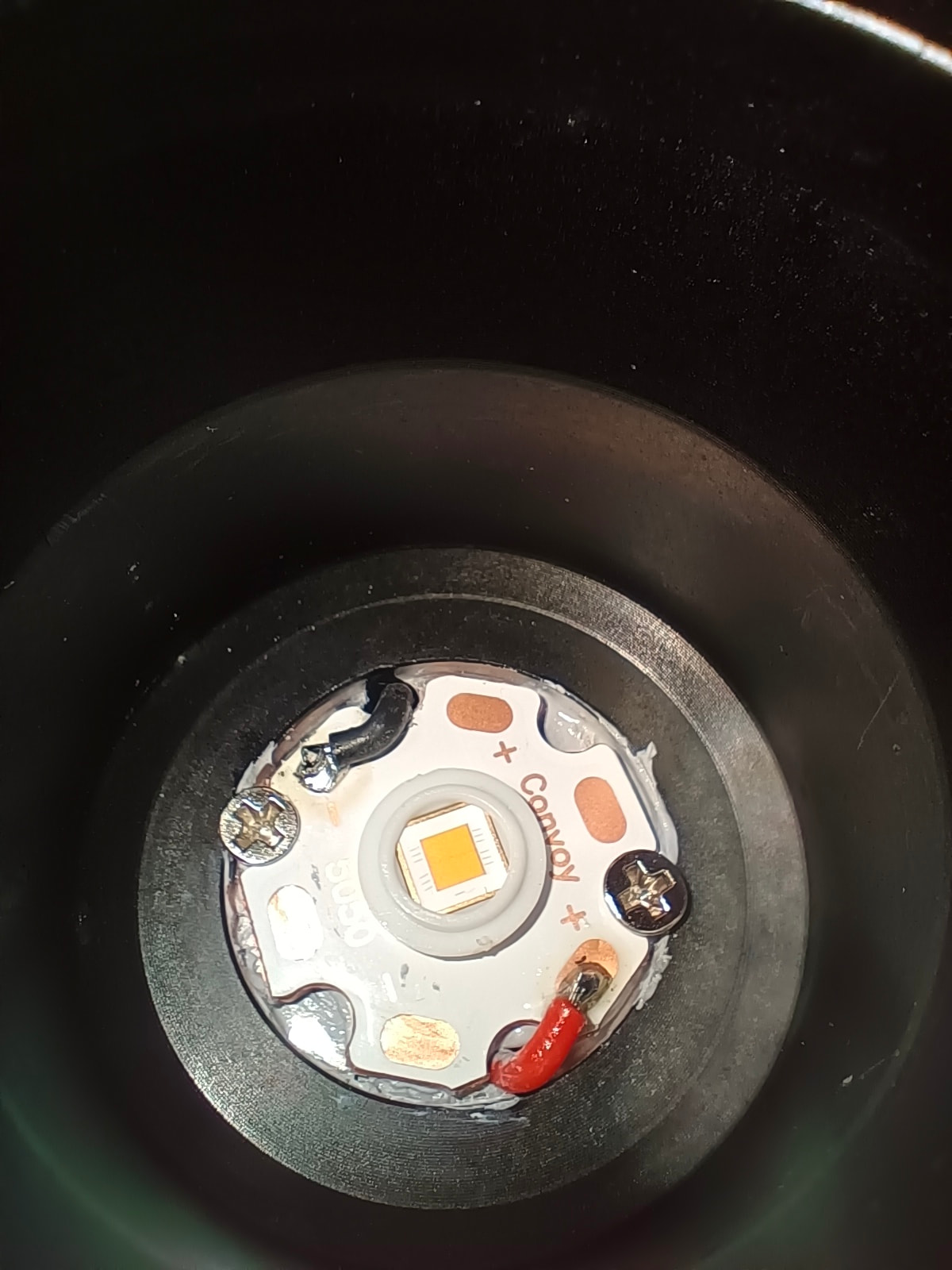
Mission accomplished!
at last I changed the gasket as the white one was too thick.
Thanks everyone!
Quite warm, this SFT70!
Good job. I like how you covered the emitter for soldering.
Absolutely well done.
I personally would have used al lot more solder the positive wire to fill the whole pad.
But this would mainly be a ascetically preference and has no practical effect.
And In genus idea to cover the LED for soldering
I forgot to ask…how did you like using the soldering tip @INeedMoreLumens suggested?
I use that same tip for a vast majority of my soldering. It works great reaching down into deep heads like the C8 etc.
Thanks, I used the white gasket that was slightly rised above the emitter, and the sticker that was sealing the rosin flux (Chinese, European representative in Poland – Polen). I used that because it wasn’t very sticky and figured it would have been less of a pain to remove it.
Thanks, me too, but as I didn’t find a method in which I could keep the wire pushed down with what I had, I had to push it down myself, and couldn’t add solder. I tried to do it on the negative wire, and of course, it came off.
Absolutely brilliant! The only thing being, if the tip was less angled and even more flat, it would have been better in this application, as the depth of the C8 head* wasn’t really compatible. Certainly much better than a pointy tip, though. I think it will remain on the soldering iron most of the tines, now!
:::::::::::::::::::::::::::::::::::::
*I am not convinced that. the C8 uses an integrated head: the silver drilled base where the LED MCPCB sits, seems to be screwed on from behind, being threaded outside to screw on the head, and inside to have the locking ring put on once the driver is in. Effectively, being a screwed-on pill.
:::::::::::::::::::::::::::::::::::::
I am really grateful to you all:
@six7
@savagemann
@Boaz
@SammysHP
@INeedMoreLumens
@QReciprocity42
@gravelmonkey
@delphi
@Toaster79
@Dc38
The soldering has always been something so frustrating, every time I looked online the usage of flux was totally missing, and of course I was just doing blobs of solder running away and not sticking.
Now I feel I overcame that mental blockage, and I will train more.
Today I am going to solder the cables of the bicycles, as I dislike a lot the ferrules. I will also start soldering all the electricity wires when working in the house, not to have ends as in a copper brush that it is impossible to fit in a connector.
I will finally be able to build RC battery packs out of the two lawnmowers batteries that have a broken card. They are 42 18650 cells!
As they have tabs spot welded on, I will use those as much as I can and I will solder on the tabs only.
One thing with soldering you learn with time is, how you can use two hands to substitute at least two additional hands. 
Be careful what you do. In many situations soldering wires isn’t allowed, depending on the type of connector, especially when screwed (solder will deform/creep under pressure and the wire comes loose). Modern connectors with spring contacts are more tolerant, but soldering is still not recommended. Depending on what you do, also check the standards for what is allowed and what not.
Ferrules are usually the easiest way of taming stranded wires and also the most reliable with a proper crimping tool (which will apply exactly the required pressure). Again, some types of connectors are not compatible with ferrules and work best with bare strands or some only with solid wire.
Soldering is something of an art. There are a million different ways to do it, and many people will claim, “You have to do it a certain way.” But a lot of these rules can be bent or even broken if you understand where they come from.
Don’t listen too much to that—find the way that works for you. It might not be the fastest or most efficient method, but if the results are good, who cares? Especially if you’re doing this as a hobby.
If you allow yourself to be a bit wasteful with solder, it can actually make it easier to get better results. For example, it’s generally not recommended to reheat existing solder joints.
I use a technique where I pre-tin wires and the MPCB with “lots” of solder, then let gravity and the capillary action of the soldering tip help remove the excess while feeding in fresh solder.
This way, I can indirectly control the temperature of the solder pool surface by continuously feeding and melting new solder, keeping it as cool as possible. I also use flux-core solder, so I’m constantly introducing fresh flux.
All of this helps keep oxidation on the solder joint surface to a minimum (basically none), while still maintaining good contact with the copper base material underneath. You can end up with a beautifully shiny layer of solder covered in flux on the PCB.
For the cable, you can do something similar.
If both sides of the joint are prepared like this, you can basically “weld” them together in a second or so—quick in and out—while adding minimal or no additional solder when making the actual joint.
And you don’t have to hold the cables awkwardly for a long time while the insulation melts and you burn your fingers.
But in the end, don’t just listen to me—try it yourself. It’s a matter of practice. Find a way that works for you and gives you a good balance between an enjoyable process and solid results.
@elstellino You gave me a good idea with how you covered the emitter. I have a bunch of LED gaskets on hand. I am going to modify one of each type to use as covers specifically for soldering mcpcb wires.
I’ll probably use little scrap pieces of plastic, or thin fiberglass material and glue it over the top, essentially making a cover for the emitter. The fiberglass sheet may be a good option. I have some that is very thin. I think .2mm and can be cut with scissors.
Let me know how soldering bicycle cable end works out. I tried years ago and gave up, but that was before I had decent soldering equipment.
my plan to solder wire was for then putting them in this sort of connector:
Ferrules for bicycles, it’s another story, and once you take one off, the cable is often ruined; if you need to remove or replace whatever is attached to it (usually a derailleur or a brake), at times it becomes necessary to also change the cable, because the stranded cable starts developing spiky rebellious wires. 
@savagemann I haven’t tried yet, had little time during the weekend. I also tried a while ago with my previous “Lötfett” flux, unsuccessfully.
I was researching though, and I read that for stainless steel another kind of flux is necessary. And you don’t just solder.
You need a silver brazing alloy and a torch, plus an acid/fluoride based or borax based flux for brazing.
But, a better solution for bicycle cables seems to be… thin (not gel) superglue! To be applied just after cutting, let it penetrate from the very tip, and that’s it!
Still have to try it myself, though.
That’s exactly the type of connector that must not be used with soldered wires. Stranded wires are not allowed either. Hell, even the whole connector is not allowed in most applications. Use Wago 221 connectors (the original or similar, there are many clones with major flaws). They are easier to use, work well with stranded wires and maintain pressure, even when the wire deforms with time.
I’ll tell you the truth, I’ve seen the screw type my entire life, they are still sold everywhere and they are really, really common over here; I saw the Wago ones just earlier when I was looking for a picture of the screw one, but I’ve never seen them in the conventional shops.
Stranded wires are the only ones sold here. I’d have a really hard time if I wanted to fit some solid wire. I’ve seen them rarely on old installations (for instance, we bought a flat for rental and half of the property is with solid wires of very thin gauge, of about 60 years ago) and they were widely used for analogical telephone landlines.
Well!
I bought this set of road/MTB cables and housings in which each end of the cable has the different cable stopper, pear shaped for road, and sideways cylinder on the other side, for MTB.
As I obviously had to cut it on size for my bike before fitting it, I thought … Well, it’s in my hand, let’s go upstairs and try.
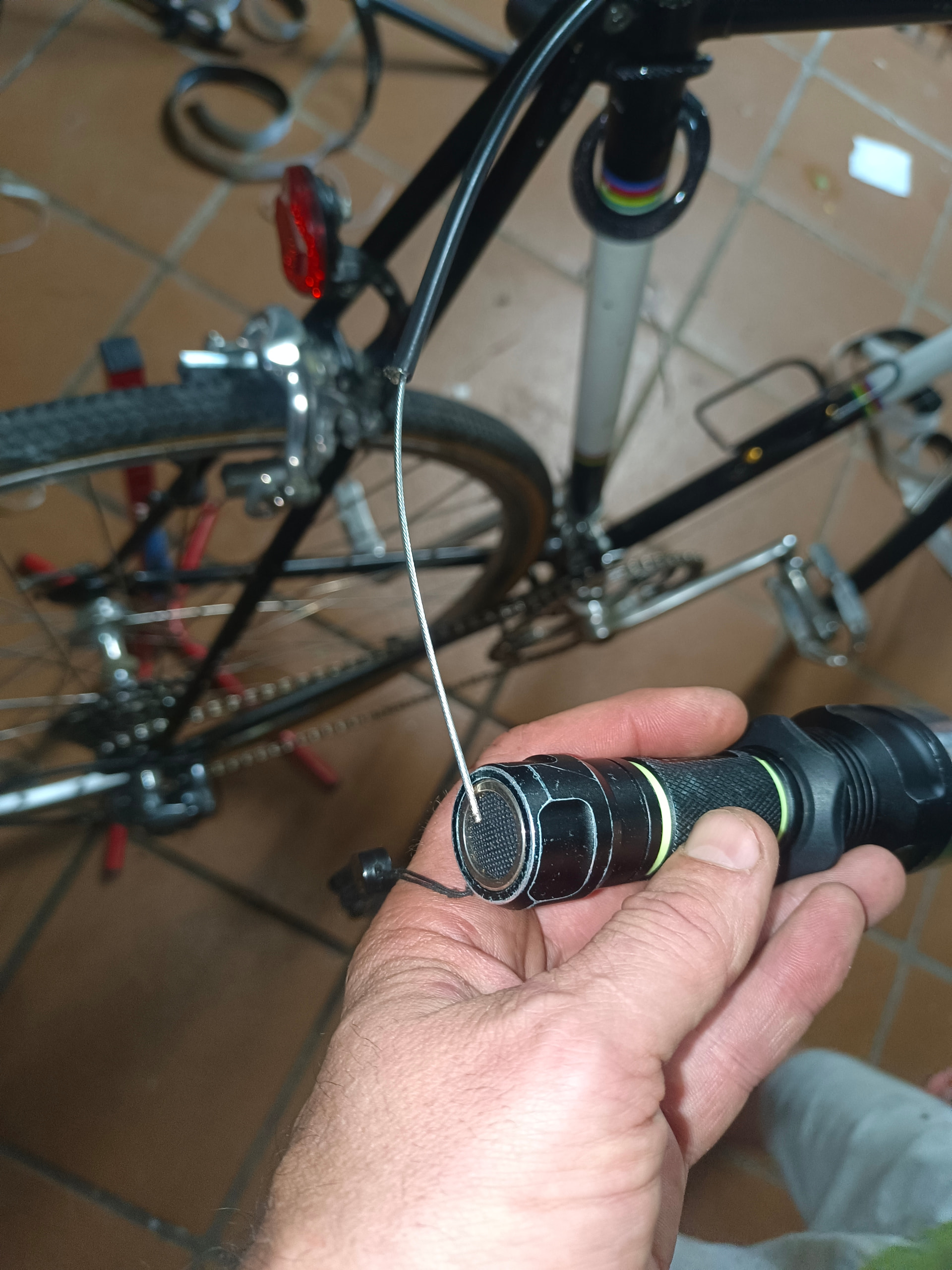
It worked! I heated up from the tip of the cut cable, and put the solder on the other side if the tip, so very close. I used abundant soldering paste, the one that I should have mentioned at the beginning of this thread, that I know is quite acidic and should work better for stainless steel. It wicked it up as if it was paper, amazing.
I don’t need to, but now I have the other cable and will do the front one too!