This should be enough to satisfy human eyes. Nobody would see the difference. Where did you get that PC Lime Djozz?
I will send some Red Green Blue Amber E17As to you when I get them.
- Clemence
This should be enough to satisfy human eyes. Nobody would see the difference. Where did you get that PC Lime Djozz?
I will send some Red Green Blue Amber E17As to you when I get them.
- Clemence
Not sure where best get the Rebel lime at the moment, I got them years ago from a portugese aquarium seller that has disappeared since. I see Ledsupply, Luxeonstar and Digikey, so all american sources. There is a Luxeon Z with the same colour as well at Digikey.
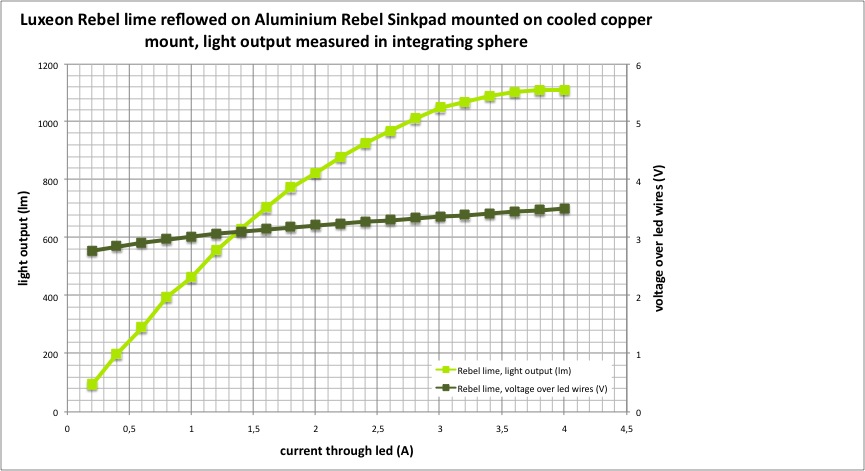
Btw, I have quite a stash (30 or so, would have to count them) of 20mm Rebel Sinkpads doing nothing, got them free from vestureofblood a few years ago. I could send them if they are suitable for your project (those Rebel lime leds put out up to 1000 lumen if needed :sunglasses: )
I see that RS-online has the Luxeon Z lime (Luxeon Z has a simple two-pad footprint, like the E21A) for more than $5 a piece, a pretty expensive led but I could order there and send them.
Thanks for the offer Djozz but let’s wait, until I get those Green E17A first. If they’re good enough then I don’t need the PC lime. Besides E17A form factor is better suited than the bigger lumileds. I think green E17A inside a yellow plastic cap (or yellow heat shrink tube) would look very close to the green-yellow firefly light to the eyes. I just noticed that my Armytek’s green switch LED looks somewhat PC lime behind it’s yellow silicone button.
- Clemence
The Luxeon Z is tiny, hardly larger than its 1x1mm die. And what I remember from European fireflies the 530nm greens do not match that colour.
(Lampyrus noctiluca: )

(being persistent here  )
)
How did you install those Luxeon Z on it? Did you ask it to carry the battery pack too?
Anyway, I just checked one of your test that I never seen before. OMD, this thing is just too small. But yes, the colour spectrum is very close to firefly.
- Clemence
Maybe you could catch the fireflies with Optisolis. Fired up the 5000 K quad at 4x100 mA without optics and it only took a minute after a fly started investigating it. Landed right on an emitter and made it its home until I turned it off…
To be honest, I have no idea if a single firefly would have enough output for measuring.
It has a hydrogen fuel cell, didn’t you notice the small hydrogen cilinder between the legs?
Ages ago I took a 555 timer and fudged about a 5-10sec period and fractional-second “on”-time, and used a 3V yellow Christmas light bulb as a firefly lure. Kindasorta worked. A bunch would flit around the yard but nobody would get too close to investigate.
They probably figured there was something hinky, and didn’t want to get too close.
Kidding Djozz. I know about the natural fuel it carries. It’s just your firefly is much greener than ours. Here’s it’s closer to green-yellow.
- Clemence
It could be your timing was spot on to their sex signal. There’s a very good documentary movie about it by the legendary Sir David Attenborough: “Lights On Earth”. Watch it for free in YouTube. Firefly also one tricky creature which can fool other male to get the female by sending false beacon.
- Clemence
From what I understood, the “fittest” males were those who could stay lit the longest, like who could hold a note the longest. The females would be attracted to the long-lighters, and the would-be bugs would go without.
So I set it for something like ¾sec or so.
At some point, I wanted to mod it and ended up cooking the 555. Still got it somewhere, but it doesn’t work. Just a “rat’s nest” thing, bend the pins from the 555 straight-out, solder the resistors and cap right to the pins.
Toykeeper has in her Andúril Firmware random modes: Thunderstorm and candle light.
Maybe you can tinker with the values?
Let’s wait until the project gets real. Oftentimes, the clients asked me their impulsive wants. Toykeeper and Loneoceans are two names I have in mind, both of them have this “random” mode driver.
- Clemence
I think these LEDs are an excellent fit for horticultural LED grow lights. Judging by the spectrum, it’s a pity the company is so exclusive that it doesn’t want to sell its LEDs on the mass market.
Grow lights are actually mostly red and blue LEDs because those are the wavelengths plants absorb best (the exact wavelengths and ratio depends on the plant though)
It is much more efficient to only produce those specific wavelengths, as all the other wavelengths don’t contribute as much.
That’s why grow lights are not high CRI white lights, they are a mix of red and blue, making purple/pink.
You are very mistaken. Lamps with two-color spectra were recommended back in 2012–2014. Numerous studies have been published since the 1960s demonstrating that the entire light spectrum, including the green range, is important for plants. Virtually all modern grow lights are built around white LEDs.
Moreover, today it is recommended to use LEDs with the widest possible spectrum and a high color rendering index.
Yes the other wavelengths contribute to growth, but not as much as red or blue. Therefore from an efficiency perspective, considering watts of energy consumed by a lamp, you get more plant growth per watt using only red or blue because the other wavelengths contribute less.
When you have a facility consuming several megawatts of energy for lighting, you only want to use what is most efficient.
Full spectrum is still used in some stages of plant growth because it is good in certain phases, but not in all. You can look at YouTube videos of hydroponic plants and massive buildings used for automated growing, they have some full spectrum lights, for certain types of plants or growth stages, but usually only red and blue is used for the majority of the cycle.
https://academic.oup.com/insilicoplants/article/6/1/diae008/7688906
The use of only the red and blue spectral ranges is possible only in greenhouses with abundant natural sunlight, or in setups where plants are grown during the early stages of development, for example for seedling production or plant propagation. Beyond these applications, the use of lamps with only red and blue spectra is essentially no longer relevant. No plant can develop properly under blue and red light alone.
The United States and Israel are among the leaders in medical cannabis cultivation. Neither relies on two-spectrum grow lights; instead, they generally use fixtures based on white-light LEDs.
Moreover, Seoul Semiconductor, together with several universities, conducted extensive research and concluded that their SunLike LED series is well suited for plant lighting due to its broad spectral distribution: Seoul Semiconductor SunLike LED Grow Light Review
That is why I mentioned that Nichia LEDs are also particularly well suited for plant lighting — their spectrum contains a significant amount of 660 nm red light.
These new grow buildings are actually designed to block all natural light completely because sunlight introduces variation in plant growth as some receive more or less sunlight and grow faster or slower than other plants depending on location in the facility, outdoor weather, season, etc.
The goal is to have all the plants grow at the exact same speed and harvest at the exact same time, that means removing all uncontrolled variables.

And yes the nichia LEDs have a significant amount of red, but also all other wavelengths like yellow, green, violet, etc. which is why their efficiency per watt is so low compared to a pure red or pure blue led.