I wonder if someone has done calculations on the amount of radiative cooling. One needs to keep in mind that at the same time a light dissipates heat as thermal radiation, it is also receiving heat from the environment in the same way. The question is how much the power difference is between heat out and heat in.
A naive but still useful first cut on radiative cooling may be simply using Stefan-Boltzmann approximation.
For instance: a small object with high emissivity in thermal IR at 50°C in a 25°C room will be net radiating out to a tune of 150 W/m². Outdoors with clear sky and an idealised setup that should be even higher as the radiative temperature of surrounding will be lower than ambient air.
To compare it with convective cooling contributions, the simplest could be the Newton’s law of cooling with the object at const. temperature. This translates to the difference between object-air temperature multiplied by a constant. The constant varies pretty wildly, ranging from less than 5 in still air to some 10 times as much if you assume air is forced to move at reasonable speed (not fan cooling but walking and moving your hand or head in air).
All in all it’s probably reasonable to assume that radiation is on par with convection and may dominate when the flashlight isn’t moving much.
@ebastler may be right to point out that shiny copper may be advantageous in conducting heat away from the source to the surface but detrimental in shedding it further to the surroundings.
1 Thank
Very nice ideas!
Would you show me how the calculation is done? It’s not obvious to me how to input the ambient temperature in the Stefan-Boltzmann law and arrive at the net power.
I believe that the first-order approximation of net radiative flux from (or to) a small object can be done as follows:
If an object is at temperature T (in Kelvins) and it’s surface has emissivity ε, it should radiate out ε×σ×T⁴, where σ is the Stefan Boltzmann constant.
As you pointed out, the object also absorbs radiation from surroundings, but at lower rate and at longer wavelengths since T∞ is lower. If the absorptivity is the same as emissivity (common) it also should follow Stefan-Boltzmann law, just in the other direction. The net should be
ε×σ×(T⁴-T∞⁴)
Depending on the choice of ε (high in IR for most coatings, but low for polished metals) that should result in some 100-200 W/m² net out for an anodised flashlight at 50°C in a surrounding of 25°C.
Outdoors with clear sky the T∞ may be quite a bit lower than the transparent air temperature resulting in a higher rate of cooling, but that’s theoretical mostly as you hold the flashlight and it sees all objects around it not just sky.
These are napkin calculations, but my point is that radiation may be not negligible and consequently polished copper may not be that helpful in heat dissipation.
1 Thank
Thank you very much for explaining your calculations! 100-200W/m^2 is indeed nontrivial.
I wonder what a good way to estimate surface area of a light would be. Intuitively, small surface textures such as knurling contribute a lot to surface area but very little to cooling, so the “surface area” we should use for calculations should not be the literal surface area.
For all I know - true. Radiative flux is normal to local surface, so with knurling the area and thus the total net radiation out should be a little larger. But with deep knurlings or fins, the extra surfaces may see each other and cancel out, so the effective area increase may be even less.
2 Thanks
I wonder how the copper cooling actually performs, notwithstanding the heat flow back of the envelope calculations above?
For instance, the Convoy T6 is offered in Al and also Ti-Cu versions. Lots of people have them I understand. Is there a meaningful difference between them heat-management wise?
I just want to add one unsolicited reflection to the heat transfer discussion: I think that the radiative cooling contributions may rise rapidly as the light gets hotter since the radiative flux out depends on the 4th power of temperature while convection probably varies linearly.
But there may be another aspect of it that I discovered. While highly polished copper has very low emissivity in thermal IR range, it appears that a clear coating on it may increase it by more than an order of magnitude, bringing it much closer to anodised aluminium.
I don’t really know, but aren’t copper Convoys lacquered? (I think I recall people complaining about it as it cheapened the looks, but it may make sense heat-mgmt wise).
2 Thanks
Rapidly compared to linear, but still much slower than exponential, in the sense that as temperature increases, the proportional contribution of +1K raise in temperature approaches zero, rather than staying constant in the exponential case. In the 40-100 degC regime (313-373K), each 1K raise in temperature increases the emission by less than 1.3%; going from 40 to 100 degC–slightly warm to instant burn injury–barely doubles the emission.
Very interesting to see that the lacquer has such high emissivity! It’s unclear how much it affects conductivity–it needs to conduct heat from the copper to the surface before being able to emit it. There exist radiative cooling paints that convert heat to a wavelength of IR that escapes directly to space without atmospheric reflection of absorption; might be interesting to coat a light in one.
I think that this may be negligible - the coatings on metals are probably a few tens of μm thick and have little thermal mass.
It looks like the the copperhead of Convoy T6 Cu-Ti is indeed clear coated - good idea.
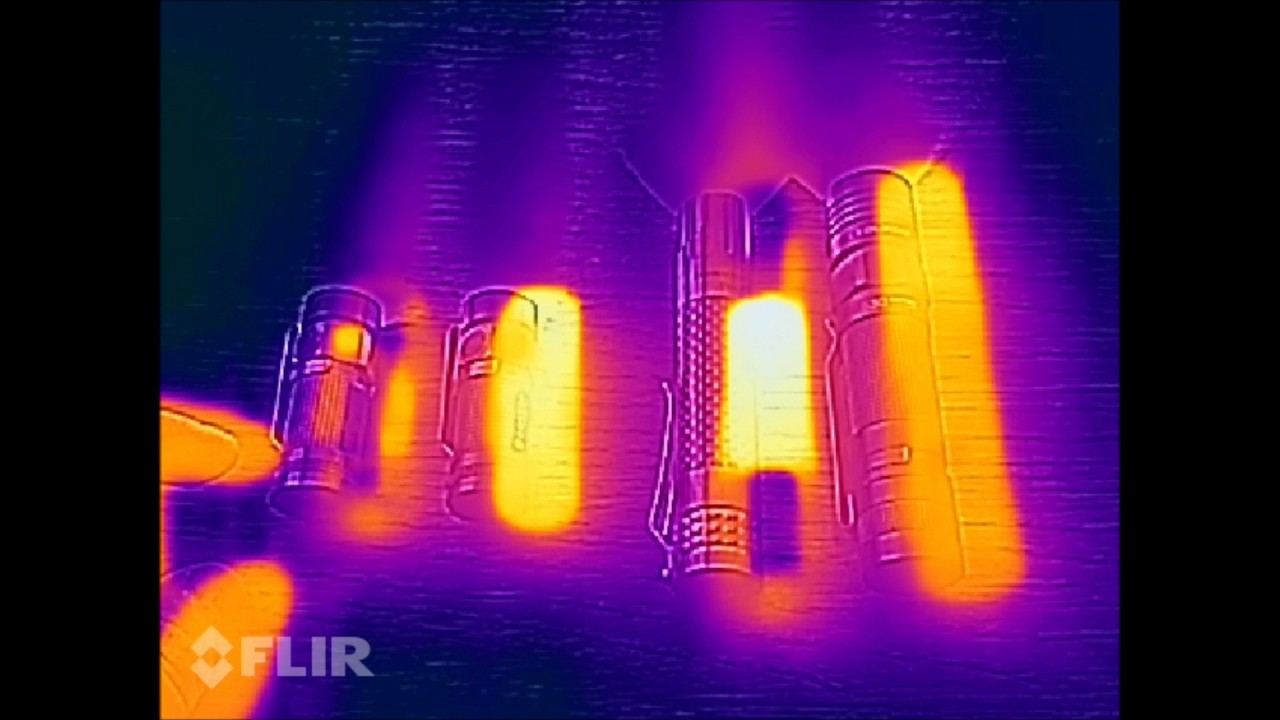
A video trying to compare heat management of copper and alu flashlights. Not sure how to interpret it yet, especially the copper Lumintop, or the wisdom of its design, however it does it.
p.s. I just looked it up the Lumintop and the tube is covered by some polymer reinforced with fibre, but I don’t know if it’s a veneer on top of Cu tube or some other construction?
p.s s. I have a hypothesis (which does not agree with the author commenting on the middle being hotter when touching the flashlight). FLIR cameras deduce surface temperature from object’s emittance in 8-12 μm range, assuming some common (high) emissivity, probably not far from that of carbon fibre plastic veneer on middle tube. But if the copper ends are bare and polished, their emittance is very low and FLIR reports them as colder even if they are the same or hotter. It looks to me that the whole flashlight got hot including the middle.
I also found a similar past discussion, reaching similar conclusions:
A FET is a field-effect transistor used by the driver to control the LED current through pulse-width modulation (PWM). This means the transistor acts like a switch (it turns on and off very quickly, unnoticed by the eye). It’s one of the cheapest drivers and therefore has low efficiency. Why? Because the LED consumes excess voltage, and in high-power modes, there’s no constant current regulation (hence PWM).
The advantage is that it allows the flashlight to reach high brightness levels, but it will gradually decrease as the battery voltage decreases (inefficient regulation).
3V/6A indicates the driver’s output voltage and current. This means the output power will be 18W for both drivers (DCCD and FET). However, the DCCD driver will maintain constant brightness because it can sustain the current supplied to the LED, unlike the FET driver, where you’ll see a rapid decrease in brightness.
Why does the FET driver’s voltage drop so quickly, but not the DCCD driver’s? Because the FET driver consumes the battery voltage until it is depleted (it has no regulation), with the resulting current surge to compensate for the power. In contrast, in the DCCD driver, even though the battery voltage continues to drop, the current will remain constant and stable until the battery is depleted, providing a sustained brightness level for longer.
1 Thank
A few items that still puzzle me:
If I understand correctly, a FET driver simulates a direct-drive (i.e., driverless) circuit with a switch that operates at very high frequency to achieve PWM dimming. If this is indeed the case, a FET driver is actually as efficient as a driver can hope to be, since it does not perform any sort of conversion or burn excess voltage.
Most FET-driver lights are inefficient as a system because most LEDs are very inefficient in the high-current regime, which a FET driver often achieves due to lack of current limiting. However, if you were to pair a very power-hungry LED (e.g., LHP73B) with a battery that is incapable of pushing the LED to its limit (e.g., a high capacity 18650), a FET driver would be quite efficient, though not so healthy for the battery. Similarly, a very high Vf LED (e.g., old XPL-HI) also does not achieve its maximum current with most batteries, and can be reasonably efficient with a FET driver.
This confuses me a great deal: since FET drivers are not current-regulated/limited at all, it makes no sense to Convoy to specify “3V 6A FET”. My guess is that either the 6A is an empirically measured maximum based on specific LED/battery combinations, or that the driver is actually a FET-based linear driver.
Convoy does not seem to specify whether the constant current driver is a buck driver or linear driver; however, since the product photo does not show an inductor, one can safely assume that it is a linear driver that simply burns off excess voltage.
This simply describes what is observed, but does not explain why it happens. I think I can attempt to illustrate why a linear driver appears to sustain maximum output for longer. Below in red is a constant-current (5A) discharge curve for a 18650:

Let’s say that a linear driver is driving an LED with Vf = 3.2V at 5A. What the driver does is simply burn off the excess voltage over 3.2V as heat, with the output curve outlined in blue. The blue curve has constant current and constant voltage for the most of its run, hence the perception of constant brightness. The area between the red and blue curves–a significant proportion of a battery’s stored energy–is wasted; this wastage becomes increasingly severe at lower drive levels due to the lower Vf, and thus the greater Vf gap that is burnt off.
On the other hand, a FET driver’s output curve would be more akin to the original red curve, but slightly dominated by it due to voltage sag of the cell at higher current. Nothing is burnt off as heat at the driver.
Thus, at any given battery level, a FET driver is more efficient, and produces more output, than a linear driver–in this regard, FET is strictly better than linear. This is also precisely the problem: by being more powerful at any given battery level, it depletes the battery more quickly; thus, if one looks at at any given moment in time rather than any given battery level, the FET driver’s advantage disappears.
1 Thank
It’s a puzzle to me as well. Not sure, but I think maybe @Simon_Mao lists 3V 6A in the wrong section, FET driver. It’s a Buck 3V 6A driver and should be in the Constant Currert driver section?
Also, SST40 is 3V 6A in CC section, and 3V 8A in FET section. Confusing to a non-technical person (me) because I normally don’t see voltage/current designation for a FET driver. Would appreciate an explantion.
From convoylight listing of S21E:

All extremely good questions, and ones that Simon should clarify! Please feel free to post your inquiries in the main Convoy thread.
Under the listing for S21E drivers, the non-Anduril 3V driver’s photo does not feature an inductor, so it’s probably linear rather than buck.
As a sidenote, I dislike the term “constant current” because it does not distinguish between linear and buck/boost drivers. It also does not specify whether the constant current is drawn at the LED (true for both linear/buck/boost drivers) or at the battery (true only for linear–a boost/buck driver consumes more current at the battery near the end).
2 Thanks
Correct.
3V/6A indicates nominal values. The LED is designed to operate on 3V directly. The complete circuit—MOSFET, leads, springs, and wires—allows for a typical maximum of 6A with a good Li-Ion battery (4.2V). The value is not fixed due to battery composition, temperature, and tolerances. Therefore, it can vary by ±10% to ±20%.
Although there is no active control, there is a natural limit imposed by the sum of internal resistances.
Therefore, 6A is the expected current under nominal conditions, not because the driver regulates it.
It’s worth stressing: Convoy and most other flashlight makers don’t build linear FET drivers (those would require a MOSFET operating in its ohmic region as a variable resistor, generating a lot of heat). They’re simply using the MOSFET as a low-resistance switch (saturation region) and possibly PWM’ing it for low modes.
That is, it’s a direct FET. The MOSFET works as a saturated (on/off) switch with very low Rds(on). It doesn’t dissipate energy or regulate; it only limits the total internal resistance.
This is believable. I think it is poor practice to give this rating without specifying its empirical nature. When better cells and lower Vf emitters become available in the future, these drivers could prove disastrous for some combinations, and I think the 519A is already approaching that.
Would you explain to me how you arrived at this? I am not knowledgeable about electronics, and have been under the impression that the previous generation of Convoy’s 5A drivers are FET-based linear drivers, designed in response to high 7135 failure rates.
There are also empirical observations suggestive of this impression: since FET drivers deliver instantaneously the peak current regardless of the drive mode, the tint of any emitter should be most unchanged throughout the entire range of modes. However, there is a very noticeable tint shift with certain emitters (e.g., 519A, SST20, Osrams) going from low to medium to turbo on the old 5A driver. Furthermore, my phone camera easily picks up PWM with a pure FET driver from Mtn, but does not detect any from Convoy’s old 5A driver, even with the fastest shutter speed.
I really wish someone would test Convoy’s drivers to figure out their architecture and confirm the efficiency claims. There’s evidence suggesting that the latest T3 drivers on NiMH are quite a bit less efficient than the previous 4-mode T2 driver…
Great discussion - a question, I hope related: if the driver is FET + PWM, and the LED needs fairly low Vf say some 3-3.4V like 519a even on Turbo, how is the fresh Li ion voltage reduced even before the PWM is involved?
I thought “constant current” just meant it was constant over a short period, i.e. didn’t use PWM. Are you sure it also excludes boost/buck?