Alien Covenant because I still like the first two movies and I thought “come on, how bad can it be?”.
Yes. Yes, it can. 
Alien Covenant because I still like the first two movies and I thought “come on, how bad can it be?”.
Yes. Yes, it can.
I know, but I got a good laugh out of it 
Still, I would gladly rewatch any Alien movie rather than go see the new Ant Man.
The Black Stallion. Kid & black stallion shipwrecked on a deserted island. Saying anything more would be spoiler. Tense ‘Oh no! What if…?’ ending. Worth the watch, especially if one is a horse lover.
slmjim
Operation Fortune: Ruse de Guerre (2023)
(a Guy Ritchie movie that was supposed to release last March.)
The rumor is that originally this film had bad-guys who were unambiguously Ukrainian. Naturally those references were removed–I’d love to know what else was removed and if any scenes were re-shot because this film seems to be missing something.
This movie isn’t bad. It’s a mediocre Guy Richie action movie which means it is still about 5 times better than most non-franchise action movies coming out. The action is still shot well, and there were some good laughs to be had. This film just felt more predictable and more generic that the best work I’ve scene from this Director/Writer.
The main cast was mostly great, although I thought Josh Hartnett’s character should have been written and/or played differently. He was just so unambiguously lame that I didn’t care what was happening much when he was the focal point of a scene.
I was curious to see what Aubrey Plaza would be like in a Guy Richie film and I was disappointed–she basically just acts like a modified version of her Parks and Rec character. I don’t really know what I expected lol. (I don’t blame her, they probably hired her for her schtick)
I liked Bugzy Malone in the movie, but he doesn’t have a lot to do. Not sure if it was a struggle to extract good performances or if his character was always intended to be so ancillary. Maybe he interacted a lot with the previously-Ukranians 
Cary Elwes did a great job and felt like he belonged in his role.
Jason Statham was Stathaming the shit out of things again and that never fails to please. 
Curious to see how I like this one on a rewatch about a year from now.
We saw All Quiet On The Western Front last night.
It was NOT quiet, so that title is a bit daft. It was basically just them shoving the horrors of 1918 warfare in your face for over two hours, which I more or less expected. They tried to make the characters distinct and memorable, but it wasn’t done as effectively as it was in a war movie like Saving Private Ryan. This was just an OK movie for its genre. Not more, not less. I’ll never watch it again, but I don’t regret seeing it once.
Not sure what you mean by the first two movies? If you mean Alien & Aliens, then yes, but there’s still a few more in-between. I felt that Prometheus was well worth it, however Alien: Covenant as a sequel to it was a disappointment.
Yes, I meant Alien & Aliens. Both fantastic movies in their own way.
Did not like Alien³ at all. Alien Resurrection was a little bit more bearable to me. Hated Prometheus and Covenant for the scripts, I felt the stories made very little sense. All IMHO, of course.
I saw Night of the Creeps (1986).
This movie is bad.
It’s a horror comedy, but none of the jokes are even remotely funny.
The acting is generally pretty bad.
The music is decent.
The third act is better than the first two, but the movie is still terrible.
The movie is not very entertaining, but at least it isn’t boring.
Ikiru (1952)
Ikiru (“To Live”) is the story of Kanji Watanabe, a 30-year City Hall employee in a large city who began his career with drive and passion, but has for many years simply become another cog in the machine of a large bureaucracy that accomplishes little except to promote the careers of the elected officials at the top of the city government. Watanabe spends day after day stamping documents and avoiding taking any action that might upset the routine of all of the city government employees, which consists of sending citizens with complaints and requests for government action to the other departments in City Hall.
One day, however, Watanabe receives an alarming diagnosis from his doctor - he has a terminal illness and less than a year to live. This knowledge causes Watanabe to take his first days off in 30 years, dumbfounding his co-workers, as he is determined to experience life in many ways for the first time. He meets a stranger in a bar who, upon hearing Watanabe’s drunken confession that he has a terminal illness and does not know how to begin living a real life, volunteers to show him the night-life of the town. The man escorts Watanabe to various gin joints, dance parlors, and street parties, where they get drunk, dance with women, and eat good food. Watanabe finds that he can’t stomach the food and drink, due to his illness, and soon realizes that he is seeking more than just thrills and fun for himself - he needs a purpose. Only after sending several days going out on the town with a young woman from City Hall (who first seeks him out only so he can stamp an official form authorizing her to quit her job) does Watanabe realize that he needs to accomplish something significant before he dies. He decides to help a group of women who have long-petitioned the city government for a small park to be built on a seeping sewage spill.
This movie proceeds at a pace that might seem slow for viewers accustomed to the pace of recent movies made in the west, but the wait through the scenes of Watanabe enjoying the company of others on the town and persistently toiling to convince, cajole and badger city officials to approve the park project pays off at the end, when the final scenes detail the discussion by Watanabe’s co-workers and family at his wake. Only then do we see that director Akira Kurosawa had more in mind than simply showing us a portrait of a man who finds a reason for living only when he realizes he has not long to live. We also see clearly that each of the people who thought they knew Watanabe well only knew him from their own perspective, and that there were many facets and qualities of his personality and his life that only others knew or recognized during his life. Although Ikiru has many qualities of an older movie, the basic messages are still as relevant today as they were when the movie was released, and the presentation, acting and direction are all timeless.
The script for this movie was in part inspired by Leo Tolstoy’s novella “The Death of Ivan Ilyich.” Steven Spielberg admires Ikiru enough that, in 2003, his company DreamWorks announced that it would remake it with Tom Hanks starring, a script by Richard Price, and direction by Jim Sheridan - but the movie was never produced. However, in late 2022, a remake titled “Living” was released, starring Bill Nighy. I will look forward to seeing the new version with Nighy, but there are good reasons why this is a classic movie, and why Kurosawa considered this movie his greatest work. Highly recommended.

I’m in the process of acquiring a bunch of foreign films.
Ikiru (1952) is one of them, but I haven’t seen it yet. 
Good choice. For a more recent movie, I also recommend “Youth,” with Michael Caine, Harvey Keitel, Paul Dano, Rachel Weicz and Jane Fonda. It’s a “foreign” (to those of us in the USA) film by director Paolo Sorrentino, but it’s all in English dialog so it’s very accessible to native English speakers.
Other classics that you might have already seen: La Dolce Vita, Nights of Cabiria, Z, Solaris (1972 version), Bicycle Thieves, and The Leopard. I’d add also The Third Man and The Remains of the Day, also, if you can get them and haven’t seen them yet.
I saw Turbo Kid (2015).
This movie is not very good.
It was made for CA$60,000 and it shows.
It’s like a very low budget Mad Max movie, and not in a good way.
Instead of everyone driving really cool motor vehicles, they ride bikes.
Yep, it’s a movie where adults ride bikes, and it is not impressive in the least.
The acting is okay.
The music is pretty good.
The plot and script are pretty lame.
Parts of the movie are quite violent, and the violence is not done very well.
The movie is not very entertaining.
I mean, considering the very tight budget, it’s not surprising that the movie isn’t all that great.
Sometimes I like low budget movies, but not this one.
John Wick 4 (2023)
JW4 continues the series’ tradition of top-notch fight choreography, stunts, and camera work. The proverbial shark is dizzy from being jumped so many times at this point, but it doesn’t matter. The comic-book-esque character of Wick is still a treat to watch thanks to top-notch production qualities and the satisfying world-building.
For pure action entertainment I give this movie two thumbs up.
Some small disappointments:
Again, my disappointments were small. I think this is a worthy entry into the series as long as you can live with it shedding the last vestiges of believability in favor of spectacle. (Let’s face it, JW3 was already 80% of the way there.)
I’ll be adding the 4k Bluray to my collection for sure.
That’s an interesting review - I have been curious about the impressions of people who have seen #4, given all the hype ad the length of the movie. My personal view is that the three I’ve seen are completely untethered from reality, even laughably so at times, but I know many are enamored of the “world-building” in the series and find it at least somewhat believable. I admit that I am a bit jaded about certain aspects of the story and how they draw the main character, given that in my younger days I was deep into martial arts.
I just watch them when they are free on television to see the references to other well-known movies that are sprinkled into them (like the reference to the Tuco gun-building scene in the Good, The Bad, and the Ugly that was in JW3) and to see the creative aspects of the camera work, stunt work, and other technical aspects of how they put them together.
Each entry in the series has been less realistic than the last. In terms of action movies my realism bar is pretty low. I mostly mean that the stunts are practical and/or avoid breaking the laws of physics too much. No entry before JW4 has broken the laws of physics so flagrantly or so often. I think they just had a lot of cool stunt ideas they wanted to cram into this entry.
World-building doesn’t necessarily have to include great depth for me to label it good. For me it is more about giving the viewer a cohesive sense of place. There are a lot of modern movies where various locations are supposedly visited but it never feels like that is the case. The Wick series is good about establishing shots while also adding in details (visual or conceptual) that sell the idea that this is a different world with it’s own rules.
I do think that most martial arts schools are scams designed to lure in people with 0 athletic ability to pay membership fees in the false hope that they will become brick-breaking machines. That being said, CQC is a real thing that is practiced and taught so I guess I am able to suspend my disbelief enough to entertain the idea that someone might attain Wick’s level of mastery. (especially in the cranked up world of the series) Ever see the movie Equilibrium? Compared to that movie suspension of disbelief for Wick is easy lol
I think the series is for people who just want to see good stunt work again so your reasons for watching check out. I also loved that Dollars “trilogy” reference.
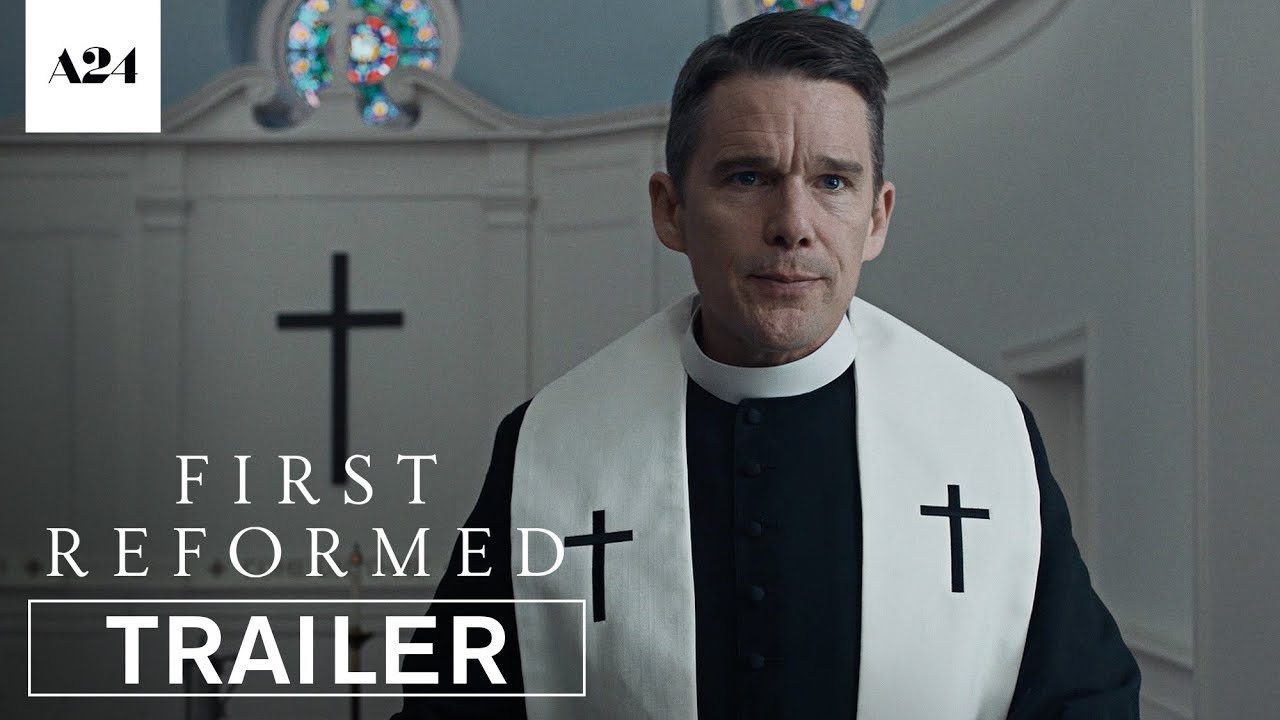
First Reformed (2017)
Paul Schrader’s somber “First Reformed” can be interpreted and experienced on more than one level, as there is more than one layer of meaning to be gleaned from the movie by the observant viewer. On the one hand, the movie is a character study of Reverend Ernst Toller, a conservative Reformed Church minister presiding over the historic wooden, white church where he gives monotonal sermons in a hushed voice to a dwindling gaggle of regulars, while reporting to the church’s owner - a large, modern mega-church with uplifting decor and uplifting music, with cheerful sermons given by a minister who wears tailored suits rather than the traditional black robe donned by Reverend Toller. Toller is sick - very sick - although he refuses to discuss his health with even those in his life who care about him, including an ex-lover whom he rebuffs rudely and repeatedly as she entreats him to allow her to help him, and the Reverend in control of the mega-church who sternly tells Toller he needs to stop the drinking he has taken up recently and address his health in order to be an effective leader and component of the larger enterprise.
Toller is to give the introductory sermon at an event celebrating the 250th Anniversary of his historic church that was once a stop in the Underground Railroad. He is conflicted over his participation in the big event, however, as it will be hosted by the major benefactor of the mega-church that owns his own church - a large manufacturing corporation in the area that Toller knows is a major polluter in the area. When Toller is asked by the wife of a young, new couple in his congregation to counsel her husband, who is an environmentalist depressed enough about the condition of the planet and the prospects for improvement that he wants his wife to end her pregnancy rather than subject their child to the world they live in, Toller’s doubts about his association with the business world, and the compromises required of him, and his apparent unhappiness at his own station in life, build to a crescendo that provokes him to consider drastic action.
So, the movie is obviously about Rev. Toller’s personal struggles in figuring out how to deal with the situation he is in personally and professionally, but it is also about the conflict between moral and behavioral purity and the less-pure demands of the real world where people are employed and have to physically live their lives. Everyone must make decisions every day about whether to compromise one or another of their ideals. In reality, most of us carry on without even thinking of the choices we make every day that affect other people and the planet, and the future of people on the planet. We don’t agonize over these decisions, we just act according to the norms of our social environment, the behaviors that were inculcated into us growing up, and the necessities of our economic situation and the demands of others. Rev. Toller is someone who spends a lot of time measuring himself, and others, against the biblical standards of God as he understands them, and he is much more rigid than most about judging himself and others according to those standards. Of course, in today’s world, when you combine a fundamentalist mindset about the proper standards of behavior with a man who feels he has failed to live up to them himself, due to being divorced and failing in his relationships, you get a very unhappy person who becomes increasingly desperate to reconcile what he believes with what is actually required of him in the real world and what he needs as a human being of flesh and blood. And when such a person begins to question some aspects of his life, he or she can begin to question his or her fundamental beliefs in a way that can shake them to the core.
Paul Schrader has addressed these serious themes before, in previous movies he has written and/or directed, such as Taxi Driver and The Last Temptation of Christ, as well as Blue Collar. As in his other movies, Schrader suggests that the conflict between moral purity and the realities of a less-than-perfect world can lead either to saintly, altruistic behavior that can destroy its proponent, or to anti-social, violent behavior as one lashes out at an evil society. Here, too, we see a man struggling to decide how to lead his life, when he realizes that he is as lost and unsure of himself as the congregants who come to him for help and to whom he imparts aphorisms meant to guide them to a better place in life that he himself has come to fear may not in reality exist.
No doubt Schrader sees Rev. Toller in himself, as it is well-known that the writer/director grew up in a Reformed Church household in Michigan, where his parents warned him that going to the movies was a sin that would destroy him. Schrader has recounted the story of how he became sick when he drove into town by himself and first entered a movie theater out of terrified curiosity. Schrader has fought his own battles with chemical dependency and violent, anti-social behavior toward others and toward himself, and you can feel the real passion he put into the character and script in this portrayal of a man who is still trying to find his way in the world at middle age.
One note about the ending: if you look at how the camera moves during the last scene, and think about what other scene involved camera movement like that one, you will realize that what appears to happen at the end is not what is actually happening. The scene makes a lot more sense, in terms of the characters and story as we know them, if you keep that in mind. Highly recommended.
That’s why I learned Kenpo from people on the sparring circuit, rather than in a commercial school.
Oh I wasn’t trying to say anything about your own training. I thought I had gathered from your post that your time with martial arts had led you to dismiss them entirely. Seems I read your post too quickly and misunderstood your meaning.
No harm done at all. Yeah, I really enjoyed martial arts, but the demands of school and work, as well as health issues, prevented me from continuing.