I wanted to buy a headlamp for night running, hiking, and light trekking, while also being suitable for everyday use. I’ve tried both Fenix HL18R-T V2.0 (HL18) and Nitecore UT27 MCT 2025 (UT27) headlamps, and here is my grain of salt.
Both headlamps come with a lithium battery, and they can also be powered by three AAA batteries, which is convenient if you want to swap in spare batteries. They both feel comfortable and stable when wearing, and offer 5-year warrant in my place.
The HL18’s strengths are its build quality—it feels noticeably more solid—larger battery capacity, and simpler, more intuitive operation. The headlamp has a charging port, so you don’t need to open the case to charge the battery every time. Its drawbacks are a lower CRI (especially for white light) and a heavier weight (103.6 g by my own measurement).
The UT27’s advantages are its three-color temperature settings, higher CRI, and much lighter weight (74.5 g vs. 103.6 g, both with battery and headband). The UT27 also produces a wider and more even flood beam, while the HL18’s beam is slightly more focused (its floodlight is still usable). Its drawbacks include a thinner and softer body and bracket maybe due to the lighter design, and its tilt mechanism is less solid than the HL18’s (though the lamp is light enough that it doesn’t wobble much when running). It lacks a 5-lumen candlelight mode. Charging requires opening the case (you can still charge without removing the battery, and the UT27 can be used normally in all modes during charging). More functions mean slightly more complex operation, so it may take some time to memorize them. Previous UT27 versions had issues with headband brackets breaking, but this version is reportedly reinforced and improved.
Weight breakdown:
- HL18: 45.9 g (body), 79.3 g (plus lithium battery), 103.6 g (plus headband)
- UT27: 34.6 g (body), 60.2 g (plus lithium battery), 74.5 g (plus headband)
I also used a lux meter in a dark room to measure brightness over the first 15 minutes on Turbo and High modes (room temperature ~24 °C). The relationship between illuminance and light output is linear. Assuming the initial brightness reaches the rated output in the manuals, the approximate light output curves over time are as shown in the figure. This is just a rough qualitative test, but I noticed that the UT27’s curve doesn’t match the manual very well (yes, I’m aware the manual uses a non-linear scale).
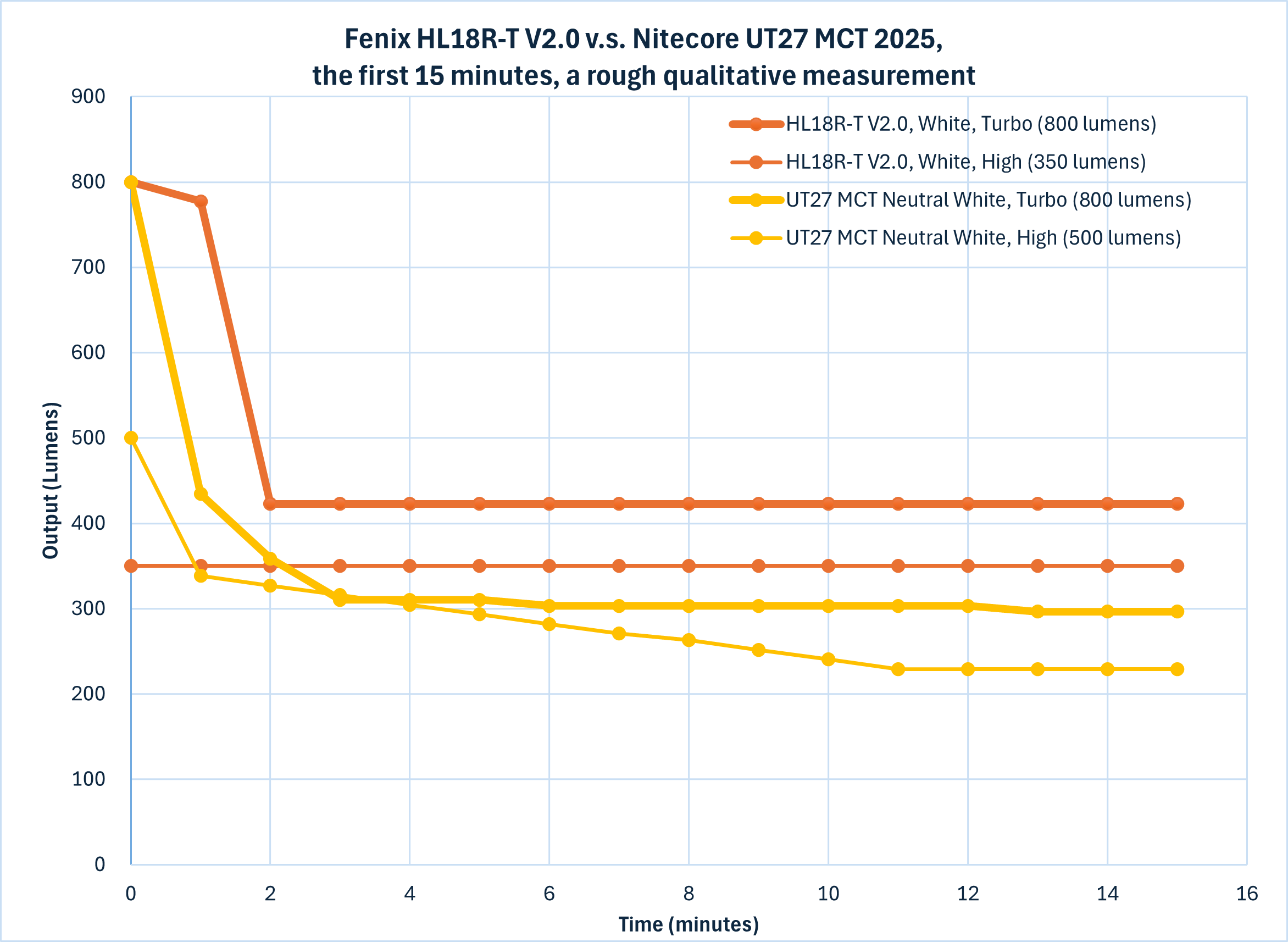
In the end, I decided to keep the HL18R-T V2.0 for its relatively stable output and more reassuring build quality.