Adapting, adopting, complementing — what’s your strategy?

I was contemplating various strategies we can use to achieve, what we want from our flashlights.

  • Adapting is anything that changes the looks, characteristics or functions of the stock gear, for instance:

    • UI programming (if possible)
    • dedoming/swapping the emitters
    • change of optics (SMO↔OP↔TIR↔diffusion)
    • installation/removal of magnet
    • change of clip
    • change of driver
    • etc
  • Adopting is — in principle — the opposite of adapting: keep the gear as-is but figure out how best to benefit from it and potentially untapping its hidden potential. For instance:

    • Separate memory for each of the channels (flood, spot, flood+spot, red) in Sofirn HS21
    • Many lights get back from Turbo to the previously used mode instead of going Off, upon clicking the switch.
  • Complementing is a way to obtain the desired set of functions from more than one flashlight, instead of insisting to get them from one piece of gear.

  • Theoretical / empirical. The above can be applied:

    • when contemplating/choosing the gear for purchase
    • after purchase

What is your usual/preferred strategy (or mix of strategies)?
1 Thank

I like this writeup. Logical, concise, precise.

The first thing I usually do is to adopt something. If I need to, then I adapt it, and if that fails, then complement.

That being said, I will theoretically “use” the stuff before buying it, unless it checks a bunch of stuff off the bat, like the d3aa and kr1aa. I think it’s safe to say that many of us here adopt with intent to adapt, and most of those end up complementing the others.

In practice: I wanted a primary light to hold at least 50 lumens of decent throw (4klux) of high cri for a full standard work shift on a full charge, i.e. 8-12 hours. A modded (i.e. adapted) Novatac 120T (adopted for this purpose) spits out 70ish lumens for at least 10 hours on a 16650. Because it MIGHT fall short due to partial drain of intermittent use elsewhere, I needed a secondary light with more “in the field” variability in brightness while remaining high cri, and had a floodier beam to complement the relative throwiness of the primary, (which is ironic, as this one gets used more often due to its features), enter the d3aa or kr1aa. Adopted for its features, the only adaptations were to put a magnetic carabiner, and customise the switch ring/button to make it dimmer and look nicer.

Finally, the last complement is essentially a combo of all three, the kechain lights. The d3aa was essentially already the ultimate mashup of runtime, variable brightness, and fuel adaptability, but a tiny light or two I wouldn’t mind giving away would be convenient…olights i3e and imini2/ultra. I don’t need super cockroach runtime, but it would be nice to extend the runtime to at least 3× for each of those, as 3 hours should be an ample extension of luminance for me to get to or set up safety if my other lights have died.

I also carry a spare cell and some steel wool for some primitive lighting as a last resort.

And if ALL of that fails, I carry a little light of sorts, it’s warm and comforting, and offers solace and peace in times of extreme struggle. Iykyk.

2 Thanks

Great stuff. Thanks for sharing. I’ve enjoyed it immensely. There are different needs and different ways of addressing them. The journey is as important as the outcome. Contemplating, experiencing it as well as and learning from others is important part of this hobby, to me.

1 Thank

I like to adapt my lights to come closer to my preferences

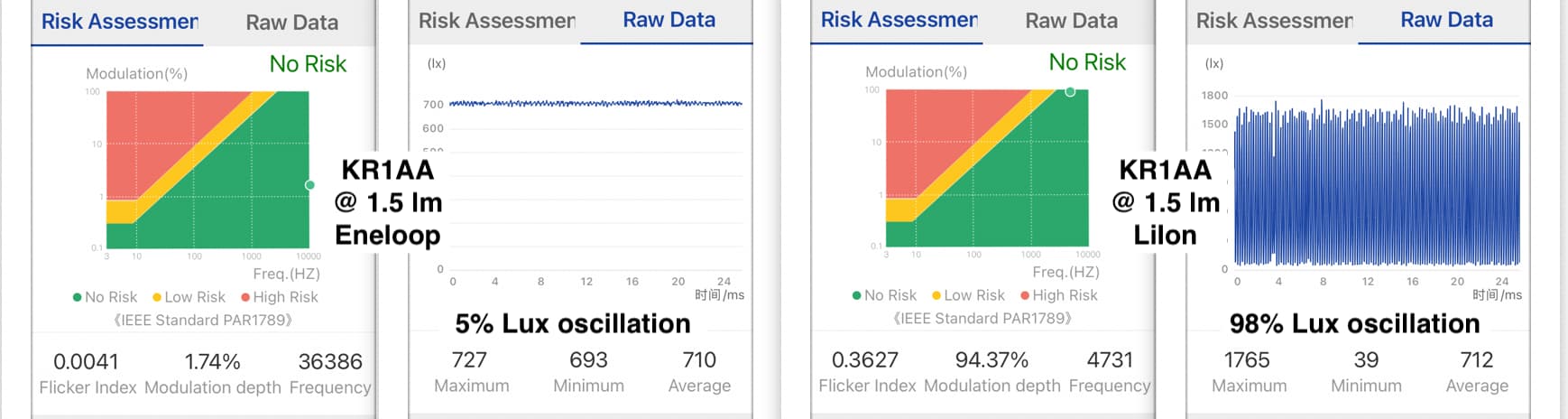
for example, I prefer lower Flicker Indexes, and lower Lux oscillation depth

I just learned I can get there by using Eneloop instead of LiIon on my KR1AA..

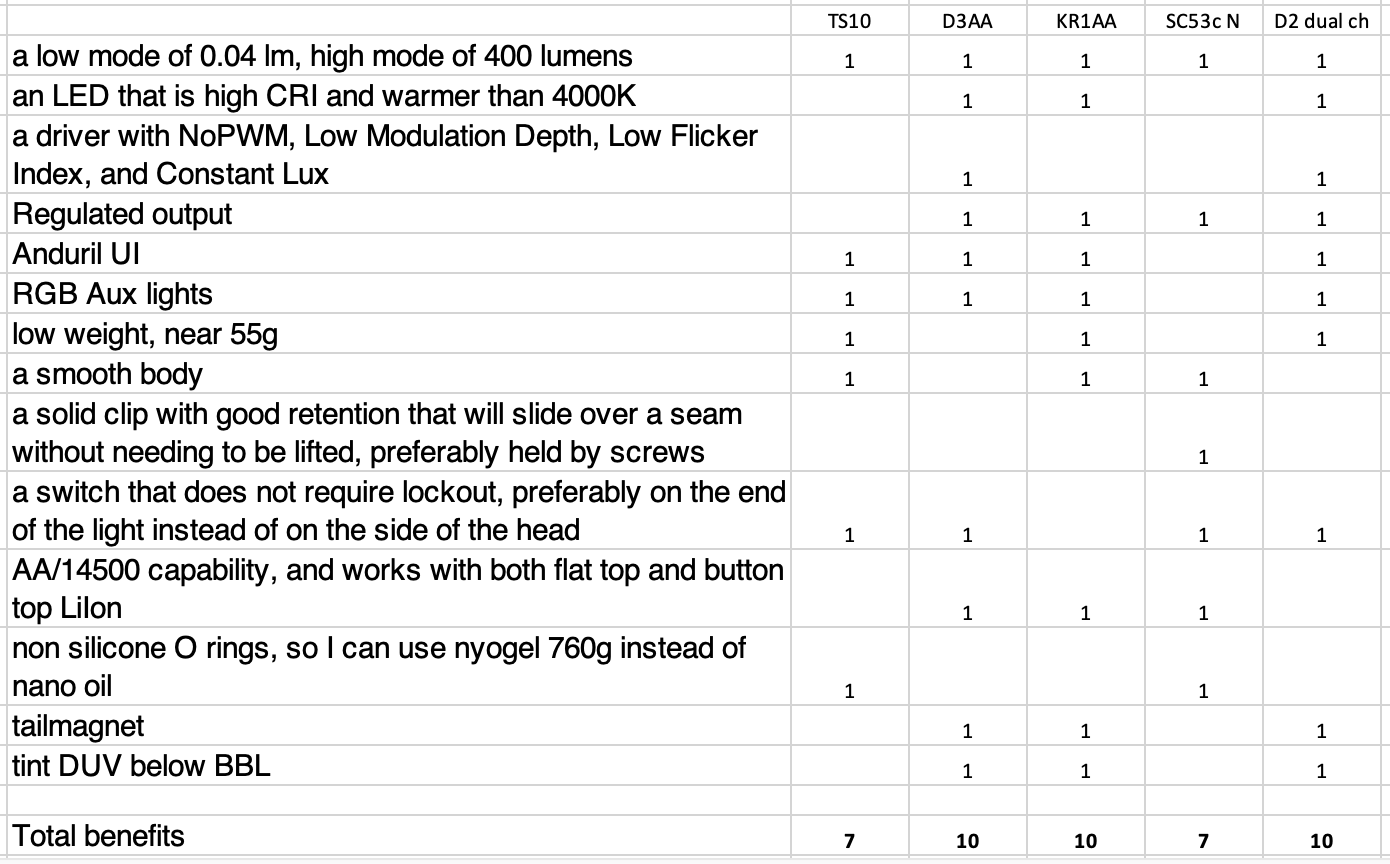
here is a list of criteria I consider when evaluating a stock light:

I recently changed the KR1AA Orings to Nitrile and lubed w Nyogel, and swapped the battery to Eneloop. This raised the score by 2 points :wink:

3 Thanks