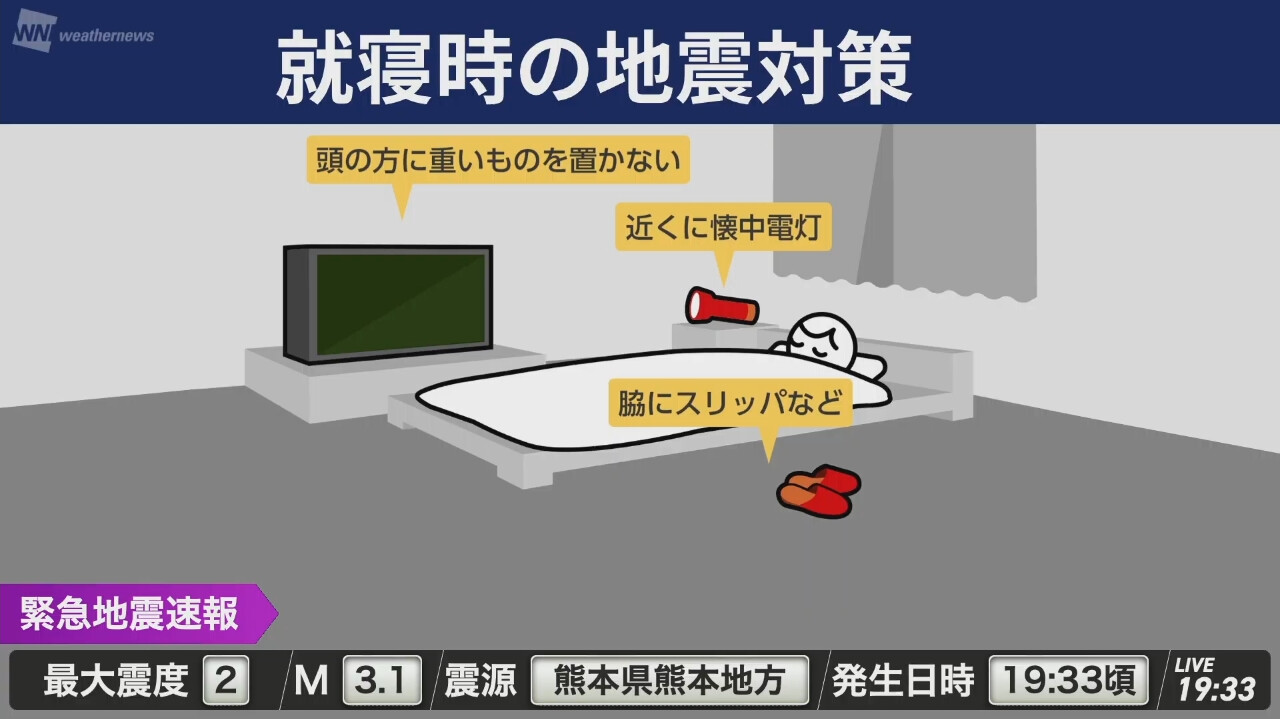
Keep heavy objects away from the head of your bed.
Keep a flashlight within arm’s reach.
Keep slippers close by for a quick escape and to protect your feet from broken glass.
New reason to buy more, unlocked.
Keep heavy objects away from the head of your bed.
Keep a flashlight within arm’s reach.
Keep slippers close by for a quick escape and to protect your feet from broken glass.
New reason to buy more, unlocked.
A flashlight stored in a way that the shaking doesn’t end up hiding it, and heavy shoes or boots within reach, if winter, make sure that you can grab a jacket in case you end up outside or if the house temperature is going to drop quickly while you search and do things in the dark.
I live in earthquake territory.
We keep go-bags packed with everything we need in case we need to rush out.
Whenever we get a small quake, that means a possibility of having a bigger one.
So my procedure is to take my shoes, wallet, keys, flashlights etc and put them by the front door, near our go-bags.
Go-bags have more substantial footwear, and clothes for all weather inside. Along with several other goodies.
That is the way to go, I always thought that a little storage shed in the backyard would also be nice, it could store some post earthquake needs and if built light to shake instead of break, it could also serve as a hard shell tent to stay in.
After Northridge (1994 California quake) some people in Big Bear were sleeping in their cars with some space between them and the house or trees, I noticed that while sleeping in a supermarket (at Northridge) parking lot aftershocks were sending some roof debris closer to my car than I had thought likely, but a little shed could hold the ice chests and bedding and tools and such.
The 1989 Loma Preita quake rocked the CA Bay Area bad. We were about 20ish miles east of SF.
We ran out the back door of our condo to see the swimming pool turn into a 6 foot tidal wave. It splashed over the 5 foot fence and landed about 20 feet away right in front of us as we were fleeing.
one flaw with the flashlight-in-drawer move — drawers shift in a quake n the light migrates to the back corner exactly when u need it lol. i keep a headlamp hung on the bedpost instead. physically can’t roll anywhere, n hands free for moving stuff or helping people.
also lithium primaries for the bedside light, not rechargeables. a li-ion cell sitting in a drawer for 2 years might be at 60% or worse the night u grab it. lithium AAs barely self-discharge, shelf life is like 10+ years. bit of glow tape on the body too so u can actually find it at 3am.
quake prep is basically 90% “can i find my stuff in the dark” anyway
@brad @savagemann Thanks for sharing your experiences!
As you mentioned, multilayered prevention is always important to ensure true readiness.
Two is one and one is none!
This is a great point.
Most of my true “emergency” flashlights are loaded with cr123 or energizer lithium AA cells.
Same goes with anything mounted on a weapon.
Energizer Ultimate Li / CR123A is definitely a safe and high-performance option. Especially for the cold weather.
Your hooked headlamp with GITD approach sounds good!
This might be a bit off-topic, but after experiencing an alkaline battery die on me in the freezing cold, I completely stopped using them, even for devices where batteries get changed regularly. Getting rid of the nightmare of corrosive leaks is a huge bonus.
Luckily, both NiMH and Li-ion have way better cold resistance, and lithium primaries work like tanks even on the coldest nights. So I’ve never experienced the same kind of darkness since then.
prep for earthquakes, hurricanes, etc. is similar.
however, earthquakes do not give you time to get ready.
in our go-bag are flash drives with essential document copies.
here is something to consider: most shelters do not allow pets
whose vaccinations cannot be verified (kennel cough, etc.)
That’s important point!