I bought a T3 a while back for glowing stuff up, but now want to produce some GITD beads in a silicone mold. The beads would be similar to the fancy ones the ladies collect and thread onto a bracelet, with the metal eyelets.
The mould takes 8 beads, and the resin cures in 2-3 mins. 365nm is apparently the best for penetration of deeper resin such as this. High wavelengths are better for surface layers like sealing polished copper from the air or wood coatings.
Anyone use a flashlight for this kind of thing? I dont really want to buy a proprietary UV curing lamp, I like the dual use of a flashlight but I’m wondering if one of the multi led cheapos would be better than the focussed beam of the T3?
Nice thing about the UV resin as opposed to the mixed is I can experiment with single beads before batch cooking
Should work just fine. I’m using S21A for similar stuff in bait making for curing UV resin and works like a charm. The more concentrated the light the faster the resin cures.
Good to know I see an advantage with the larger head size and higher output compared with the little T3. I’ll give the T3 a go, I’ve bought enough resin to get the hang of reducing bubbles, from what I read there’s a bit of a learning curve. I’m planning to use larger grit GITD sand for a sparkly effect. This is @gravelmonkey fault, he kindly sent me some glow tape plus a few of his homemade beads, They’re impressive enough for me to want to try.
Do you have the ZWB2 filter or the clear glass lens in there?
I used a 365nm UV light for curing UV resin, and the main issue is penetration. I built my own light with a quad-die 5050 emitter and 3A driver, and it still doesn’t reach the interior only 2mm deep–the problem is probably not power but wavelength. I recommend getting a 395/405nm to complement the 365, longer wavelengths tend to penetrate better.
I wouldn’t worry about ZWB2 vs clear glass, the loss is less than 20% or something. But higher wavelength would require clear glass.
For thick objects or ones with small surface-to-volume ratio, 2-part resin would be preferable to UV resin.
This is what I read too, though reversed with the 365nm penetrating and the 395nm doing the surface cure. DARKBEAM produce a dual led/dual switch torch, but it’s not something I’d want to buy.
I’ve messed around with 2 part resin before and it’s a mighty faff, getting bubbles from the mixing and the suspended ingredients settling out. I intend for the UV quick cure to overcome that, and also allow me to play with the mixture by testing it on one or two beads.
I’m inclined to believe that the source is incorrect, as it is a general phenomenon that longer wavelengths penetrate better (unless the material specifically filters longer wavelengths). UVB is stopped by the epidermis, while UVA goes through. Polycarbonate is opaque to UV, but transparent to visible light. The list goes on.
Yeah, I’ve also experienced the issue of large particles settling very quickly in 2-part epoxy, so UV is a sensible choice. I would get a S2+ in 365nm, and then get some generic 395nm flashlight on Aliexpress, or get such an LED to swap into a white light Convoy.
Not too sure, I got an AI overview from Google that goes on to say the visible light purple lights seen in nail bars are the cheaper 395nm and used for surface cure. Key word being “cheaper” I think.
Not that I’m arguing the point or anything, it’s going to be a case of try it and see.
365nm offers deeper, more thorough curing for thick resins with less visible light, ideal for professional/thick projects, while 395nm provides good surface cure and is common/affordable, great for general hobby use but has more visible purple glow and heat.
Yep, best way is to try and see. I also looked this up and am yet to see a reliable source confirming that 365nm goes deeper. Funny thing is, the first article AI linked just said 365nm goes deeper into the UV spectrum, which may be have been misinterpreted…
I’ve accidentally cured the interior of resin with just the blue light from a white LED, though the cure is only partial (it’s a jelly-like texture). So 450nm definitely penetrates better than 365nm.
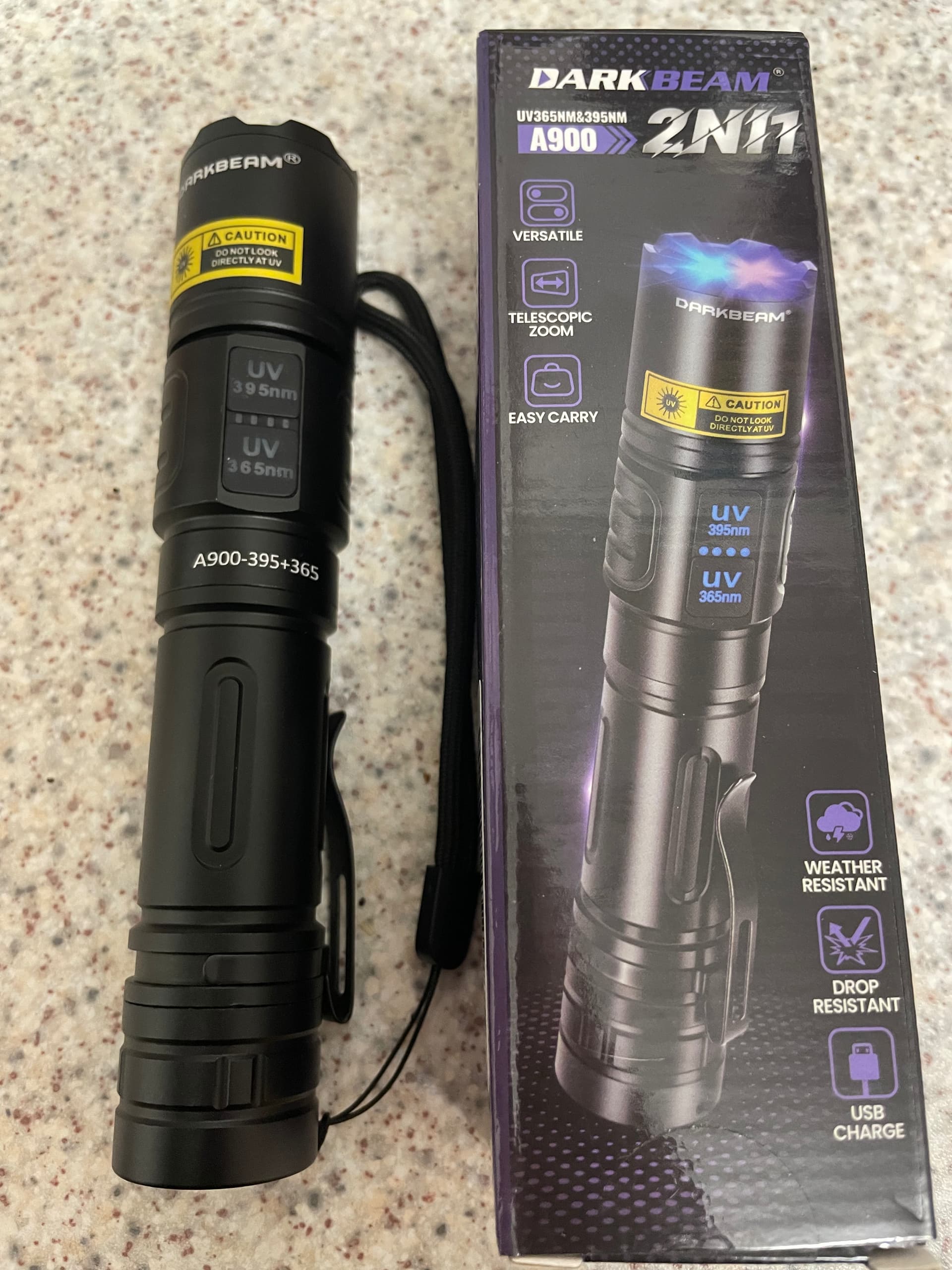
Gave up looking for a regular manufactured light with a UV and went for the one of the DARKBEAM ones Ive been seeing on Amazon and worrying theyre rubbish. This is the only light I’ve found that has both the 365nm and 395nm emitters. Its also a zoomie with aspherical lens to concentrate the beam.
What put me off was that it says it comes with a 3 x AAA battery holder and running on AAA didnt fill me with confidence regarding output. But inside is a 21700 battery, so for the £20 its pretty good value and I’m comfortable there’s plenty of light for deep resin curing.
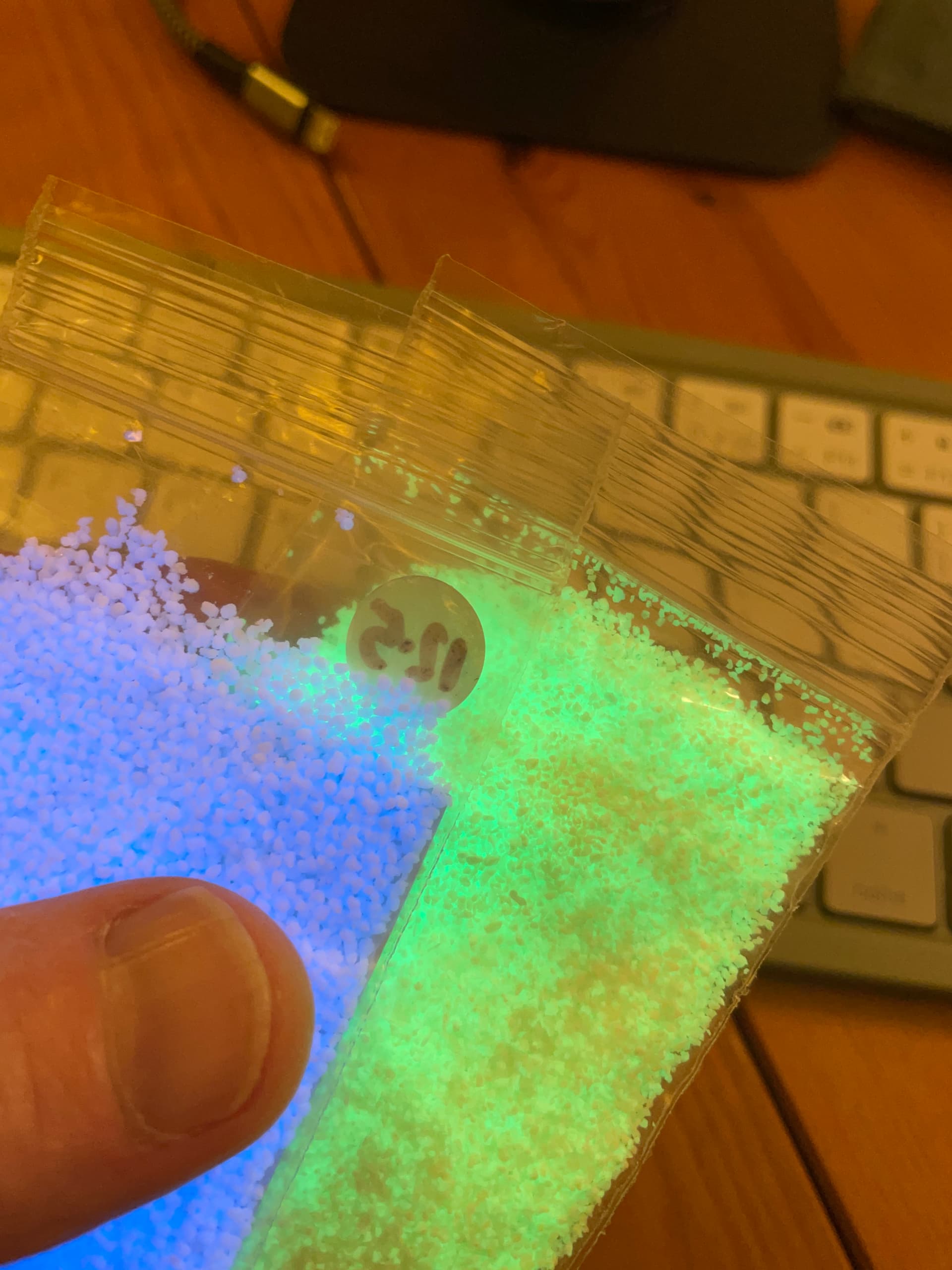
@gravelmonkey Do you use Glowtec? Quite expensive and the minimum purchase is 25 grams, but the guy there was reall helpful and not only found me some very large particle sandy glow powder that wasn’t on the website, but also split a bag of blue and green to make up 25g with two colours.
I’ve had my eye on that “stardust” material for a while, I’ll likely pick some up in the fullness of time, though I’m not yet sure what I’ll do with it.
I emailed before Christmas about this product and the guy confirmed its “solid” strontium aluminate material, not fine powder mixed with a binder or glass then crushed to c.1mm size.
Their website is a little hard to navigate.
30x larger particle size than normal glow powder would make this up to about 1mm grain size which is COARSE. One would imagine it has a very good photoluminescence.
I’ve purchased some of the green 500μm Technoglow powder when I ordered that tape; the 500μm is like a fine sand and already quite coarse. Mixing it up in 2 part epoxy was exactly as you’d imagine trying to make a 50:50 epoxy:fine sand mix would be like!
I think with the coarser “Stardust” material from Glowtec, I’d select some of the nicer shaped grains, coat them in UV resin then hand place them on the object I wanted to “enhance”.
Light looks good, let us know how you get on with curing resin in molds!
Bigger particles than that, though I’ll probably try some of that sandy grit at some point. Mike said this stuff isn’t on the website. I’ll see how it comes out, I’m hoping to see particles individually in suspension.
Happy to send you a bit of each if you want some to try?
Tried the light, now have a blob of hard resin apparently permanently attached to my finger

 I see an advantage with the larger head size and higher output compared with the little T3. I’ll give the T3 a go, I’ve bought enough resin to get the hang of reducing bubbles, from what I read there’s a bit of a learning curve. I’m planning to use larger grit GITD sand for a sparkly effect. This is