+1. The SFT-70-W is a special quad die LED with a smaller LES than the Xhp50.3 HI and can get almost as bright, but throw about 15-20% further. The fact it’s high CRI now and has decent output integrity compared to low CRI tints is also great. Fenix uses it a lot for a reason…
6 Thanks
How does an isolated driver work if either the battery or the e-switch is connected to the body tube?
In an aluminum Hank/FFL, the battery tube only contacts the spring side ground ring. It doesn’t actually pass any current through the head, because of the anodised threads. I have a quad B35AM using a standard 7070 mcpcb in a D1, with all four cathodes on the dtp, and it works without issue.
1 Thank
I don’t think I’d trust anodized threads to keep my light from catching fire… As long as the shelf is anodized, too, it’s fine as there is no friction there.
5 Thanks
Fortunately I rarely if ever need to unscrew the head. Even if the anodizing were to wear off, it wouldn’t catch fire. It just wouldn’t behave properly. I have a similar setup with four Optisolis, with the four cathodes on dtp, in an M1, and even when the metal screws were shorting the mcpcb to the shelf it still worked. I just couldn’t change modes properly.

I agree. Aside from throwing much better than the LHP531, the SFT70 3000K is the only high-power LED I’ve ever used whose blue spike+cyan dip is small enough to be unnoticeable in real use, beating even the SFT40.
Looking at the provided spectra of the NV1010 (which the LHP’s will share), the blue spike+cyan dip is much more pronounced, which means the emitter probably won’t look as nice in real use, even if it achieves comparable CRI values.
7 Thanks
Yeah, many often focus on bigger number = better… but seam to forget how flawed if not down right broken CRI is.
“When a measure becomes a target, it ceases to be a good measure”
We need to look more at the spectrum and if the light actually looks nice.
And maybe we need to look more at efficiency and less at efficacy 
Manufactures do a lot to get better efficacy number that is actually bad for light quality. like removing deep red, adding excessive green. or the spiky KSF LEDs…
7 Thanks
For the contrarians out there to debate: there is no objective standard at which an LED can be manufactured that conforms to the optimal color rendition preference for each and every single set of eyes. However, CRI is an objective standard. A specific designation of LED is a standard. A reference sample is a standard. That said, would the mfg tweak the spectral balance like an audio equalizer? How many colors would be considered? 3? 5? 7? 256 bit?
The beauty of not having a target is also its curse…no baseline!
3 Thanks
The colour-rendering index was introduced at the time when the second-generation
fluorescent lamps (deLuxe type) have been brought onto the market. At the time of developing the
compact fluorescent lamp phosphors, they have been optimised to achieve good efficacy and high
> colour rendering index, and not good visual colour rendering. Today, a major technological
breakthrough has led to a new generation of light sources based on LED technology. The emission
spectra of these is different from that of fluorescent lamps, thus optimising these to achieve a high
colour rendering index could again lead to differences between calculated and observed colour
> rendering.
There is SSI
CRI is way older than LEDs
The Standards are entirely made up. References have been selected. Not many of them… 8 to be precise.
They are all low-saturated colors.
And only one per “Hue range”
Vision is way more susceptible to color change in color context as it is to absolute color.
If all the reds look a little bit more or less saturated or more or less bright.
it’s not as obvious as if some reds look the same while other Reds “normally” look the same or very similar, all of the sudden change appearance compared to them.
think of a Apple with red and orange hues. if the whole thing looks more or less bright no big deal. but if some of the red Spot become Dark gray and some of the Orange becomes Green this would be
You would need multiple colors pigment with completely different spectral composition that appear the same under reference illumination.
and then see how they differ in saturation and hue to each other.
CRI can’t do this because there is only one color per hue range.
Another problem with the 8 colors and corresponding values per color are in no way Perceptually weighted added.
It’s like if you would want to have a Rating for how good a Car is performing.
You can give it a rating for Acceleration, top speed, handling,
But if you also give it a rating for number of cup holders, size of cup holder and maximum force the cup holder can hold.
If you Would mix all of this rating together with the same weighting it it would no longer be a good rating for how good of a car it is.
even if all of the tests are done to exactly specified objective standards.
even a camping chair could be decent car in this rating.
In short summing and averaging them together with no weighting is not useful and this is what CRI does.
No “Value below 80” would give a way better indication of actual performance then “90 on average”
So you can have many CRI 70 lights some that look ok and some that look horribly.
Even a CRI of 85 can still be a really bad light source while other can be good.
They don’t consider “colors” they the full spectrum as a continuum. then weight how much a reduction or boost of a wavelength range for a given spectra would influence the outcome.
then it’s just optimization problem. to find local maxima for whatever they optimize for.
for example
5 Thanks
AFAIK, that’s not possible. Period.
Steel, maybe. Aluminum, no.
1 Thank
@Simon_Mao I just had an idea.
The jagged bezels, but made from brass. I guess green with that matte golden bezel would look so nice, and many other colors as well.
The AI overlord says, it would looks like this:

6 Thanks
All human standards are made up, lol…I’m somewhat familiar with that stuff. It’s like how what 1kg is had to arbitrarily be established, then later defined essentially as an atomic based mass. It seems logical that human eyeballs are not only preconditioned based on genetics, but heavily influenced by the environment they observe as well. It’s like how the same person might prefer different CCT for different tasks, even though a ballpark of 3500k-5000k (right around 4500k) seems to be the preferred choice for many. However, it’s entirely possible that it’s only what we prefer based on what’s available, so we really don’t even know what that may be.
If I might tweak your car analogy…swap the cup holder bit for “braking distance”. That makes more sense as a counterpoint to engine performance as it pertains to handling as a standardized scoring…
That said, any “objective” standard we currently have is simply a reference point. Maybe I’m being pedantic, but I still don’t see how a human imitation relative to natural phenomena can possibly be seen as an “objective” standard, besides the “it is what I say it is” philosophy…
1 Thank
It’s like our eyes evolved to see sunlight and fire…
10 Thanks
Tell that to my employer who blasts 7000K overhead lighting to keep the nightshift awake. Oh and ofcourse it must occasionally flicker!
5 Thanks
Yeah, pretty much…though apparently doping the spectrum beyond what natural sunlight and fire has is somehow an objective standard…
That some of the reference colors make little sense was the point of this analogy.
But what they are measuring is clear and physically defined. 1 kg is a mass. It can be converted to any other unit of mass, and so on.
CRI, as a measure of “color rendering,” is objectively doing a bad job at predicting color rendering (except for the 8 example colors, which in no way represent the full gamut of colors).
CRI is not about preference. It’s about how accurately a pigment illuminated under a light looks compared to the same pigment illuminated under blackbody radiation or daylight.
The metric is not very good at this. It’s neither linear nor perceptually uniform, nor does it allow you to make accurate calculations.
You can’t say that a particular color pigment under a light with a CRI of 80 will have a ΔE of X.
You can’t even say whether a color will look closer to how it is supposed to look under natural light with a CRI 70 or a CRI 80 illumination.
It is entirely possible that the color looks (and measures) closer to the correct color under a light with a lower CRI.
3 Thanks
I think the whole issue with spectrometry is that it is foundationally mutually explored with spectroscopy. By definition, you can’t look at something that can’t be looked at. Hence my perpetual statement, “light”, as in EM, is everywhere. It just doesn’t “show up” until it interacts with something.
1 Thank
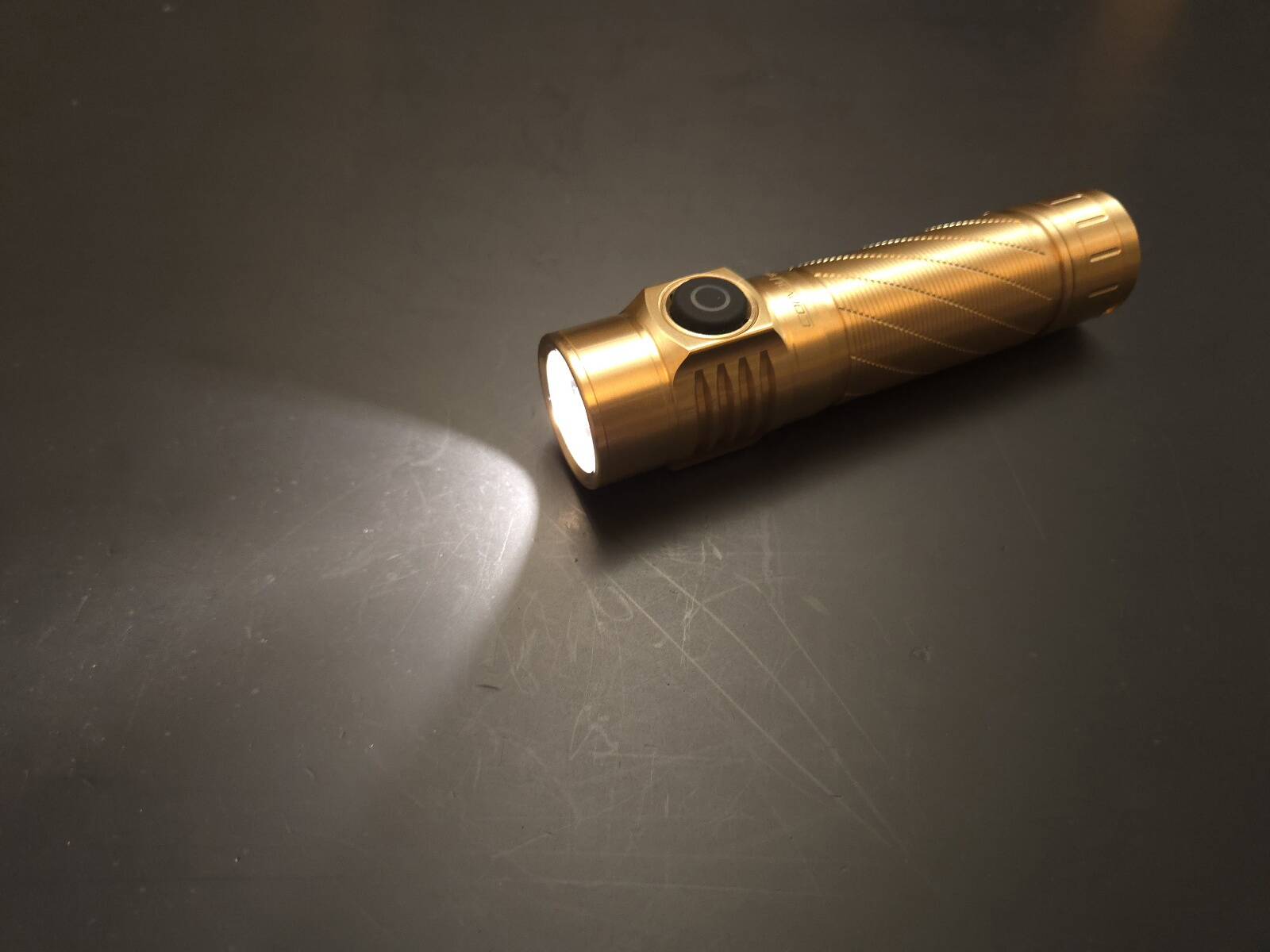
Received my S21E in brass yesterday. I really like the host but the UI on the 10a buck is not great so I’m going to order the Anduril driver. Is there a raised retaining ring for the switch available anywhere? The button sits a little too proud for my taste.
1 Thank