First off, I should mention I’m a noob and only have a surface level understanding of the hobby.
I’m trying to manufacture a device that incorporates a 365nm UV flashlight. The device host is ABS plastic, therefore temperature management is my biggest problem at the moment.
Here is where I’m at so far:
Battery: 2*4000MaH arranged in series to give 7.5V. (this cannot be changed)
Emitter: YingFeng ( HYR35G45N365KN-D1)
Driver: LM317, I believe it’s adjustable. (Due to the battery configuration it was not possible to use 7135 drivers)
Voltage: 3.4
Current: 700mA
Power(W): 2.4
MCPCB: Custom aluminium board
Peak operating temp: about 82C (five minute test)
I’m also using an aluminium orange peel reflector and ZBW2 filter.
My goal is to reduce the temperature to 70C or lower. I can do this by limiting the forward current. But that in turn limits the light output. Does anyone have any suggestions?
Would using a copper mcpcb make a big difference?
Does anyone have data on operating temps of other more efficient LEDs?
Do you think the driver is appropriate given the battery restrictions?
PS - I had idea that I could potentially take advantage of the fact that the reflector is aluminium… Maybe if it’s in contact with the mcpcb that would allow the reflector itself to aid with heat dissipation?
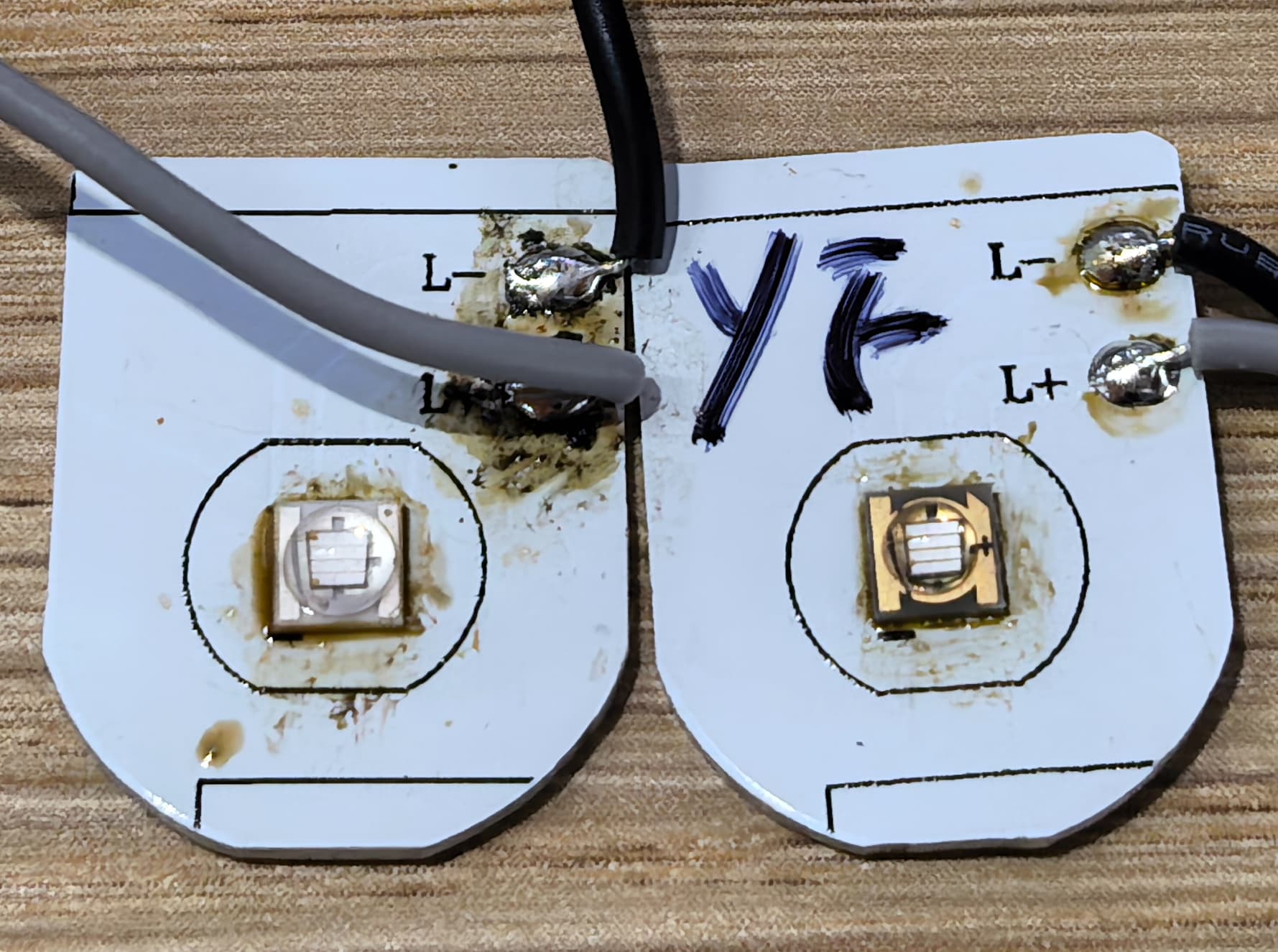
photo of the current aluminium mcpcb with the YinFeng and another really really budget emitter
The LED does not have very good power handling, so forward current can’t be too high anyways. A copper board will make a significant difference, and there must be a good thermal path from the board to the exterior of the device.
Look into Seoul CUN66A1G, which has better power handling.
Unfortunately, this doesn’t quite work because (1) there is no good thermal path between reflector and MCPCB, and (2) there is no good thermal path between reflector and the device’s exterior.
is power handling the efficiency or something else? Is it an issue at 700mA or below? or is it more relevant if you want to overdrive?
I have an air vent which moves a small amount of air across the mcpcb and reflector to the outside of the device.
Are you aware of any tests on this forum comparing aluminium to copper? I read that copper reduces hotspots on the board itself when compared to aluminium but that’s all I’ve found so far.
I will look into it but my budget is limited, so I may not be able to afford an emitter that costs more than the Seoul. (buying in bulk, 1000+ units)
at the moment no, but if I were to have the mcpcb customised I could leave some metal exposed on the front of the board and maybe use thermal paste between the board and the reflector?
There is some airflow around the reflector bringing air to the exterior.
My apologies for being unclear with terminology! By power handling I mean how much power it can take before output levels out and falls. Larger emitters (larger emitting surface and larger footprint) have better power handling, and emitters with better power handling are also more efficient given the same drive power.
Better power handling certainly benefits overdrive, and one should consider running the LED at the rated power without adequate heatsinking a form of overdrive.
There are some old Al vs Cu MCPCB tests here. Since UV emitters are less robust than white, the difference is likely to be more pronounced.
Understood! I somehow missed that you are getting emitters in bulk, in which case even small cost differences matter.
I still see 2 potential issues:
Exposed metal might lead to the + and - terminals of the LED shorting on the reflector.
Thermal paste is a liquid that becomes less viscous at higher temperatures. It is likely to flow into the reflector and destroy its surface during operation.
I would still suggest implementing a metal thermal path from the MCPCB to the exterior of the device.
Oof you’re going to need a LOT better heat dissipation. Looking at the spec for that emitter you need to have a temperature of around 50C to push 700mA through that emitter to stay withing manufacturer’s specifications.
More metal, heat path to the outside of the device. Could you have a chunk of Al with good thermal path to the outside of the light that the light engine is attached to?
@BudgetSteve THIS is probably your biggest issue if trying to use the reflector as a thermal path…(welcome back by the way)
Another idea you could try are TIR(Total Internal Reflectors) or fresnel style magnifiers. (Polarizers, even?)
You might even be able to get away with diffracting a low power UV laser(or a series of them) to cover a swathe pattern, and it might be power efficient…
**actually the UV laser idea might not be cost effective anymore…back then I paid like $15 for 8 UV laser pointers, now they’re at least $15 a piece…
If what @blwilli says is accurate (that the emitter is rated for 50C at 700mA) then I suppose I am trying to overdrive here with a target temp of 70C.
Cool to see the copper vs aluminium tests. Surprised that the material affects the brightness. It seems at lower currents the brightness does not change much.
Another comment said that aluminium stores heat better but copper transfers it better. I suppose if I’m trying to use airflow to transfer heat away, that the copper would help for that too. When talking about a tiny piece of metal I imagine aluminium reaches it’s storage limit very quickly but that’s just a guess.
I will abandon my idea of using the reflector as a heat sink due to some good points made here. I think my next steps are to reduce current to 600mA and if affordable I will try to have a copper pcb made!
Regarding a thermal path away from the pcb:
How thick would that path need to be, if I’m using copper wire for example?
Inside the device (maybe an inch from the pcb) there is a metal motor housing (unrelated to the LED). I could possibly run a copper path between the two and shed heat with the metal motor housing.
Is anyone here aware of budget emitters that might be slightly more efficient than the one I’ve been using? Some brands I’ve come across in my search are liteon, epistar and cree but I don’t know how they compare to YingFeng on price and efficiency. The data is proving hard to obtain!
Thanks @Dc38, what might a thermal path look like? Copper wire? See my recent reply about the motor housing.
I don’t think I can get into adding more components. I’ve reached my sealing on cost already because I have to manufacture 1500 of these devices out of my own pocket. Also note that this is not a thrower or spot, it’s meant for close range, about 10cm, give or take 5cm.
It needs to be decently thick, and copper wire definitely doesn’t have nearly enough cross-sectional area for this.
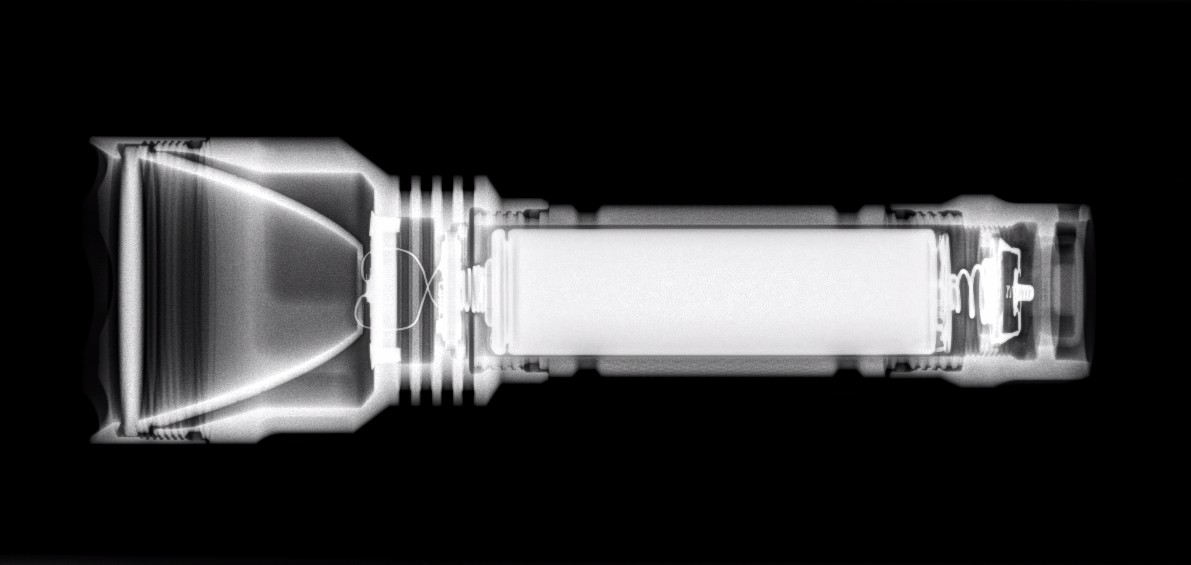
Here’s an example of a good thermal path. The MCPCB rests on a shelf that, along with the entire head of the light and heatsink fins, was machined out of a single, contiguous piece of metal. You can get away with less material due to lower power, but this is the ideal type of design.
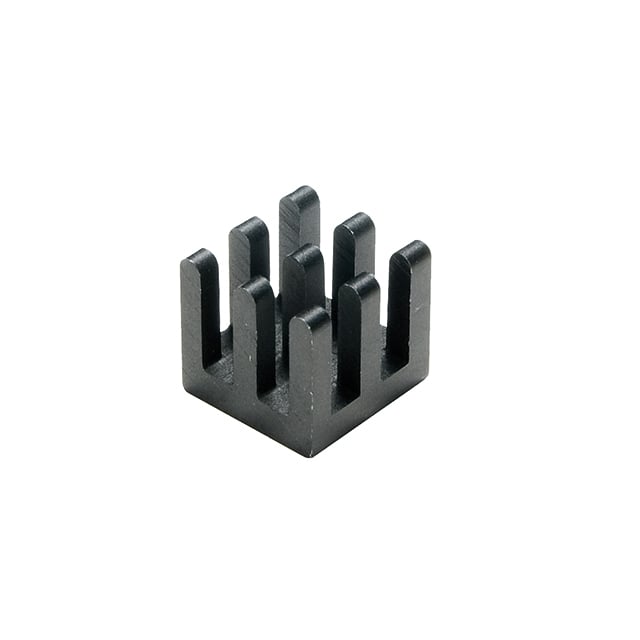
Basically what @QReciprocity42 posted…you want to get the heat outside to as much surface area as quickly as possible. Finning the conductive material helps, or you could get a standard CPU heatsink and go from there.
Copper wiring would probably not cut it unless it’s around 2/0 gauge, at which point you’d probably want to flatten it out and turn it into a lattice of sorts…think heat piping in cpu coolers. Or in the case of a contained lighting system like a flashlight, use the body as thermal mass or heatsinking.
***added: you could probably design something like a barrel shroud on a pewpew, allows passive heat to radiate/airflow, while allowing you to move it around as needed.
This would be my best bet and I’d try to channel as much airflow as possible through it. Stick a ntc against it and measure the temperature. Play with current to get it to 60°C or something like that
It’s hard to say. In the short term, probably not, but it may cause the degradation of the emitter to accelerate.
This could be a partial solution: even though there is no good thermal path to the exterior, a small heatsink adds enough thermal mass/inertia so that it takes longer time to reach a high temperature. If you put a warning to use the UV light with a duty cycle, say 1min on followed by 5min cooldown (these numbers are made up), then this is a perfectly adequate solution.
Oeuf. Never ever voltage-regulate an LED. Use a current regulator. Also, using a linear regulator to burn off more than half the supply voltage is like riding the brake and burning off more than half the power the engine puts out by cooking the brake pads and rotor.
There are boards that will efficiently step down 7.4V to ~3.6V, and a pair of 7135s could current-regulate that easily to the 3.4ishV you need.
But… why? There are so many UV lights that already spit out decent UV from spot to flood.
I build tons of those, 700ma is safe to have it enclosed on a big chunk of AL, but keep in mind Uv leds are more sensitive to heat than white so make that chunk bigger, using copper mcpcb makes a huge difference if it is a direct thermal path, your leds look like they will fit right on xp star. there are also AL stars with direct heat path, which is also ok, as long as it is not a dielectric type star with no direct thermal path.
LM317 is A TERRIBLE choice, it is a voltage regulator, you’d have to build relatively complicated circuit to regulate current and voltage, get a cc cv step down board on ebay, or amazon, and save yourself some trouble, those are around 5 bucks, very reliable, I used several dozens of them, and only had 1 fail so far.
You can use a thermal switch 55-60C NC and place it directly on same heatsink as your led, if it gets tripped your led will be around 70c, wire it to power input so it shuts the whole thing off, assuming it ever get that high. or you can have 2 of those regulators and a relay, one set to 700ma, and another to 300 or less, instead of shutting it off, relay will switch over to lower output driver.
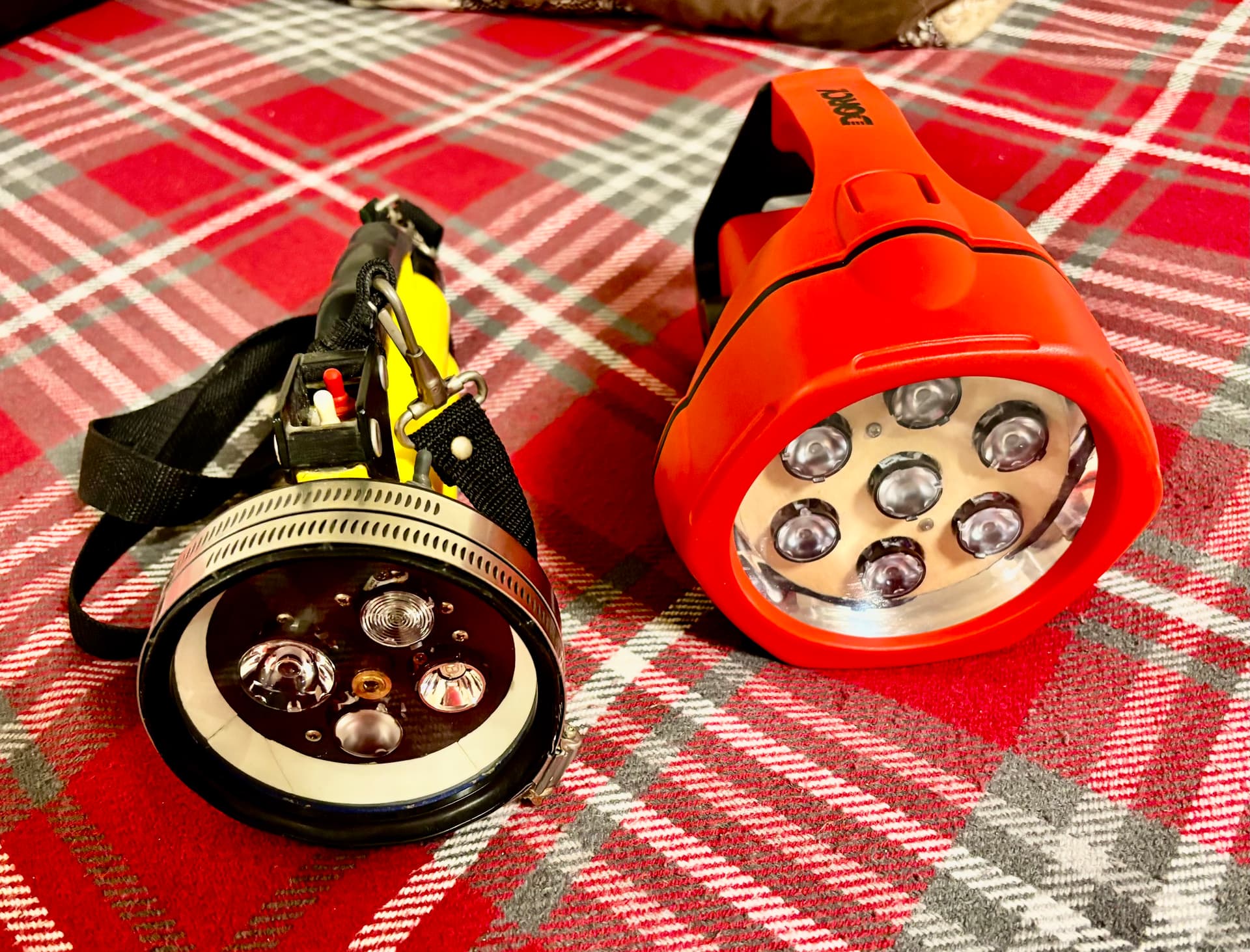
These have UV as well as other colors, yellow one i build more than 15 years ago, red one few years later, so far both work like the day I build them, all leds run at 700-800ma. they seem to show no degradation that you can see with a naked eye.
As far as optics, for uv under 400nm, you want as little as possible, for 15cm, you do not really need it at all, neither reflector nor tir. As far zbw2 filter, make sure it is for your exact wavelength, you get a wrong one, you most likely will lose output, you do not have much to begin with using 2-3watt leds .
Actually you can use metal reflector as a heatsink if done properly, it will add heat absorbing ability to star, but only if they have clear heat path. But what I see on the picture you posted it terrible, all that flux need to be removed, alcohol works best, it may not only flow, but many are acidic it may eat up insulators, and oxidize connections. and why do you have so much around leds? what solder paste do you use to reflow?
It looks like both you and @alpg88 are recommending against LM317. Would be interesting to know why voltage regulating is a bad idea.
I get what you’re saying about the linear regulation issue though.
Are there any other options that don’t include a step down board? As I am mass producing these and there are many components involved, even uping the cost of any one component by a few cents has a massive knock-on effect to the end consumer.