Low CRI/R9 LEDs have a hard time bringing out reds, so would being rosier look better by compensating for the lack of R9?
no
With Low CRI, Red things will still look more brown than Red.
I NEVER buy Low CRI lights. Unless I plan to replace the LED with High CRI.
Now that there are so many great lights that already come w 519a LEDs, there is really no reason, for me, to buy Low CRI lights.
1 Thank
I wonder if I am just not really sensitive… I have a XHP50.3 HI 3000K R70 (70 CRI, -15 R9 according to my opple) and a B35AM 3500K R9080, and I can barely see any difference between them outside of CCT unless I specifically point them at things where I already know there will be a difference, and even then it’s miniscule.
My parents have some cheapo “filament” style LED bulbs in their kitchen, with unknown CRI, and those make every food look like brown goop. But the R70 50.3 has no such issue, even food looks mostly the way I expect it to 
To see the difference it helps me to have a High CRI, High R9 light to compare when using Low CRI
For me the difference is most noticeable when illuminating things with Red content, including my skin, wood grain, and foods. This use is at relatively close range, what I call indoor distances.
otoh, Low CRI makes green plants look really nice and bright green. At outdoor distances, Low CRI is perfectly adequate to identify a Bear in the Woods. I dont really care about observing the subtle colors of its fur, eyes, or gums, when it is about the eat me… lol
Any light is better than no light, but for me, High CRI is the only way I fly. I dont spend much time using my lights outdoors, or in Bear Country, lol. Most of my use is at indoor distances and Im interested in the most full spectrum color rendering possible.
High R9 gives me more vibrant reds. Pink Tint does not accomplish that.
2 Thanks
Higher CRI/R9 is indeed better, but would CRI/R9 affect what one would perceive as optimal duv? For example, let’s say you have to choose from a continuously varying duv at 100 CRI and p CCT, and you chose that q duv is best. If then you have to make the same choice at 70 CRI at p CCT, would you still choose q duv or something lower?
I think no,
my DUV preferrence does not seem to change based on High or Low CRI.
otoh,
Does Color Temperature affect preferred DUV?:
I think yes:
at cooler color temperatures I tolerate higher DUV… sunlight has positive DUV…

at warmer color temperatures I prefer more rosy duv… campfires are more red, than yellow.
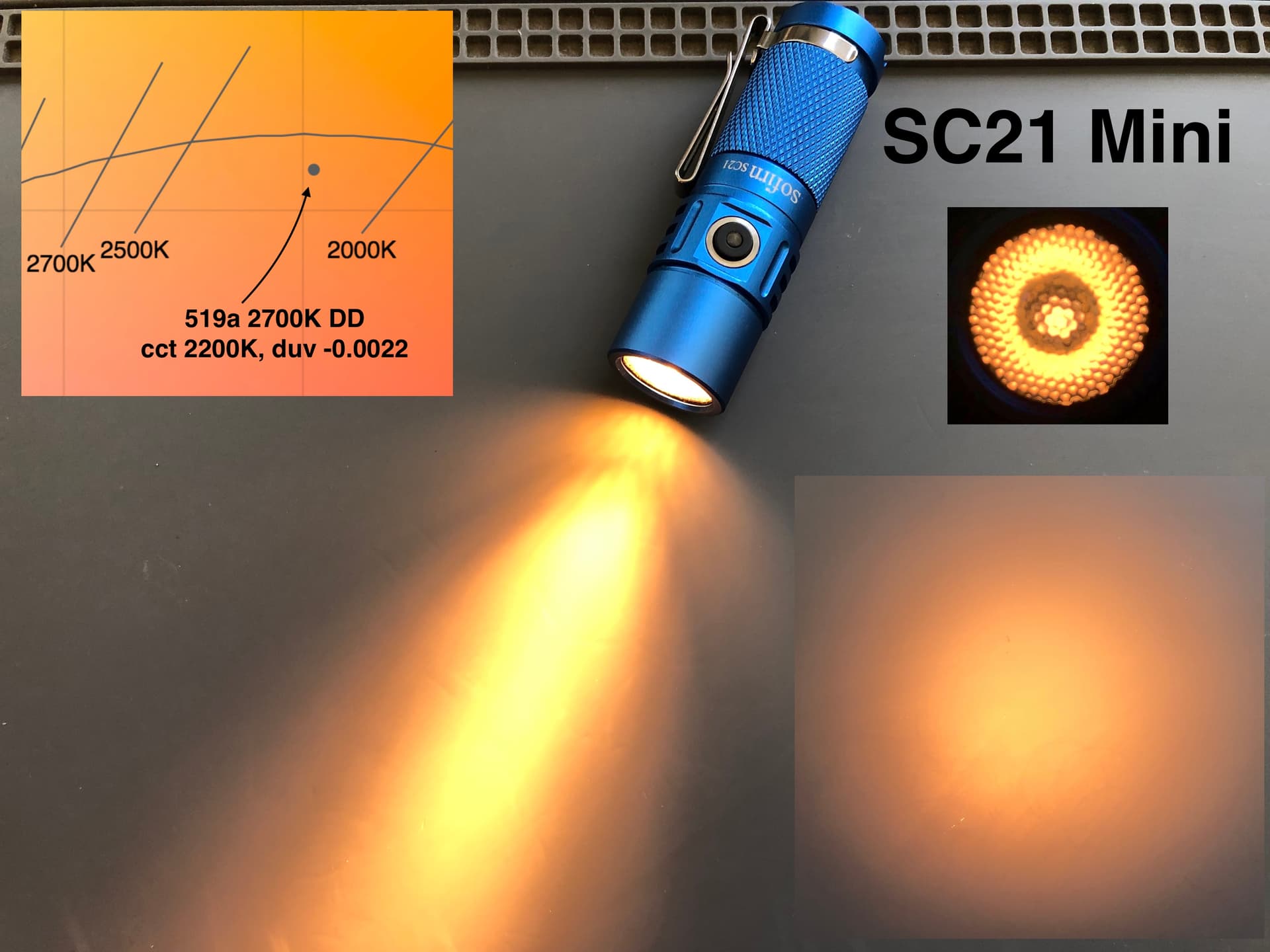
The thing is, DUV mostly only affect white / gray things. I could point two of my light at wall and the Low CRI light will have a rosy tint (R70 XHP70.3 4000K) and high CRI light has a (relatively) green tint (519A 4000K). But that’s as much as a difference you get out of them - white wall hunting.
As soon as you point them to anything that has colors, the DUV difference disappears and the high CRI light’s color rendering vividness wins out immediately.
It’s bizarre to see a rosy light makes wood surface look so pale and green and the green light makes wood surface look really natural and reddish. It also tells you how limited white wall hunting can be in determining light quality.
Back to your topic: Will rosy tint compensate for the lack of red rendering? Yes for white wall hunting, no for pretty much anything else. Also low CRI doesn’t only affect red. I find teal / sky blue things appear dark blue under R70 lights, no matter the CRI. It corresponds to the dip on the other side of the yellow hump of a low CRI light spectrum. That is also a color to look for when comparing Hi and Lo CRI lights.
3 Thanks
I’ve found that ‘white walls’ mean little to nothing to me. When I’m checking out a light in my LR, I point it at everything else - all the furnishings / furniture, all things I’m highly familiar with the correct appearance of under an extremely wide range of lighting conditions, and which reveal the color accuracy of the rendition of the incident light from the flashlight to my feeble brain immediately and clearly. The human optical system / brain are remarkable for that. The one time I point one at a white wall is when evaluating color temperature EDIT: and distribution pattern. I won’t start theorizing about why this works for me, but I know it does, so I don’t need to theorize (which I’m not really qualified to do anyway;-). Then again, I also don’t use a spectrum analyzer simply to tell me what an audio system sounds like (although they’re standard equipment for effectively equalizing a system installation).