Interestingly.. I decided to order a tube of the 705. It ended up costing me $1.37 shipped?
Is this what you folks were seeing? Just curious.
3 Thanks
The 705 transparent cost me about $4 shipped for a 45g tube
2 Thanks
I think you may have had a first-time customer discount. Usually it’s around $4.
2 Thanks
just ordered, $4.46. It’s the weirdest thing, it said returning customer discount was $1.07, but for some reason jumped to $4.46 when checking out. Not sure if bait and switch or some FOMO bs
Yeah it was $0.99 one time price. I just hope I get the right stuff…
1 Thank
make sure it’s the 705
Aliexpress has a very buggy site. Sometimes it will show a steep discount that doesn’t actually work when you order the item.
2 Thanks
Yeah I have seen that so many times. This time it took my order at $1.37 with taxes. I guess I got lucky… But thanks for the feedback.
2 Thanks
When it arrives, would you recommend that I apply it directly onto the glass area and allow it to settle out? Keep in mind that everything in the dropin is IN the dropin, I can’t remove the engine or guts for ease of access, so it’ll be like playing a high stakes game of Operation…I do have some syringes I can use as well, and I’ll probably test it on some spare glass prior to execution…
I just don’t want to risk an air pocket shart and splatter the stuff into all the nooks and crannies and reflector, even if it might help to waterproof the non-potted part between the reflector and pcb…
1 Thank
I wonder also about application. Meaning the proper way to get the 705 to form a dome. If it is thinner and self leveling… won’t it just form a flat covering rather than a curved dome shape?
2 Thanks
My recommended method is to get a drop of the liquid on the tip of a plastic toothpick, examine it to ensure no bubbles (if there are, discard and get a fresh drop), and then touch that drop on the LED surface. It self-levels more than water but still has nontrivial cohesion, so it will still form a dome. The dome just won’t be as large/tall as the original LED dome without risk of spreading out. The 519A is probably the easiest emitter to dome, as the circular footprint of the original dome somewhat inhibits spreading.
This method allows much finer control than simply squeezing the material directly onto the LED, and should have no issues avoiding the reflector.
2 Thanks
I cleaned the emitter with 99% ipa.
Then I got a dollup on the tip of a toothpick.
Dripped it onto the emitter. It’s pretty thick and flows slowly, so you have a little time to gauge how much you are putting on.
In the first couple minutes after application, I would flip it upside down for a few seconds if I felt it was about to flow over the edges.
It sets in about 5-10 minutes. Cure is about 12-24 hours.
3 Thanks
@QReciprocity42 wanted to ask, how’s the aging test for the K705 coming along? I remember checking that thread a few days ago..I believe you were testing for yellowing/cloudiness, and the effects of UV exposure?
1 Thank
Many thanks for checking back on this! It’s been 18 days since the test; during this time some samples of UV resin and K705 were left by a sunny window, while a SFT25R domed with K705 has been operating continuously at 700mA. None of the samples exhibit any visible discoloration.
1 Thank
Got inspired by this thread earlier, what if I add some fluorescent dye, like red and orange, into that glue? then apply only a very thin layer on the surface.
Negtive duv shift and lower CCT are expected. and i do measured a -0.008 duv shift and -200K CCT shift, unfortunately, with about 10~15% efficiency drop.
I will send this emitter to get a more accurate efficiency measurement to see whether it is worth tunning duv by this way.
2 Thanks
I’d probably recommend testing it on the cooler CCT, mainly because they have more light/emission energy to work with. To the average layman, they’ll also reveal tint shifts more aggressively than with the warmer tones. It’s not likely that you’ll get much blue activation with the warmer CCT, and if you do, you’ll probably have (as you experienced) reduced the output substantially. I was messing around with highlighters on a projector slide, trying to find a budget alternative to zircon minusgreens and other such…but @Boaz offers such a niche and cost effective service/product that it becomes diminishing returns to try and make my own ineffective versions. The only benefit to homebrew is being able to mix my own cocktails of pigment, but again, it’s not very long lasting nor super effective…
Also, Boaz’s filters are completely non-destructively reversible, which may not be the case with a dye-impregnated dome.
1 Thank
That’s a really nice idea, and I’ve tried this exact method to convert blue lighted tailswitches to different colors. The problem is that even at such a low level of light exposure, the dye gets “sun-bleached” and loses its color in a matter of days or weeks. If one were to incorporate the dye into the emitter dome, it would likely not survive a few turbo blasts. Dyes are sadly much, much less efficient, and chemically stable, compared to dedicated LED phosphors.
1 Thank
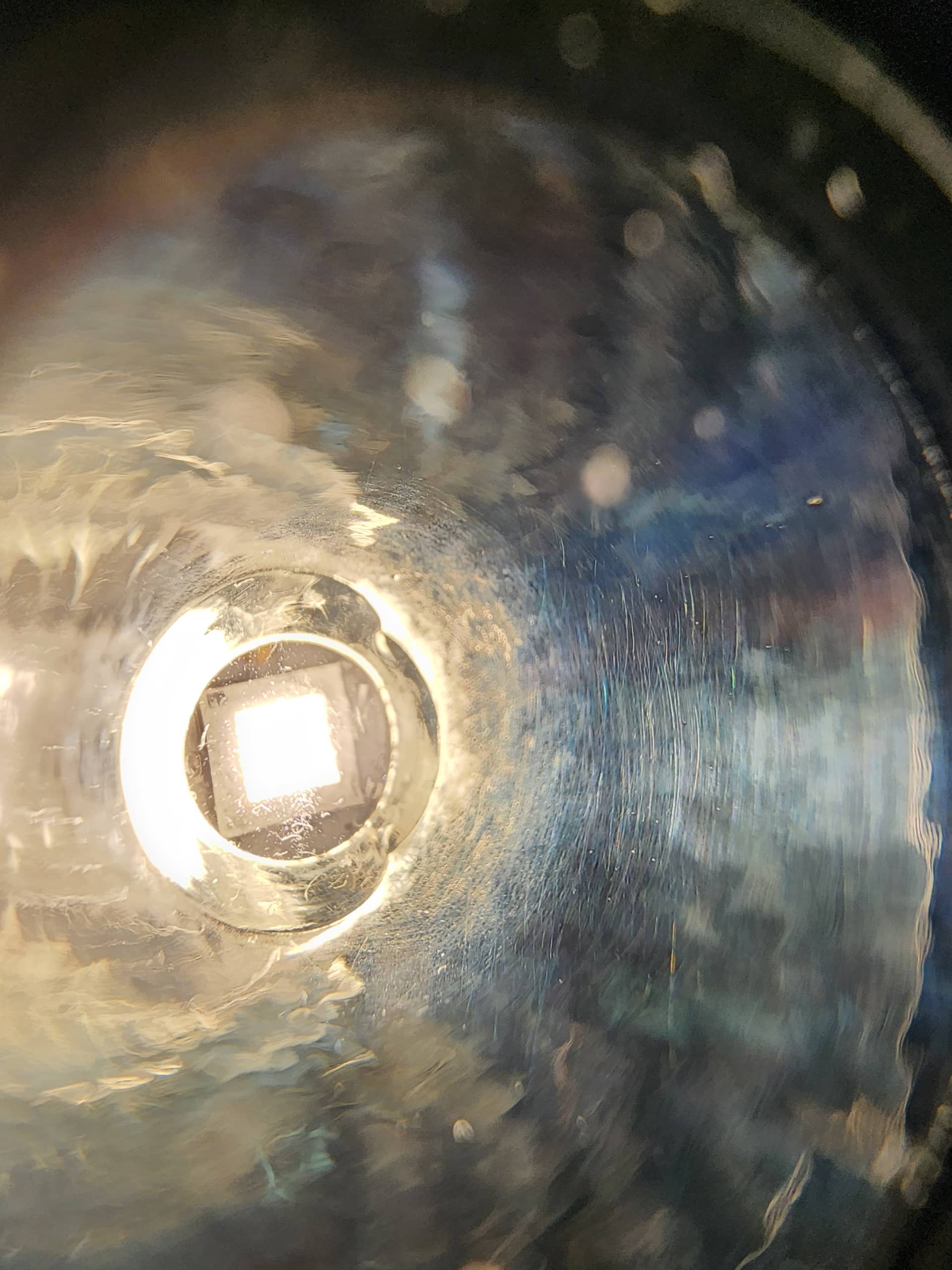
So…I’m going to do something that will either be utterly brilliant and visionary, or completely smooth-brained and stupid in retrospect, unless someone does it first. I’m gonna use some Invisible Glass automotive window glass cleaner on the m31 that I botched, and see what it does to the kafuter and to the fudged reflector.
After all, I can’t make it any worse than this, right?
1 Thank
I haven’t done any high power experiments on the dye mixture. and i only applied dye on a 5200k 5050 emitter.
Anyway, it is always interesting to mess with emitters
1 Thank