Hey, gang! I want to confirm if my memory is correct about Fenix ANSI output ratings being the most accurate. Lately I've been thinking that my IS calibrations are low since my output readings seem so much less than others, especially on the brighter lights. My IS was calibrated when I built it and my readings are exactly what Match saw with the exact light. Others I've compared with were also within a percentage.
I just received my first Fenix light today, a TK35UE, that Fenix rates at 1800 ANSI lumens. On fully charged Panasonic PDC cells I see 1711 lumens at 30 seconds. Should I adjust my calibration formula based on the TK35UE?
I probably would, I dont own many stock lights so calibrating my lumen cooler was a challenge however after getting it to a point I felt the calibration was pretty good (based off my burst-mode quark, my TK45 and several bare emitters going off Djozz’s and Match’s numbers) I had my buddy come by with his PD32 and a SENS CR I gave him a while ago for me to measure, both of them came out spot on the factory rating using my formula, I was pretty proud of myself.
Are you able to get another newer production fenix to borrow? again my test’s of the 2 Fenix’ I did after initial calibration came out within 1% (and the sens CR was exact) of the factory rating.
I think Fenix is on the significantly liberal side, closer to ZL than ANSI.
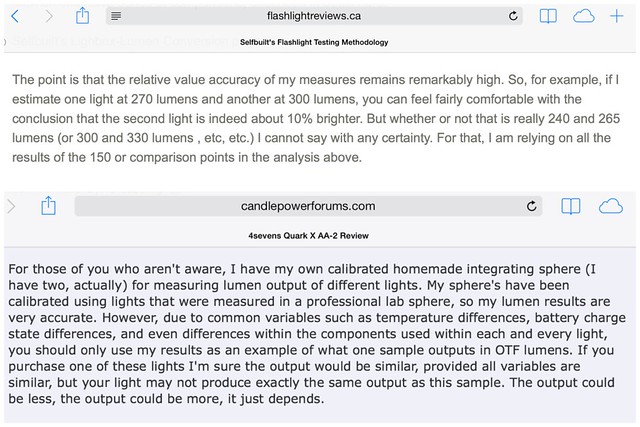
Here are some ANSI accuracy statements from Selfbuilt and ti-force, and these two guys have measured the same light at 300 vs 240 lms, respectively, or ~25% difference. ti-force’s is the only reviewer I’ve seen to claim ANSI accuracy and his scale seems to match Foursevens, Eagletac, and [earlier] ThruNite’s quite well. I personally use a Quark QP2A-X, D25A or twisty T10 to calibrate my light meter, as this scale also matches my quality US-made lights.
For another perspective of the exaggeration > conservative continuum, here is an example of an SC52 108lm/3hr mode (green line) vs a ’12 D25A XML 75lm/2.5hr mode (gold line) - I got the same result BTW - on a Fenix lumen scale:
I am no expert but have long figured that Lumens out is a approximation as it is dependent on batteries used and their exact charge as well as LED to LED variations in a given bin number, variations in driver circuitry, light initial temperature and exact time the light is measured from turn-on for LED lights. LOTS of variables involved including how well regulated the driver circuitry is.
I note that RMM includes some battery recommendations for maximum output levels for his high current draw lights so I presume that such lights will put out more if fed with high current capable batteries rather than UltraFire POS batteries as an extreme example. Most light Lumens ratings do not include info on the batteries used for the testing and IMO they should if battery make and version makes a difference.
When I built my IS I used a couple of Thrunite lights (Ti & T10) as well as a couple of Zebralights and a couple others I can't remember. Match had built a special light that was fully regulated and tested it on his IS he had made and calibrated. We both had the same measurements on our spheres (2 lumens apart). This told me that I had done right with my initial calibrations. I can't recall what Match used to calibrate his but I know it had some 4sevens and a bunch of others that were different from mine so I've always been extremely confident about my calibration. I figure it was calibrated by not only my lights but all his too since we both had the exact same output numbers with the exact same test light.
Then there was a thread about a year or so ago where someone was ranting like a loon about how Fenix lights are always dead accurate and are the only lights to be trusted with their output numbers. No one disagreed with him so I figured there may be something to it which is why I originally started this post. My TK35UE is rated at exactly 1800 lumens but I only see 1711 in my IS. So either my IS is off or Fenix aren't what they are cracked up to be. I'd rather believe that Fenix is right because all my lights would be brighter than I thought they were. :P
@Richwouldn't: Not true. What you are saying is true about unregulated lights but regulated lights are called that for a reason. As long as the cell being used can deliver at least 2.8A to drive a Nanjg 105c, for example, any cell you put in that light will get exactly 2.8A Not until the voltage drops below what is needed to maintain the forward voltage will the light drop out of regulation and start to dim. The new FET drivers vary widely because they take all the cell can give. Some cells can give more and so the light will be brighter using them. Cheaper lights that don't use FETs but are also unregulated will vary based on the cell used. A regulated driver doesn't care what cell you put in it. Output is the same regardless.
I agree to a point. Due to component variations between lights including LED and regulator components variations I would expect that there will be output variations between lights. An individual light may be regulated but it will NOT be exactly the same as another supposedly identical light. The question is how much they will vary and unless you have multiple samples of a given light, preferably made over a period of time and with different lots of the same LED, this is impossible to determine. I worked in electronics and electromechanical QA in Silicon Valley for 20 years so am familiar with variations in electronics.
You are right, there is always a bit of variance but my point was that the same light, if properly regulated will draw the same regardless of cell used. I wasn't saying that all lights of a particular model or build will read the same as it's siblings. A single regulated light will be the same brightness on a TF Flame as it will on a Panasonic PD or a VTC4. Each LED of a particular model bin can vary as much as 10%. It's why one guys sample light could read 10% higher than another guy who has the same make and model of light.
I guess I simply shouldn't worry if my reading is a bit low for my TK35UE. The same tested by Fenix may have been brighter than normal and my sample might be weaker than normal. It's really only a 5% difference. :D
I assume Fenix buys the LED chips by the reel and put them in lights, if every light were tested before sale then i would trust your TK35UE but you could have gotten a chip thats binned correctly but lower output for that bin (is not each bin within something like 5%)