This unit was provided to me by Grecell in exchange for a technical review and evaluation.
From the Specifications:
Fast Charging: GRECELL 240W portable power supply with 153.6Wh/12800mAh capacity, equipped with 5 output ports and 2 input options, supports charging multiple devices. Providing Type-C 100W fast charging to meet various outdoor and emergency power needs.
Compact & Portable: The power bank station packs powerful energy in a smaller size. Weighing only 4.5 lbs, it is designed for mobile office work, camping, hiking, and outdoor adventures. This outdoor generators rectangular design makes it easy to store and fit into carry-on luggage, saving space.
Small But Powerful: This solar power bank is ideal for outdoor activities like camping and hiking, as well as emergency backup power at home. This portable charging station features an adjustable LED light, a built-in phone stand, and offers SOS and three lighting modes to provide reliable lighting and support in any situation.
Safe & Reliable: The portable generator for camping uses lithium iron phosphate (LiFePO4) batteries, offering longer lifespan and higher safety. It is also equipped with advanced safety features, including overvoltage, under voltage, short circuit, and overload protection, ensuring peace of mind during use.
3 Charging Methods: The solar powered generator can be charged via a 100W solar panel (in full sunlight), a car charger, or an AC power outlet, taking 1.5-2 hours to fully charge. This ensures uninterrupted power during outdoor adventures and camping trips, ensuring convenient charging for your devices at all times.
Specifications
| Model Number | T200 |
|---|---|
| Battery Type | LiFePO4 battery |
| Capacity | 12.8V, 12Ah / 153.6Wh |
| DC/PV Input | DC 7909, 12V-26V⎓8A, 100W Max |
| USB-C1 Input | 5V/9V/12V/15V/20V⎓3A, 20V⎓5A, 100W Max |
| DC Output | DC 5525, 12.8V⎓8A |
| USB-A Output | 5V⎓3A, 9V⎓2A, 12V⎓0.5A, 18W Max |
| USB-C1 Output | 5V/9V/12V/15V/20V⎓3A, 20V⎓5A, 100W Max |
| USB-C2 Output | 5V/9V⎓3A, 12V⎓2.5A, 30W Max |
| Total DC and USB Output | 240W Max |
| LED Lighting | 3W |
| Dimensions | 8.18 * 4.56 * 4.56 inches |
| Weight | 5.99 lbs |
What you get
1*240W Power Station
1*USB-C Charging Cable
1*DC to Cigarette Lighter Outlet (Output)
User Manual
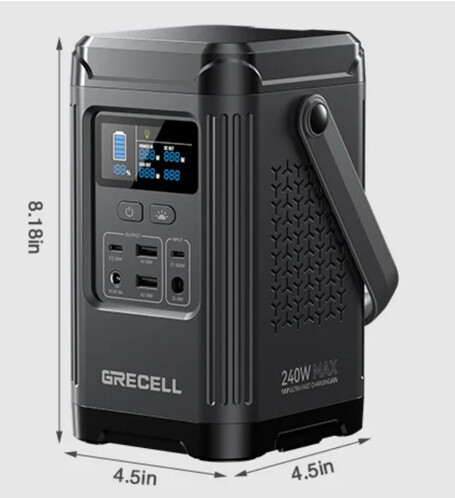
I have had the T200 for several weeks now and have been using it regularly. First I will go over some of my finding on performance then below relate my thoughts on using the unit.
Keep in mind that my background is in engineering not writing prose. So I apologize if this might be too technical or dry for some.
The construction is all plastic (but what isn’t these days). It is quite solid and seems that I could take some banging around. Though I haven’t tried that. The handle is made of rubber and is comfortable.
The unit is very stable for use on a table or firm surface. I did have a few times when it fell over when I put it on very uneven surfaces (rocks).
A couple of nice features are the light and the pull out tray to hold you phone in a position for viewing while charging. More on the light a bit later.
So how did it work in use?
Charging:
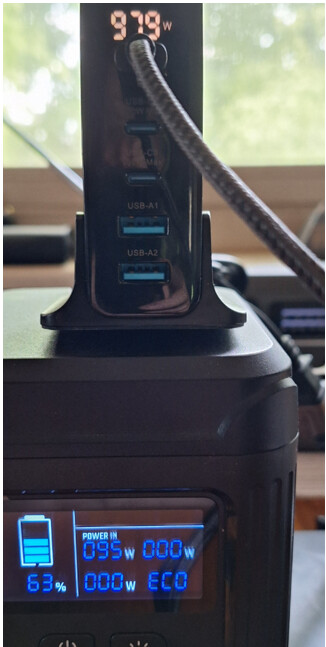
The unit charged using close to the full output from my 100Watt PD charger. The charger showed 97.9 watts while the T-200 showed 95 watts input. It took right at one hour and 30 minutes to charge from empty.
For solar charging I tried with a few panels. 25, 50 and 100 watt. I was told that the unit has an MPPT charge controller in it. But I wonder about this. None of the panels gave more than about 50% of their rated output. The best I could get was around a 55 watt charge rate with the 100 watt panel. This in full sun with the panel aimed properly at about 2PM on a cloudless day In June. I have seen 75 to 80 watts out of that panel with other devices with MPPT controllers.
USB device charging testing
Protocols supported:
The following protocols for USB charging are supported according to the FNRSI tester. This uainf the 100 watt rated USB C port.The results fit in with the specs, but it is nice to see that most of the more popular charging protocols are supported.
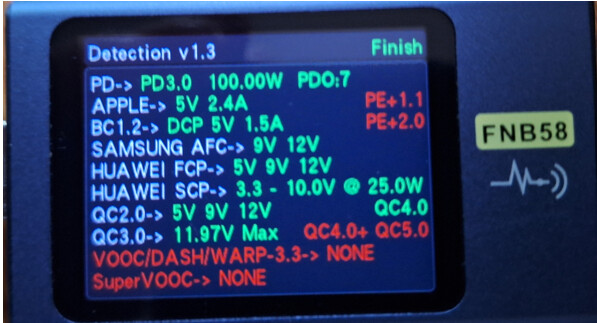
I did see 100 watt charging from the USB C 100watt port and 30 watts from the 30 watt rated port. The USB A ports delivered the rated 18 watts. This was using the above pictured FNB58 meter.
Discharge and capacity:
I wanted to add a note here because I was truly questioning my testing result, I did some research on power bank testing and found a formula that helps me reconcile the numbers that I got in testing with the claims made in the specification.
Real Capacity = cell voltage V x Advertised Capacity x Efficiency Rate / output V
*The real difference is encountered when dividing by the output voltage. I did the PD test at 20 volts. *
Using that divisor and a nominal efficiency rating o 90% the numbers make more sense.
*We would have 3.2V (nominal LFP voltage) X 48,000 X 0.90 / 20V (the output voltage) equals 6912 mAh. *
This matches much closer to the numbers that I got.
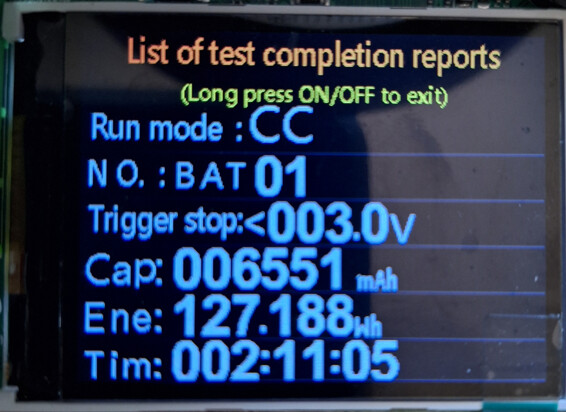
USB PD
I used PD 20 volts at 3 amps for this test. I got 6551 mAh and 127.2 Wh out. Full discharge from full charge took about 2 hours and 15 minutes. The tester is the Atorch DL24P with their add-on PD trigger board. I am a bit confused about the discrepancy on the MAh readings. It was far closer when testing the capacity using the DC output. (See below).
(See note above)
DC 12 volt output test.
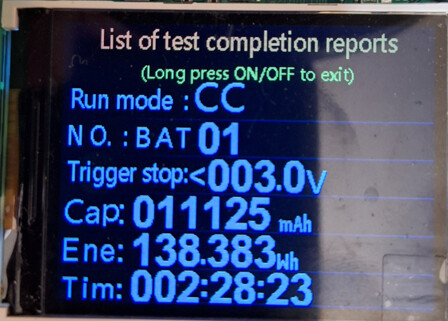
After a full charge I used the 12 volt output to test capacity. I used constant current set at 4.5 amps. Initially the voltage was a bit above 13 volts. It stayed above 12 volts until about the last 2% of the discharge These results were better than the PD test. I got 11,125 mAh and 138.4 Wh.
Note, using the above formula and a 12.6 V output for the average I got only 1080 mAh as the expected result. Which indicates either a higher efficiency than 90% or a lower average voltage out during the testing.
I was not able to test to see if the T200 could output the full rated 240 watts. Due to lack of measurement gear to track the required outputs. I did check at about 205 watts from the 12 volt and PD outputs simultaneously…
Outputs
There are a good selection of USB outputs on the front panel. There are two USB C ports that support 100 watts and 30 watts respectively. Two USB ports that support 18 watts. Plus a 12 volt DC output good for 8A.
Usability
The unit has a nice display that has the information we need for input and output levels and battery level. I found the display to be visible in anything short of direct sunlight.
The connectors are solid and hold cables tightly. The controls are well labeled and easy to use. The buttons are well made and actuation positive, there is good tactile and audible feedback on actuation.
At about 6 pounds and 8X4.5X4.5 inches the T200 may not be suitable for back packing, but for car camping or something to keep in the car for topping off devices, it works well.
According to what I have read with the rated capacity of 153.4 Wh it can only be carried on an airplane with airline approval. So I would be wary about trying that.
Other features
The light on the back is controlled with its own front panel switch. It is articulated so that it can be aimed in several directions. It flips up from the back over 180 degrees and swivels 360 degrees with detents every 90 degrees.
There are two brightness levels. The brightest one will light up my kitchen well enough to do essential things. I won’t be tripping over the things my dog leaves around to see if he can break my nec, I tried using it to wash dishes and it was fine for that. It can light up the inside of a tent very well. I think it would be fine on the lowest level for reading and it would last for lots of hours with the battery capacity that it has. The only problem for me is that the sequence includes tow level and an SOS and Strobe setting. I wish there would be a way to take those out of the rotation. I can’t see many uses for them in normal use of the power station.
The T200 uses an LFP battery that is rated at 3000+ cycles before it drops to 80% of the new capacity. This along with the fact that it is safer and can be stored at 100% charge with less risk of deterioration makes the solution much better than similar unit using LiIon batteries.
The T200 comes with a 2 Year warranty. This is considerably better than what any of the other power bank units that I have carry.
Pros and Cons
Pros
Good size and weight for its capacity.
More outputs than a comparable capacity power bank.
Comfortable handle
Nice light
Good display
More capacity than the common power banks
Solar charge controller built in.
Pricing.
Cons
Does not quite meet the published specifications for capacity in my testing.
The UI for the light needs work. Get rid of the blinkies in the main rotation
Maybe too big for carrying regularly for some. (but this is required for the features and LFP batteries)
Final thoughts.
After having used the unit for almost two months I find that it is a handy devise to have around. It has more real capacity than any of the large power banks that I have. Everything works as advertised. The inclusion of the ability to solar charge the unit is real nice thing to have. I like the unit quite a bit. If one can accommodate the size and weight for their application, I recommend looking at this one. Especially at the current price as linked above.