Is ceiling level 90/150 the highest sustainable level on other Anduril lights besides the D3AA?
Hi Jon! By thermally regulated mode I mean that light will step down and honor the set temperature limit. So regulation here refers to flashlight temperature stabilization and does not refers to the output stabilization.
Per screenshot you shared we see that light does step down after 10 min:
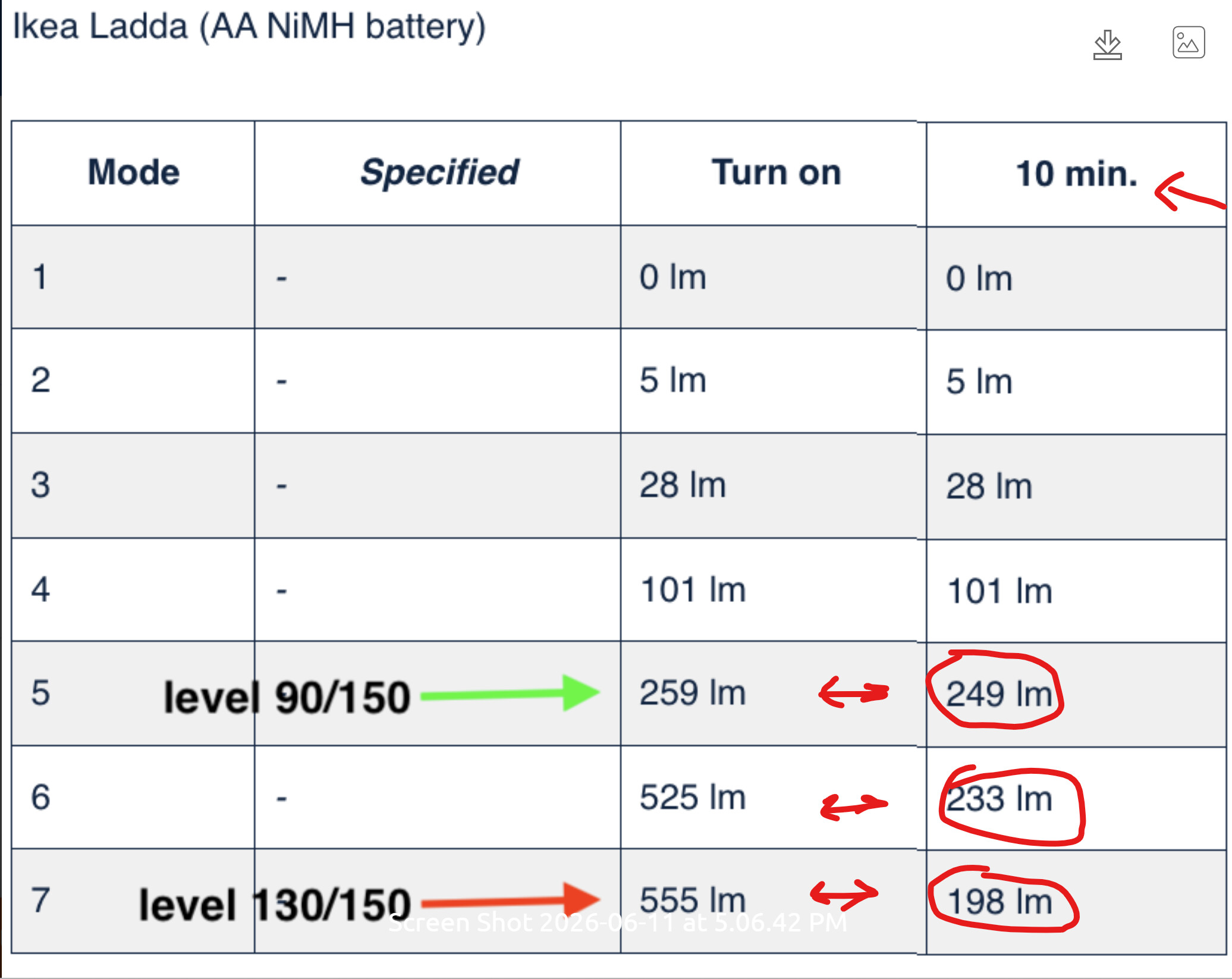
That is indication to me that level 7 is thermally regulated mode.
I also may be wrong that turbo is not thermally regulated but I disable it for a different reason since I want ceiling not exceed sustainable output for more than 50-100%. D4V2 can produce 2400 lumen (for boost driver) I think but I do not want it to be more than say 800 lumen if sustainable 400 lumens. That why when it step down due to thermal regulation is less jarring. Since perception of brightness is non linear even step down to 50% is not that jarring but step down to 20% will be jarring.
Example of thermally unregulated mode is candle mode where light can exceed thermal limit and get dangerously hot and there a number of examples where it caused burns - example
Possible dumb question: Is TS11 also can be updated using 3 pin programmer available on int-outdoors? I see it has 3 pin layout and saw people mentioned that they updated their TS10 which I assume using same platform using UPDI protocol.
Every level in the regular “on” or “ramp” mode (including turbo) is thermally regulated, except the levels which are so low that temperature is irrelevant. This is configured per hardware model, based on that specific light’s behavior. Do a grep for MIN_THERM_STEPDOWN to see the limit for each light. Usually it’s about 50/150 to 70/150, though there are a couple which are higher. On an Emisar D4v2 with FET+1 driver, for example, anything under ~100 lumens is not thermally regulated because that’s not bright enough to get warm.
The exception is the BLF LT1, because it can’t sense temperature. The LEDs are too far from the MCU to be able to sense how hot they are. But the LT1 is designed to never go high enough to need regulation.
Currently, only the main “on” or “ramp” mode has thermal regulation. Other modes, like strobe and candle, don’t yet.
1 Thank
I think I misunderstood your comment and my reply was intended to point out which ceiling level does not get hot enough to trigger thermal step down.
imo step 5 is very close to the output that only generates as much heat as the light can dissipate, and therefore is right at the boundary of thermally sustainable output.
I agree step 6 and 7 definitely generate more heat than the body of the light can dissipate, and will get the light hot enough to trigger the thermal sensor to step down the output.
Also agree, the thermal sensor Is active even at step 5, as you marked on the chart. It steps down the output from 259 lm, to 249 lm after 10 min.
I also agree that candle mode does not use the thermal sensor.
1 Thank
I always thought the BLF LT1 seemed like a natural host for a dual channel buck, or probably more appropriately a boost driver, since it was the first Anduril dual channel light, and it provides ample space for extra components. It’s still using the original 7135 based driver, as far as I know.
If I read code correctly D3AA starts to check thermal sensor data at 40/150 - link and D4V2 if using lume x1 driver at 60/150 - link.
Indeed, it looks like it does. That probably doesn’t need to be so low. There’s not much impact from setting it too low though, as long as it’s high enough to avoid any weird hardware control values. Some lights use hybrid PWM+PFM, which does odd things with the control values, so the thermal floor needs to be above all that. This isn’t relevant for d3aa though.
The worst which would happen by setting the thermal floor too low is that it could drop lower than necessary when trying to cool down after a particularly hot turbo burst. However, looking at runtime tests by reviewers, I don’t see that happening during tests.
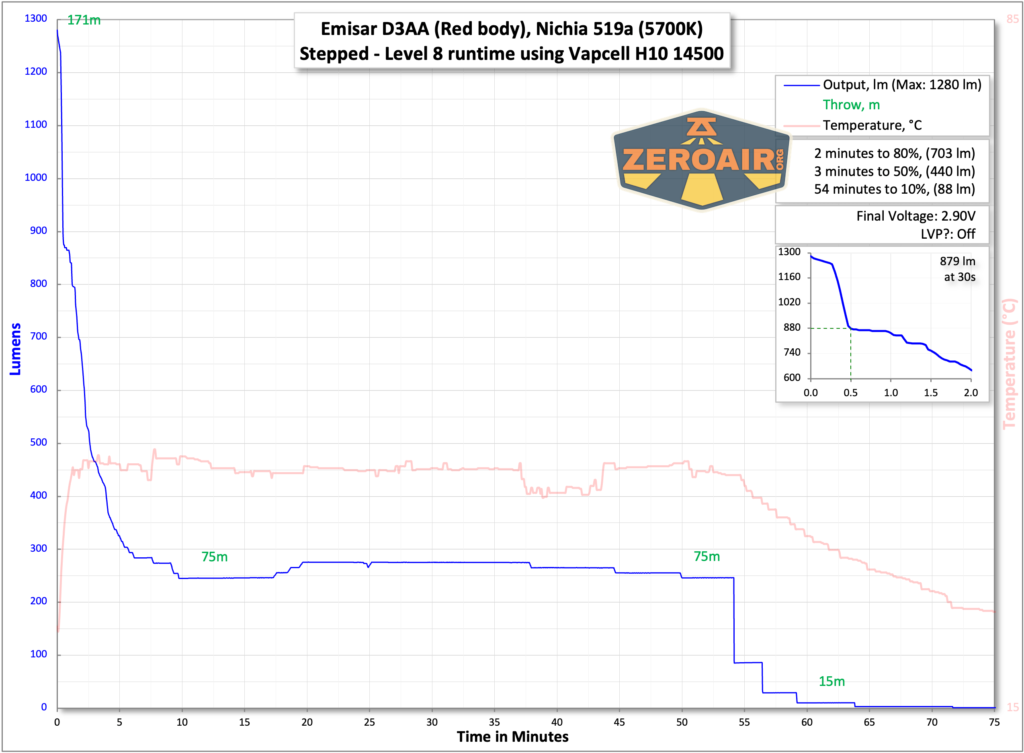
For example, Zeroair saw a slight overcorrection when using a 14500 cell, but nowhere near low enough that a higher floor would be relevant. It dropped to around level 95/150 when it should have stopped at about 100/150… nowhere near the floor of 40/150. So that’s more of a PID tuning issue, not a thermal-floor-too-low issue:
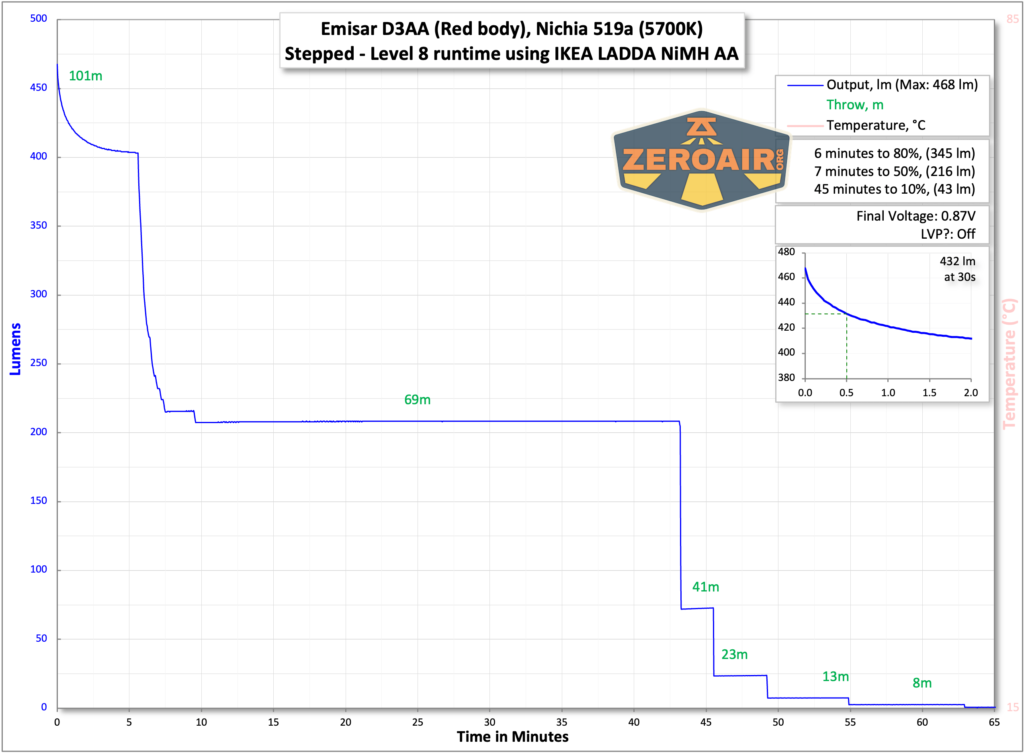
As far as I can tell, nobody saw even a slight overcorrection when using a AA/NiMH battery. Results for NiMH were pretty close to the ideal curve:
Usually the thermal floor only needs careful tuning on lights which are extremely overpowered on turbo, like the original Emisar D4. The floor is basically a hard limit to prevent excess overcorrection and bouncing while it tries to regulate after an extreme turbo burst.
2 Thanks