can someone with sufficient knowledge about drivers in these lights illuminate a bit as to how the efficiency of the dual channel driver will be - in relation to the standard driver for the d3aa (i have read that this is one of the best to get for 14500 lights).
Efficiency is Power Out divided by Power in, which is VoutxIout/(VinxIin).
In a linear driver, which the dual channel driver is, current in = current out, so it’s just Vout/Vin.
if after cell voltage drop Vin is 4V and Vout=led Vf = 3.1V (1xNTG35 at 2A) then efficiency = 3.1/4=0.78 = 0.78%, at 3.5Vin : 3.1/3.5 = 89%
The lower the cell voltage the higher the efficiency, the lower the current the lower the efficiency, because cell voltage drop decreases, increasing Vin, and the LED Vf decreases, for ex. at 0.2A Vf=2.7V, with 4.1Vin efficiency is 66%.
Perfect.
Thank you for this explanation. I read your post and the specs - regarding the driver you seem to have developed for the d3aa:
Specifications :
Constant current boost driver with 0.7-5.5V input voltage range, supporting low voltage AA cells and Li-ion 14500 cells.
2A~9V output with li-ion, about 19.5W with 3x519A. ~0.6A~9V output with NiMH (Eneloop), ~5.1W.
~5.5A input limit.
94%/93% peak efficiency/min efficiency at max output on Li-ion, 90%/85% on NiMH.
30kHz minimum switching frequency to avoid audible noise and flickering in low modes.
High Dynamic Range : more than 100 000:1 dimming ratio.
Electronic reverse polarity protection.
Anduril 2 with AVR32DD20 MCU, RGB AUX, button AUX, UPDI programming with standard 3 pads flashing layout, automatic cell strength detection and then the usual Anduril stuff.
now - to me it seems, that the dual channrl driver pales in comparison. Well, this should be considered then when balancing the trade off for having two channels (essentially paying off with about 15-20% less efficiency). Would this estimation be correct?
Please note you also lose the AA/NIMH elements support since linear driver can only work with 14500 which to me bigger disadvantage compared to lesser efficiency.
I find this very useful at times when I dont choose to carry two separate flashlights. And I dont have to bring a charger when I travel with a 14500 light
true Dual Channel efficiency is different than single channel
otoh, Dual Channel still has Regulated Output
true Dual Channel works on LiIon only
otoh, Dual Channel still has NoPWM
I find Lumintop USB-C 14500 LiIon very useful (with Turbo disabled).
(note Hank’s website says to only use UnProtected batteries. I find Protected USB-C 14500 batteries work fine as long as I disable Turbo. And USB-C 14500 batteries are not too long)
USB-C 14500 are the same length as Eneloop, so there is no issue with the battery being too long.
When Im traveling I dont have to bring a separate charger, as I would need for Eneloop or other LiIon.
Yes, thanks for mentioning the other differences like 1.5V AA usage.
Well. Now is it possible to guesstimate the differences in runtime between the single channel and dual channel drivers?
When I’ve measured 7135 drivers (like the +1 part of a FET+1, used in a TS10) vs Hank’s recent boost drivers (D3AA, KR1AA, Lume X based drivers), I’ve found 40% to 60% higher lumens per Watt on the boost drivers. That means instead of running for 10 hours per charge, it’ll run for 14 to 16 hours per charge using the same battery at the same brightness level with similar LEDs.
Edit: Not sure about the efficiency of the dual-channel linear drivers. I haven’t measured those. I would expect it to be a little higher than a 7135 driver, but I’m not sure how much. Definitely not as high as a boost driver.
Both 7135 and Hank’s linear drivers are linear, so any difference between the battery voltage and LED voltage gets burned off as heat. But Hank’s are constant current, while 7135 uses PWM (pulsing). Also, 7135 (in a common “FET+1” setup) is limited to 350 mA while Hank’s can do however many Amps are appropriate for the LED. He matches the limit to the LEDs.
Yes. Thank you for being concise and detailed. Now, as this light is fantastic (d3aa) - it would be helpful to have some concrete information as to how much less runtime is possible with the linear dual channel driver.
I guess, Hank has not changed anyfhing within the driver architecture whilst porting it to the d3aa?
Would be cool some day to see buck driver for dual channel.
I suspect that with anduril it will most likely require two separate buck circuit which from my judgement should be possible since we see a lot of boost / buck design which to me should be comparable in size.
In principle probably you can get away with single buck circuit but then you wont be able to do smooth ramping between channels which is required by anduril 2.
But I confess last time I worked with electronics was in 10th grade so my current knowledge lags a lot.
You could possibly use one buck converter and share it between the two led channels and still have channel ramping, as long as they have a similar Vf (meaning not red+white for example),with 2 mosfet, switching between one and the other LED channel at a certain frequency, The Sofirn IF25 does this (at around 1kHz).
I think two independent channels are better though, it’s not difficult to do if it has a low dimming ratio (~1:500 like the first noctigon boost driver) and would fit no problem on a D3AA sized driver, for HDR/low moon modes it’s more complicated.
That what I suspected that such setup will result in possible flickering.
From user perspective it will be around ~1 lumen which yeah probably too bright for moonlight. EC150 I have per spec has 0.2 lumen in L2 mode which is good enough for me (do not reference to D3AA since it floor in a different league and I do not have a tool to measure lumens for a level I configured ).
Yeah, the recent drivers from thefreeman and loneoceans really set a high standard for other lights to live up to.
The D3AA, DW3AA, and KR1AA set the standard for AA/14500 lights, and most of his single-channel 18650 + 21700 lights have an option for a good boost driver too. I was going to try to list them, but … looking at his store, it’s almost all of them now.
FWIW, Hank sells firmware flashing tools for both his old and new drivers… so you can keep the firmware updated on all your Hanklights. Basically every light ever supported still is, and can run the latest firmware.
Even the really old attiny85-based ones can still be updated. But for those, they mostly didn’t have flashing pads yet, so they’re a huge pain to update. Anything from attiny1634 and newer (so, D4v2 and newer) is easier to update, because that’s when flashing pads became common.
All Hank’s lights I have on AVR32dd20 platform I think. I am considering get flashing tool if it be available when I will be doing next order!
Is flashing kit already available for purchase for the most recent platform? Note sure if flashing pins on lume x1 and d3aa are identical.
Edit: yes found " 3-PINS USB-UPDI Programmer" sku. I think description for d3aa needs to be updated since it states that the programmer is not avaibale yet
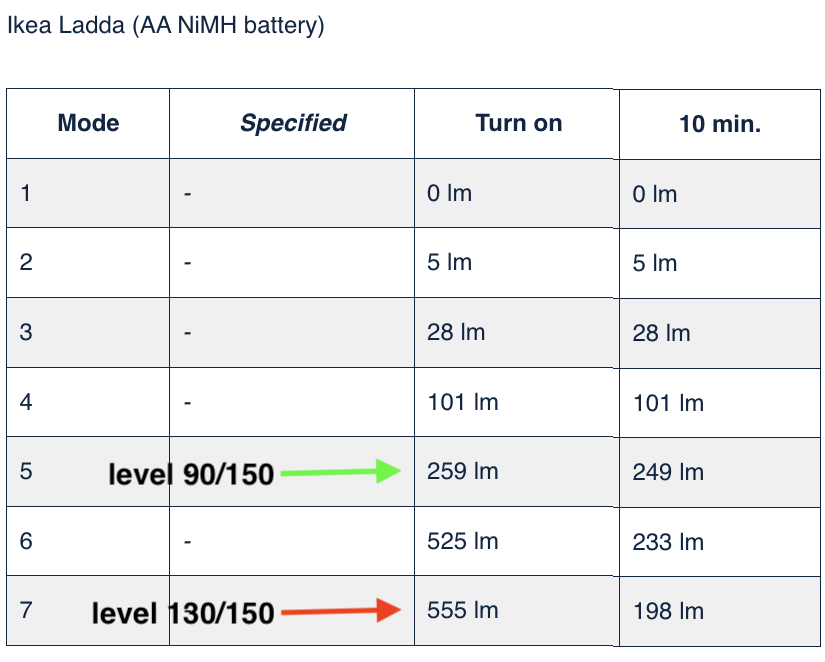
what that suggests to me, is that step 7 whose default ceiling is 130/150, is not thermally sustainable (this is not turbo, which corresponds to 150/150)
unless Im mistaken, that chart shows that the thermally sustainable output (with default ceiling 130/150), is step 5 of 7 in stepped ramping , whose internal level is 90/150, equivalent to about 250 lumens on Eneloop. (the result is similar on LiIon because heat dissipation is relatively consistent, regardless of battery)
I hope that makes sense.
other lights will have other sustainable output levels, based on how big the light is.. bigger lights usually have higher thermally sustainable outputs
If turbo is disabled, it doesn’t go above the ceiling. The ceiling can be set to whatever the user wants, like setting it to the highest sustainable level.
Turbo styles available are:
0: No turbo. Ramp -> 2C goes to the ceiling, and there’s no way to go higher.
1: Anduril 1 style. Ramp -> 2C goes to full power.
2:Anduril 2 style. Ramp -> 2C goes to ceiling, unless you ramp up to the ceiling first. Then it goes to full power.
This can be set separately for Simple UI and Advanced UI. The default on most lights is style 0 for Simple UI, or 1 for Advanced UI.
To access this setting, use:
Advanced UI -> Off -> 10H -> Option 4 for setting the Simple UI turbo style… or
Advanced UI -> On (ramp) -> 10H -> Option 4 for the Advanced UI turbo style.
It’s kind of an obscure setting hidden in a back corner, because it’s not something most people ever want to change… and if they do, they’ll typically only change it once.
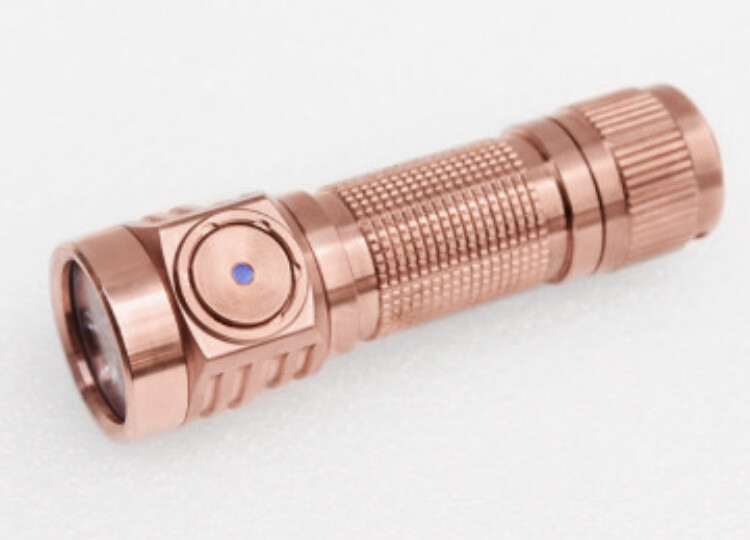


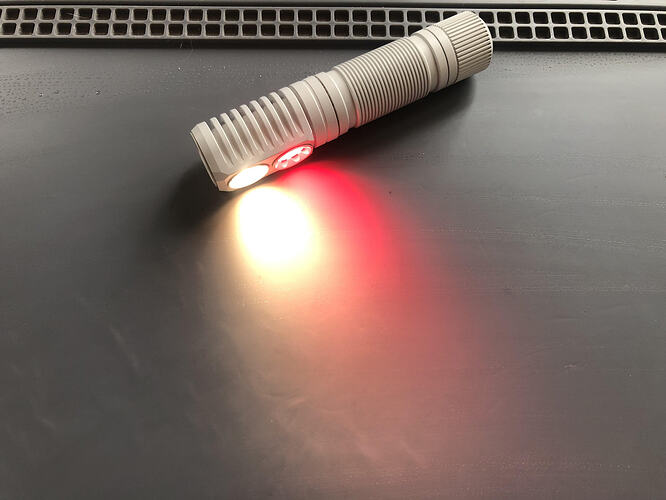
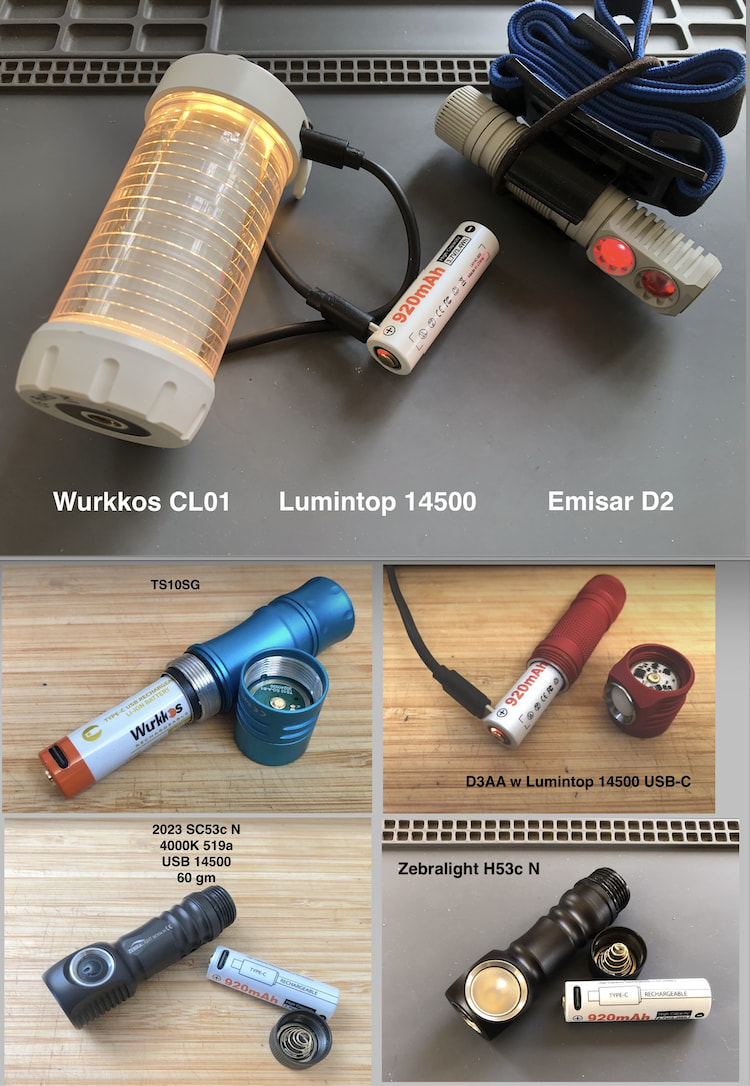
 ).
).