Help designing 10mm copper MCPCB + SST-40 for motorcycle turn signal retrofit!!

Hi all,

I’m working on a small form-factor LED project for my Harley turn signals, and I’m looking for help designing a custom MCPCB + LED driver solution.

Goal:
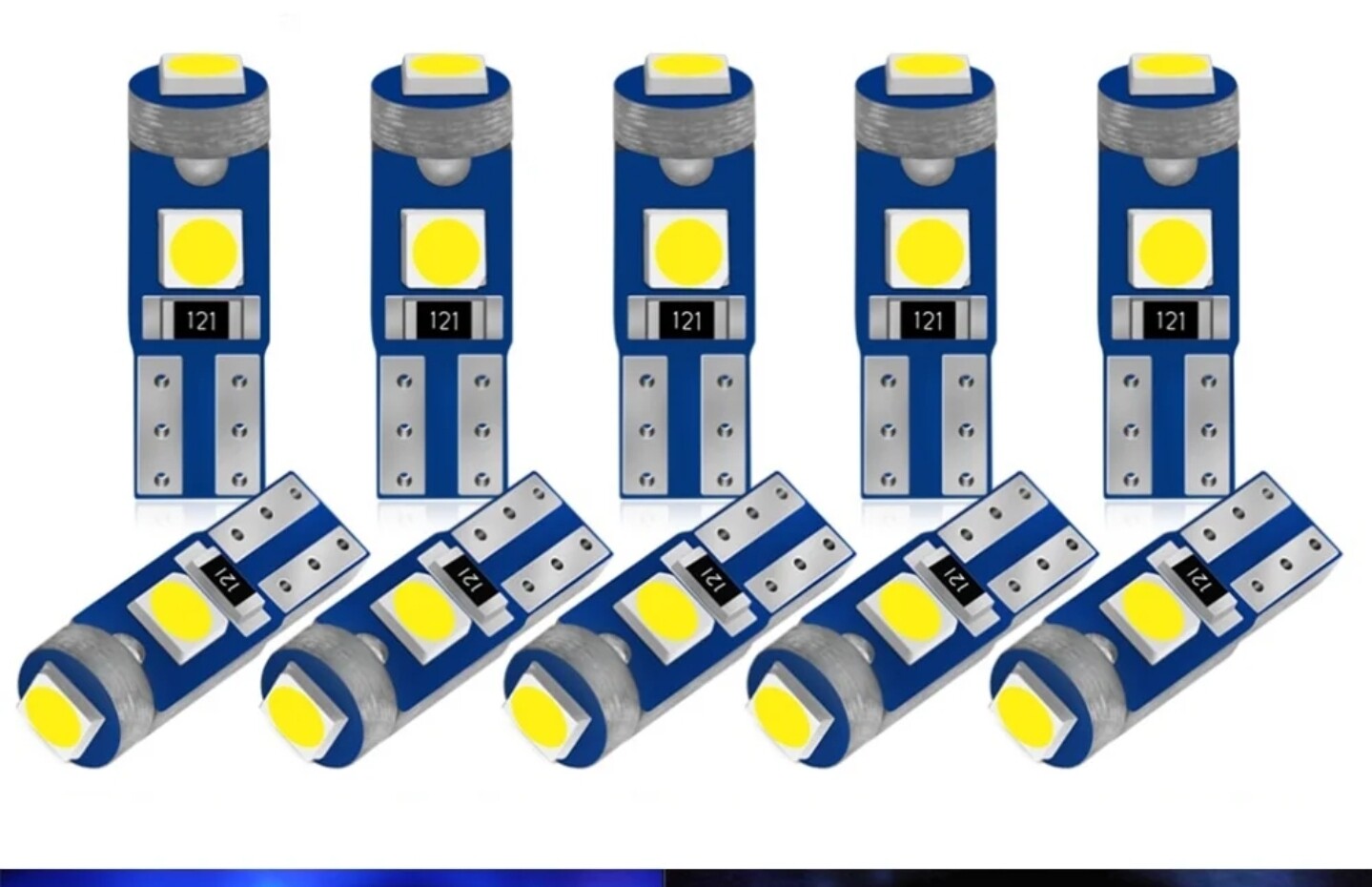
Replace a standard T5 automotive incandescent bulb with a high-power LED on a direct-thermal-path copper MCPCB.

LED:
Luminus SST-40 – 3V or 6V version (advice welcome)
Target output in turn-signal duty cycle: ~1200–2000 lumens

Electrical environment:
Motorcycle turn signal
12–14.4V system
LED only powered in intermittent flashing mode
Duty cycle approx. 50% typical
Cycle frequency ~1Hz

Plan physically:

A 10mm DTP copper MCPCB mounted on top of the T5 plug body

MCPCB replaces the small LED cluster

The custom board carries one SST-40

Rear contact pads connect to T5 automotive socket pins

A tiny constant-current driver fit in-line to the signals, and there will be no room in the housing for a driver!

Requirements / questions:

  1. Best MCPCB layout for thermal extraction in such a small volume

  2. Recommended driver solution

Target approx. 5–6A for full SST-40 performance (if thermally feasible)

OR a safer regulated ~3–4A level for longevity

  1. Advice: 3V SST-40 vs 6V SST-40 in this context

  2. Any suggestions for improving thermal mass and heat spreading

  3. Suggestions on where to prototype the board (OSH, JLC, PCBWay, etc)

  4. If any members here have experience making custom LED PCBs — I would happily pay for help with layout and production

This will only be on in short bursts because it’s a blinker, not a running light, so it will never be at 100% continuous duty. Still, I want to do this the right way — thermally, electrically, and mechanically.

I appreciate any expertise or collaboration!
Thanks in advance.

WB, edeekeos!

1 Thank

Why do you need 2000 lumens in a turn signal?
There’s no 6V SST-40. SST-70 is a 6V emitter.

2 Thanks

2000 lumens isn’t overkill.
It’s being seen before someone merges into my ribcage. If you’ve ever rode, you’d understand.

Thanks for your help.

3 Thanks

A quarter of that is already way more than stock and doesn’t blind people behind you.
You really shouldn’t overdo it! Brighter doesn’t always mean better visibility, a blinded driver behind you can crash into you because they can’t see.

Why specifically that LED? Wouldn’t an LED that is already sorta yellow be better?
Like LMP LHP531 - Convoy flashlight just as an example

Or maybe even a 12V LED? GETIAN GT FC40 LED R9050 - Convoy flashlight

For a turn signal, you don’t have to use a constant current driver, a resistor is good enough since it’s usually not running for more than a couple of minutes with a 50% duty cycle.

1 Thank

2000lm is not “being seen” territory, but “blinding someone so they crash into you because they can’t see shit” territory (at least at night)…

Might actually be brighter than your headlight, depending on which type of light you have. But unlike a headlight the turn signals have no upper cut-off. It’s essentially a rear-facing blinking high-beam.

Anyway, +1 for 1800K LHP531 - cheap, floody, and essentially a PC Amber LED which means less of the emitted spectrum is absorbed by the orange blinker housing since it is too blue. But definitely not at 5+A.

5 Thanks

If people rode cycles enough on the streets shared by other traffic, everyone would unanimously agree with you statements. I was considering something similar with my GL1800 Goldwing. Before I went the DIY route, I converted all of my lights with store bought LED’s to see how they performed. After doing so, I never looked back. Depending on the bike, the first thing is to swap the amber turn signal lens for aftermarket clear lens. Then order amber LED replacement bulbs (the brightest available). I used Amazon for these. Read current reviews for each particular bulb type you intend to replace to reach a good compromise between brightness and reliability. Also read cycle forums to see what others are using. You’ll also probably need to change the turn signal relay for an LED compatible version, which prevents the lights from flashing too quickly (hyperflashing). If not available for your bike, a way around that is to wire a small incandescent bulb in parallel into the circuit and tuck it under the seat to provide the necessary resistance needed for stock operation. You’ll need to do that for left and right turn signals. I used red LED bulbs for the brake and rear running lights, shinning through stock red lens. The difference between before and after is startling. Not only were they a great deal brighter, the color is far more brilliant and makes them much more noticeable.

Disregarding DOT regs over my safety, I went with high powered LED headlights. I found some manufactured on a copper back plane, which placed the emitters on the mounting stalk MCPCB in the same location and direction as the incandescent filament inside the stock bulb. This makes the radiation pattern similar to the stock bulb so that light doesnt get scattered into oncoming traffic. You’ll still need to test to verify your results. Not all headlight reflectors play well with all LED swaps. My combo just happened to work well, while maintaining a sheer beam cutoff like the stock beams. Any scattered light WILL BLIND ONCOMING TRAFFIC, and you will be held fully accountable if you blind someone with non DOT approved lighting. My bike has 4 headlights and 2 amber fog lights. I ride with all 6 of them blazing during the day to command attention… and they do command attention (assuming the idiot who threatens my life isnt distracted by something else). LED low beams at night are more than sufficient.

While I was already satisfied with the LED swaps, I took a huge leap forward. To enhance the tail of my bike, I installed red police take-down lights, which I wired to activate with my brake lights. I mounted one on the luggage rack (which is roughly the same height as a driver seated in a car), and another low on the fender. They are programmable with several emergency flash patterns available. The mode I chose is specifically for brakes. It flashes 4 times when power is applied and then the light remains on steady at 75% power until the brakes are released. Search “Feniex Industries - Red T3 Surface Mount”. They are a professional product available through multiple vendors and found on thousands of emergency vehicles. Multiple mount types are available and can easily be modified to fit. I also considered using some as amber auxiliary turn signals, but Im already very satisfied with the amber LED bulbs with clear lens mod.

I also added color appropriate LED strips to the tail and sides of my bike. Again, you dont want to skimp here and buy the best and brightest you can find. To maximize the life of strip LED’s, buy a 12VDC PWM LED controller. Dialing them down to 50-60% power allows for a much longer service life without sacrificing much brightness and blinding everyone at night.

I have been using this setup for 30,000 miles, have been followed by police dozens of times and never been pulled over. Never a sneer from a driver or rude comment from pedestrians, accept “Cool lights. Where can I buy some?” Almost everyone in my local club followed suit and we ride together with much greater presence. Now when I touch my brakes in traffic, people back off and maintain a much greater distance behind me.

Regardless of how many lumens you are throwing out the front of your bike or from behind, ALWAYS assume you are completely invisible to other drivers. Drivers seem to be getting less attentive by the day. Ive lost a lot of friends through the years from cars killing them on motorcycles.

If you havent dont so, check youtube for “MCrider” and many others. There are some great videos concerning lane position and strategy to stay in one piece.

Hope something there helps.
1 Thank

Did you read they want 2000+lm turn signal lights and not headlights? 2000lm is approaching headlight/high beam brightness, and without any cutoffs this will essentially render anyone behind them completely blind the moment they turn on the turn signals.

1 Thank

Yes, and did you read the solution I provided?

1 Thank

Careful, you’re making claims based on theoretical lab numbers instead of how these actually function in real-world use. I said 1200 to 2000 lumen emitter rating, not 2000 lumen blasting straight into someone’s eyeballs. That alone changes the whole argument.

Here are the parts you’re missing:

First, emitter lumens are not the same as lumens leaving the housing. LED bin differences, driver losses, heat saturation, and thermal throttling all bring that number down significantly.
Second, the amber lens itself kills a huge chunk of output. Depending on the LED wavelength match, you can lose 40 to 70 percent of the total light right there.
Third, this design has no reflector. A bare emitter behind a diffused lens spreads light wide, creating broad visibility, not a tight blinding hotspot. It is candela density that blinds people, not raw lumen count.
Fourth, the signal is pulsing, not constant. Half the time it is off. The human eye resets between pulses. That dramatically reduces glare.
Fifth, these are mounted low, rearward, and off-axis relative to following drivers. They are not aligned like a headlamp or focused into mirrors.

You keep comparing this to a 2000 lumen headlight beam, which is a totally different optical system with reflectors, cutoffs, and focused projection. That comparison just doesn’t hold. My goal isn’t to burn retinas, it’s to ensure a texting SUV driver at 3 car-lengths actually registers a turn indication instead of plowing into me. A motorcycle isn’t surrounded by crumple zones. If your concern is blinding other drivers, you should be more upset at the lifted trucks with LED light bars and cheap projector knockoffs pointed straight ahead, not a small amber turn indicator behind a diffusing lens.

There’s a difference between realistic engineering concern and dramatic speculation. You clearly don’t grasp even the basics of LED optics or real-world signal design, and that’s fine, but don’t pretend you’re educating anyone here. Everything you’re saying is based on imaginary “what if” scenarios and emotional hand-waving, not actual knowledge or experience.

If you don’t have the technical understanding to contribute something useful, then just step aside and let people who actually know what they’re doing discuss the topic. I asked for engineering input, not uninformed panic.

Either add real knowledge to the conversation, or move along.

Stop being so arrogant. I gauruntee ebastler knows far more than you.

Emitter binning, driver, etc has nothing to do with the lumen target of 2k lm. 2k lm is 2k lm no matter how much power it takes to do it.

Whether or not 2k lm, after amber housing and stuff is too much I don’t know

2 Thanks

Also, absolutely get lhp531, white led through amber lens is a lot of waste

A T5 xenon bulb puts out around 200 lumens. And that’s plenty for a blinker. You’re wanting 6x-10x that amount of lumens.

As others have said, you’re going to blind the people around you!

3 Thanks