Well, it’s getting close to hunting season and I need to put my home brew trail cameras out. They are 2S AA driven cameras. I put Eneloops in the camera and have alkaline C or D cell batteries wired parallel. When the control board senses motion, it turns the camera on to take pictures and it shuts back off when the the motion is no longer detected. As the camera drains the Eneloops, they are recharged by the alkaline batteries or something along those lines. The problem is, C and D cell batteries are expensive and I have a ton of 18650’s, plus the are smaller. Is there any way to just do away with the Eneloops and the alkalines? Have say 2P, 3P, or 4P protected 18650’s to power the camera? How would I efficiently regulate the voltage down to 3V?
I used to use a LiFePO4 cell instead of alkalines without any issues. The camera was an old 5Mp Panasonic so risk was low. Do you have any of those LM 2596 buck circuits to try? Like this
Using DCDC step down converter!
I thought about something like the LM2596. However, the PIR control board controls the camera on/off. That means there would be no switch between the batteries and the LM2596. The switch is on the output side of the buck converter. Would there be a parasitic drain on the batteries from the LM2596?
Texas instruments 2596 datasheet Not sure if I understand this correctly. When turned off (standby mode) quiescent current is 80uA however when doing nothing but on, quiescent current is 10mA.
If you have “plenty” of 18650’s, it seems the 10mA current draw shouldn’t be too much of a problem. Put enough cells in parallel until you’ve got it covered. How long would the cameras be left alone between changing out cells? A 10mA draw would take 350 hours to drain a single 3500mAH cell, right?
They would get changed sometimes weekly sometimes monthly
Well, assuming a 3500mAH cell @ 10mA, you’d get close to 15 days, not counting the power used for actually taking pics. I’d guess 3P or 4P would be plenty.
Yeah, I did some math which is scary stuff for an Alabama educated boy living in Mississippi.
Eneloop AA’s are about 2000mAh. Since they are wired in series, the mAh stays 2000. The 2x C-cells in series parallel to the AA’s would be 6000mAh each, so 6000mAh since in series with each other. So….total mAh would be 8000mAh for the combination of AA’s in series and C-cell’s in series. 3P 18650’s would be basically equivalent and 4P would surpass the original setup. I’d likely go 4P 18650 as the extra cell would accommodate the drain from the buck controller. The mAh for the 18650’s would actually be more useable, as during the winter cold weather the chemistry of the alkaline batteries would suffer compared to the Li-ions
you could parallell more eneloops as well, just buy something like thishttps://www.fasttech.com/products/1009/10002604/1289501 or maybe the ones with covers.
does the camera need standby power? and how does the PIR motion board controller turn the camera on/off? could you put some switch between the 18650 and the dc-dc converter that the controller board could control? So that the dc-dc converter only “sees” the battery when the camera need power? maybe you could use a transistor as a switch in that case.
maybe some pics and links could help us help you even more :nerd_face:
you basically hack the camera. Run wires from the controller (pictures below) to the camera. The PIR board has it’s own power source. It senses motion, turns the camera on, then activates the shutter to take a picture. The chip on the control board is programmed so that it will take a picture every 1, 2, etc sec while it senses motion and will stop taking pictures once there is no more motion detected. It then waits 30 sec and if it no longer senses motion it turns the camera off.


Man! Haven't you seen the new series "Zoo"??
You are going to check the cameras and find the animals shining some of Dr.FrankenDale's lights on you or worse yet they may discover lasers. LOL
No I haven’t seen the show, but the thought of animals with Dale’s lights scare me!
I do however enjoy getting pictures like the following


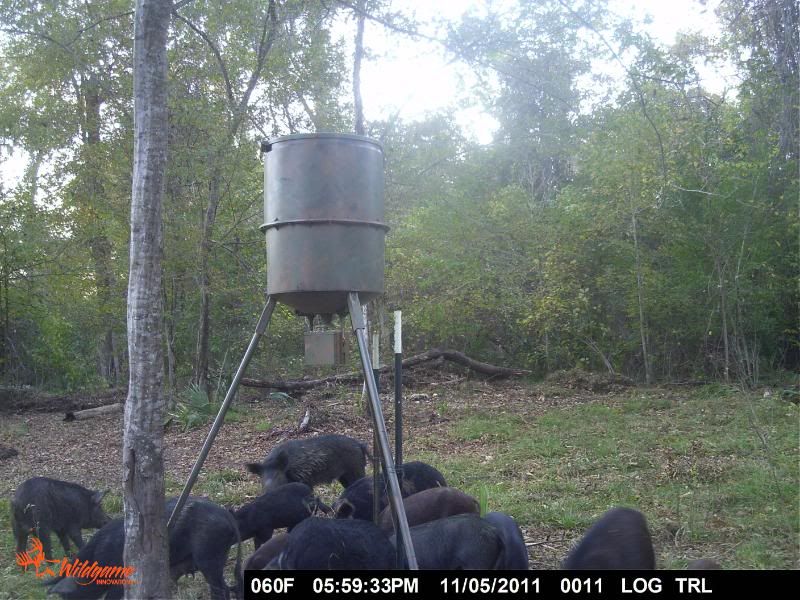
I miss the old days, where people actually went out in nature and actually saw the wild game in person, learned their habits and the whole thing. Those were better days.
I disagree. I absolutely love spending time alone in the woods, but cameras definitely have their place. I keep cameras to keep an eye on the hog population, to check for trespassers, and to identify cull deer that I no longer want in the reproductive chain so the deer herd will be healthier. I also just like pictures of animals. We have a huge bobcat, that I’ve never see in daylight, but at least I can admire him through pictures at night. Without cameras I’d never know he existed.
I live several hours away from our property, and I don’t get to spend much time out there. Cameras help me figure out doe to buck ratios so I know how many does to shoot. There have been years I only shot does because of the lack of bucks seen in person and on camera. Regarding deer, the way our property is situated, it’s not like any other property I have been on. It’s a 100 acres of the best chance to see wildlife I’ve ever seen. I see wildlife every single time I go there. I’ve counted over 50 deer in our field at once.
Unfortunately, deer generally do not bed on our property. They come from all over to eat the 13 acre field of wheat and oats we plant, then leave to bed elsewhere. They never stay on it, so it’s hard to know what’s going on. I’ve set up stands near heavily traveled trails and never see an animal. Cameras tell me that a specific group of deer consistently use that trail coming into our property at 1 in the morning and they leave out at 4 in the morning.
Due to hunting on surrounding properties, there is a huge amount of nocturnal activity on our land, activity I’d never see without cameras. Even the cameras don’t tell the whole story. I stayed late one night after hunting to see what hogs would come out. Using my night vision binoculars, I stopped counting at 80 hogs in the field at 9pm.
Your last picture is the one that would scare the crap out of me. Pigs/Hogs/Boar are crazy and mean!!!
I have little electronics knowledge, but could you use a linear regulator like the 105C to power the camera from 2AA, the camera can accept the 3V-ish it wants and the 7135s burn off the rest?
Also many cameras will take a different voltage if you run them off the A/C adapter the company sells (usually a plug somewhere on the body), that might be closer to the li ion voltage.
Awesome pics btw
i still don’t fully understand :bigsmile:
But could you “hack” the camera so the motion controller cuts the connection between the 18650 batteries and the dc-dc converter, instead of between the batteries and the camera?
otherwise, look for a linear regulator with correct output voltage, there’s several that should suit your application. the boring part compared to a dc-dc converter is that the extra voltage will just be burnt off as heat. so your 3-4.2V ~9Wh 2600mah 18650 battery will “become” a 2V, 5.2Wh, 2600 mah battery…