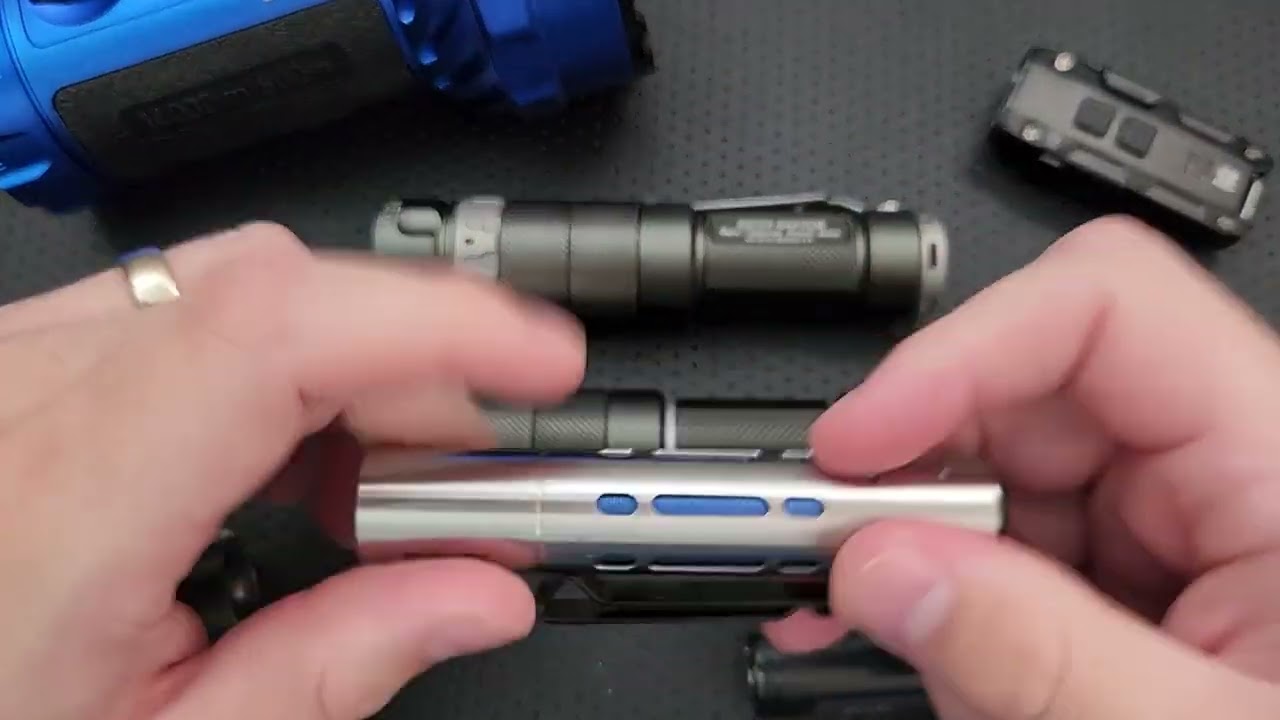
I came across this video and thought it was interesting, I pretty much agree with everything he is saying.
I have dozens of flashlights with probably a dozen different interfaces, and it can be annoying to try to keep track of them all.
I have an RRT01 and I really like it. It is generally plenty bright, it has a nice throwy beam profile, it has a nice emitter, and an easy interface. I think it also has the lowest low of any light I have.
It’s nice having lots of features, but when it comes to something like Anduril 2 (or with the active development, Anduril 37), half of those features are inaccessible because I haven’t sat down to study the epic poem that is the instructions.
Glad to hear more good things about the RRT01. I ordered one of these a few days ago for a great price on a Black Friday sale. Still waiting for it to arrive, but after watching youtube reviews, it seems like a great light. I’m planning on keeping mine small, but knowing me, I’ll get the urge to try the extensions at some point, just because they exist.
I agree about the proprietary / non replaceable batteries. Not for me. Too much chance of that coming back to haunt ya.
As for those rectangular lights - I’ve never warmed up to them enough to want one. Maybe it’s tradition, or just me being old school, but I want my flashlight to be cylindrical, dang it.
I think the problem with rectangular is mainly having proprietary or nonreplaceable batteries. A Wuben X1 is on my “maybe a good deal” list because it doesn’t use proprietary ones.
I don’t really think of e-switch lights as tools. Clicky’s are more reliable imo. E-switches are fun to play around with but my users are mostly clicky’s. The only exception is head lamps with physical lock out.
I have an original RRT01, and it’s pretty good. The beam is particularly nice, and the interface is dead simple.
It has some downsides though:
Really poor efficiency, especially on low modes, so the battery doesn’t last as long as other lights. I mostly use low modes, so this one really hurts… like, I have to charge it about three or four times as often as other lights with similar-sized batteries.
A tendency to self-drain its battery in just a few days, while making no light, if the control ring is even slightly out of position … which can happen easily while carrying it. So after draining a couple batteries that way, I got in the habit of compulsively twisting the ring to ensure it’s actually off.
No battery check function, so I can’t tell how much power is left.
No LVP, so it requires protected cells… and the only way to tell the battery is low is when the cell’s built-in protection circuit trips and disables the battery.
Protected cells cost more and generally seem to hold less energy. The biggest ones I have which fit the RRT01 are 650 mAh… but I get 900 to 1100 mAh on other lights of its approximate battery class (14500 / 18350).
With the above issues, I end up paranoid that the battery is going to cut out at any moment, and I find myself using the lowest brightness levels I can, to extend battery life… but it doesn’t help much due to the poor efficiency. At moon levels, it uses about 12X as much power as most of my other lights.
No consistent output levels, so I can never tell if my eyes are tired or if I just have the light turned down.
Mine is the original 18350 model with no tail switch.
Anyway, it’s a really neat light… but it has been sitting unused on a shelf for years because I prefer other lights.
For general-purpose use for non-enthusiasts, I’d recommend something with standard 18650 or 21700, a built-in USB-C charger, a battery indicator which can be checked at a glance, a balanced beam (roughly 5 to 20 cd/lm), overheat and low-battery protection, at least a year of standby time per charge… and ideally a UI with very simple core functions: click to turn on or off, hold to change brightness. Keep the torch somewhere visible so you can find it in the dark, and charge it when the battery indicator turns red.
And they dare to charge $100 bucks for this… Goes to show that no product is perfect and you can only find the faults when you actually use it for a long time. From your experience, many of those faults seem to be deal breakers to me, so I will stay clear for this expensive light. Thanks for sharing the knowledge.
1 year stand-by seems hard for a e-switch light though. For a simple mechanical tail switch light with good construction, good beam and long battery life, do you have any recommendation? A lowly S2+ with one of the mode groups which includes battery check and mode memory off seems like a good stand-by light for emergency.
Not really. Most of my 18650 (or bigger) lights get 2 or 3 years on standby per charge, even with the RGB aux LEDs turned on the whole time. Like, the Emisar D4K-boost I’ve been using… with a 5000 mAh cell, it should last about 4 to 6 years per charge with the button LED and RGB aux enabled. … and if I turn the aux LEDs off, standby time increases to 10+ years.
With a little 14500 light like the Wurkkos TS10 Ti, using Anduril’s default settings (aux RGB voltage mode, low brightness), it lasts about 6 to 12 months per charge and it’s bright enough to light my way to the bathroom at night. Or with aux LEDs off, more like 3 years per charge.
Meanwhile, the RRT01, if I put it at a brightness where the LED is just barely on, like a firefly level or below… it drains its battery in about a day and a half.
Anyway, the light I’d probably gift to a non-enthusiast these days is a Wurkkos FC13 SFT40. It’s not perfect, but it’s pretty good at all the essentials a new user would need.
I vaguely remember this video… I have one RRT01 which I bought customized when the Nichia 219b sw45k was the new hotness - it’s only purpose is to showcase the rosiest emitter I have and give me something to fidget with…
Nick Shabazz is good dude, but he’s definitely got his own opinions. I’ve watched his knife reviews go from the same kinds of stuff I can afford to the really high end of production and even custom knives as his channel has progressed. He may not have the viewership of some other YT channels, but I’ve always respected his views on knives. Flashlights, though - that’s a whole other story.
This is definitely one of those “one person’s point of view” videos in my humble opinion - he’s not “wrong”… it’s just “right for him.” Which is kind the state of things for all these reviewer types so I just look for ones that justify MY view and then I can claim I’m right.
Not really, not at the power consumption for output of less than 0.1 lumen the power draw is milliamps.
Those lifetime figures are for when the led is running at the datasheet spec current (a few amps maybe more) and usually much higher temperatures than ambient room temp.
Its a complete waste of everything imaginable to leave the aux lights running year round. I cant think of anything reason to do so. If you do have a valid reason post it here, I can use a laugh.
He is mostly wrong but even a broken clock is correct once or possibly twice per day depending on what part of the world you live in. When the power goes out I reach in my pocket or my other pocket. He wasn’t carrying a light so he’s wrong big time at the very beginning. Then he says the first thing he reached for is a big fancy honkin’ light that he says he’s going to put in his pocket that he’s only used a few times probably for a review and then put it in a drawer and forgotten. His second choice is a fancy light that he doesn’t again use on a regular basis and can’t remember how to unlock it. So he likely has a pretty reliable power source and never really thought about what he would do for emergency lights. That is a serious error on his part. On his third swing he reached for that rrt thing and said that it worked. That means he didn’t have the tail cap or head loosened so that it was not locked out. That is a serious mistake that he apparently still doesn’t understand. So he got lucky on his third swing. And he’s buying 18650s with micro USB rechargeable ports on them. Maybe not a big mistake but certainly not something anybody here would recommend. If you want a rechargeable port on it at least get type C. So in the end at least he settled on an 18650 (size even if it’s not a standard length that will fit in all lights) and a relatively simple UI. And he concludes that he needs to be able to pop in spare batteries. As toy keeper points out you have no clue how much capacity is in those batteries in that light. So as she said that’s not the best light. One that is rechargeable without taking batteries out is a better choice for most people. And spare flashlights with batteries in them is probably a better choice than carrying spare batteries around. LOCK OUT YOUR LIGHTS WHEN NOT IN REGULAR USE.
I have my ZebraLight SC700d turned on most of the time so that I can see. Blackout curtains block light coming in. It sits on my bedside table on the lowest mode.
I was using aux lights on my D4SV2 but they (e.g. yellow/orange) seem brighter than the lowest mode of a SC700d. The TIR optic is shallower so the aux lights look brighter when I look directly at the torch sitting on my bedside table. The SC700d has a deep reflector where I can’t accidentally look at the LED and the beam reflects off of the ceiling.
The way LED life spans work is sort of logarithmic. Using the manufacturer’s spec as a baseline, the rated life is like…
50,000 hours @ 3 A @ 85 C
But change the power and temperature, and the life span changes too. These are only rough estimates to give an idea, but…
50k hours @ 3 A
25k hours @ 4 A
10k hours @ 5 A
1k hours @ 6 A
100 hours @ 7 A
1 hour @ 8 A
10 seconds @ 9 A
… and it has a similar pattern in the other direction. They can get hundreds of thousands of hours by turning the power down, or potentially millions of hours when using them at a tiny fraction of their rated power. I’ve had LEDs run nonstop for decades until the device they were in was eventually retired for other reasons, and LEDs have gotten a lot better since those were made. (FWIW, 10 years is about 87.6k hours)
Aux LEDs on low mode are on the long end of that scale, and can typically be treated as if they have an effectively unlimited life span.
I’d say we’re worrying about peanuts, but … that would be an understatement.
Powered at a common rate of about 0.1 mA (i.e. 2 to 3 years to drain a single 18650 cell), it provides a firefly level of illumination and color-coded battery status in exchange for about 3 Watt-hours of energy per year. For comparison, a single peanut holds about 7 Watt-hours of energy.
Doing the math, that means “a complete waste of everything imaginable” is equivalent to half of a peanut per year.
Most of the comments made have to do with finding your light during an outage. If you keep your aux lights running continuously you wont have a light to use during an outge.
Seriously, if you tell me you keep them on because you think they look cool, I can respect that.
Remember the light is a tool that you choose to own in case you ever need it. If you need it for whatever reason and it does not work or only runs for 15 seconds because you wanted to keep the aux lights running continuously, that will be a real sad day for you.
Remember, the light is not only for walking your dog. What happens if you need it to prevent a crime against someone or against yourself and your battery is close to dead because you were running the aux lights for the past ten months.
Come one, is this the best argument you can make? Keeping the aux lights on continuously so you can find it in the dark? Seriously?
As the saying goes, “Even a broken clock is right twice a day.”
Not gonna be a sad day here as there are over 100 other flashlights ready to go with at least 40 with batteries charged in them. At least 50 other 18650’s as well. Hoarding does have it’s benefits when needed.
Lanterns, Check, both battery and old school Coleman.
Matches and lighters, Check.
Aux heat source, Yep.