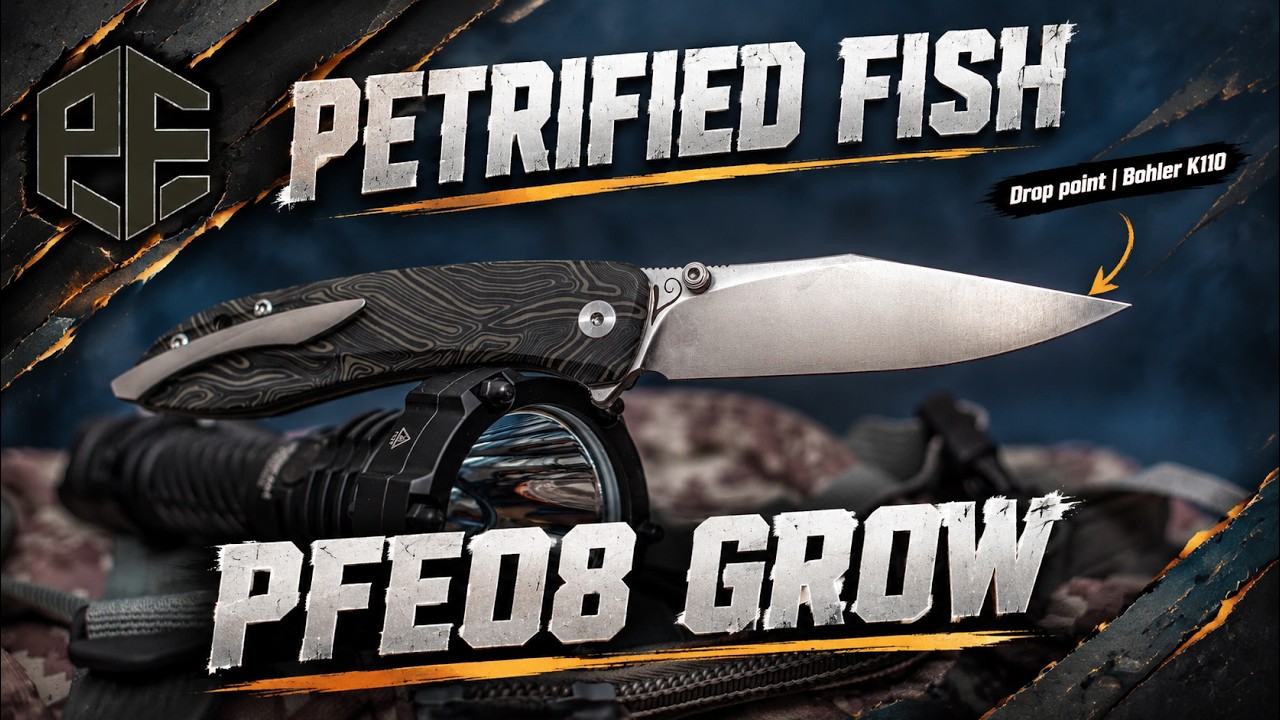
Specifications
- Model: Petrified Fish Grow PFE08 GRDMS
- Type: Folding, Drop Point blade, Flipper, 2 Thumbstuds
- Blade: Bohler K110, HRC 60-61,
- Overall Length: 20.7 cm \ 8.15"
- Blade Length: 9.2 cm \ 3.62"
- Blade Width: 2.3 cm \ 0,9"
- Blade Thickness: 3.4 mm \ 0,13"
- Handle Length: 11.5 cm \ 4.52"
- Handle: G10 (including Gmascus)
- Locking System: Button lock
- Accessories: Titanium pocket clip
- Blade grind: Flat
- Blade finish: Satin
- Pivot system: Caged Ceramic Bearings
- Weight with G10 scales: 108g \ 3.81oz


PETRIFIED FISH PFE08 GROW at AMAZON | ALIEXRESS | PETRIFIED FISH OFFICIAL WEBSITE
PACKAGE AND LOOK
The knife comes in a black, textured sealed box tucked inside a slipcover featuring a die-cut brand name. It isn’t a luxury design, but the packaging is certainly decent, and it looks good enough from a standpoint of gift as well.
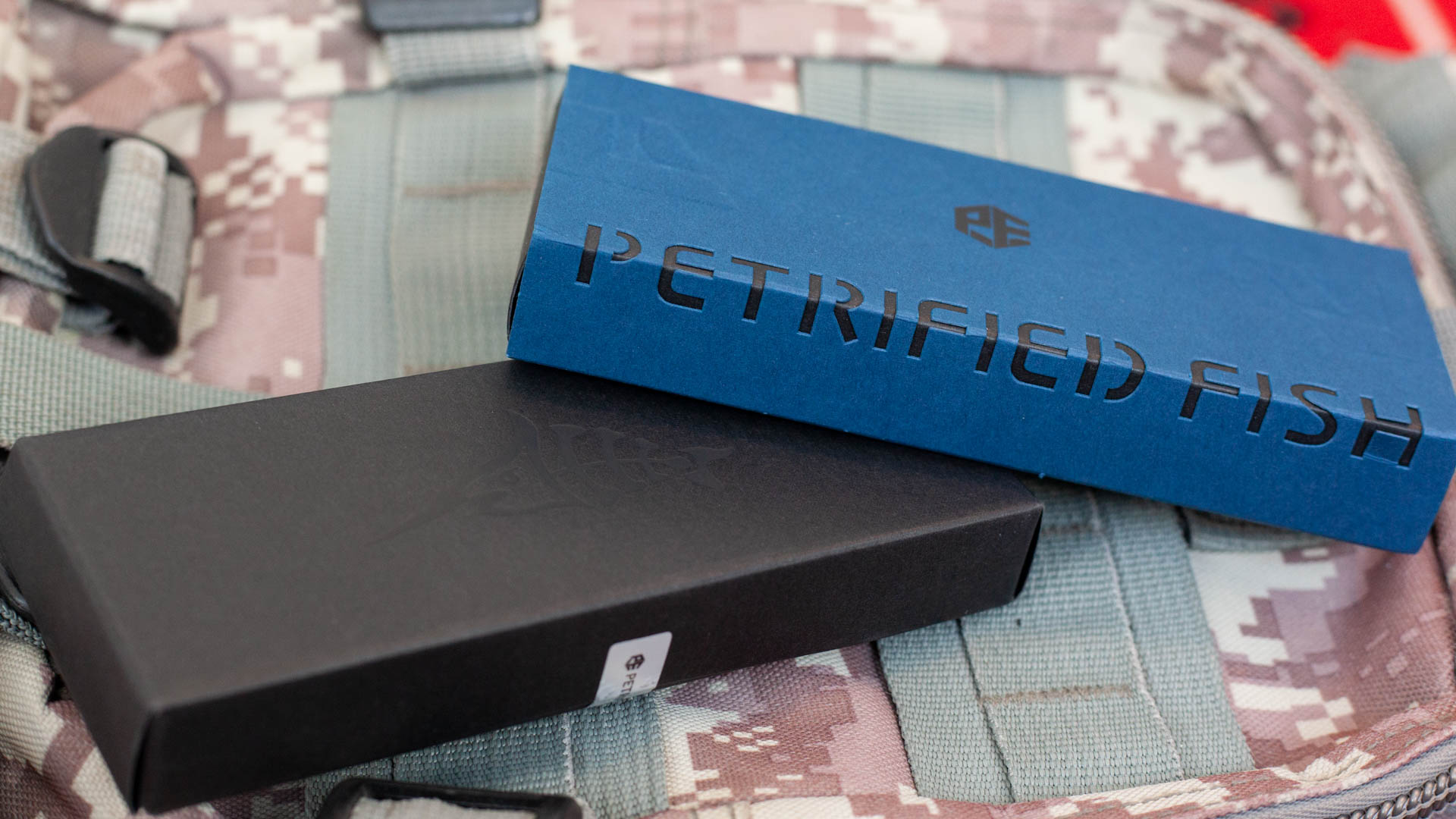
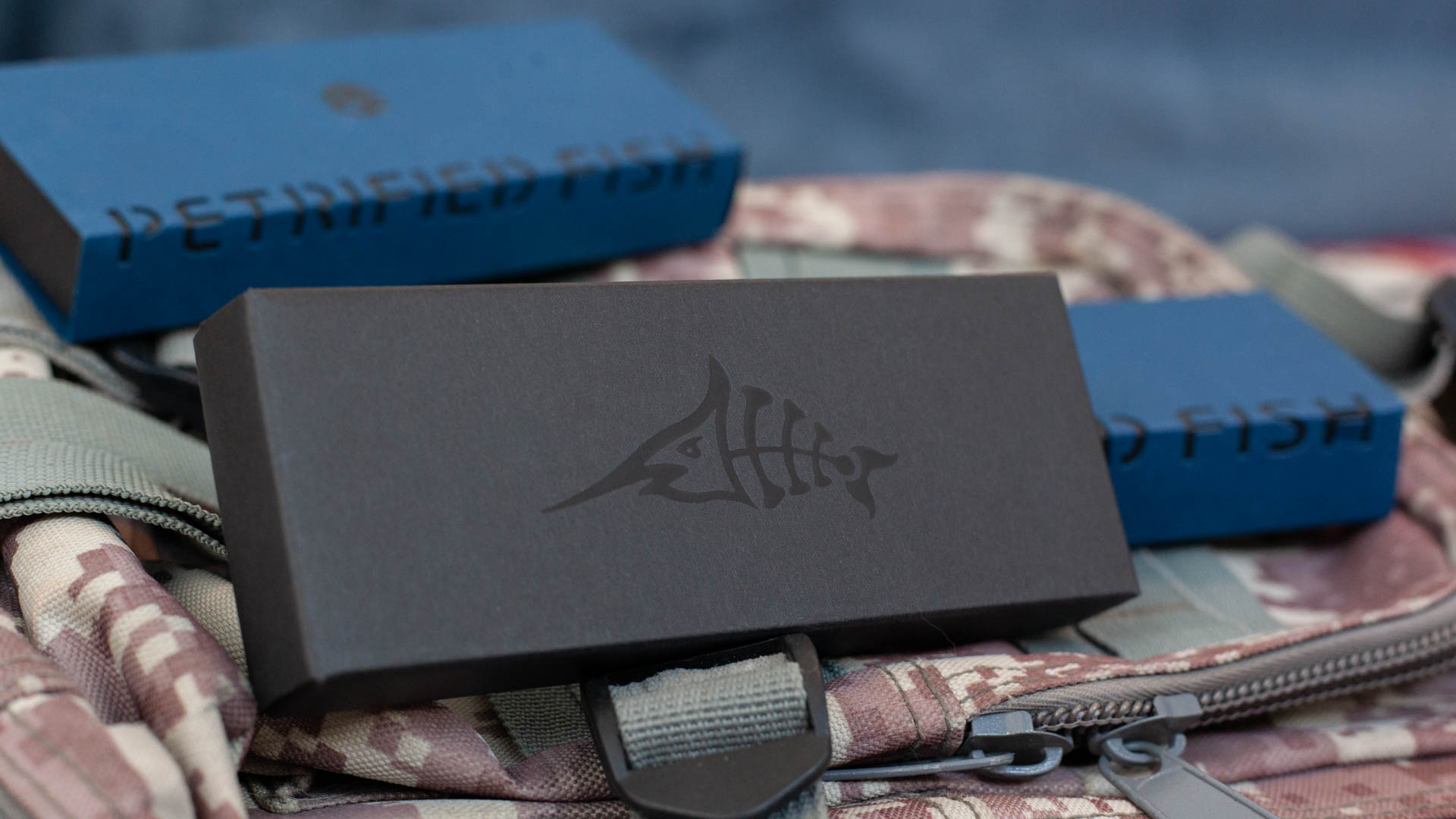

The kit includes:
- Petrified Fish “Grow” knife
- Cleaning cloth
- Sticker
- Packet with silica gel balls
- Several spare screws


I have no idea why manufacturer have chosen “Grow” for model name. When I look at this knife, a predatory fish immediately comes to my mind. And not just any predatory fish, but a specific one: the pike.
The knife shares that same sleek, narrow silhouette and a body that curves gently.


The knife is medium-sized. It is neither a compact model designed specifically for easy pocket carry nor a large one that relies on blade size for utility. Instead, it is the knife with common size for EDC tool. It won’t weigh down or bulge out of your pocket, yet it offers a secure, comfortable grip and a practical blade length.
The handle scales are made of fiberglass laminate G10 and PFE08 model line includes version with a Damascus-style pattern known as “Jmascus.” As shown in the photo above, the Jmascus option comes in two colors. If you prioritize grip reliability, there is also a classic black version featuring a grippy, micro-textured surface.
The grip is comfortable. Edges of handle scales are beveled, nothing digs into the palm . The undulating longitudinal groove in the scale not only makes grip more firmer, but also adds a sense of swiftness to the silhouette, lending it a certain dynamism.


The clip is located on only one side which is CON for someone. However, it is attached right at the very end of the handle, which will undoubtedly appeal to fans of deep carry; the knife will be completely invisible in the pocket.
The clip’s design is outstanding. The manufacturer claims it is made of a titanium alloy, and that seems plausible. In reality, the material doesn’t matter much to me; what I really appreciate is its ergonomic, non-aggressive, and smoothly flowing shape, free of sharp edges.


The manufacturer’s logo is engraved on the head of the nut into which the screw holding the blade is threaded.

The lanyard hole is quite wide. I’ve come across the opinion that it should have been positioned closer to the edge. Reasons? Lanyard can catch on the pocket’s edge when you put knife in pocket.
I tend to agree with that. If you look at photos of the disassembled knife, you can see there is enough room in the handle to move the lanyard hole closer to the edge. I dont use lanyard at all, so that is certainly not a problem for me at all.

The knife employs two thumbstuds, a flipper tab to deploy and a button lock to close and lock blade . I`ve also met a feedback that i agree with. The thumbstuds should have been positioned slightly further away from the handle edge. They are right up against it now, leaving simply not enough room for the finger intended to press on them.
I don’t mean that the thumbstuds are unusable as they are now, they are far from it. My point is that they aren’t as easy to operate as those of other PF knives; this placement requires some getting used to, and you have to apply pressure from the top rather than the side.


However, in practice, I much prefer using the flipper tab, as it allows for a significantly faster blade deployment. OMG, it works like some fidget toy. I just press a little bit and blade is being catapulted out of the hande. Then loud “click” and i press button to close blade.

The model name and type of steel are marked on one side of the blade base, while the opposite side features an abstract, flowing shape. Given that the brand name includes the word “fish”(which is implying river, lake or sea), I would assume that this silhouette represents a stylized seaweed.


The button can be used not only to close this knife. Thanks to ceramic bearings, the blade moves with exceptional ease and smoothness, so effortlessly, in fact, that it can open under its own weight; you simply need to press the button and tilt the knife so the blade points downward.
You can see this in action in the final part of the video review.

So, I’ve finally reached the most important part: the blade itself. Here we have a drop-point blade made of Böhler K110 steel. And this is a high-carbon, high-chromium cold-work tool steel produced by the Austrian-Swedish conglomerate Böhler-Uddeholm using the electroslag remelting process. This steel features a complex and interesting composition; it holds a fine edge, offers significant hardness and high toughness. Its typical hardness range is 59-62 HRC. This steel is used in the manufacture of knives in the above-average price range.
The blade is perfectly centered and has an elegant shape with a fairly narrow tip. This type of tip should be effective for thrusting, though one must be careful not to snap it off. In this regard, a tanto is far more robust. There there is no back


However, tanto is flat blade and it definitely falls short of the PFE08 when it comes to cutting comfort and ease of sharpening.
As for the sharpness right out of the box, the edge of PFE08 blade is razor-sharp, just like with the other Petrified Fish knives I own. The knife easily passes all those funny sharpness tests: it shaves hair and slices through paper as well as the soft skin of overripe tomatoes.

Usually, a knife is used to look at insides (as Bart Simpson said, “knife goes in, guts come out”). But I propose taking the knife apart and looking at its insides.
The knife is quite easy to disassemble, making maintenance simple. Beneath the handle scales, we see the frame - featuring circular cutouts for weight reduction, and two ceramic bearings that provide the blade’s effortless, smooth action.
By the way, take a look at these screwdrivers with the unusual handle design. Petrified fish also sells a set of two such screwdrivers - perfect for the standard screws that hold the two halves of the casing together.


Overall
The PFE08 is a knife that is pleasing to both the eye and the hand. It features attractive, high-traction handle scales with a Damascus-style texture. The opening and closing mechanism is incredibly simple. The blade action is sooo smooth that you find yourself fidgeting with the knife even without any practical need to cut something; you just want to press the flipper tab and hear that satisfying click as the blade locks into place. Then press button and see how blade literally falls back into handle. Then repeat.
The clip allows for deep-carry positioning, though it is limited to one side only.
Regarding technical drawbacks, I can point out only one thing: an extra 2mm of clearance between the thumbstud and the handle would have made opening the knife via the stud much easier.
The last minute of PFE08 video review shows how blade moves and how sharp it is. Though i appreciate, if you see full video (that is just 3 minutes long) and like it.