I’ve been using lights for a long time I’ve tried them in many different situations and time and time again whenever I’m using less than 800 lumens I start cursing and I start cursing loudly I literally yell it doesn’t work for me
It’s amazing how happy I was to have 200lm from a mini aa maglite back in 2014–it felt enough for whatever task I had. Nowadays somehow it feels less enough for the same tasks, even though nothing has changed other than the availability of other, brighter options.
It’s possible that the availability of better tech is just making us greedier, as we evaluate tools not based on their absolute performance, but performance relative to the competition. If someone from 2000 had a LED flashlight that puts out 800lm, I doubt they would start cursing loudly (or quietly) about it being not enough for their needs. By 2050 we may well be cursing about how 10,000lm is too dim for EDC…
3 Thanks
So…you’re looking for an area/work light, not a flashlight, lol…for a work light, I get it…more lumens is more better, up to a point. You don’t really need the fixture to have the single brightest LED at that point, you could just set up an array with more surface area on the heatsink. 2k lumens out of an array of 10 LED’S is much easier to cool than 2k lumens out of one LED, depending on the arrangement…
If your dark adapted eyes cannot see with less than 20 lumens, you might want to see an optometrist or some other vision doctor…
Most LED’s going to above 300Lumens are likely to be driven at 1A+, likely at least 1.5A, even. It WILL get warm to the touch if it’s a flashlight. Another thing you could look into is actively cooled lighting, with little fans and thermistors/thermostats to regulate the airflow in/on the light. I put my 2000 Lumen maurauder mini in front of a floor “turbo” fan, it stayed pretty cool, until I left it out of the wind…it got warm pretty quick.
I’ve recently (within the past 4 years or so) fallen back to sub 1kLm lights for sustainable runtime. As it pertains to this particular diamond LED tech, I can see it being beneficial on panel/array style lighting, or even outdoor fixtures where active cooling could help the LED to run brighter for longer. It would not be very beneficial for pocket sized lights unless we start using some one-way thermal superconductors to instantly wick the heat from the components to ambient air or our hands.
1 Thank
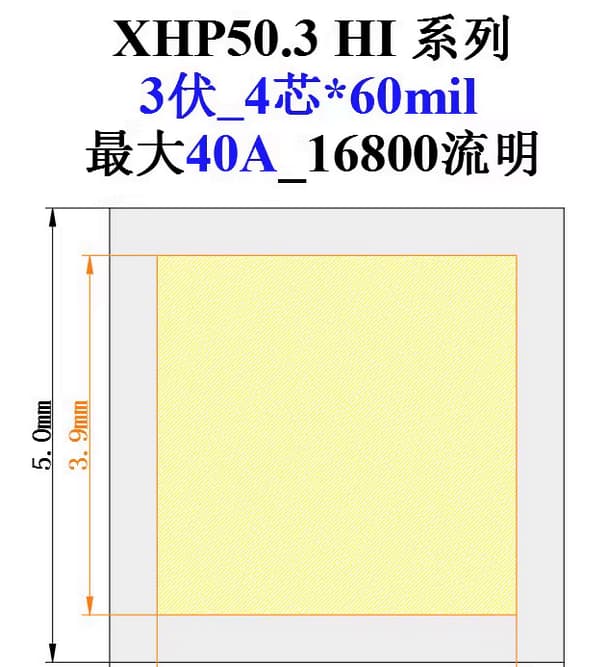
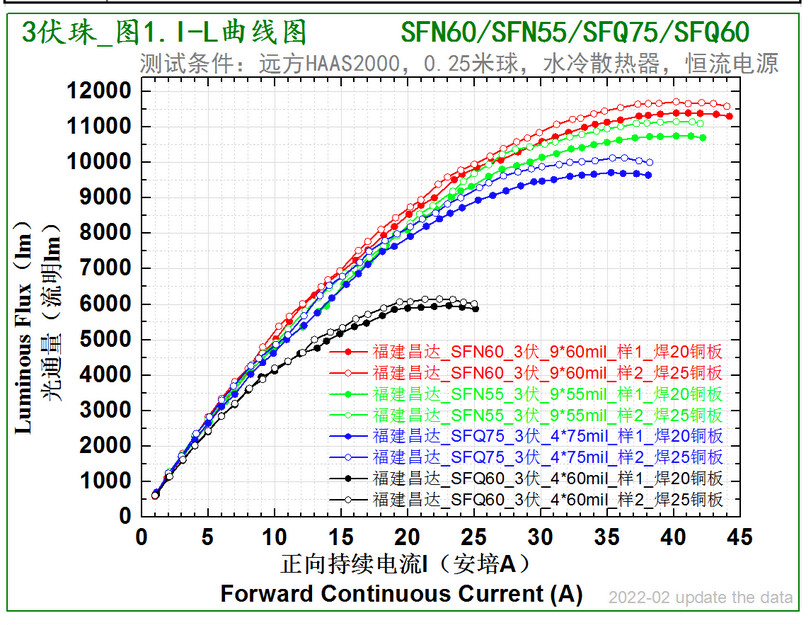
Changda’s product description on a site, “XHP50.3 HI” here means SFQ60. But I checked it again and found that this may be seriously exaggerated. Because they showed in another site with detailed test curves that it would saturate at 20A. I’ve corrected the post.
1 Thank
Thanks, also for that chart!
I was planning to use it with a FET driver (from Convoy) and am aiming for around 16A, which should be fine according to that chart.
The lumen readings in this chart seems way too high. I got around 9000 lm for SFN60 cool white at maxium of 30 Amps. We are talking about a huge difference which would be clearly noticeable in my measurements and setup…
The lower max current could be just manufacturing tolerances though.
3 Thanks
I already thought the output numbers were a bit high, from what I’ve found before on the SFQ60, so your statement makes sense.
The SFQ60 should be able to survive the short 16A bursts, but if it doesn’t, I will just drop in a different LED in that flashlight! I’m am going to find it out, one way or another.