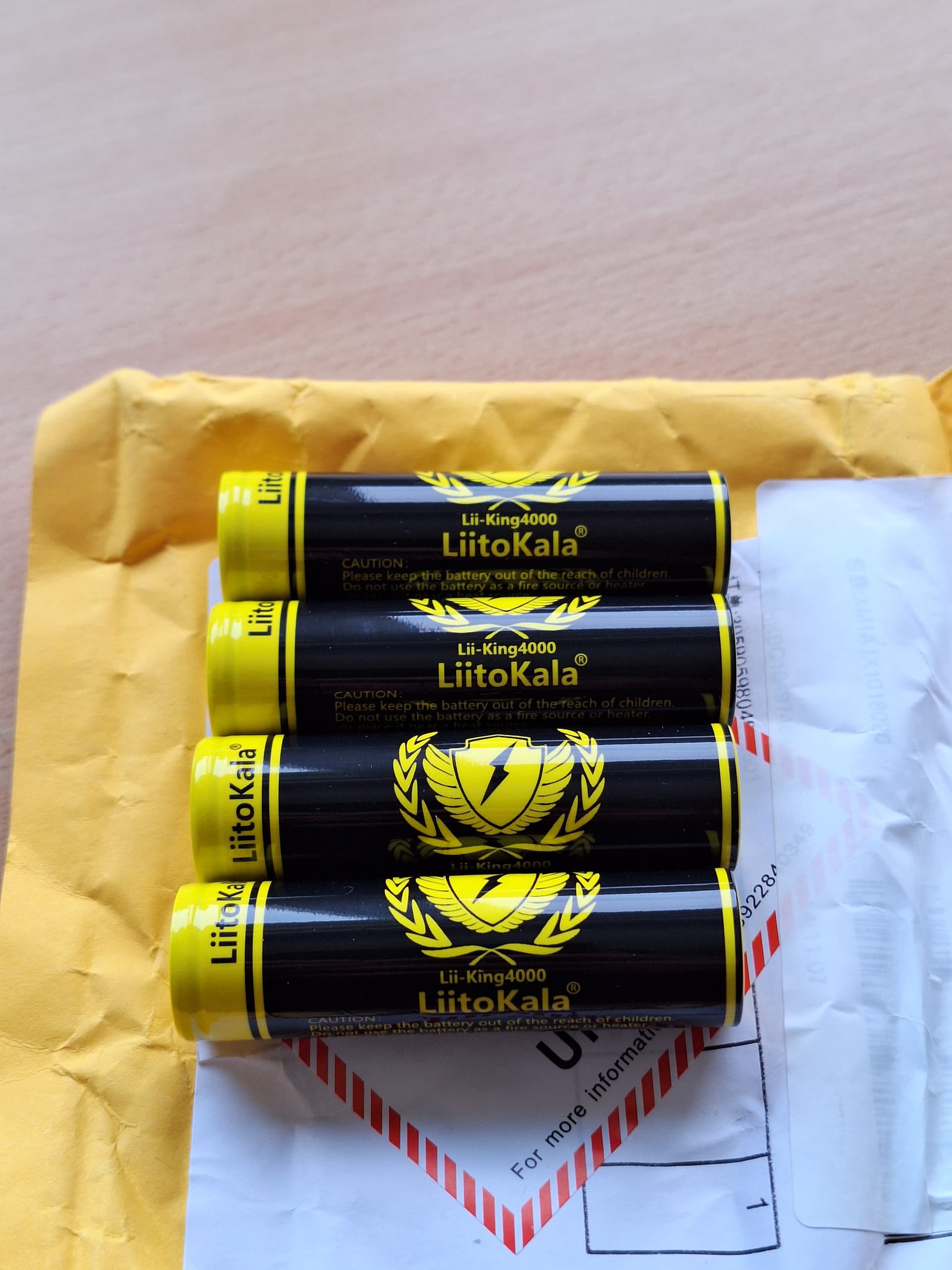
Just picked up four of these for less than a tenner from “liitokala Offical Store” on AE.
Too good to be true?
Just picked up four of these for less than a tenner from “liitokala Offical Store” on AE.
Too good to be true?
Link?
I think this one
That store also has 26650 7Ah and 21700 6Ah but those aren’t super cheap.
Yep. That’s it.
I’ve seen, more or less, the same offer also here in the EU. (Roughly € 11,- for 4 pieces.)
From what I’ve checked in several reviews (with images) on Aliexpress, a lot of people have tested them with their battery chargers between 3800 and 3900 mAh capacity, if I remember correctly. I believe I haven’t seen a measurement with a dedicated 4-wire capicity tester/electronic load, which would be a bit more accurate.
I’ve just ordered 4 of them now and am planning to test them on my DL24 tester.
Just a tip for people that use the Aliexpress app: If you add several listings/offers of this battery (and possibly other LiitoKala batteries) to your cart and then check the ‘Coins page/section’ in the app, you get a lot of offers for high discounts using your coins. For example: The 4 I just ordered, went from € 11,89 down to € 6,78.
I have one 7000mAh 26650 (the Lii-70S), that I’m currently testing. Normally I refuse to buy 26650’s, but I found an offer that brought it down to € 5,70, which was low enough that I was willing to order one, just out of curiosity.
As described above for the Lii-King batteries, I’m pretty sure that good discounts can be found in ‘Coins section’ in the app.
I bought the PCB version with discharge current 12A(claimed). However, my Terminator M2 turns off on turbo, which draws 9.4A (as 1Lumen measured in 3200LM M2)
Yesterday I recieved my 4 Lii-King 4000mAh, ordered from the Liitokala Official Store on Aliexpress.
I haven’t had the time to do a discharge capacity test, and probably also don’t have time for it in the next couple of weeks, but I did check the voltage and internal resistance (ACIR) upon arrival, to see how close they match, and they match pretty good, which might be a good sign for consistent quality.
Values of the 4 cells that I measured in random order:
The storage voltages seem to match really closely, which is good. Maybe a tiny bit on the lower side, but certainly nothing to get worried about.
The (AC)IR numbers are also pretty close, which is very nice to see. The difference between battery 3 and 4 (15,38 vs 15,06) might seem a bit big, but when were already measuring so low into the milli ohms, those variations are still very acceptable.
According to the AE listing, the Internal Resistence (AC pressumably) is listed as <16 mOhm, so all batteries are within spec.
Out of curiousity I also did a quick check, to see if the weight was also within specifications, which should be 48g (+/- 1) and all batteries weighed in at around 47,3 grams, so also within spec.
That’s all that I can tell for now, untill I finally have time to run (individual) capacity tests on them, but that might take a while.
I performed a charge/discharge test on my Lii-M4S. Somewhat confusing results across cells:
Cell 1:
DIscharge: 3993 mAh
Charge: 3693 mAh
Cell 2:
DIscharge: 3820 mAh
Charge: 4115 mAh
Cell 3:
DIscharge: 3767 mAh
Charge: 4056 mAh
Cell 4:
DIscharge: 3751 mAh
Charge: 4350 mAh
It’s a cheap charger and I don’t really have much confidence in it at all.
Did you tested the batteries in the same slot or in several different slots in the charger? Different slots sometimes also give slightly different results, so to compare the differences in capacity, it might be good to test them all in the same slot, even though that takes more times obviously.
I also have an Lii-M4S, but I’m not sure if I have ever used the capacity testing function of it… 
Normally I use my Opus bt-c3100 for that and recently I started using a dedicated electronic load, to be able to do more accurate discharge capacity tests.
The downside of the Opus is that it stops discharging at 3V I believe, while official specs often state 2,7/2,8V (or even down to 2,5V in some cases), which could also make a slight difference in measured capacity.
I’m actually not sure at what voltage the Lii-M4S stops discharging.
Do you still know which battery is ‘Cell 1’ and ‘Cell 4’, from your test? Given that those are the most extremes in your discharge test, it might be worth testing those 2 (one after another) in the same slot of your charger, to see if the discharge capacities are closer to each other this way.
I used all 4 slots which was probably not a fair test as you say. I didn’t label the cells so I don’t know which is which now but I may do some retesting at some point. Just noticed one of the cell wraps has a small slit in it!
I don’t know if you have some kapton tape, but you could place a small piece of that over it, to protect it and/or prevent it from tearing further. Have you already placed it in a flashlight, because maybe that caused it, as recently experienced by PiercingTheDarkness: 【convoy】My alternate domain name " litnit.com" - #16368 by PiercingTheDarkness
Could also have happened before you got them ofcourse. You can always consider buying some clear 18650 wrappers from Aliexpress and put one over the Liitokala sleeve as an extra protection. Those wrappers are pretty cheap on Aliexpress.
I would like to do individual discharge tests on my 4 samples, but I haven’t got much time the coming weeks, so that has to wait for a while unfortunately.
I have some kapton tape. Good idea. Will do that. I put one of them in a Convoy S2+ but it wasn’t a tight fit. Will check out those sleeves on AE. Thanks!
also being discussed here
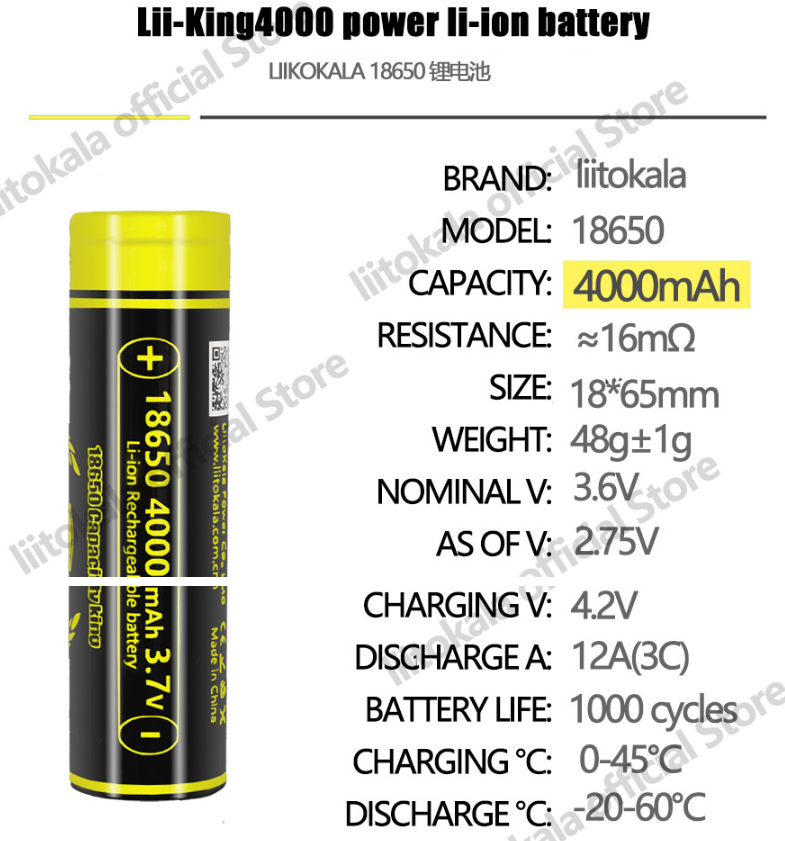
Does anyone know the Low Temperature Operating specification?
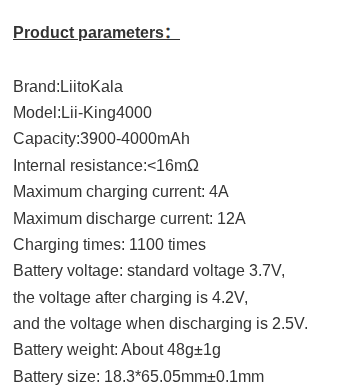
Here is the page on Liitokala their website with the ‘official specs’, but be aware that in certain places it contradicts itself: King4000 18650 4000mAh - LiitoKala Power CO.,LTD 深圳市鑫盛力电源有限公司
These images are from the same page I listed to above:
First screenshot says that it has 1100 cycle rates, 2nd image says it’s 1000. First image says the nominal (“standard”) voltage is 3,7V, the second says 3,6V. The first image says the discharge cutoff is 2,5V. The second image says “AS OF V: 2,75V”, which I don’t fully understand but that number only makes sense as a discharge cutoff voltage I think.
But on the second image you can see the operating temperatures.
thank you very much!
-20C (-4F) might be in the ballpark, would be nice to see some independent confirmation (I dont know where to find that)
My 3500mAh Skilhunt BL-135 is also rated to -20C
I dont believe the -60C for a 4000mAh cell, given that (my mistake)
the highly respected Molicel P30B 3000mAh is rated to -40C (-40F) (lower capacity is consistent with lower operating temperature limit)
What do you mean with the -60C? The 60C listed after the ‘DISCHARGE C:’ ?
The way I interpret the ‘-20-60C’ is like: -20C to (+) 60C. Just like the 0-45C is 0 degrees to 45 degrees.
Or did is mis that the -60C was mentioned somewhere else?
Thank You! that makes sense 
Im very new to this type of analysis.. much appreciate your help 
No problem, I’m glad I could help!
A year or so ago, batteries were only a small/“insignificant” part of my flashlight hobby, but over the past 8(?) months, bit by bit, I started to get interested more and more in batteries and things that are relevant to them. No clue why I suddenly started to enjoy reading about them and spending more time on it, but whatever is was/is, it added new interesting part to the hobby.
I’ve still got huuuuge amounts to learn about them and want to spend more time on testing etc, when I have the time, but I’m not in a hurry.
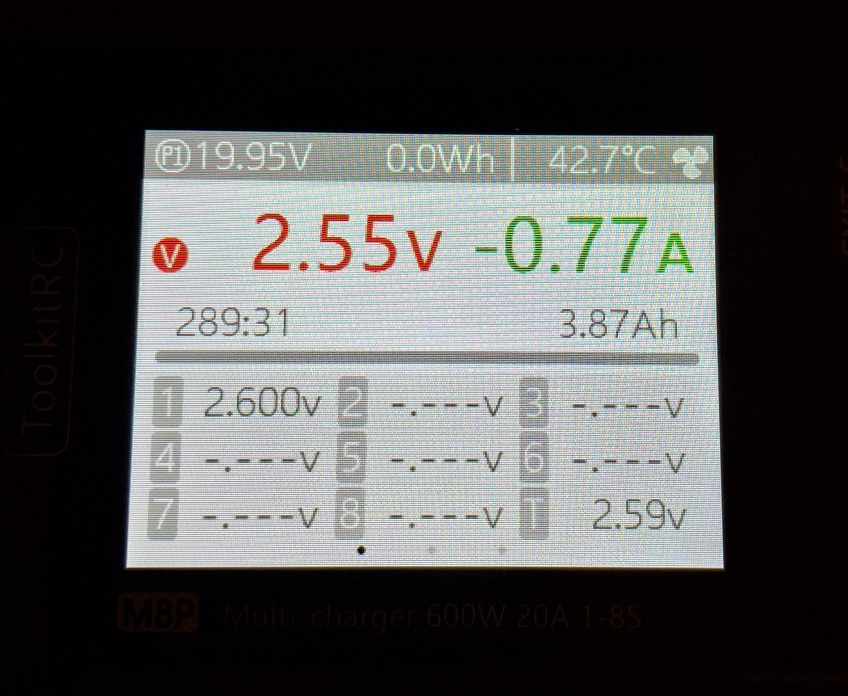
Discharge test with ToolkitRC M8P with 0.8A down to 2.60V.
Capacity: 3.87 Ah
This photo was made a second after switching to CV phase.
Update: 2A discharge and 2.50-2.55V cut-off gave the capacity 4.02Ah
Did you purposely choose 0.8A as discharge current, for it being 0,2C (of the cell’s capacity)?
I haven’t got much time the next couple of days, but I will try to test at least 1 of the 4 cells I have and for consistency I will also do the discharge at 0.8A. I’ve not decided what cutoff voltage to choose, since Liitokala mentions 2,5V, but also appears to mention 2,75V.
I will test it on my (“cheap”) Atorch DL24 digital load/capacity tester and the 4-wire battery holder.