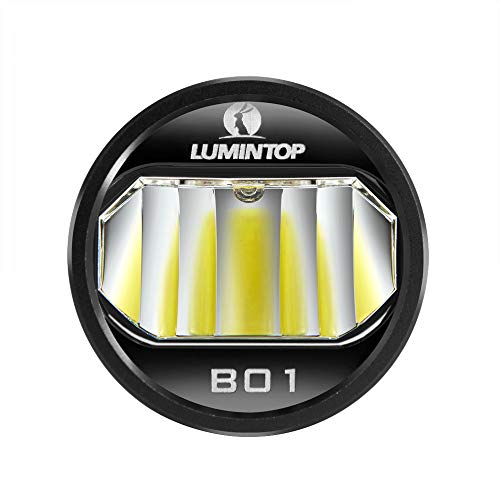
XPL-HD is a 3035 sized emitter, the flashlight has a bike specific reflector which cuts off the beam at the top like car headlights do, the emitter is placed to hit the reflector from an angle, the specified runtime on high (500 lumens) is around 3 hours on 21700. I’m fairly satisfied with the light (yet to test it riding) but the XPL-HD is an older emitter, anyone swapped it for something else with good results?

Hey Racoon, been a while. I needed the Lumintop B01 for my roadbike, ordered a couple Samsung 21700 50s cells for it and figured I’ve been away for too long so having the 21700’s I need a proper 21700 light so I ordered the Fireflies E04 Surge SFT60 10K lumen (waiting dor it to arrive) Man I have a bunch of gear sitring in drawers, dozens of emitters, drivers, various other flashaholic gear, I need to star utilizing it again.
Swapped to ffl351 and there were artifacts. Then swapped to nichia 519 and it’s good, I think dome saves it.
2 Thanks
Nichia 519 will not be as bright as xpl-hd if I understand correctly. Color fidelity isn’t something super important to me on my roadbike going fast at night, ideally I’d like more brightness than the stated 520 lumens on high from the xpl for ~3h. 2 hours at 700-800 lumens @ 6500K would be perfect. Are there any new emitters newer than the xpl that would fit the 3035 format for an easy swap?
You might want to consider the SFT25R. Bike lights are engineered to have a sharp beam cutoff, which necessitates a very small emitting surface for best performance. The SFT25R has a much smaller emitting area than the XPL-HD, with much better throw, much better regulation, and a bit more output too. The 5000K version also has great tint.
1 Thank
Don’t expect any visible change to the light output or runtime, though.
And I am not sure if the size of the die makes a lot of difference in such a reflector?
If the LED is easy to access and you are comfortable reflowing an LED, then just go for it, LEDs are very cheap (at Convoy)
1 Thank
Whenever the optical system is focusing and non-diffusing, the die size makes a difference. The B01’s reflector is approximately a paraboloid, just cut sideways by a plane containing the paraboloid’s axis rather than by a plane perpendicular to the axis, which is the case with the usual flashlight reflector.
Bike lights, like car headlights, should use as small a die size as possible to tightly control the beam cutoff, in a way that simultaneously (i) provides enough intensity on the path ahead and (ii) does not blind oncoming traffic. A large-die emitter can accomplish one objective but not both because the cutoff cannot be very sharp.
This is an important caveat–the output/runtime is essentially fixed by the driver, not the LED. Though a smaller-die LED can give the impression of being brighter due to higher intensity, even if the total output is around the same.
1 Thank
Very informative, thank you.
1 Thank
Beam cut-off won’t have much to do with the size of the die in this case. With the bigger die you’ll just get a fuller beam but the cut-off remains physically the same. A domed led might push the cut-off a little higher but I doubt it would be visible.
I’d try XP-G4 to keep things more or less the same but you’d gain a few lumen in the same CCT and CRI range. Not that it will make much difference as the output is limited by the driver anyways as it was mentioned before.
1 Thank
You won’t increase the output enough to notice by changing the LED. An LED with a similar illuminated area won’t get you more than a 20% increase, and you’d need instruments or a side-by-side comparison to notice a 20% increase.
A larger LED might get you more than 20%, but will also make the beam less focused. You may not perceive it as brighter. A smaller LED might be more focused, or might just make artifacts like another comment mentioned.
Without also changing the driver, the main reason to change the LED is to get different spectral characteristics, or a different beam profile.
1 Thank
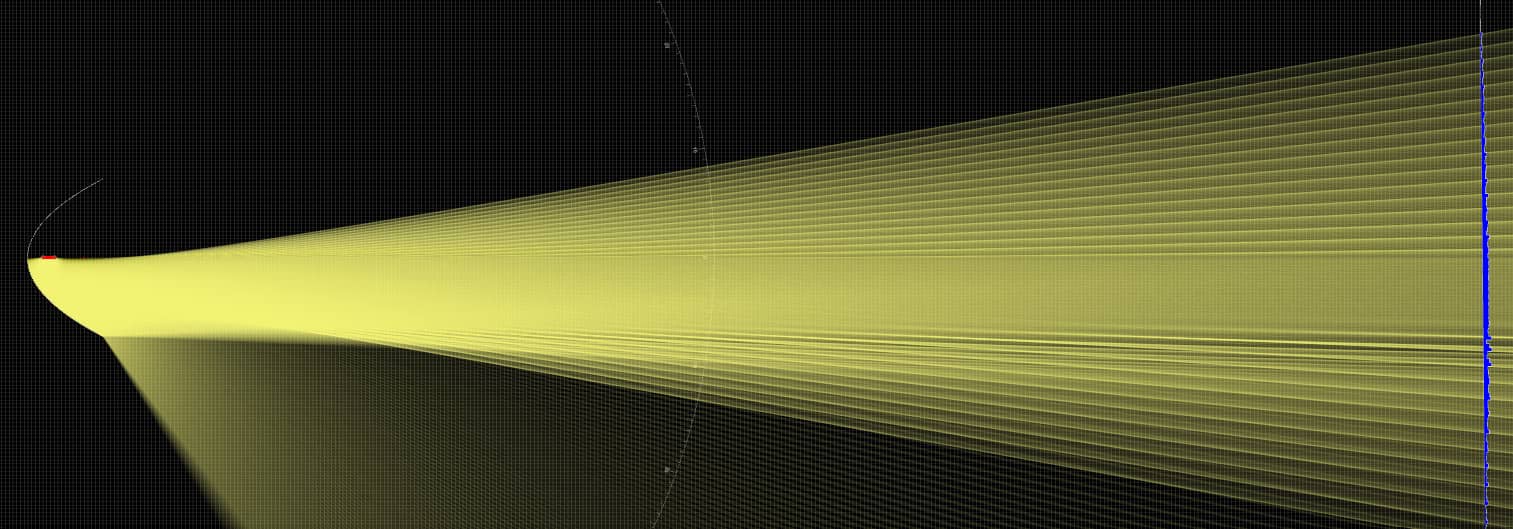
The beam cutoff still depends on die size. It’s just that the mechanism of cutoff is no longer blockage by a physical object, but beam spread after hitting the parabolic reflector. Here’s a simulation of what happens when die size is tripled:

The XP-G4 is not a good emitter in any department, in my opinion. The tint shift is horrible, which precludes its high-CRI variant from being competitive against the 519A and such. The emitting surface is domed, so throw doesn’t compare to SFT25R, but also small enough that it doesn’t gain much efficiency via low power density.
I think this is a reasonable summary. One potential advantage of a lower-Vf modern LED is longer regulated output, though it may drain the battery faster compared to a high-Vf LED, which lets output and power consumption fall very quickly as the cell depletes.
1 Thank
Yes, that’s all true but to triple the size, what led you’d have to use? Also the overshoot of the bigger die would be a bit more of a glare to the human eye. Like I said, not much of a difference, at least not in real life.
I’ll call it negligible for the sake of sanity
The point of tripling the die size is to demonstrate the dependence on die size, not to exactly simulate any scenario. If you’re interested in a realistic scenario, consider the following:
The SFT25R has an LES of ~2.26mm^2, while the XPL-HD has an estimated LES of 6+mm^2. So assuming the same output, the SFT25R has 6/2.26=2.6x more intensity, and also a cutoff sharper by a factor of sqrt(2.6)=1.6x. It’s gonna be pretty noticeable in real life, far from negligible.
This is exactly my reason behind advocating for the small-die SFT25R.
It’s not good in a C8 reflector, that’s true, but in a floodier setup it fecking shines. Ask me how I know it.
It’s “The Eye of Cree” in a tight setup
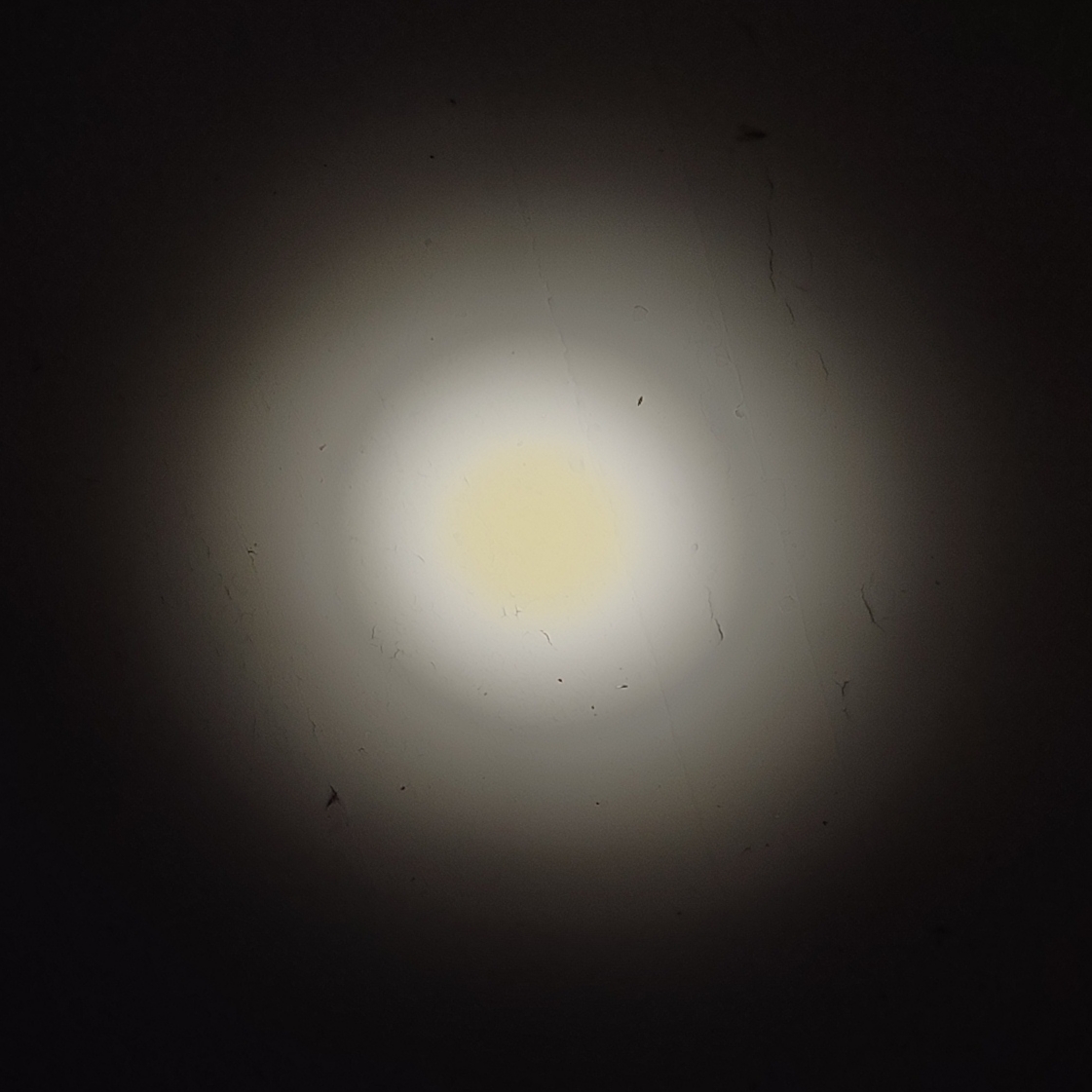
And the camera doesn’t even do it justice! But have it scattered out just a bit, it makes a really nice even beam with a really nice colour if you get the 80 or 85 cri one.
It also kicks ass in the lm/w department
1 Thank
I can imagine that the tint shift disappears with a sufficiently diffusive optic, but the bike light uses essentially a smooth reflector, which won’t diffuse the artifacts away. Plus, in a floodier setup, I don’t see a good argument for preferring the XP-G4 over the 519A, which has nicer tint+CRI and is floodier.
I was curious and checked koef3’s tests of the XPG4 and 519A, both in 5700K 90CRI. The XP-G4 has a slight efficacy advantage at low power, but above 2 amps or so the 519A actually has higher efficacy, despite the higher CRI (which lowers efficacy). So I would argue that in the efficacy department, the XP-G4 is mediocre within its CRI class.
Just out of curiosity and being lazy myself, do those bin numbers match at working temperature of 85°C? I know Cree bins a lot of their stuff at that temperature where others sell the 25°C numbers. I’m not saying this is the case here.
1 Thank
I’m not sure–I haven’t been paying much attention to operating temperature. The 519A datasheet indicates around -7% output going from 25C to 85C–I think this difference is on the same order as experimental error, and also on the same order as the difference between adjacent output bins.
1 Thank
So you never checked the datasheet?
I’m confused–I just checked the datasheet to address your question: