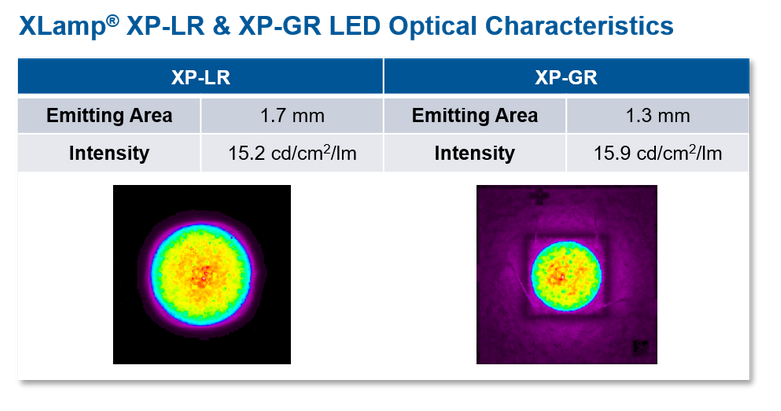
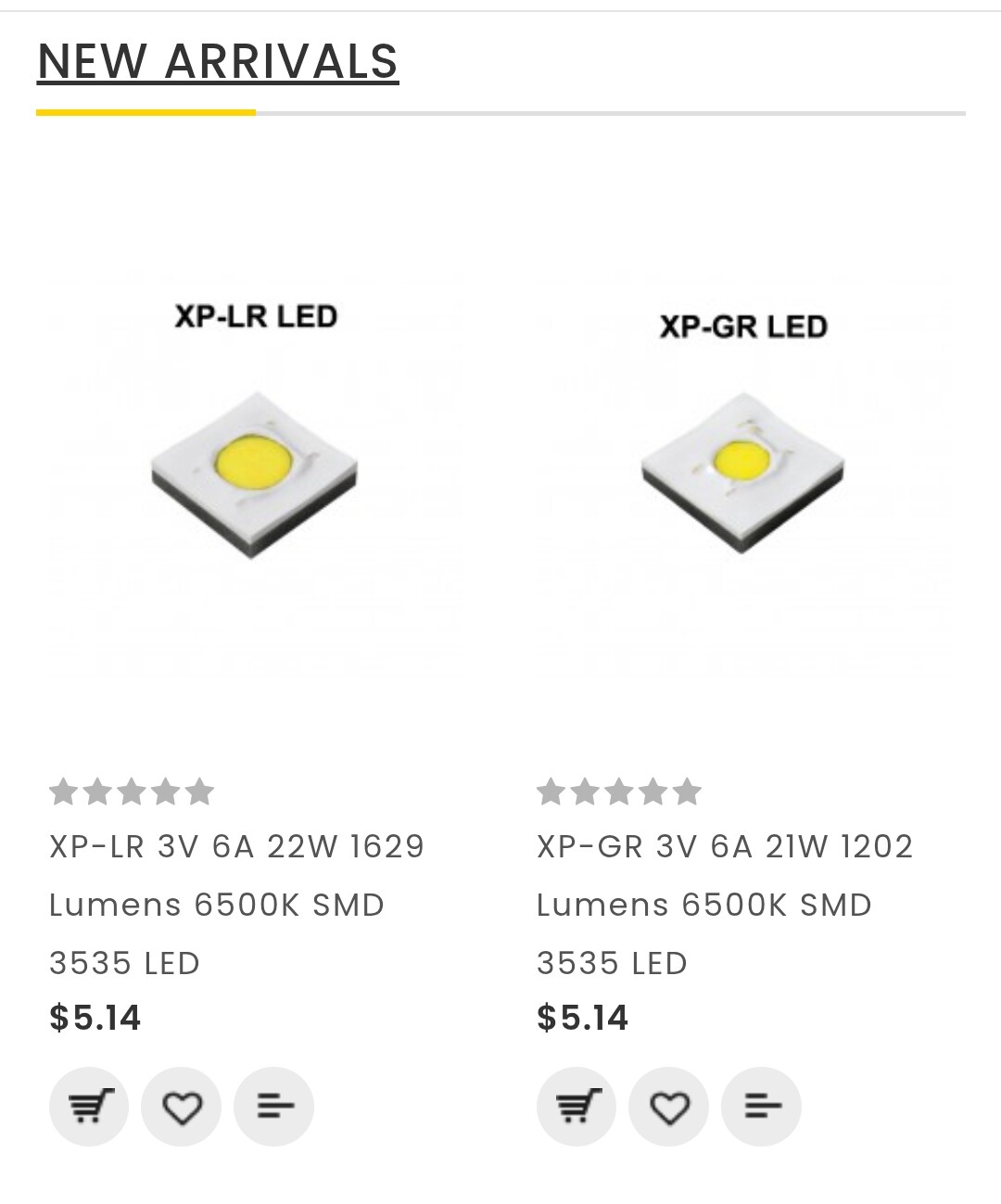
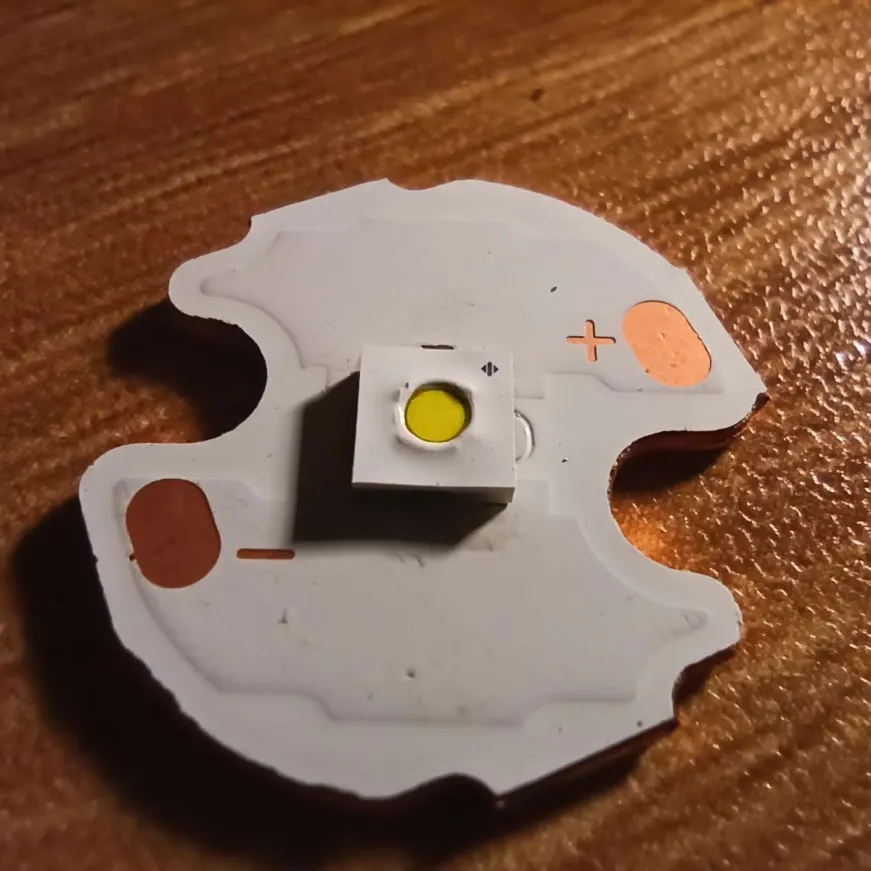
At first glance it looks as if Cree has purchased existing LED chips with a round luminous surface to build its own LEDs with. These are not built in flip chip design.
Very few CRI/CCT options available (cool white 70 CRI). Thermal resistance for XP-GR is higher as for SFT-25R (1.3 vs 0.8 °C/W), max current is 6 Amps for both.
The XP-LR is more or less the same as SFT-25R in terms of performance (thermal resistance and Vf range), the LES is also exactly the same size. The tintshift with rising current is also almost the same, and the Cree XP-GR/XP-LR are offered only in same variants as for the Luminus ones.
Really does look like a replica of the SFT12 and 25!
Right now the SFT25R in 5000K has a major issue with phosphor distribution–so far 2/2 of my samples had green phosphor concentrate near the center, making a hotspot with a very yellow center. I hope Cree fixes this, but these photos are not promising:
These are obviously not Crees own chips. Sad. I hope they made improvements to the overall tint shift vs output and +duv vs the Luminus and thoee mysterious other rouns LES ones!
This is just another proof that these are maybe rebranded Luminus emitters. Even the way the phosphor is applied to the chips seems to be identical, since the distribution on the LES is basically the same.
Yeah, I have the feeling that Cree is coming up with fewer and fewer really interesting new developments. It’s a shame that they don’t develop their own round chips, as it means we can expect more of these bought-in products in the future.
I wonder where Cree is heading in the long term anyway. The market for customizing emitters is still growing, and round chips have now arrived in the mainstream. Moreover, high CRI and exotic CCT are nothing special any more. These are all things that Cree has missed out on.
Cree was catering to their big contracts who didn’t care about round die leds, custom tints or high cri. The push for modernization of municipal lighting and industrial lighting applications drove their R&D instead. They ‘missed the train’ for these now popular round die products and San’an and Luminus capitalized. The Chinese brands rule now with (for now) low-cost high output leds (with iffy quality control).
Not only for round die ones.
However, even here the Chinese products are now competitive, especially as the chips have also become very efficient and the light color is now almost or already as good as Nichia and Co. The only disadvantage is - as you said - (still) the sometimes negligent QC.
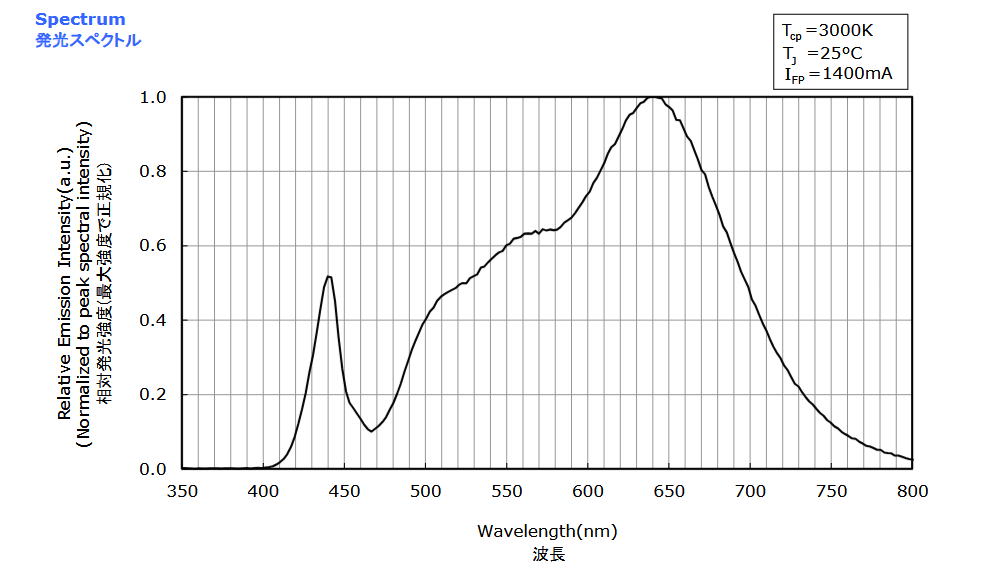
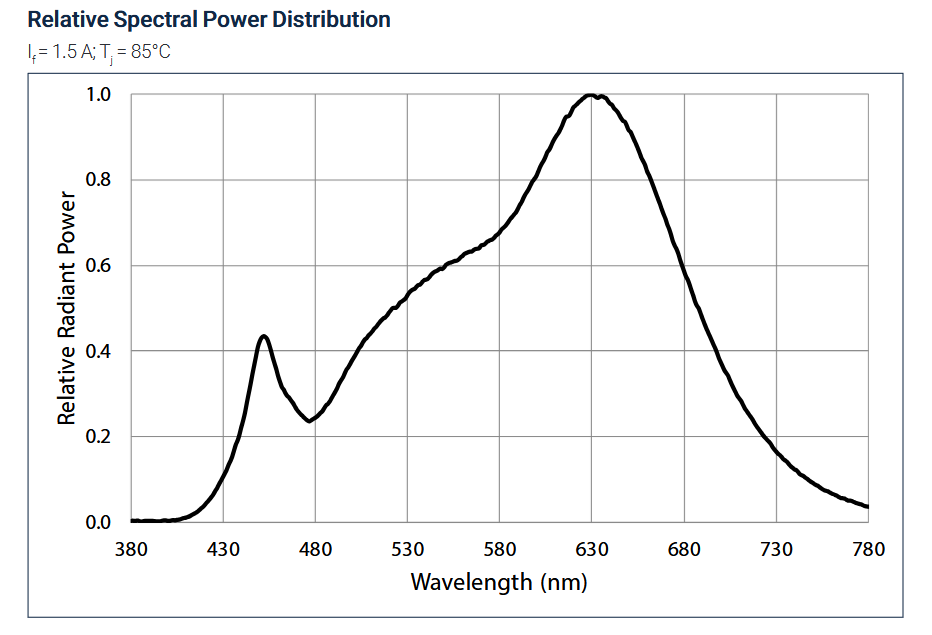
New Luminus 95CRI emitters are already beating Nichia in color rendering. When my SFT40 3000K arrived I immediately noticed that things look less pale compared to 519A 3000K, and better-balanced. Usually this sort of paleness is caused by deficiency in cyan wavelengths, so I took a look at the datasheets, and sure enough, the SFT40 has more than twice the cyan emission of the 519A!
When LED lights started becoming popular, it was the Luxeon era, then the Cree/SSC era (XRE), then once we got XMLs everywhere, all the enthusiasts started caring about CRI and Tint - and all the attention went to Nichia.
These Chinese LEDs seem promising, and very popular - just wish there was better documentation, and tighter QC. Also curious about their longevity. Also, some efficiency gains would be nice.
I know, but that’s still the exception rather than the rule. Most high CRI Chinese LEDs tend to be slightly worse than Nichia, with well pronounced cyan gap.
But you’ve already mentioned something: Nichia also needs to start making sure they don’t miss the boat in the high CRI market. Of course, the large quantities are produced for street and industrial lighting as well as residential lighting (Vitasolis/Optisolis!), but there is still a risk of losing market share in the long term. I also expect that high CRI will eventually become more or less the norm for general indoor lighting tasks and that low CRI will only be relevant for outdoor lighting and flashlights.
The real issue with the recent Chinese LEDs is consistency: the tint/CRI can vary significantly from batch to batch, and the phosphor distribution can be uneven. I suppose one upshot of inconsistency is that if one purchases a very large sample across multiple batches, the probability of finding a very good specimen (for whatever definition of good) is high. In comparison, the Nichia 519A is among the most consistent emitters I’ve worked with.
It would be good for Nichia to look into improving their phosphor mixture (to address cyan dip) and their domeless offerings (so far the 719A is disappointing and 219C V2 not available in R9080). Luminus has addressed the cyan dip very well, the 4000K SST20 spectrum in the published datasheet has almost eliminated the gap entirely.
There is BaSi2O2N2:Eu2+ phosphor with λmax = 490 nm which could be used for this (so far I know it is already commercially used for PC Cyan emitters in conjunction with YAG:Ce phosphor).
Also NKSLO:Eu2+ could be used for this.
I think it has other reasons this is not done for high power emitters (mostly saturation behavior and cost I think).
This is really interesting info, thank you for sharing!
There definitely exists some sort of cyan phosphor with low cost–my Feit Electric bulbs from Costco ($10 for a 4-pack) has 6500K emitters that are blue-pumped but exhibit no blue spike or cyan dip at all under a spectroscope. It is a good question why this is not implemented more often. Maybe earlier saturation than other colors, but I don’t have the knowledge to tell.
On a tangential note, it seems that phosphor particles have gotten more coarse in recent LEDs, e.g., 519A compared to 219B/C. What are your thoughts on this?
I suspect that this is to reduce the contact area between phosphor particles of different colors, thereby increasing efficiency by avoiding secondary excitation. For example, a blue photon from the pump gets converted to green by green phosphor, and that green photon gets converted again to red by red phosphor, which is more lossy than direct blue-to-red conversion.
If this is the case, high CRI flooders with high efficiency should be achievable by using only single-phosphor PC color LEDs, and mixing their emission later with a diffuse secondary optic.
I really appreciate all of the work you do researching and testing various LEDs, and trying to put forth simple facts. I am pleased that Cree is now offering a round die LED (even if it is a purchased die) because it gives me hope there will be more competition in the round die space.
In a copper foil wrapped SMO reflector P60 drop-in with Convoy 5A buck driver
Using my phone to measure illuminance at 5 meters.
Osram CULNM1: 60kcd at 50%, 75kcd quickly step-down to 65kcd within 15s at 100%
Cree XP-GR: 68kcd at 50%, 96kcd quickly step-down to 86kcd within 15s at 100%
Apparently, XPGR can still maintain higher efficiency at high current compared to C*LNM1, more suitable for 5A turbo light like Convoy T6.
Btw, not sure if it’s the centering or reflector issue Probably the reflector issue, the hotspot looks a bit like a triangle to me.
Not sure if this really deep embedded LES could affect performance, but this is the worst looking LED of the last several years
Don’t know what happened there. Can imagine if a manufacturer uses this LED in their flashlight that customers state this LED is broken and they want a replacement