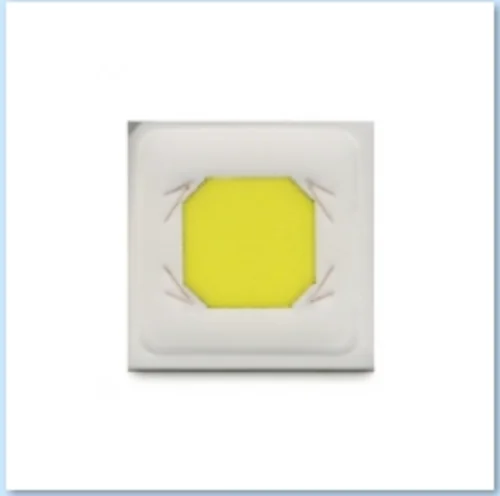
Being both low CRI throwers in 4000K, the SFT70 and W5050SQ5 are necessarily in competition, in the sense that a user wanting a such an LED must choose one among the two.
Unclear what the tint situation is–Luminus’s 5000K SFT40/70 is known for extreme CCT shift under high-ish current, so let’s hope the same doesn’t happen for 4000K. Output will certainly be more for the SFT70, and throw will be less due to (1) donut hole from quad die configuration and (2) lower power density. For compact throwers the W5050SQ5 is still the clear winner, requiring only 1/3 the power to achieve the same throw.
One useful way to view the SFT70 4000K might be the result of averaging the W5050SQ5 and LHP531. If the former is too low output and the latter too floody, then the SFT70 is just right. Conditional on the SFT70 having good tint, of course.
“Wanting such LED” - they have differen sizes and voltages, if you want one of them the other won’t work. If one’s choosing an emitter first they’re picking between flood and throw, then brightness (pencsil beam at lower brightness, wider at higher brigtness and power consumption), then CCT, CRI and miscellaneous like voltage (wether 3V/6V driver is even available for my light). SFT-70 and W5050Q5 will pretty much never end up in the same bracket next to each other. Q5 competes with SFR-25R or SFT-40.
Every Luminus LED has pretty strong tint shift but this one has new base and new looking phosphor layer - Luminus claims color uniformity and homogenous color (in the same sentence). SFT-70 doesn’t really produce donut holes, chips are so close together that it produces basically homogenous beam patters in every optics and of course it will have less throw than Q5 - that’s what I keep saying, they’re two different emitters with just one similarity - they’re both available at 4000K.
If I want as much throw as feasible, in 4000K, in pretty much any light in the Convoy tail switch lineup, the W5050SQ5 and SFT70 would both be options, just like how SFT25R/SFT40/SFT42R/SFT70/SFT90/SBT90 are often regarded as competitors for maximum throw in the same host like L21A/B. LEDs don’t need to be one-to-one replacements in order to occupy the same general functional niche.
Additionally, less intense emitters can occasionally out-throw more intense ones when the optic is not optimal; this is well documented for the SFT25R vs SFT42R in the L21B.
In any case, this argument is pointless because the thesis is neither provable nor falsifiable.
The sentence you mentioned (copied below) refers to angular tint shift, not CCT shift over current, which is the issue I mentioned.
That is simply untrue. I have the SFT70 and can confirm it makes a donut hole in every smooth reflector and clear optic I tried. Even the OP S2+ reflector smears it out barely enough to not be noticeable beyond one ft of distance.
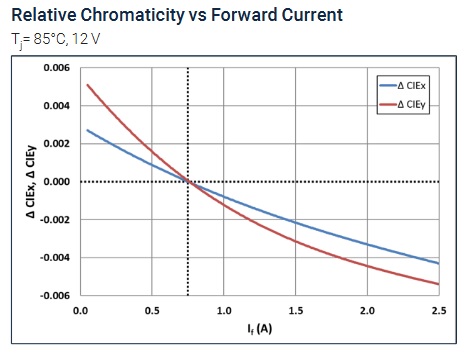
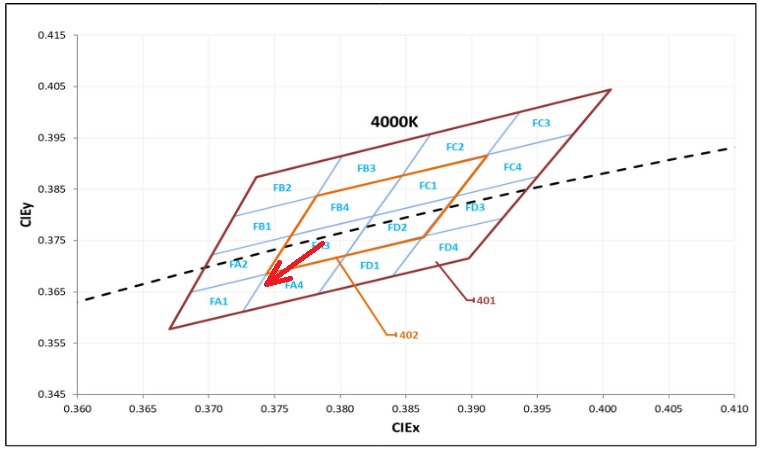
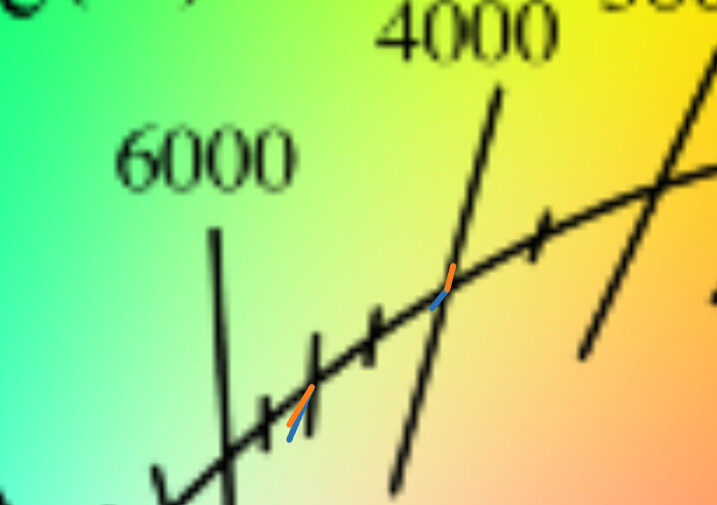
Thanks for clarifying the source regarding CCT shift. It inspired me to make a to-scale plot of how chromaticity changes over current (6V 5A) and over temperature (25C to 120C), for both old (assumed 5000K) and new (4000K) datasheets. The blue vector is change in current, and orange vector change in temperature.
So overall the new 4000K is certainly more stable over both current and temperature.
However, the 4000K becomes greener at higher temperature, with the y-coordinate (and approximate duv) increasing by around 0.006 going from 25C to 120C. This behavior seems atypical of most LEDs I know.
Maybe there is some sort of novel rare-earth free phosphor used? At least it appears to be a phosphor that is not yet very temperature-stable (also at high operating currents, which in turn result in higher Tj values)
Interestingly it seems that no red CASN phosphor is used. The peak for red is around 610-615 nm instead of the more typical 625-635 nm. I can also imagine that, in addition to the cyan phosphor, some other phosphor (green?) has been mixed in.
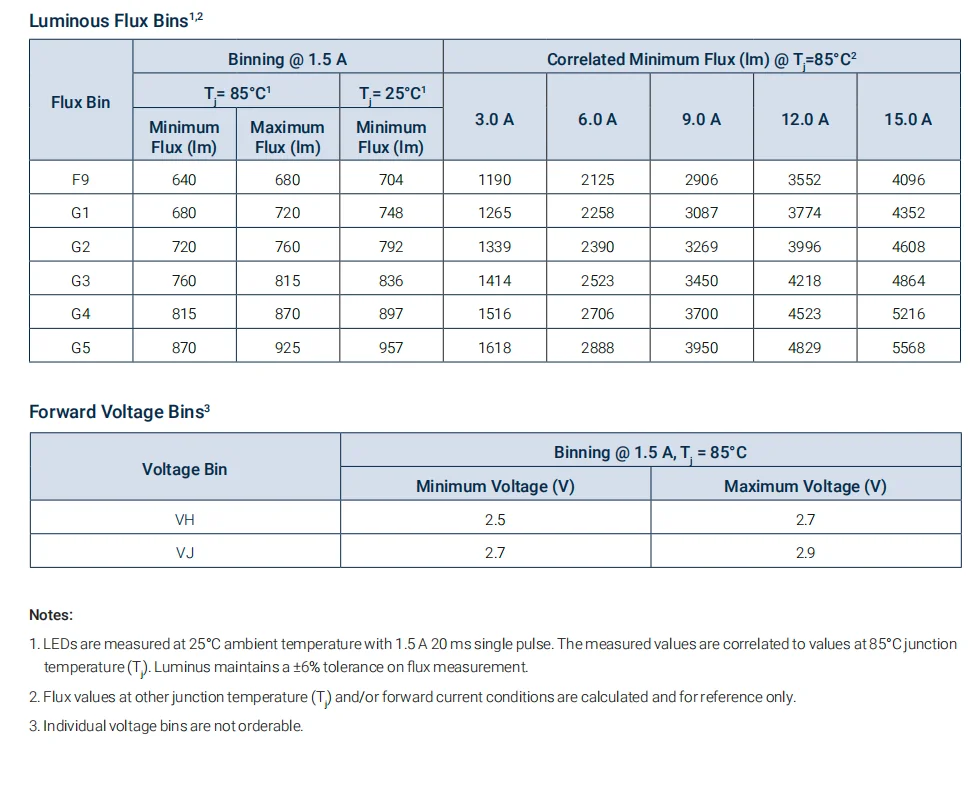
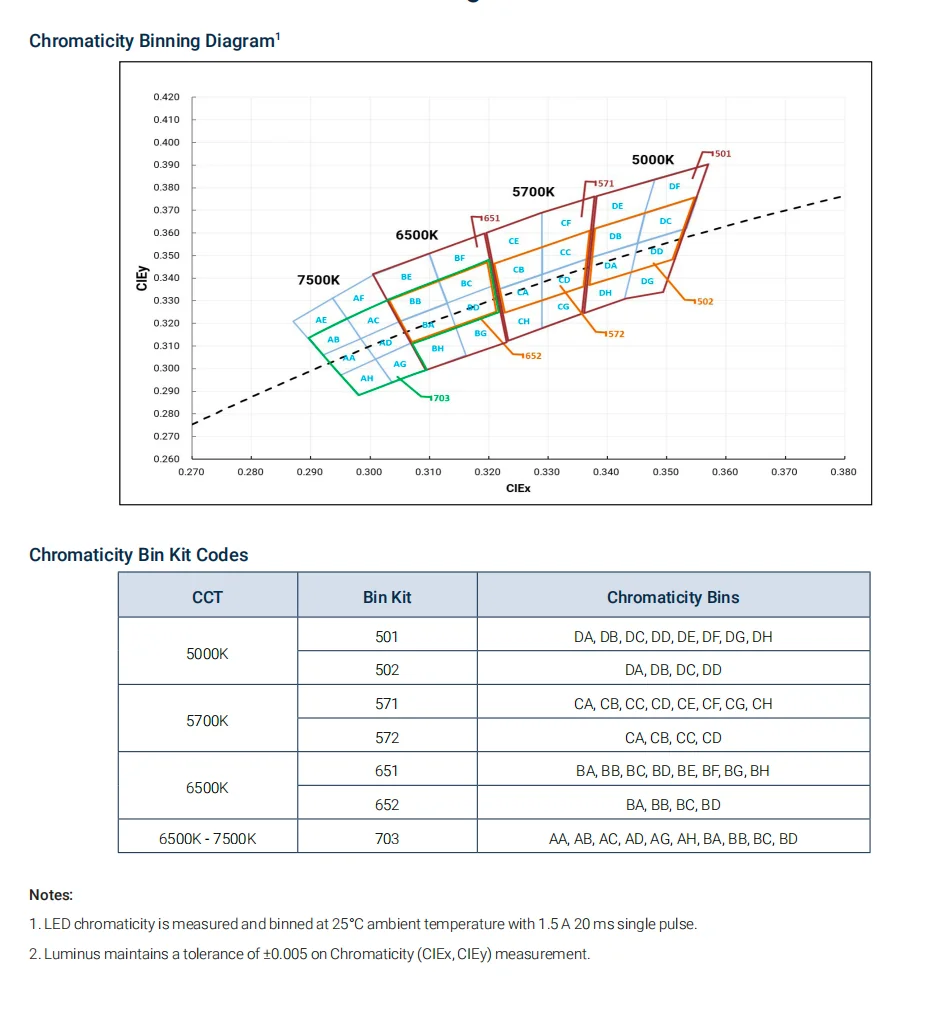
New LED from Luminus - the SFT-60! No datasheet available yet but Acebeam spoiled some things on reddit. 5050 form factor, 6,8mm², 15A max, 5000K-6500K options, CRI 70.
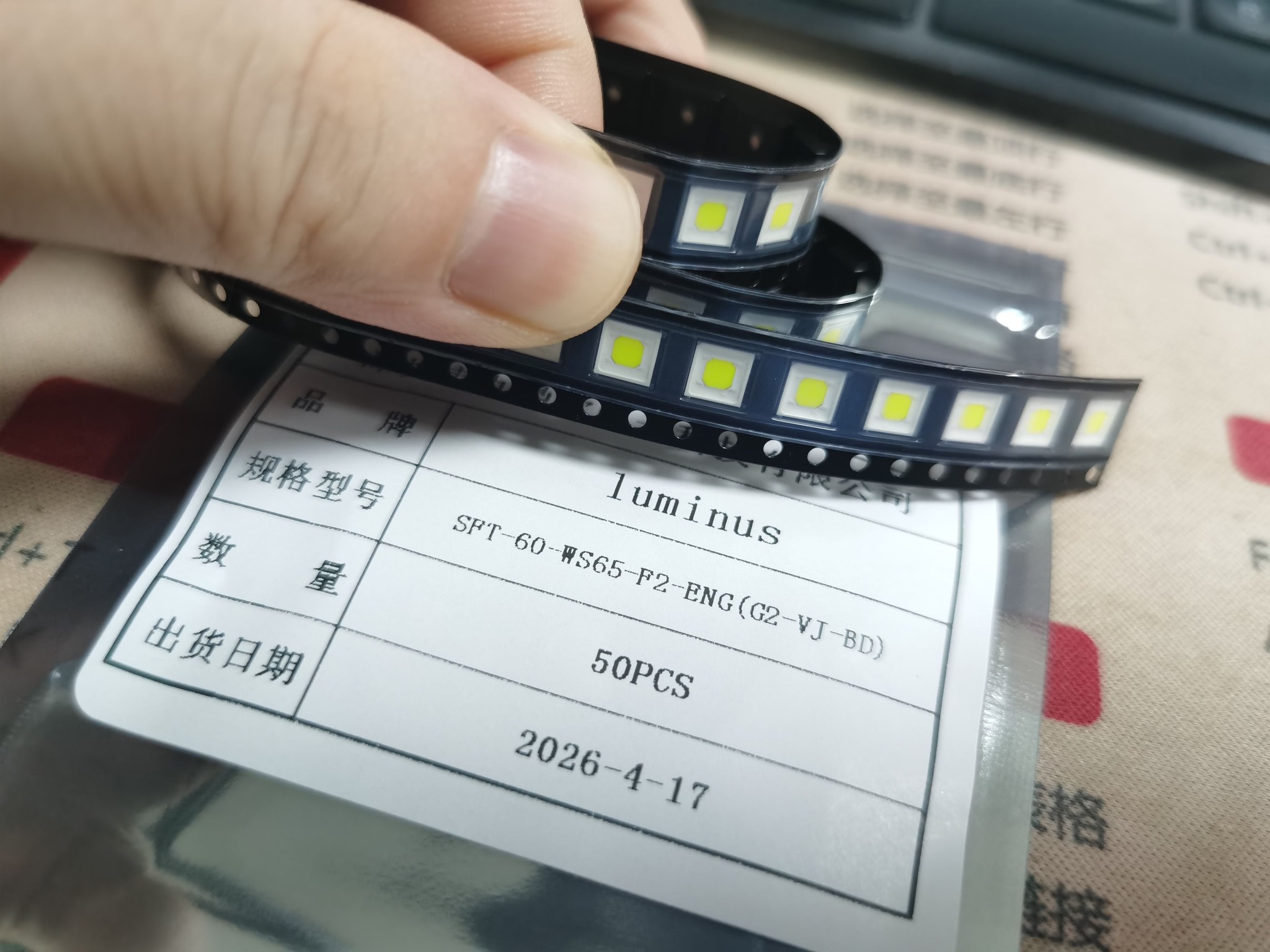
It looks like SFT-40 clone with a larger chip, lower thermal resistance and higher max current. Apparently the phosphor layer has been optimised to provide uniform beam at all angles. Also Simon got his hands on some samples, G2 bin. We’re talking about 4600lm+ from 6,8mm² LES, light intensity should be pretty high.
I wish! I’ve reached out to Simon but he is unsure whether they are commercially produced in large batches or just a laboratory sample. If anyone has evidence for the former, please let me know!