Not quite what the title advertises as I don’t know what the reality is, but as a byproduct of the Duv thread I think I know a few likely things more about Opples than before.
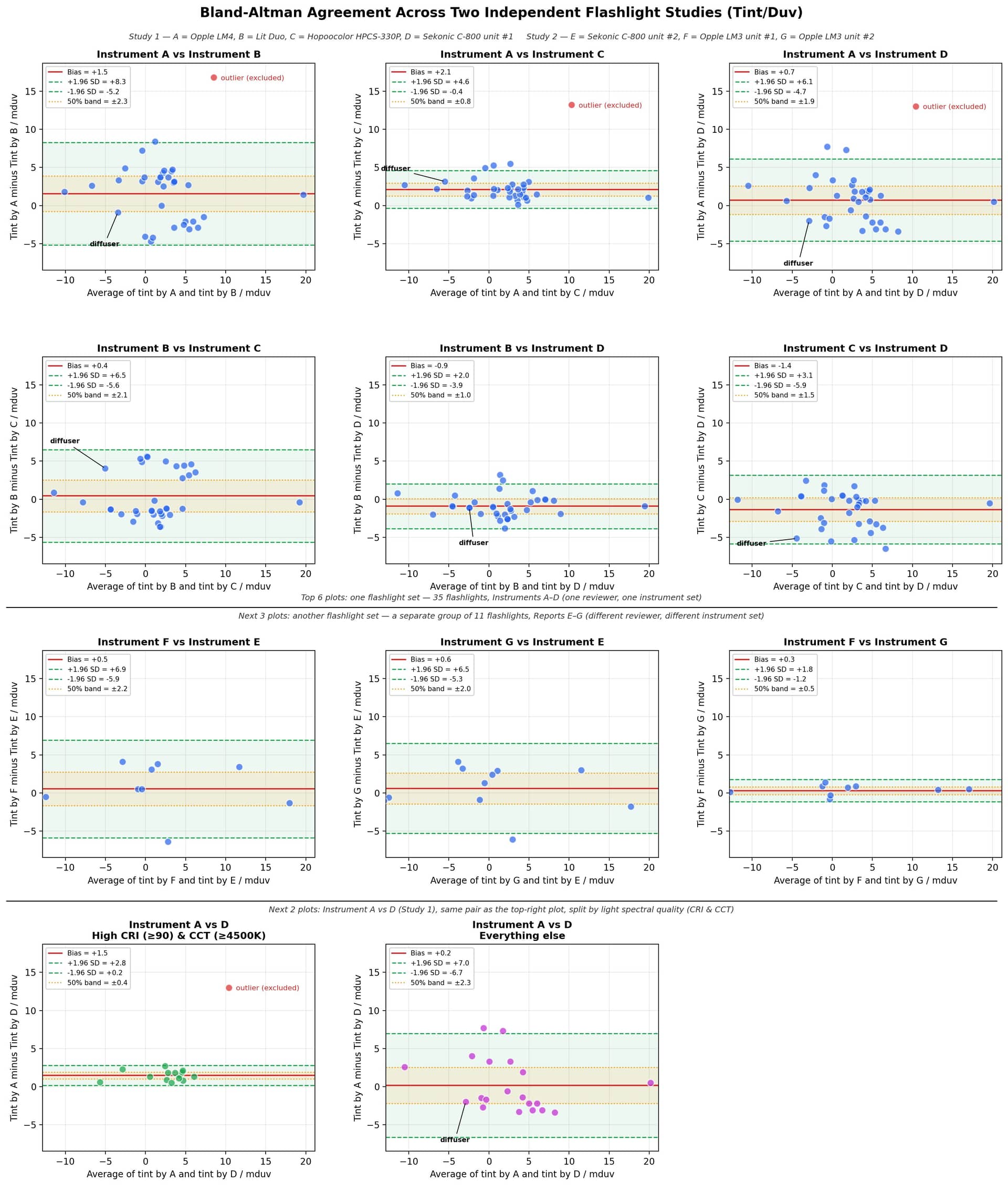
Opples are slightly biased green by ~+1 mduv compared to other meters globally i.e. subtract 1 mduv from each and every Opple measurement if you want to be more right then wrong.
Opples to Opples they are not noisy at all - they agree on any light within ~1 mduv.
If I nominate Seconics as ‘gold standard’ and compare Opples to it, the discrepancies go mad and in all directions - there must be something different between how these two read the spectrum and calculate tint.
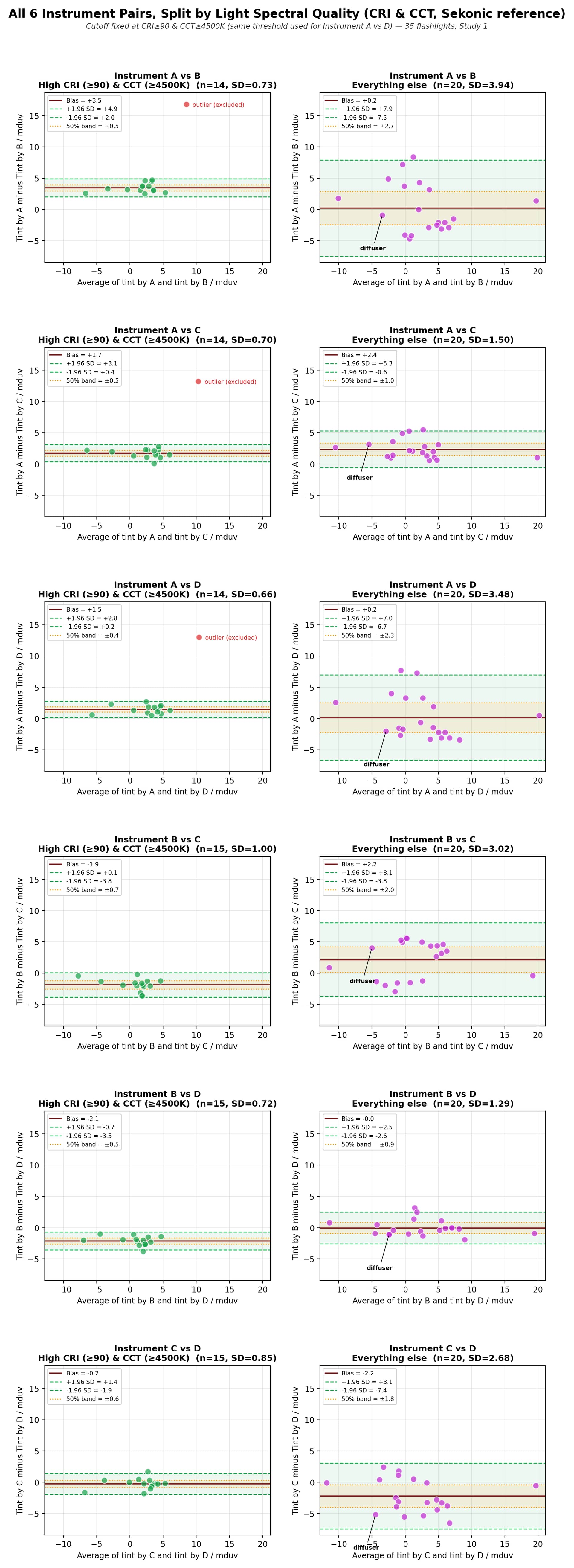
If I separate flashlights by their CCT and CRI, Opples agree with Seconics for flashlights with CCT > 5000 K and CRI > 90 to ~2-3 mduv - and go madder for those with likely spikier and narrower spectra (CRI being more influential than CCT).
It all reverses if we nominate Opple to be the gold standard (but Seconics divide light into many more wavelength bins before measuring their contributions and computing Duv).
There is a meter similar to Opple and a meter similar to Seconic spectrum-separation wise in the pool and they don’t quite agree between peers - they can be paired better across the breads.
But the Seconic and Lit, and Hopoocolor and Opole seem much closer in agreement than any other pairs. Do you know why, other than Lit is Seconic wannabe and tries to mimic it. But how it’s done with 14 bins? Then I thought Hopoocolor would be close to Seconic but it’s closer to Opole.
The Opple works¹ by matching a known spectrum to the measurements and then calculating an offset. So it effectively depends on the availability of a similar reference spectrum. The Sekonic on the other hand has a much higher resolution and can thus perform calculations on the measurements themselves.
The Lit Duo uses the AS7343 (or something similar), with 11 channels in the visible spectrum (although the response of two of the channels looks weird), so not much better than the Opple. The results depend on the algorithms interpreting the measured values. Again, it can only compare with known spectra and estimate the error.
The Hopoocolor is similar to the Sekonic and has a pretty high resolution of less than a nanometer. It should produce similar results to the Sekonic as no reference spectra are required.
Why you see these discrepancies? No idea. Have you tried different distances (gain/saturation, measuring different parts of the beam), maybe even from a diffuse reflecting surface? Was there zero ambient light without reflections from other nearby objects?
¹ Or worked, not sure how it’s implemented in their latest app for the Opple 4, the alternative Windows version is said to produce better results.
I’m just trying to pierce through the fog of opinions - mostly to convince myself what’s shit what’s shine (tint-measurements wise).
The problem is not that the Opples are cursed, but rather that it’s all noisy and biased more than we’d like to admit, albeit in a few different ways. Spectral resolution of instruments doesn’t seem to matter.
It seems to take quite a few reported mduvs to indicate the tint or their differences no matter how they are measured.
To me anything less than 3 mduv is not worth thinking about, 5+ becomes more convincing.
p.s. Reporting tint measurements any finer than to 1 mduv (same as to the legacy 0.0010) - already charitable compared with what’s actually known - should be made a crime.
IMO this type of comparison should be done with an integrating sphere and more carefully controlled measurement protocol to eliminate error. There are just too many variables when trying to take exactly the same measurement of a flashlight with several different devices.
That should not hurt, but it looks like it would not be the panacea - the method variability may not be the biggest culprit (I always thought it would be). Plus un-diffused measurements are often all we have and discuss.
p.s.: There is even one light with a diffuser in the set (I marked it on the plots), but the measurements disagree on it about as much as they do for any other light.
Here is another bit from the first dataset (35 flashlights now, 4 different prosumer light meters - some of them supposedly fancy).
There has been talk about Opples being maybe ok, but only strictly for a selected few high-CRI/CCT boutique lights - close to useless for others.
While this may not be entirely untrue, all the instruments struggle with this not just Opples.
A pattern emerges: if you feed any of these light meters only the easiest to measure lights that they like the most (i.e high CRI/CCT) they agree on them better. A lot of scatter is removed, which also uncovers the overall biases between them better (red lines on plots).
For high CRI/CCT lights, Lit always reports that the light is more magenta than what any other meter would report on the same light. Opple always reports that the light is greener than what the other meters show. Seconic and Hopoocolor should mostly agree (with each other) overall, but will still easily differ by ~2 mduv for identical lights due to scatter even for high CRI/CCT lights and some 3-4 times as much for lower CRI/CCT lights.
I think that my habit of utterly ignoring reported tint differences that aren’t at least several mduvs apart, regardless of instrumentation or method and even for the lights that are the easiest to measure, is not irrational.
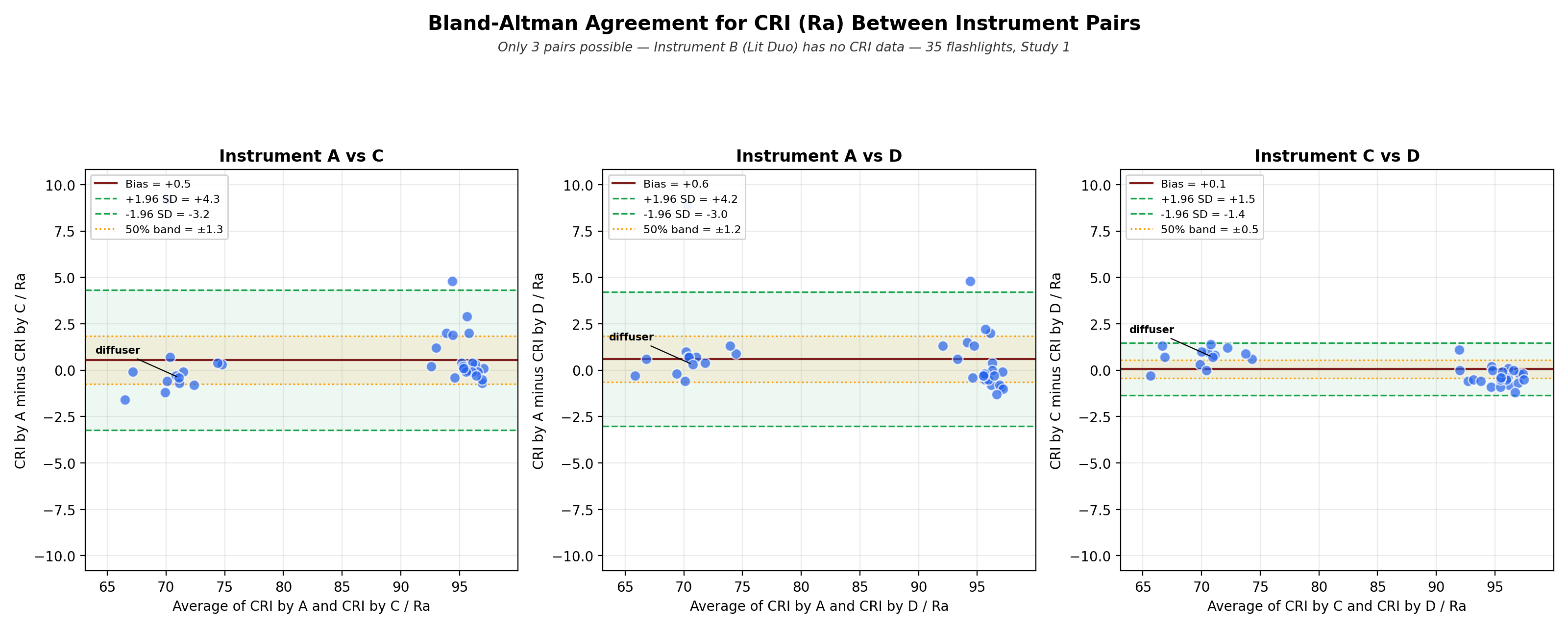
Hopoocolor and Seconic agree with each other better than either agrees with Opple on the reported CRI, but even Opole differs from the other two by not more than 2 CRI, most of the time.
So, unlike tint, the reported small differences in CRI values can be detected and compared, at least numerically, with the instruments and methods that people routinely use. Whether small differences in CRI tell you all that much even if they can be legitimately detected is questionable - there is a reason for TM30 etc.