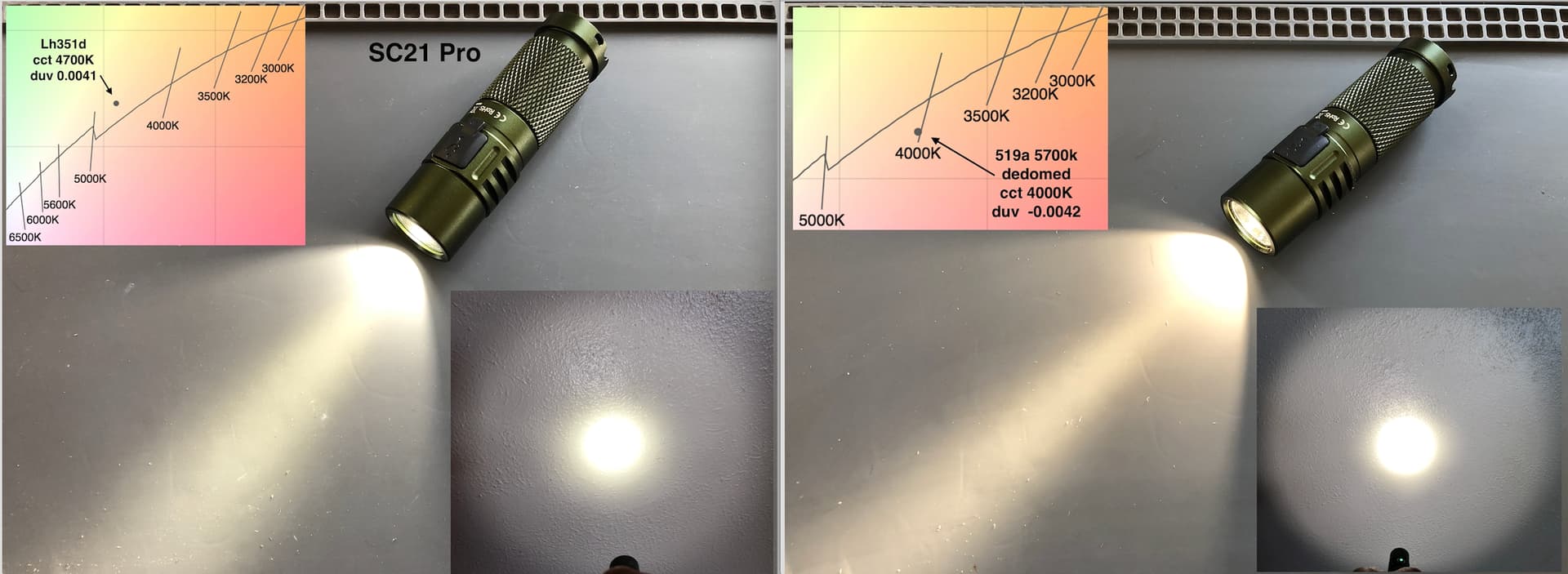
Note: all Color Temperature and Tint DUV data is from Opple 3, useful for comparing these lights to each other, but not as accurate as data from more expensive instruments.
Thank you very much for these! Very interesting. Good comparison pics of different emitters are a great help for people like me who have not tested many LEDs yet!
what seems to work best for me is to take the photo during the day, at my desk near a window. What works the worst is taking pics in the dark… I just use an iPhone on Auto White balance… The gray background seems to work better than other things Ive tried, such as white paper, or a wood table.
Awesome write-up. I was trying to explain CCT and dedoming to a co-worker who claimed he couldn’t see the difference in lights. He scrolled through and could see every difference.
Nice shots. Is it Opple Pro G3? Are you tests with opple consistent? I gave up on using my Opple because I was getting inconsistent results, maybe I need better setup.
10 Lumens gives different CCT and DUV, than 200 Lumens, from the exact same LED in the exact same host:
Different individual LEDs give different CCT and DUV, even at the same Lumens, in the same host:
note in this case the CCT are practically identical but the Tint DUV is 0.0043 apart…
Yes, it’s true
Generally the DUV drops as the current increases, while the CCT can increase a bit.
It would be very useful to specify at which current or lumens you get the results
Fortunately 1Lumen Reviews gives both Amps AND Lumens (also true for zeroair reviews):
Notice that for someone like me, that disables Turbo, a 4Amp Continuous Discharge Rate (CDR) Lumintop USB 14500 has sufficient power for Step 7 (level 130 of 150) in a D3AA. The TS10 has a similar output on Step 7, and also works nicely w the Lumintop USB 14500:
I added a second photo to this post
the comparison is at 250 lumens…
I encourage you to get an Opple or other tool, so you have the option to measure your own lights
no matter what my measurements say, LEDs vary so much, that only you can measure your own to know how they specifically perform
It makes no difference what spectrophotometer is used, any measurement of any LED will be different than any other LED, of the same type, even from the same reel
CCT and DUV data posted by other people, is only useful to give a general idea what you might expect from your own LEDs.
There is no such thing as perfectly accurate data from someone else, that would match your own individual LEDs, no matter how accurate the spectrophotometer an other person used.
Even at the same lumens or power level, no two LEDs are identical…
Of course, it also depends by type of optic used.
Perhaps with same type instruments, there may be slight fluctuations in measurement due to different calibration.
Didn’t had time to read the thread of new Opple LM4, I would buy if there isn’t risk to get a sample that record wrong measurement.
Here in the comments is described that the temperature of 1800k is out of the range for Opple and data can be inaccurate, that happen for the new LM4?
Yes, I think McBob IS talking about the Opple 4. I consider it less accurate than the Opple 3.
I do NOT consider Any Opple, accurate. It is just useful for comparing your own lights to each other.
If you want accurate data, you need to buy something like a ColorMunki or a Sekonic. I believe McBob usually uses ColorMunki… I have also seen him post a photo from an Opple 4.
Also Jackson, of JLHawaii808.com uses an Opple 4… I dont consider the results accurate, they just give a general idea.
what the Opple is most useful for is not accuracy, it just lets you compare your own lights to each other so you can measure Relative differences. And if you have an Opple 4 you can approximately compare your results to results from other people who also have an Opple 4.
Opple is NOT Accurate, it is only Approximate. Useful only for comparison purposes of your own LEDs, it shows Relative differences between LEDs.
Im really enjoying having an Opple, even though I know it is not accurate, I find it useful.
Even with accurate data, LEDs are different. Look at this accurate data from zeroair, compared to this accurate data from koef3. These charts are both for an SFT-40, 3000K (but they are two different, unique LEDs)