I encountered an interesting thread about a new model for color space, along with an expository article. I had a quick skim of the original paper because I found the expository article unclear. I’ll try to share what I hope is an accurate and accessible summary of the paper.
[Disclaimer: although a student of mathematics, I am not a geometer by training and not well-versed in the geometric machinery used in the paper. Please comment with corrections if you see a mistake in my summary.]
We want to formalize colors by thinking of them as points in some sort of abstract space (e.g., some region of the plane, but in the paper more like some sort of cone), and define a metric (i.e., notion of distance) on this abstract space that captures human perception of these colors. That is, the distance between 2 points according to this metric should correspond to how different the colors appear to the human eye.
Lots of folks like Riemann and Schrodinger came up with some common-sense conditions a reasonable geometric model of color should satisfy, and tried to implement models based on the geometry they developed for studying relativity. But these models ran into human perception-related issues, in particular the following two:
- The Bezold-Brucke effect: if you have the some color, say RGB = (0,100,100), and make it brighter/more intense, say RGB = 2(0,100,100) = (0,200,200), then you perceive the more intense color as having also become a bit more blue, say, having the hue of RGB = (0,95,105).
So: a straight, linear scaling of the same hue produces a curved path in space of colors, which means the distance used to model perceived color cannot be the Euclidean metric, which measures distance by lengths of straight lines.
- Principle of diminishing returns, more detail in their previous 2022 paper. Suppose that we have 3 colors A, B, C such that B is on the shortest path between A and C. (For example, think A = white, B = light pink, and C = saturated red.) If you look at just A and B, you might say they are pretty far apart, say 0.6 apart. If you look at just B and C, you might say they are also pretty far apart, say 0.8 apart. But if you look at the pair A and C, they are definitely pretty far apart, but you don’t perceive them as being 0.6+0.8=1.4 far apart; perhaps you think they are only 1 apart.
So: even when B is on the shortest path between A and C, the distance between A and C is shorter than the length you walk on this shortest path through B. Immediately, this rules out any Riemannian metric, which measures distance on a curved surface by the shortest path between two points. [see footnote]
What the paper does is to come up with a space, and a notion of distance on this space, such that the common-sense conditions of Schrodinger et al are satisfied, and that the two mentioned issues are avoided.
[footnote] Here’s a toy example to illustrate the difference between a Riemannian and a non-Riemannian metric. Imagine that the color space is just a radius-1 semicircle:
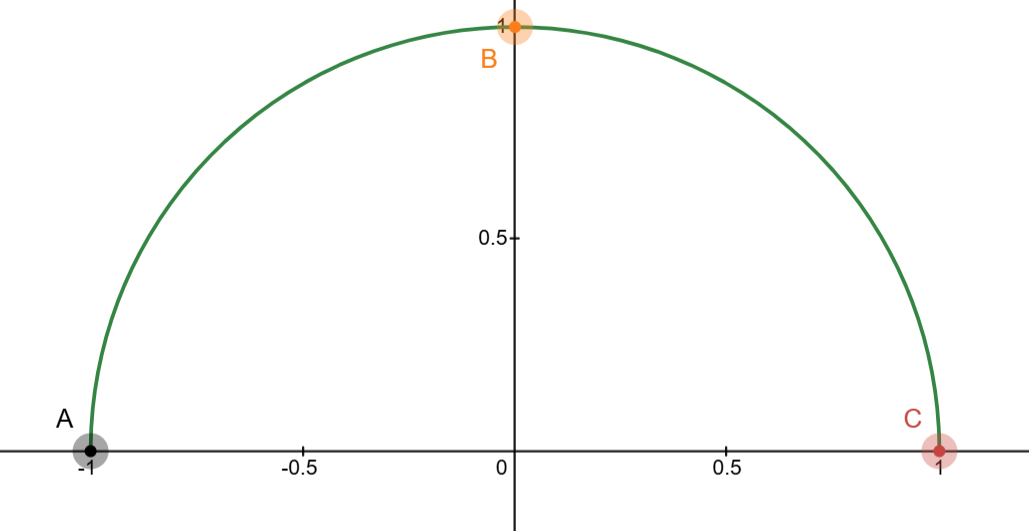
If you equip this space with a Riemannian metric r, then you measure the distance between two points by the length you walk along the semicircle. Here, r(A,B) = π/2, r(B,C) = π/2, and r(A,C) = r(A,B)+r(B,C) = π. Distances are always “additive”, and you cannot have diminishing returns.
Alternatively, you can measure distances on the semicircle by taking a ruler to the screen. This metric d on the semicircle is non-Riemannian, and you have d(A,B) = 1.414, d(B, C) = 1.414, but d(A,C) = 2 < 1.414+1.414. Such a notion of distance is sub-additive and compatible with “diminishing returns”.