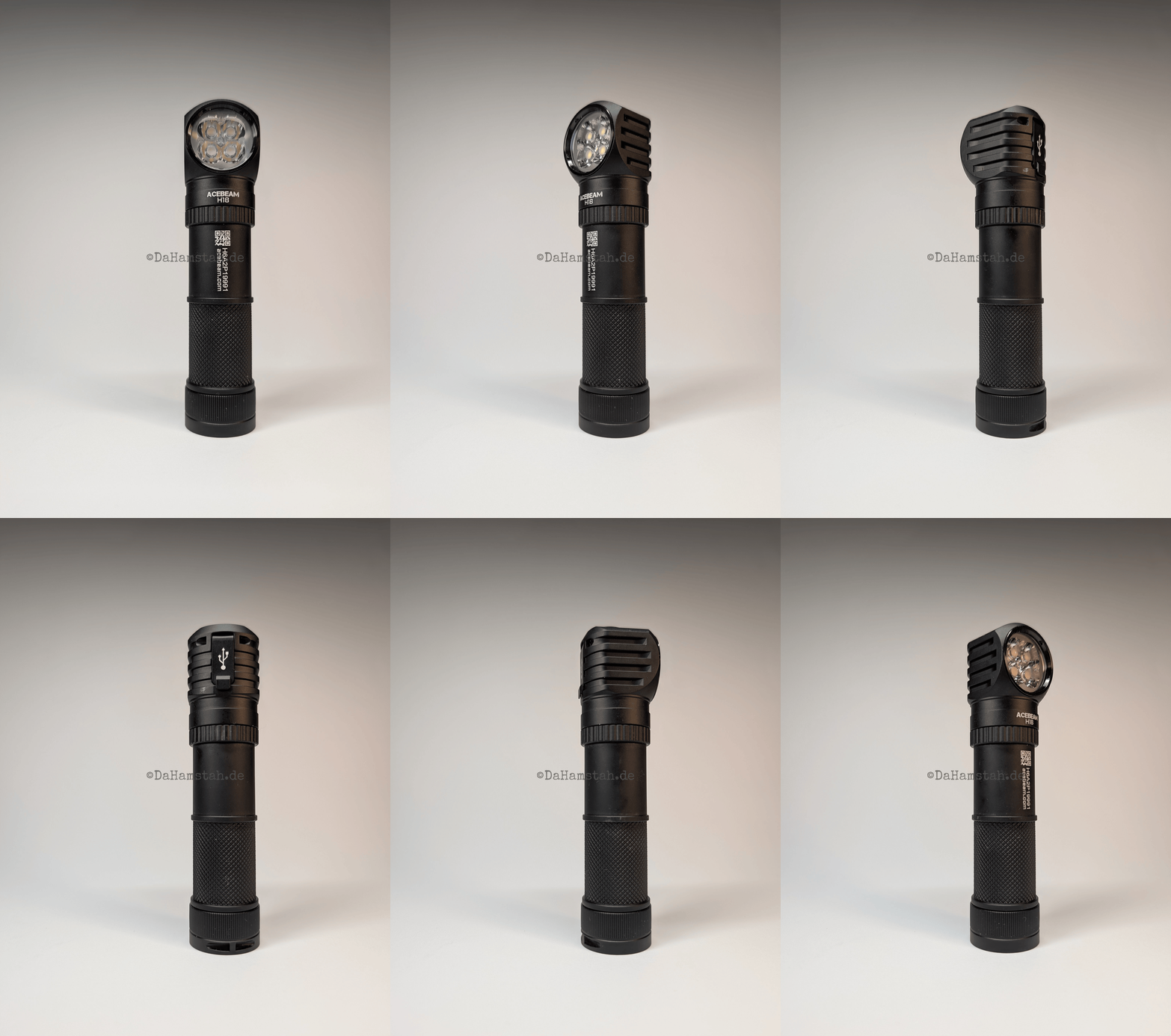
I closely followed the final stages of development and the release of the H18. A lightweight 21700-light with long runtime, 519a and red light sounds good, the maximum output also seems impressive. But how all this works together with the low weight, that was unclear to me.
All my reviews can be found on my website.
Disclaimer: Acebeam provided me with a discount for this flashlight. This had no influence on the review.


The H18 is available in two versions, with cool white, low CRI LEDs and with 519a in 5000K.

The H18 comes in an astonishingly large box in Acebeam-orange. On it you will find an image of the flashlight as well as some specs. The accessories are extensive and feel high quality. Besides the usual small parts (spare O-rings, warranty card, manual) the practical case also contains a pocket clip, a lanyard, which doubles as a charging cable, a headband and of course the light itself including the battery.

The flashlight comes in a slightly rough matte black, which is grippy and feels extremely robust. I could not find any machining flaws, all edges are cleanly deburred. The tailcap threads are well lubricated, but did not run completely smooth out of the box. After cleaning and relubing once the slightly gritty feeling also disappeared.

Opposite the tailcap is the switch. This one has a short travel, but quite a weak tactile click. You can hit the switch while wearing gloves, but if they are even slightly thicker you get absolutely no feedback. Nevertheless unintentional inputs are unlikely, the position and size of the switch play a major role in this.
Integrated into the switch is a small LED, which is responsible for indicating the battery level. It also lights up when the flashlight is electronically locked out, but only as long as you press the switch – but then you usually cannot see the LED, because your finger is covering it. You have to know this detail if you value the lockout indicator.
On the back of the head is a USB-C-port, which is covered by a metal flap with a magnetic closure and is certainly internally sealed – otherwise the flashlight would have trouble meeting the IP68 rating.


Opposite the USB-port sits a TIR optic. Behind this are 4 white LEDs, in my case Nichia 519a. The flashlight is also available with cool white low CRI LEDs. In the center of the TIR is a red LED. I am pretty sure that there is an AR coated glass lens on top of the TIR.


The construction of the flashlight is interesting. The tailcap has milling parallel to the tube, which provides good grip when tightening- and loosening it. The area next to it is machined with diamond knurling, which provides good grip in all directions, but especially for rotating the light in the headband.
Between this area and the head is a smooth section. That is where the headband is attached. As a transition to the head there is another area with milling – same direction as on the tailcap, but significantly coarser. That is the detent mechanism for use with the headband. On the head there is then a specific groove for the clip – yes, you can leave it attached when inserting the flashlight into the headband!


Fireflies L70 Helio, Armytek Wizard C2 Pro max LR warm, Acebeam H18, Sofirn HS45
The flashlight weighs 155g incl. battery.
At its longest point the light measures 120mm. The head is 27.5mm deep and 27mm wide. The narrowest part of the battery tube measures 23.7mm in diameter, the tailcap 26.5mm.
Lanyard: The lanyard doubles as a USB-C-cable. The loop is large enough and the cable is also robust enough to be used as such. I do have one concern with the cable though. The clasp is opened by pulling the connectors sideways out of the holder. That does take some force, but such a ring load is not entirely uncommon for a lanyard. For EDC certainly fully sufficient, for really tough use I would probably switch to a classic lanyard. However I am very picky when it comes to lanyards, so it is quite possible that my assessment here is overly critical. However it happened to me several times when putting my hand through that the clasp came undone.


Headband: The headband really blew me away! Not only is it incredibly comfortable over a long period of time, it also stays on the head well. The top strap can be removed, even without it the band is overall very usable, but tends to slip a little more. For use with a helmet this is great though.


The ability to quickly and easily remove and insert the flashlight is also great – but not just that, the fact that despite this the light is held extremely securely and features an easy to use, smooth adjustment mechanism shows that Acebeam put thought into the design.


The only, small, downside is that the flashlight can only be used with the switch facing right in the headband. With the switch facing left the band cannot be closed.
Clip: The clip snaps onto the flashlight securely and can be removed without leaving any marks. Still it will almost certainly not come off by itself. It has good retention, the opening is well proportioned. It rests cleanly on the milled surface. Only the area with the TIR optic sticks out of the pocket, which I think makes sense, because that way the light can sit securely in the pocket and still provide illumination.

Magnet: A magnet is integrated into the tailcap. It is strong enough to hold the light securely even on rough or slightly curved surfaces.

(Jacket)pocket: The flashlight is very compact and relatively light for a 21700, therefore it carries very comfortably and discreetly in a jacket pocket. It is also very pocketable as an EDC in pants, provided the protruding head does not bother you.

Explanation 1C, 1H...
1C: short click, 2C: double click, …
1H: press and hold without letting go
2H: short click, followed by 1H
Best things first: Acebeam is finally using 4C for lockout and unlocking! Otherwise the UI is very simple and gives no reason for criticism, even though I am not a fan of SOS in flashlights.
There is also a stepless ramping mode, you switch to this by pressing and holding the button for 3 seconds while the flashlight is turned off. The operation works analogously to the stepped mode.
| State of the light | Action | Result |
|---|---|---|
| off | 1C | on, last used brightness level |
| off | 1H | lowest brightness level |
| off | 2C | Turbo |
| off | 3C | red light, last used brightness level |
| off | 4C | lock / unlock flashlight |
| off | 2H | lowest level, momentary mode |
| on | 1C | off |
| on | 2C | Turbo |
| on | 3C | SOS (not used with red light) |
All measurements were done in my 30cm integrating sphere. The temperature was between 20 and 24°C. Additionally, an Opple Light Master III and a TASi TA636B lux meter were used. Please note that this is hobby equipment, so inaccuracies and deviations are possible!
I really like the beam profile of the light. Not completely floody, but no real hotspot either. Sufficient throw, which is combined with very good spill right in front of your feet. For my use cases this is tuned almost perfectly. On top of that there are absolutely no artifacts to be found in the beam. Great for a headlamp, but also definitely not to be despised in a 90°-EDC.
The sustained output seems quite low at first glance. The brightness on Turbo and High are, without a doubt, good. However only for a short duration, even cooling does not help, the stepdowns are timed. My first thought was “even some 18650 lights sustain more than that”. Yes, but well in cool white, low CRI. Let us take the well known Sofirn HS21. Without battery 11g heavier than the H18, but almost the same output, if you only look at the high CRI channel. a FFL L50 sol with FFL5009r sits at ~500lm in the default setting, so also very similar, even if slightly lighter still.
Interestingly the light also gets quite warm – so there does not seem to be much headroom for more output. A warm white Armytek Wizard C2 pro max sustains around 750lm, however low CRI. Perhaps the USB-port also limits the cooling, it definitely sits right behind the LEDs and does not contribute to the cooling. To be fair you have to give the light credit that High CRI always costs efficiency. Even a, not exactly lightweight, Fireflylite Helios L70 set to 70° can “only” sustain approx 700lm with a FFL707A in 4000K, at 55° it performs no differently than the Acebeam. In summary I would say that the output is not bad, but the 519A is simply not an efficiency wonder and the H18 is quite lightweight after all. The initial shock about the low numbers disappeared for me after this brief analysis, which is why I wanted to share this here too.

For the next graph the light was cooled with a fan and Turbo respectively High were reactivated after some time. The flashlight does not allow full Turbo if it is still hot, but conversely does not extend the runtime of a level if the temperature would allow it (both High-activations lasted equally long). The longer the flashlight runs, the lower the Turbo turns out, so I would assume a FET for the Turbo – meaning it is limited by the battery voltage.

For the first time in one of my reviews I want to try a new concept – a graph that shows the approximate perceived brightness. This is not about exact precision, but the perceived spacing of the brightness levels becomes clear. And in this case it is quite pleasant, the steps get slightly larger from low to high, but there is no excessively large jump among them. What I find interesting about this view is that it shows quite well that the 30lm, which the flashlight sustains for a long time, are proportionately not that little at all – sure, for wide area orientation that is not enough, but to illuminate the path for the next few meters absolutely.

| mode | Max. in 1. minute | Lumens at 30s | max. temperature | Temp. @ 30s | Runtime (until shutoff) |
|---|---|---|---|---|---|
| Acebeam H18 turbo | 2774 lm | 2240 lm | 57.8 °C | 54.4 °C | 12h 15min |
| Acebeam H18 high | 930 lm | 917 lm | 57.0 °C | 32.8 °C | 12h 11min |
| Acebeam H18 med2 | 277 lm | 277 lm | 45.2 °C | 30.7 °C | 15h 12min |
| Acebeam H18 med1 | 146 lm | 146 lm | 36.7 °C | 30.3 °C | 21h 22min |
| Acebeam H18 low | 30lm | 30lm | – | – | – |
| Acebeam H18 moon | 6lm | 6lm | – | – | – |
Whoever takes a look at the runtimes will understand why I did not measure low and moon.
At turn on I measured 6920cd on Turbo and thus 166m of throw.
| Low | Turbo | |
|---|---|---|
| CCT | 4600K | 4700K |
| CRI | 98 | 96 |
| DUV | 0,001 | -0,001 |
Flicker is in the green zone, PWM is, as advertised, completely undetectable – neither with the eye, nor with a camera.
All measurement results can be found here


For comparison here are a few of my favorite 90°-lights. The Sofirn HS45, an Armytek Wizard C2 Pro max LR warm and a Fireflylite L70 Helios with the ultrarosy 707A in 4000K. The differences are clearly visible – and if you ask me, the H18 not only has the most pleasant tint, but also the best beam profile. But see for yourselves!


For this light I present you two charging curves, one for the built in charging function – inside the flashlight. And another one for the built in charging function – inside the battery. For both applies: There is nothing to complain about. Both charge quickly and yet quite gently, each with a clean CC-CV-charging algorithm.
Reverse polarity protection and LVP are present twofold – in the battery and in the flashlight. The battery is rated at 6400mAh, my Vapcell S4+ displayed an impressive 6800mAh for the battery.
Neither the flashlight nor the battery itself feature a powerbank function. I find that a bit of a pity, especially the battery with its high capacity would have made a great powerbank.
The H18 was with me, among other places, on the highest mountain that’s entirely within german borders and got me wonderfully through the night during the ascent in the dark. It stayed on my head for quite a while in the daylight, because I simply forgot about it. After that experience I can tell you, this light will definitely accompany me more often.

The H18 is not a perfect flashlight (which one is?), but one that is interesting for many applications. It is worth taking a close look at whether Acebeam’s implementation fits your own requirements. Because if it does, then you can enjoy the advantages of the H18.
And the light has quite a few advantages. Robust construction, IP68, yet USB-C without a rubber flap. High CRI with a great tint (in the 519a version), yet usable sustained output. A really comfortable headband, in which the good clip can stay attached.
Also for those who like to have reserve light over a long period of time, the flashlight is a full recommendation – the H18 reserves a good chunk of the battery for a long runtime at 30lm. Add to that a good, PWM-free regulation and a simple UI.
And because things like this always make me happy: The accessories are high quality and extensive, so that you are prepared for almost anything. The H18 was with me on vacation in the mountains during testing and unobtrusively and flawlessly handled all tasks there as my only headlamp – including an ascent lasting several hours in the dark. Whether the flashlight fits your profile as well as it does mine, you have to decide for yourselves. If it does, stop by Acebeam and make the tough decision between high CRI and high output!