Anakim DeepGlow GD11 multi-spectrum dive-light!
Okay, so I’m the proud new owner of the above light (it’s a mouthful!), and I gotta say, it’s nifty!

DeepGlow GD11 box
The light comes in a nice all-black presentation box with a sleeve around it with the color-art. Opening the box, you’ll find the light and accessories nestled in thick foam with cutouts for each. Aside from the light and insert for the manual, you’ll get the lanyard, extra O-rings, and usb charging cable. The 21750 cell is included in the light itself, with insulating disc to not let it drain in storage. The cell itself has a built-in charging board and takes any usb-C cable. It has indicator lights visible at the positive end to let you know it’s charging/charged. It doesn’t fit into my Opus, so I can’t do a capacity test on it, but it’s held up pretty well for all my playing with it.

All the goodies inside. 21750 cell is in the light.
The light itself is that nice semigloss black that’s not chalky rough nor glossy smooth or slippery. It’s surprisingly devoid of knurling, especially for an underwater light, but has some nice grippy furrows cut into the battery tube. Also, the tail is a slightly larger diameter than the tube, so that plus the wider head gives it a sort of dogbone grip to not slip out of your hand.
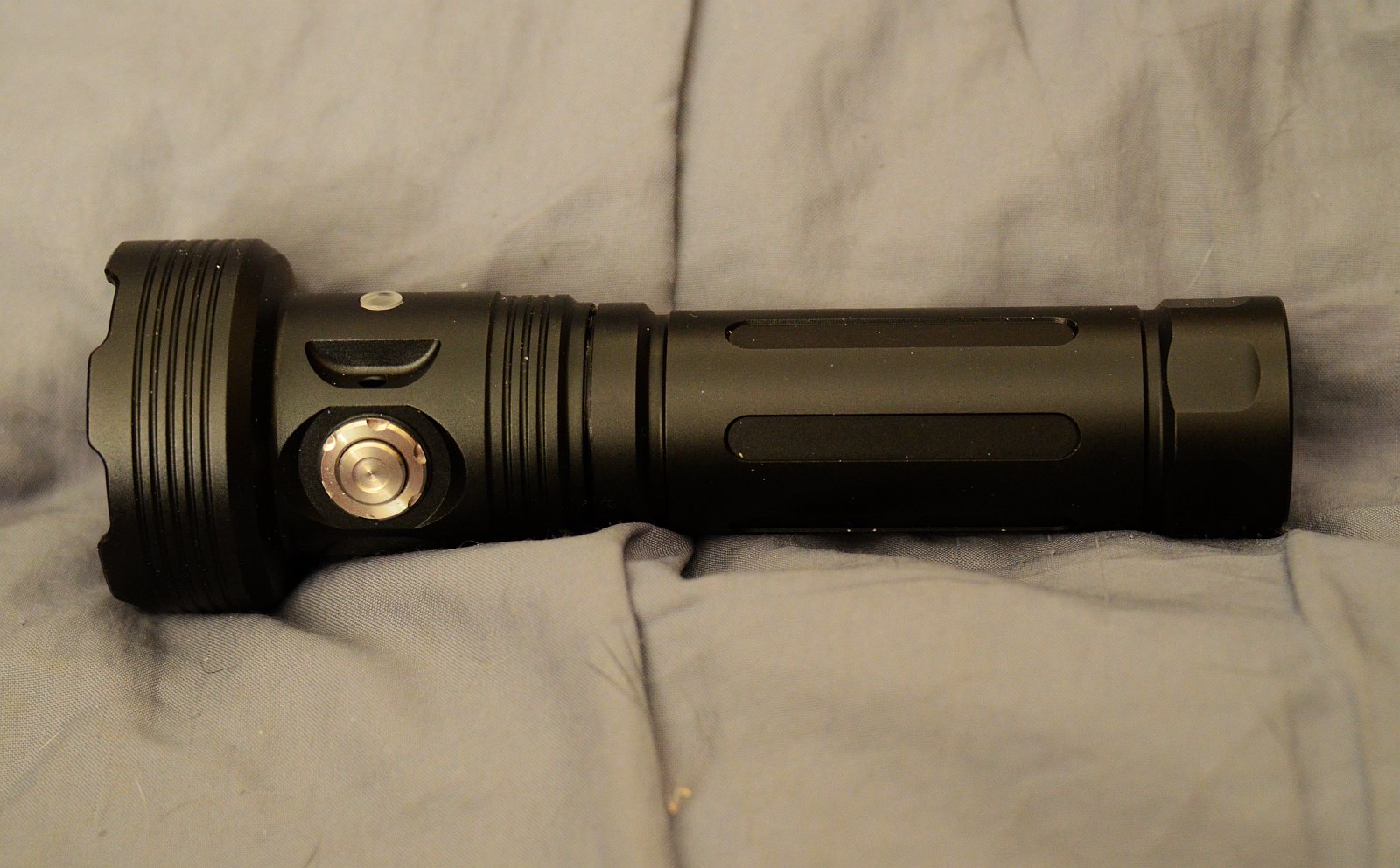
The star of the show!
The switch takes a good amount of force to press, but I was told that underwater, water pressure makes it easier to press. In this weather, I’m not able to go diving into near-freezing water to test it, so I’ll take it on faith. 
Speaking of water, the light is designed to be used strictly underwater to aid in cooling the light, so cooling fins are largely absent. There’s circuitry to throttle down the power if the light starts to overheat, though, but if you want full power, it’s gotta be underwater.
So, charge up the cell, stick it back in the light, and play with it. The UI is pretty simple. Each bank of lights (colors) has only one level: 100%. Click on. Within 5sec, click to switch between white/red/blue/UV and back. If left untouched for 5sec, another click turns it off. So yes, if you’re using the light for a while on white and want to switch to another color, you do have to momentarily turn off the light and then immediately back on and then switch colors. There’s also an emergency-mode which you can engage by holding the switch for at least 8sec nonstop, after which the light will flash alternating red and blue.
It’s a dive-light, first and foremost, but can switch between a nice white directional light, plus red, blue, and UV flood lights. The central white light is on the cool side, and if I had to guess, around 5500K-6000K? The emitter looks like an XM-L2, which is surprisingly dated but gives a nice wide hotspot behind the small central reflector. The other colors are made by 9 emitters in orbit around the white emitter, lit in groups of 3, so 3 red, 3 blue, and 3 UV, and are pure flood. The UV light seems to be 395nm because of the faint purple spill. 365nm emitters I’ve encountered tend to bleed a pale-blue or eerie-green color. For underwater, I don’t think 365nm is that critical, but I haven’t fluoresced corals and the like, so can’t say.
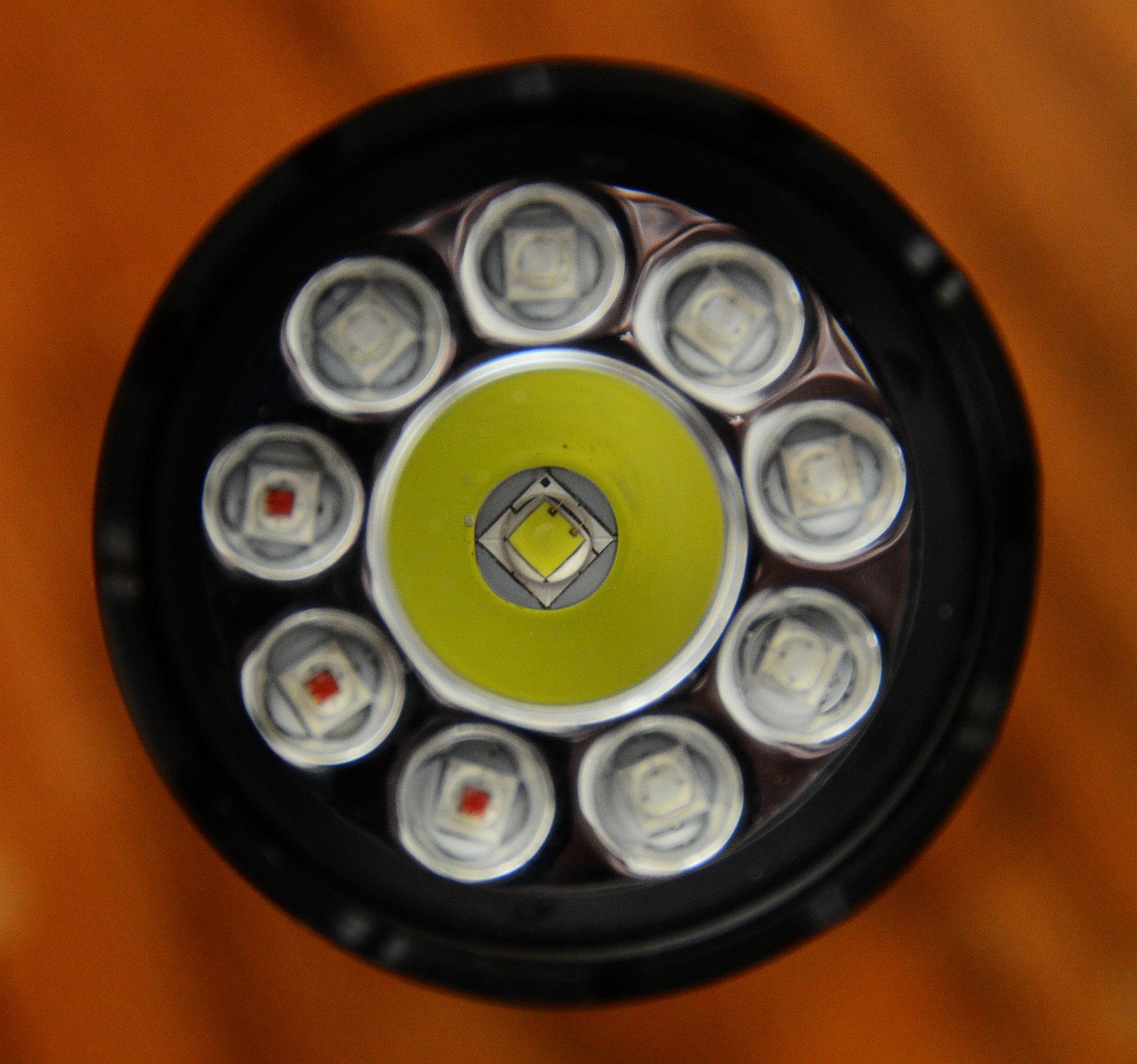
Top of the light showing all the emitters. Clockwise from top: 3 UV, 3 blue, 3 red.
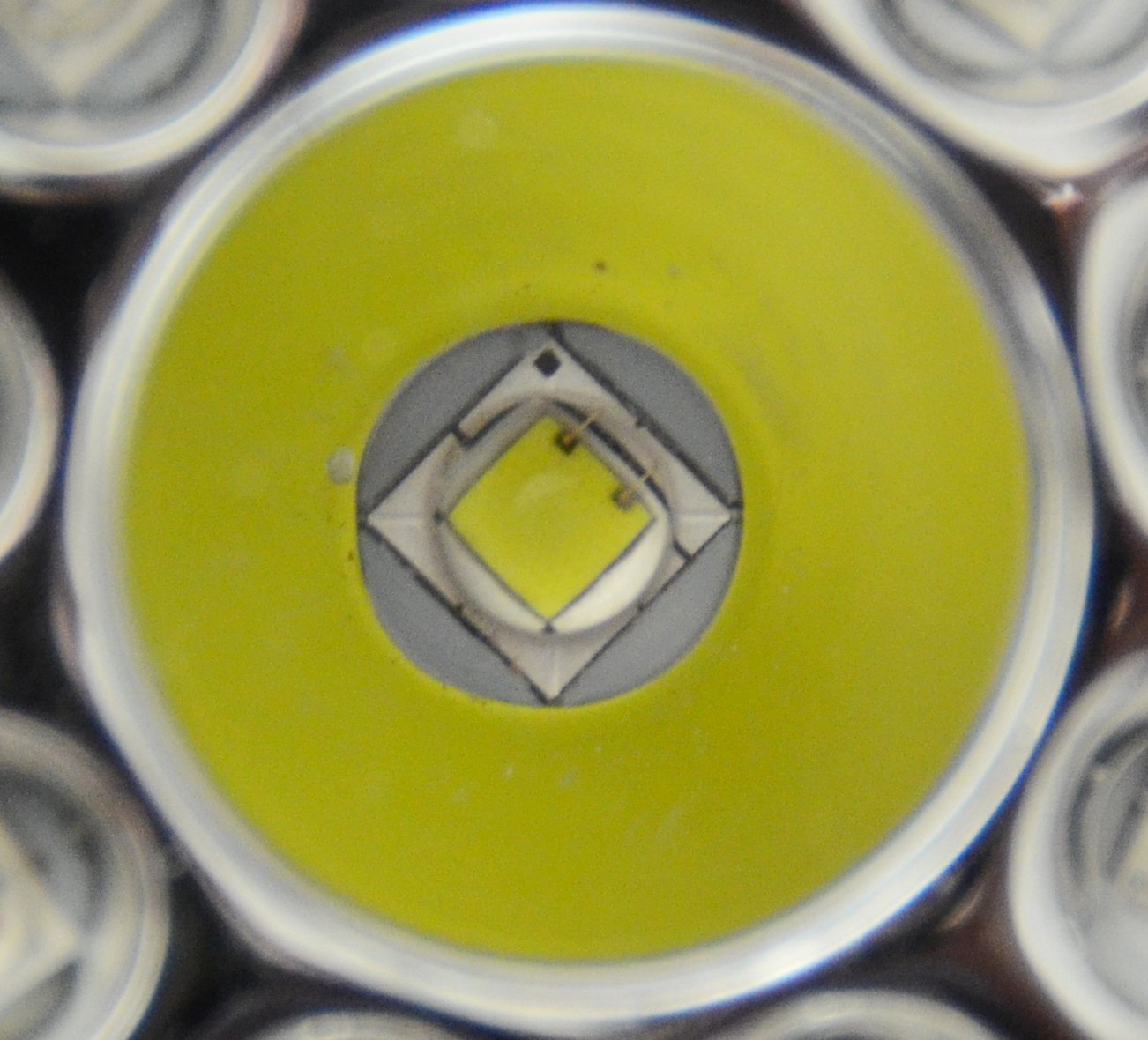
Central white emitter. XM-L2?
So why those colors? White is hella bright and directional, and used conventionally as any other flashlight. Red is ostensibly for not spooking undersea critters when sneaking around to observe. Blue for easily fluoresced flora and fauna. UV for hardcore fluorescence.
I’ve been using it rather extensively around the house, taking care to not run it too long that thermal stepdown would have to kick in. I’m not sure if it’s there to keep to safe and sustained high temperatures as needed, or if it’s more of an emergency feature to keep the light from melting in case it’s used “dry” and without water-cooling.
I actually like the beam for around the house, admittedly at farther distances, because the beam is bright and throwier than I’d use normally in the house, but for looking at the exterior of the house to check for damage after the recent storms, checking pipes and shingles and all sorts of things, the light’s about perfect. It has lots of reach, it’s plenty bright, and it puts a nice white light on the target.
Switching to UV to check for “organic material” comes in handy, too! I haven’t seen much wildlife outside to see if red lets me sneak up on anyone, but it’s there if I need it!
I doubt I’d go scuba diving, but maybe snorkelling along the surface might be fun, and I’d certainly like a light like the GD11 to do some multispectral analysis on some denizens of the (not so) deep.
All in all, I like it! Then again, having multicolor lights like the WK30, WK40, UC90, etc., it should be no surprise!
 (Oof, I didn’t even notice the list price.)