Armytek is currently working on an upgrade of their tactical flashlights. The new models, with “Max” in their name, use larger 21700 batteries, allowing for longer runtimes. Together with more powerful LEDs, the brightness has also been increased.
One of these new models is the Armytek Predator Pro Max. I had already reviewed its predecessor a few years ago. In addition to a larger battery and a different LED, there are also other changes.
You can find the German version of this review on my website: SammysHP Blog › Armytek Predator Pro Max
The flashlight was provided by the manufacturer for this review. Thank you very much!
Overview
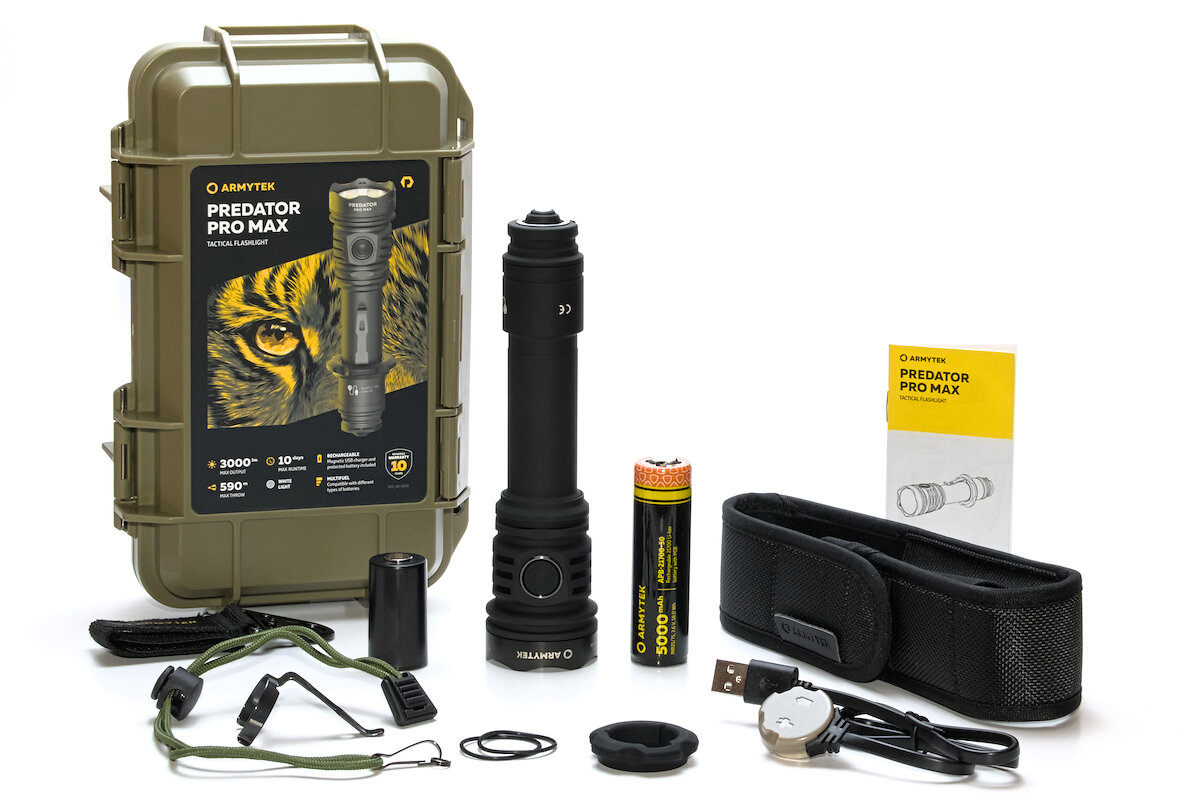
The Predator Pro Max doesn’t come in a traditional cardboard box, but in a small plastic case. Even though the flashlight doesn’t really need such a sturdy carrying case, the case will likely still find a practical use.
- Armytek “APB-21700-50” 21700 Li-ion battery (5000 mAh, protected, flat-top, 75.3 mm long, 3.53 V at arrival)
- Clip
- Holster
- Lanyard with key ring and carabiner
- Tactical ring
- Magnetic charger
- 2× replacement o-ring
- 18650 adapter
- Manual (EN, DE, FR, RU, FI, SV, NO, PL)
- Case with carabiner
The user manual now comes with a language selection adapted for the European market. However, its content has been significantly reduced and only briefly describes the operation. Technical data and specifications are found exclusively on the case.
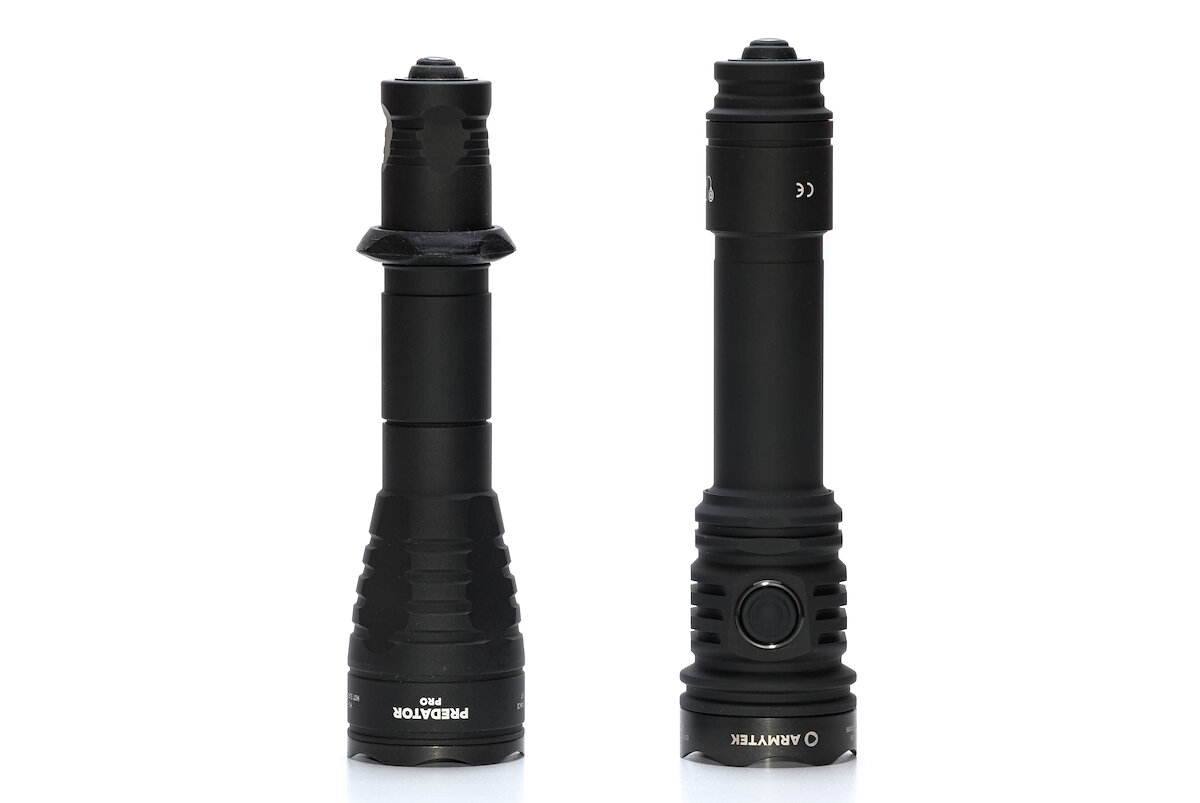
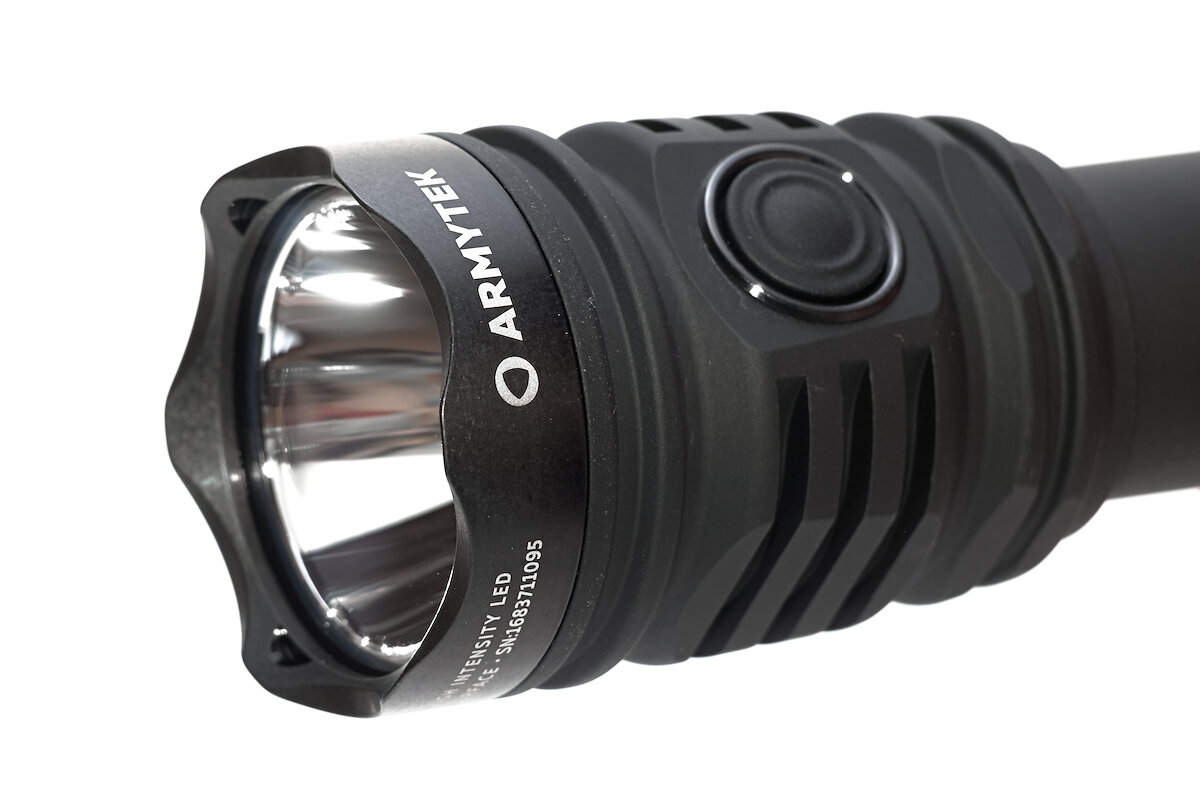
When placing the two flashlights side by side, You can easily spot the similarity. But in detail, there are several differences: a more edged head with pronounced cooling fins, an additional side button and a slightly modified tailcap.
The two generations differ only slightly in size. In particular, the diameter at critical points – bezel, battery tube and tailcap – is identical, so existing accessories remain compatible (for example diffuser, mount or remote switch).
| Predator Pro | Predator Pro Max | |
|---|---|---|
| Length: | 160 mm | 165 mm |
| Diameter (head): | 41.0 mm | 41.0 mm |
| Diameter (battery tube): | 25.4 mm | 25.4 mm |
| Diameter (tailcap): | 25.4 mm | 25.4 / 29.2 mm |
| Weight (without battery): | 137 g | 168 g |
| Weight (battery): | 47 g | 74 g |
| Weight (total): | 184 g | 242 g |
An impressive achievement, especially considering the battery is three millimeters thicker and the battery tube is constructed with double walls (more on that later). However, the difference in weight is clearly noticeable.
In terms of length the previous Predator Pro, despite using an 18650 battery, was comparable to many 21700 flashlights. The new Predator Pro Max, with its 21700 battery, now fits this segment better, but it still ranks among the longer models in this class.
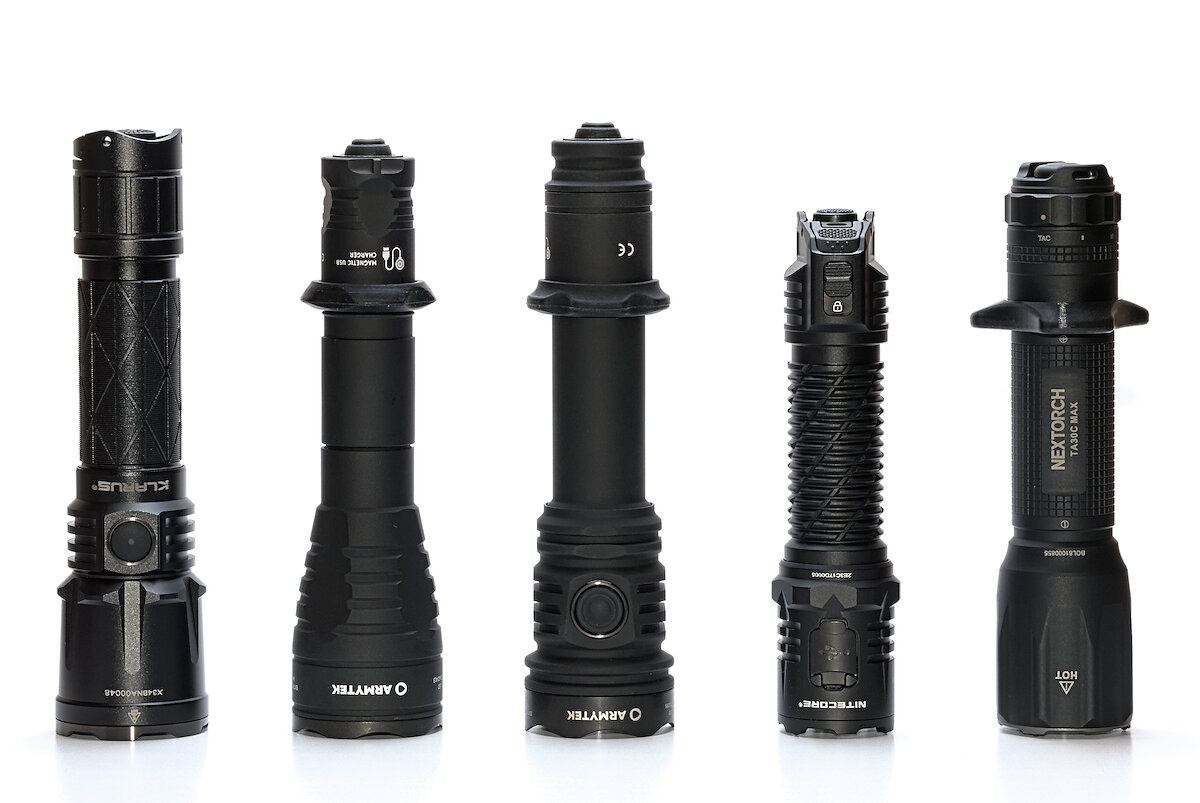
Klarus XT21X Pro | Armytek Predator Pro | Armytek Predator Pro Max | Nitecore P27iX | Nextorch TA30C Max
The rough surface provides a secure grip even with wet hands, without any scratchy knurling. It somewhat resembles a chalkboard – though this does make cleaning the flashlight a bit more difficult.
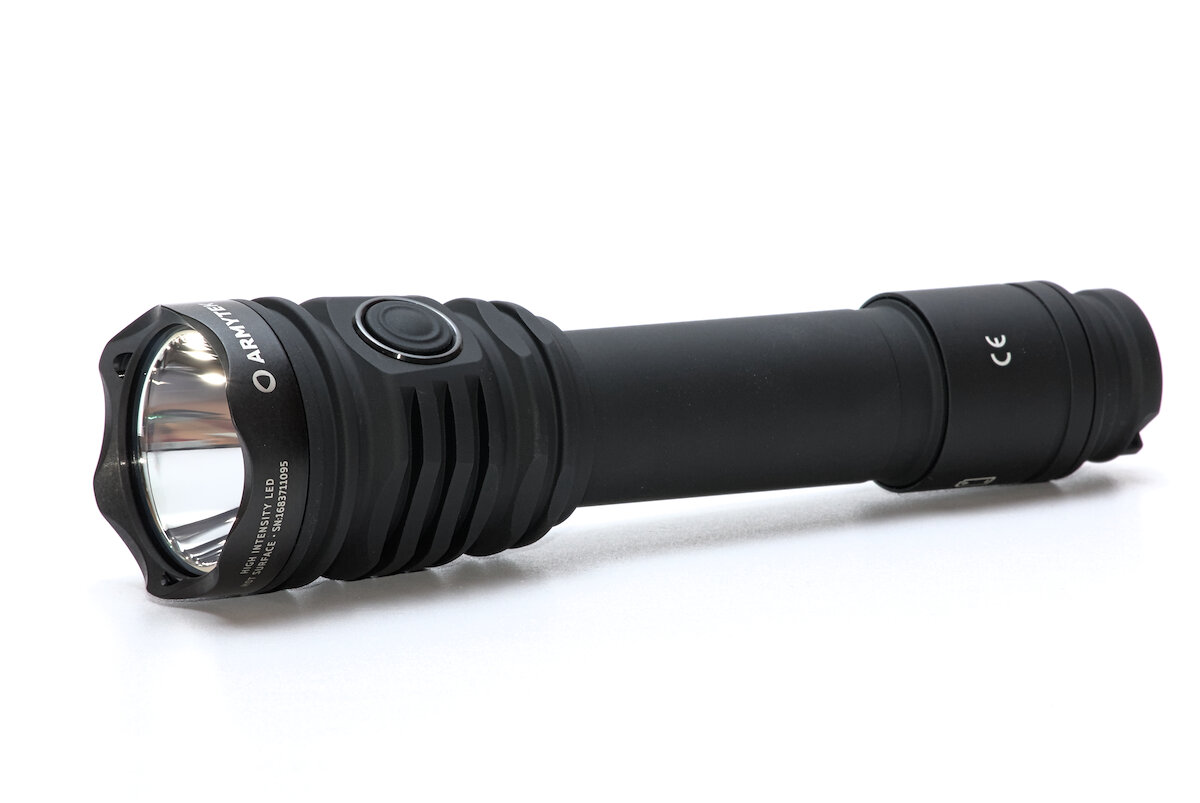
The front is protected by a black stainless steel bezel, whose wavy shape not only gives it a tactical feel, it also allows you to see whether the flashlight is on when it is placed upside down.
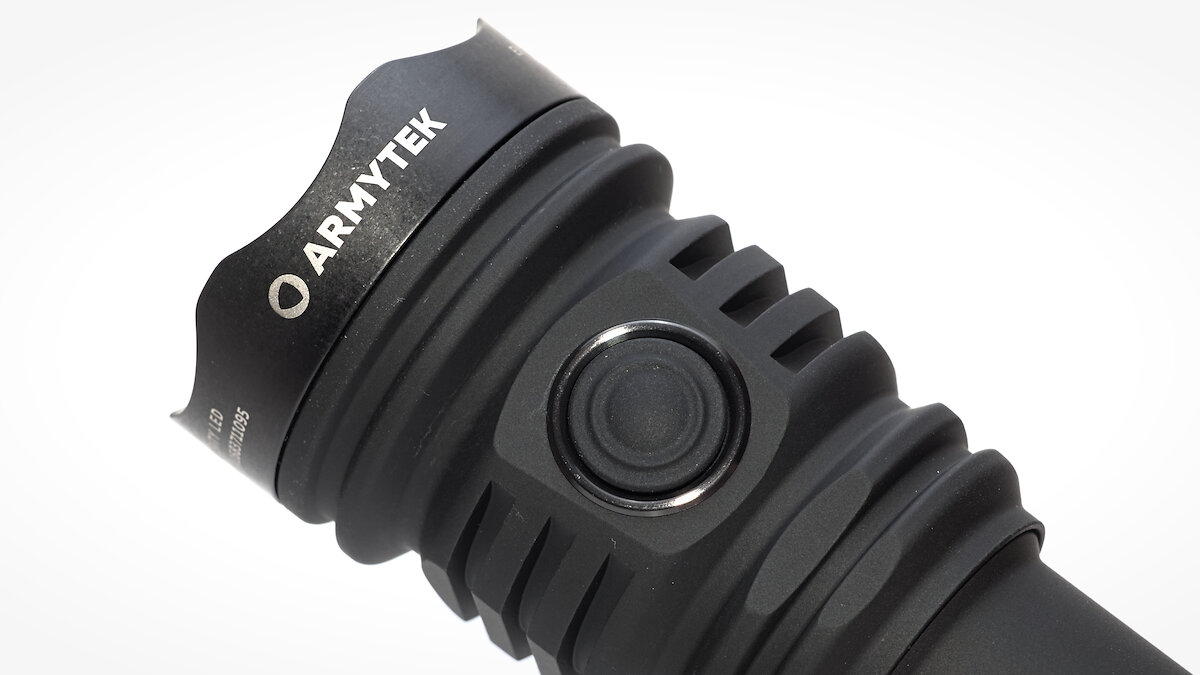
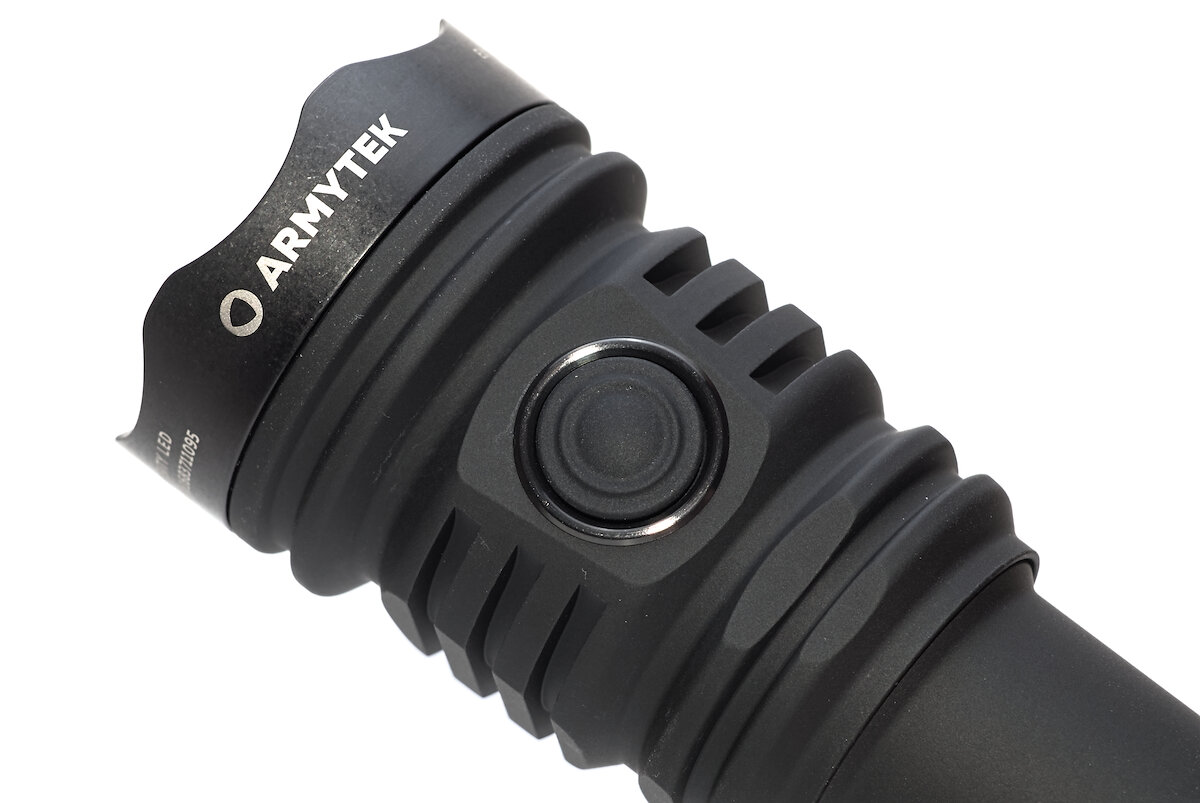
New to this generation is a button on the side of the head. Previously, adjusting the brightness required loosening and retightening the entire head multiple times. Unfortunately, Armytek has opted to not use their distinctive yellow color for the button, which is used on many other models.
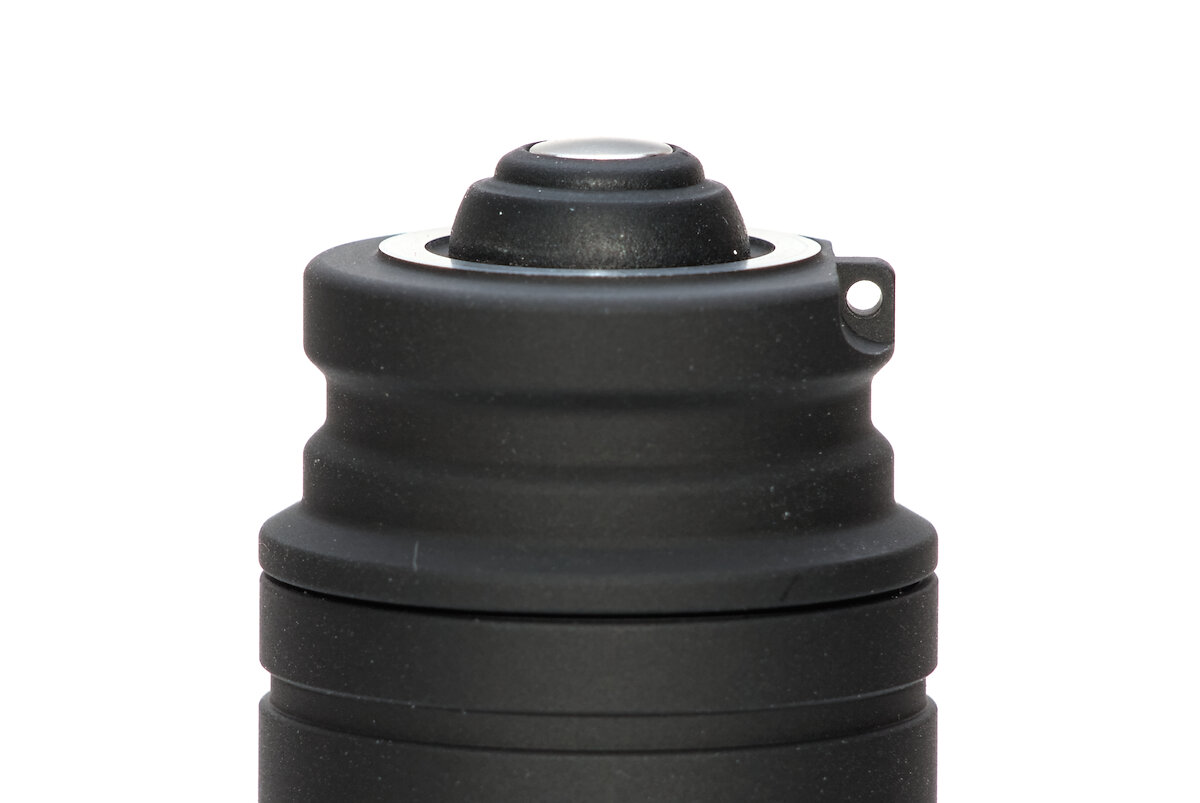
There is a tiny hole on the tailcap for attaching a lanyard. A sufficiently thin cord would likely wear through quickly, so I strongly recommend using a small key ring. Conveniently, a suitable ring is already included in the package.
If desired, the included clip can be attached to the flashlight. Attaching the clip is somewhat hard and will likely leave visible scratches on the flashlight, which is why I have avoided using it so far.
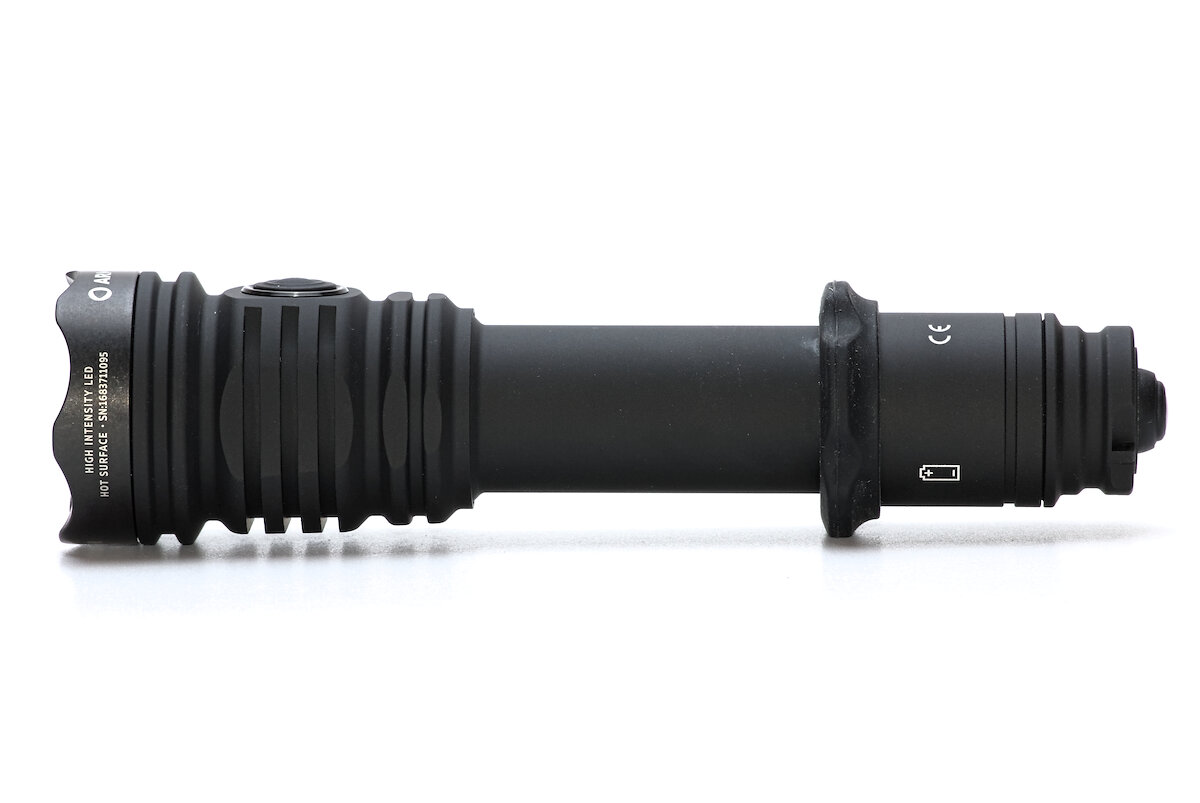
For more flexible and comfortable handling, a “Tactical Ring” can also be used. However, installation requires considerable force and patience. The O-rings should be removed beforehand to avoid damage. A cutout in the ring allows it to be used together with the clip.
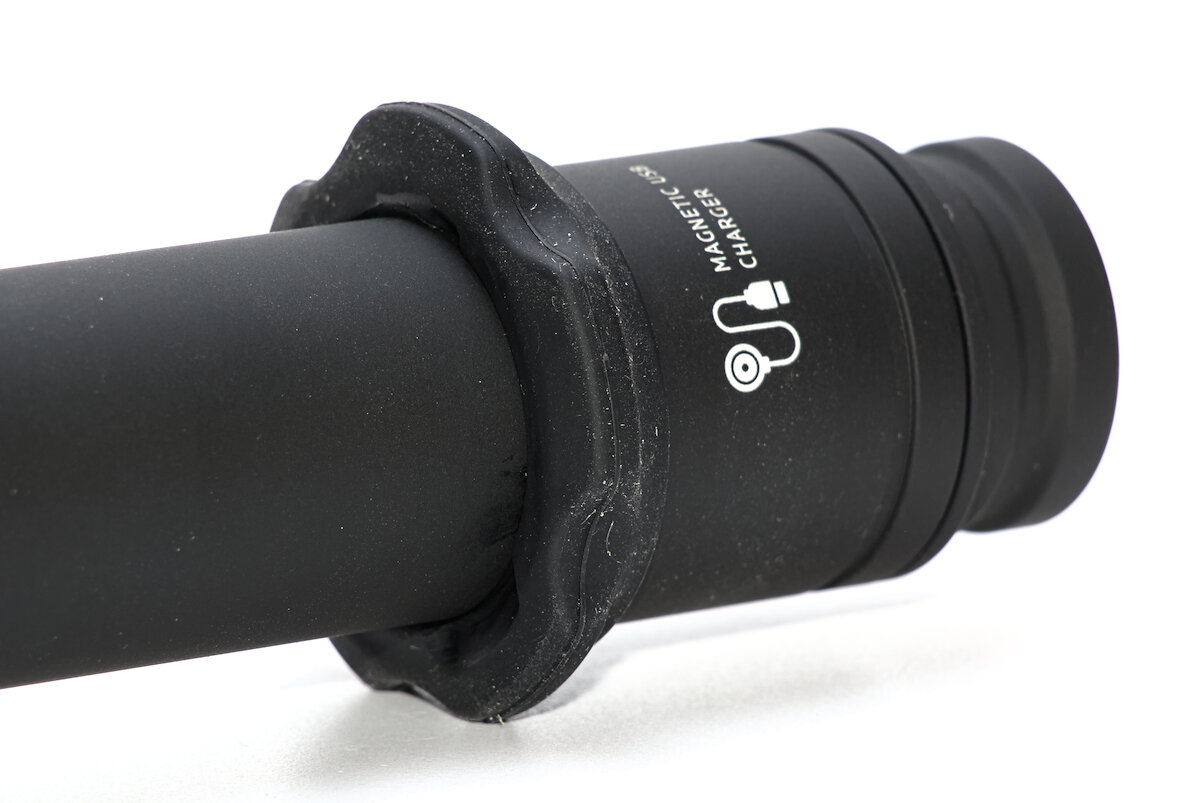
At the same time, the Tactical Ring prevents the flashlight from rolling. Without it, it easily moves on a flat surface.
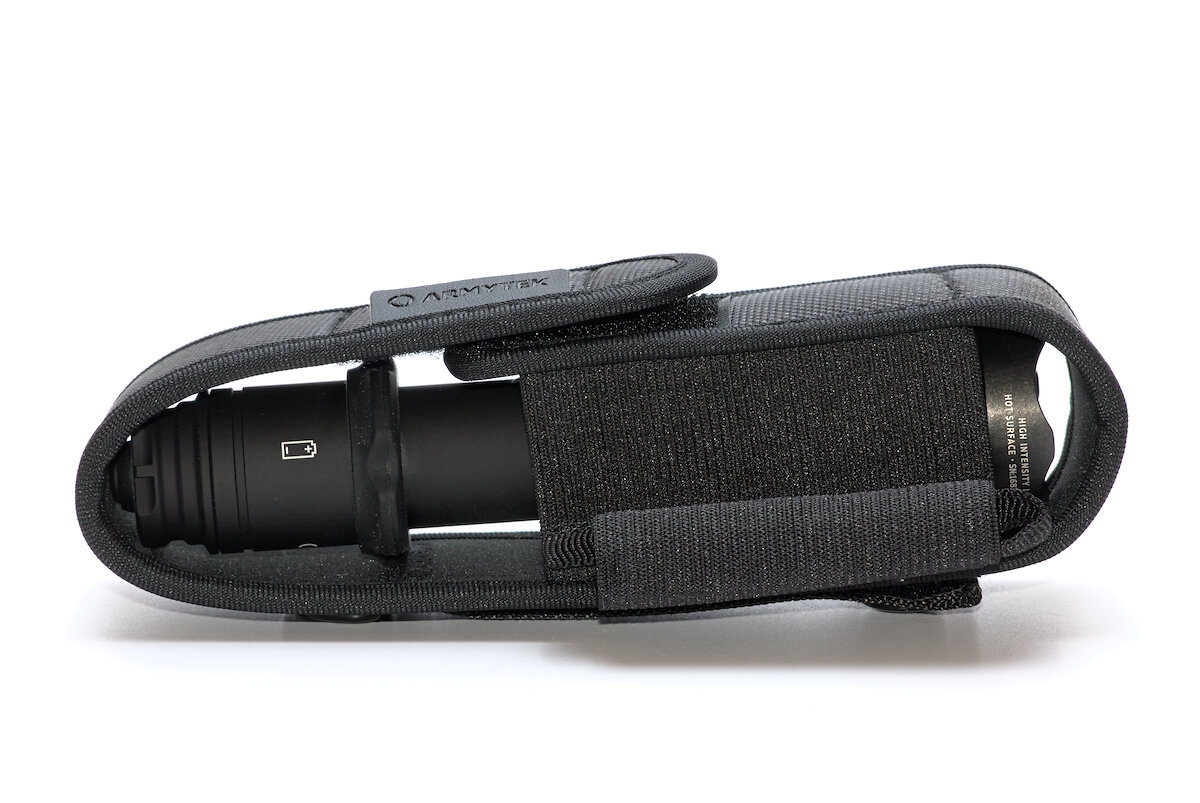
The included holster allows the flashlight to be transported and carried safely and securely. It closes with Velcro and also features an extra loop on the side for a spare battery. Unfortunately, the tail switch is not protected against accidental activation. A suitable protrusion or cap, like on the Klarus XT21X Pro, would have been useful.
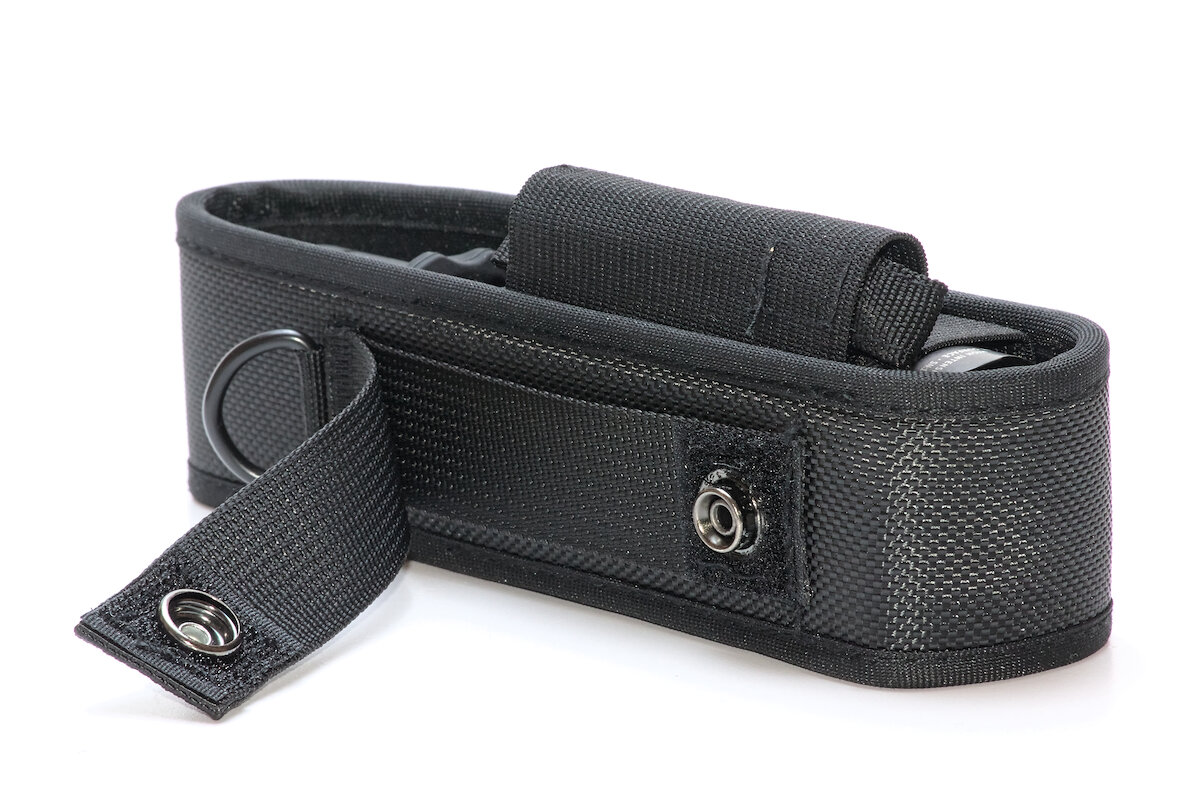
The holster can be worn either via a fixed loop or via a second loop, that is closed with a snap button and Velcro. This also makes it MOLLE-compatible. The setup is complemented by an additional D-ring.
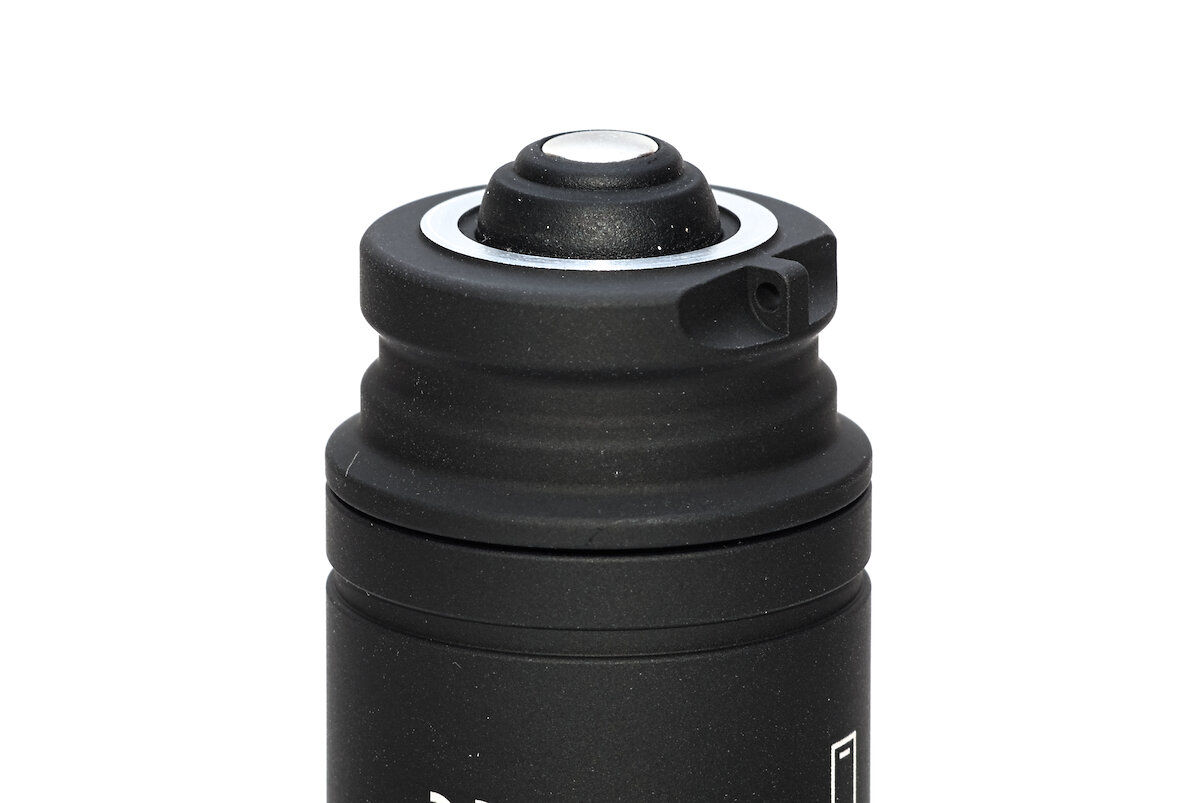
Two O-rings in front of the rear threads ensure the flashlight is sealed against water. Contact with the battery is made via a strong spring. Compared to the previous model, the tailcap design has been slightly modified: the electronics are no longer secured by a threaded retaining ring. Instead, the tailcap now consists of two screwed and additionally glued halves. A spring washer has also been added.
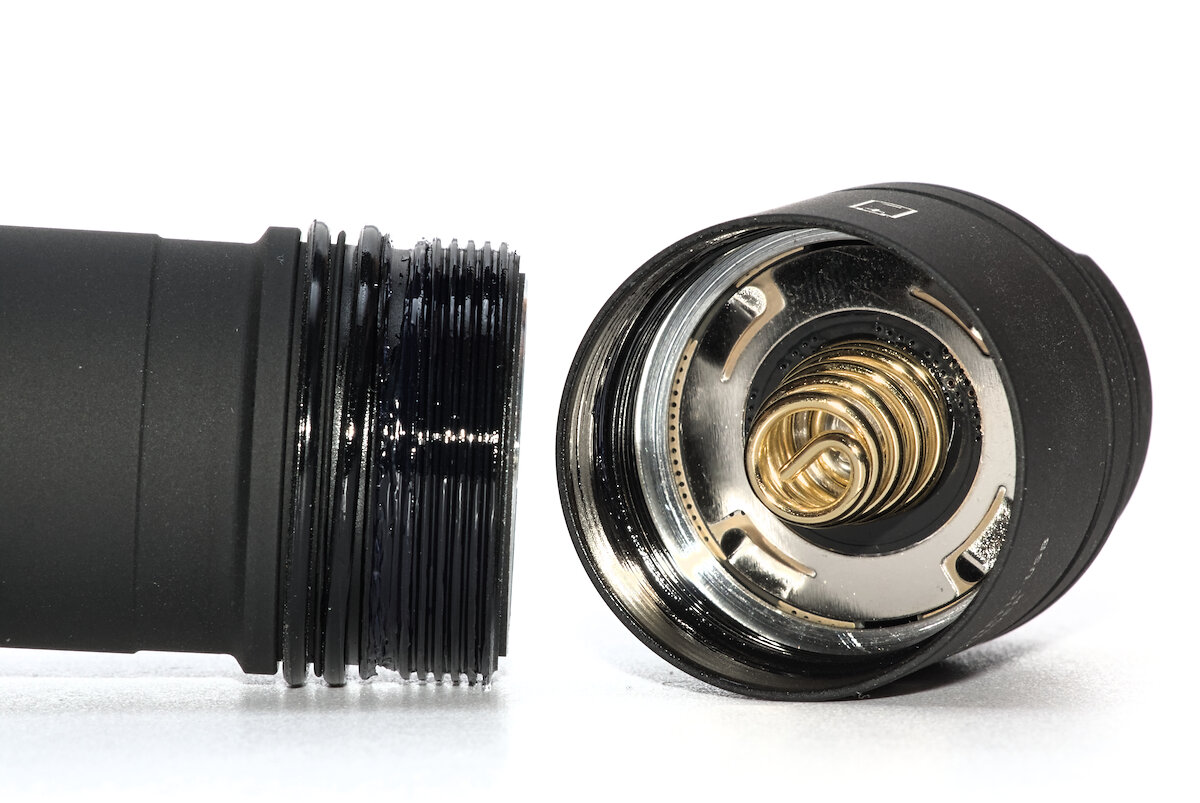
This spring washer establishes contact with the inner battery tube – also a changed compared to the previous version. The inner tube is directly connected to the positive terminal of the battery, allowing it to supply power to the electronics in the tailcap.
I have some concerns regarding the safety of this design. For one, the positive and negative terminals are very close together, making it easy to cause a short circuit when the battery is inserted and the tailcap is removed. A damaged battery shrink wrap, combined with compromised anodization of the battery tube, could also result in a catastrophic short circuit. Additionally, the distance between the spring ring (i.e. the positive terminal) and the negative body is only about a tenth of a millimeter. The previous generation of the flashlight used a single battery tube, so this change seems unnecessary to me.
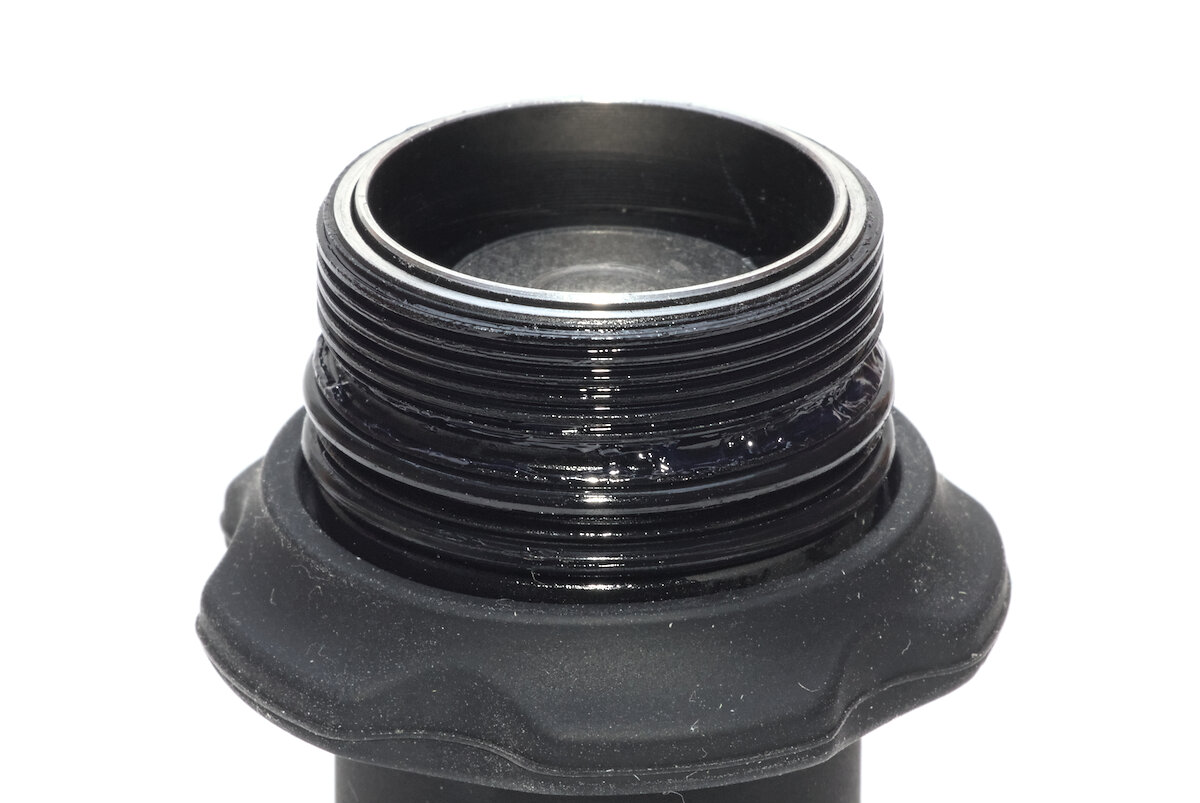
The head and battery tube are permanently glued together in this model. There is also a spring in the head. The flashlight supports all types of 21700 batteries, whether protected or unprotected. Additionally, with the included adapter, it is possible to use 18650 batteries or two CR123A batteries in series.
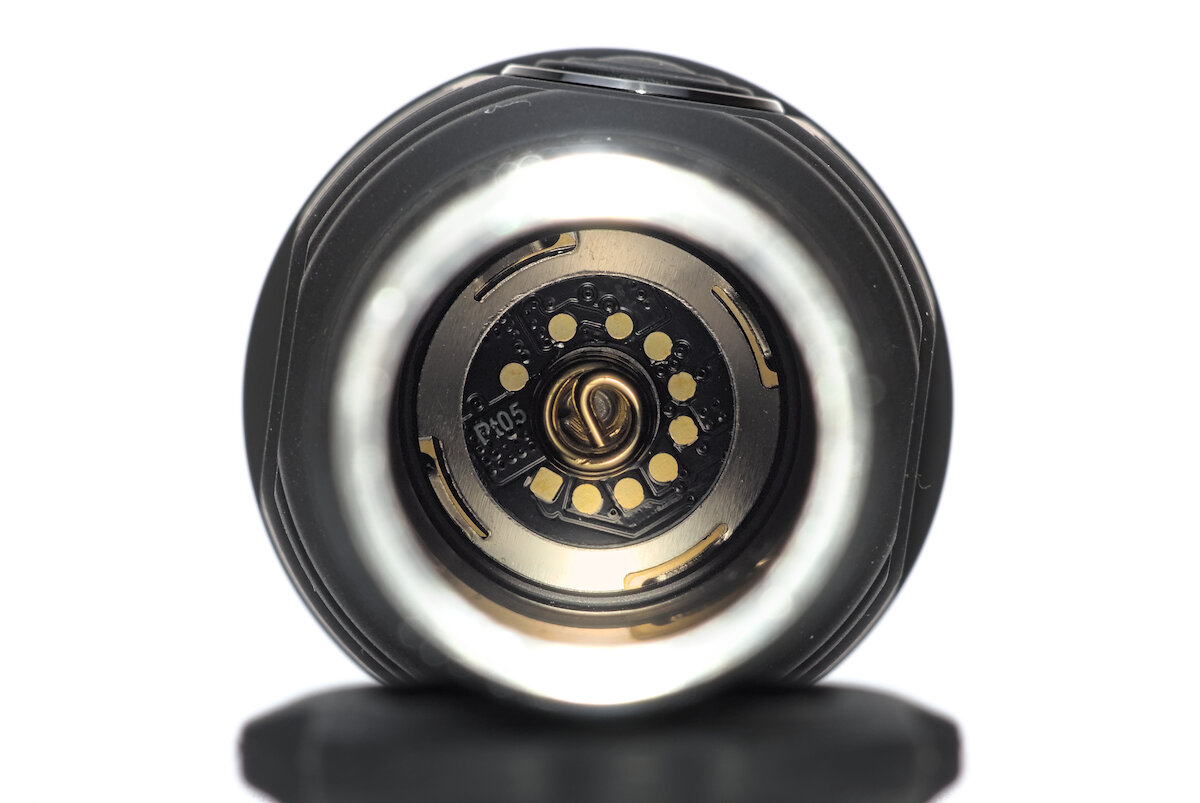
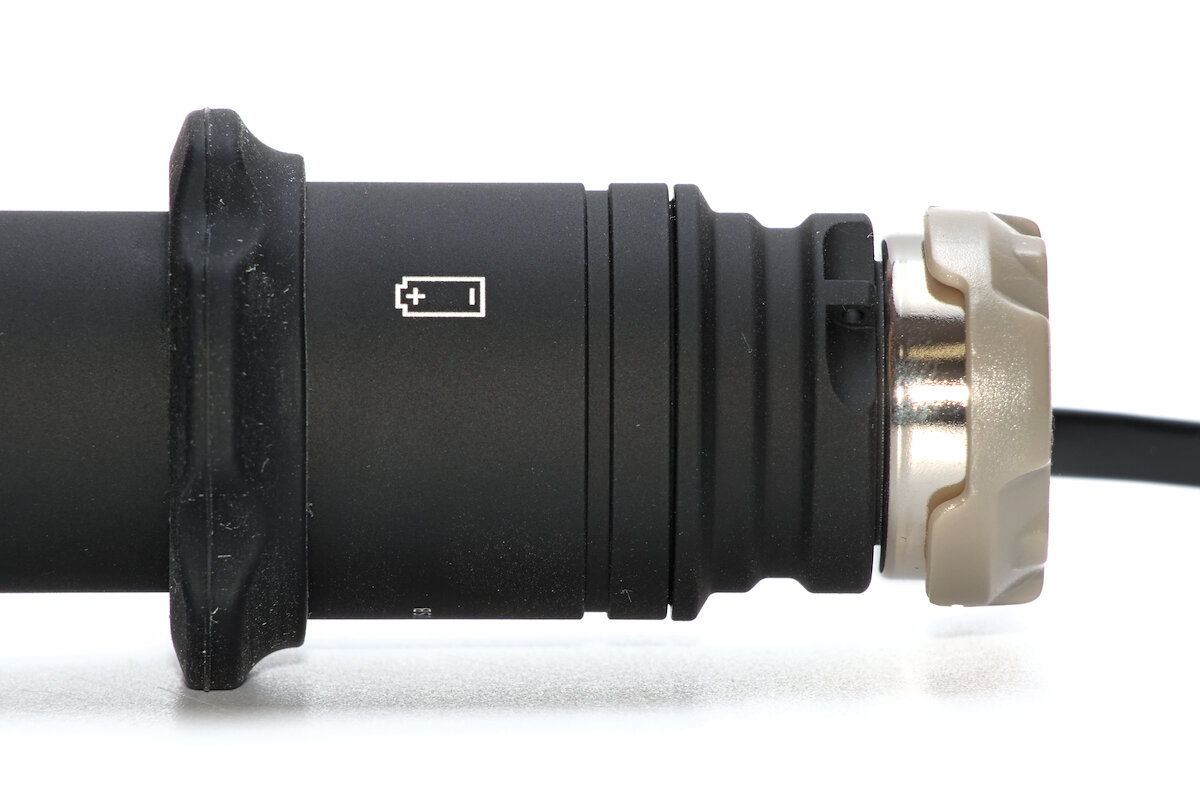
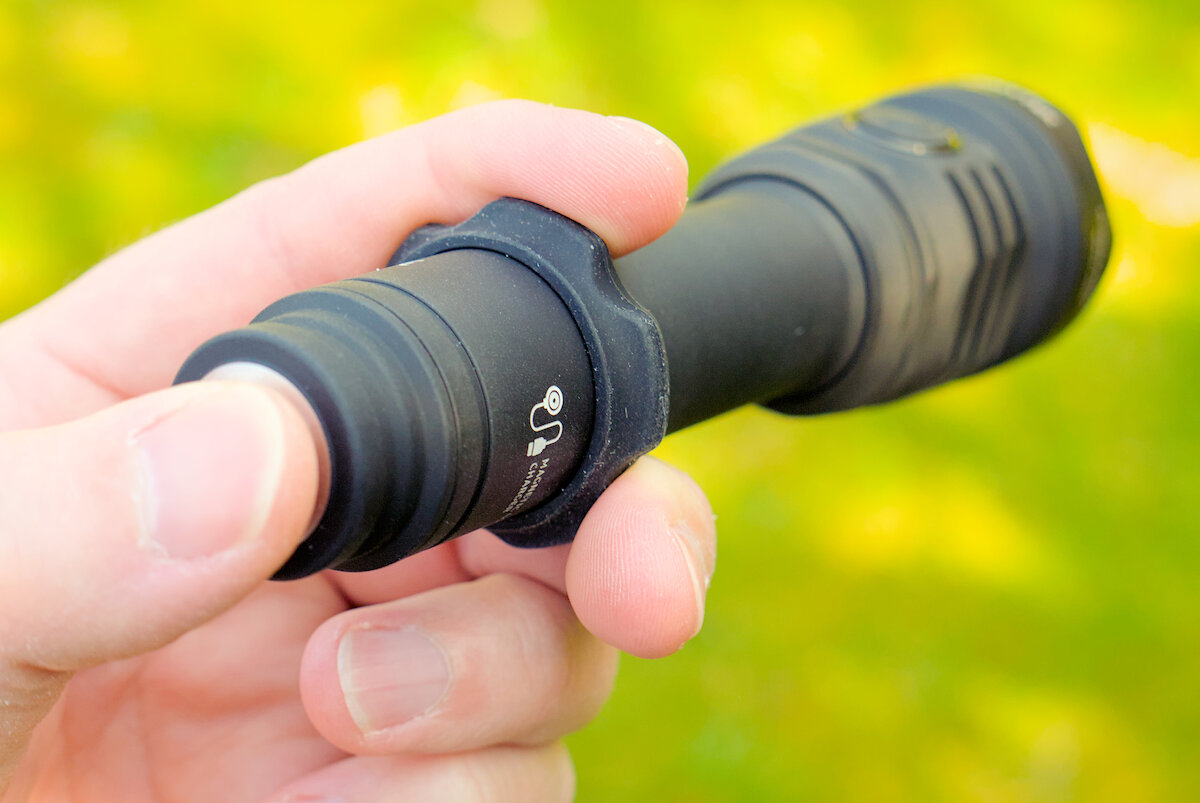
The small metal cap on the switch and the exposed ring serve as charging contacts. This eliminates the need for a water- and dirt-prone USB port. However, charging only works with the special magnetic USB charging adapter that comes with the flashlight.
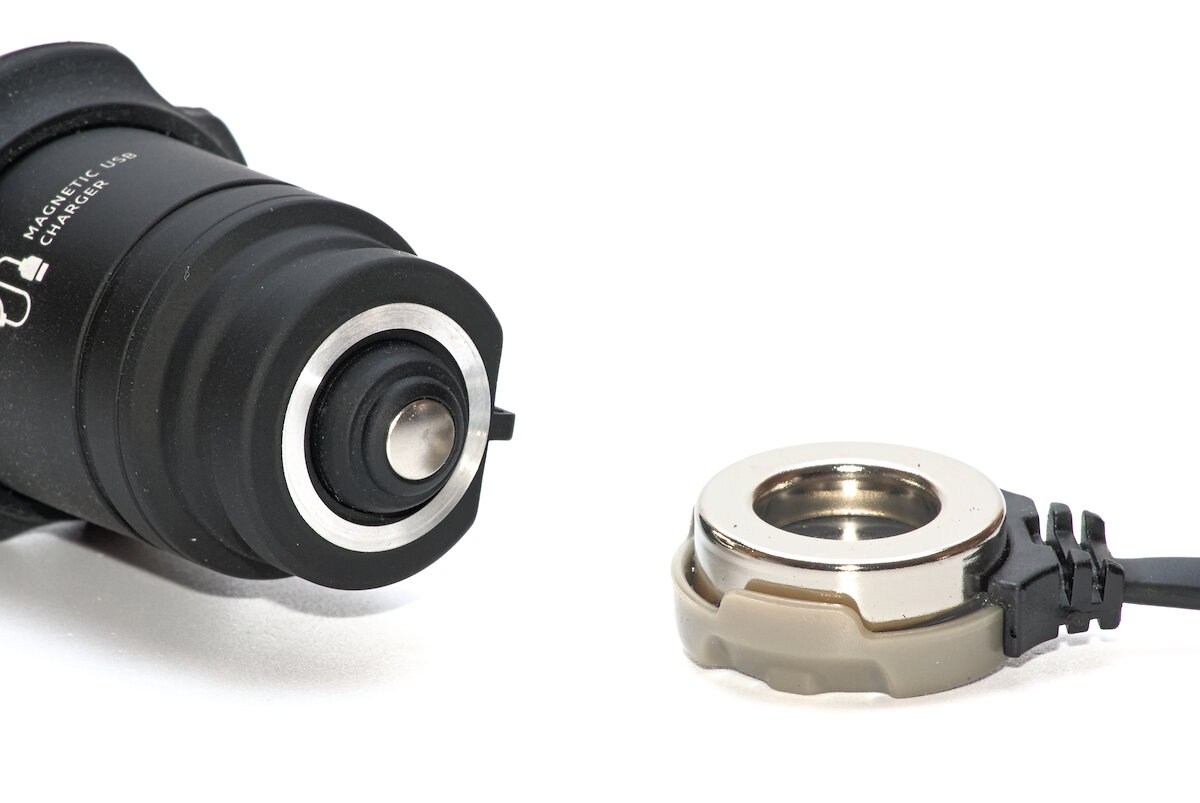
You only need to bring the adapter close to the charging contacts, where it snaps into the correct position by itself thanks to the magnet. It hardly gets any easier than that. The tailcap must be tightened for charging. If the flashlight is on when the charging adapter is connected, it first turns off – and then back on a second later. Charging only begins if the battery voltage is below approximately 4 V.
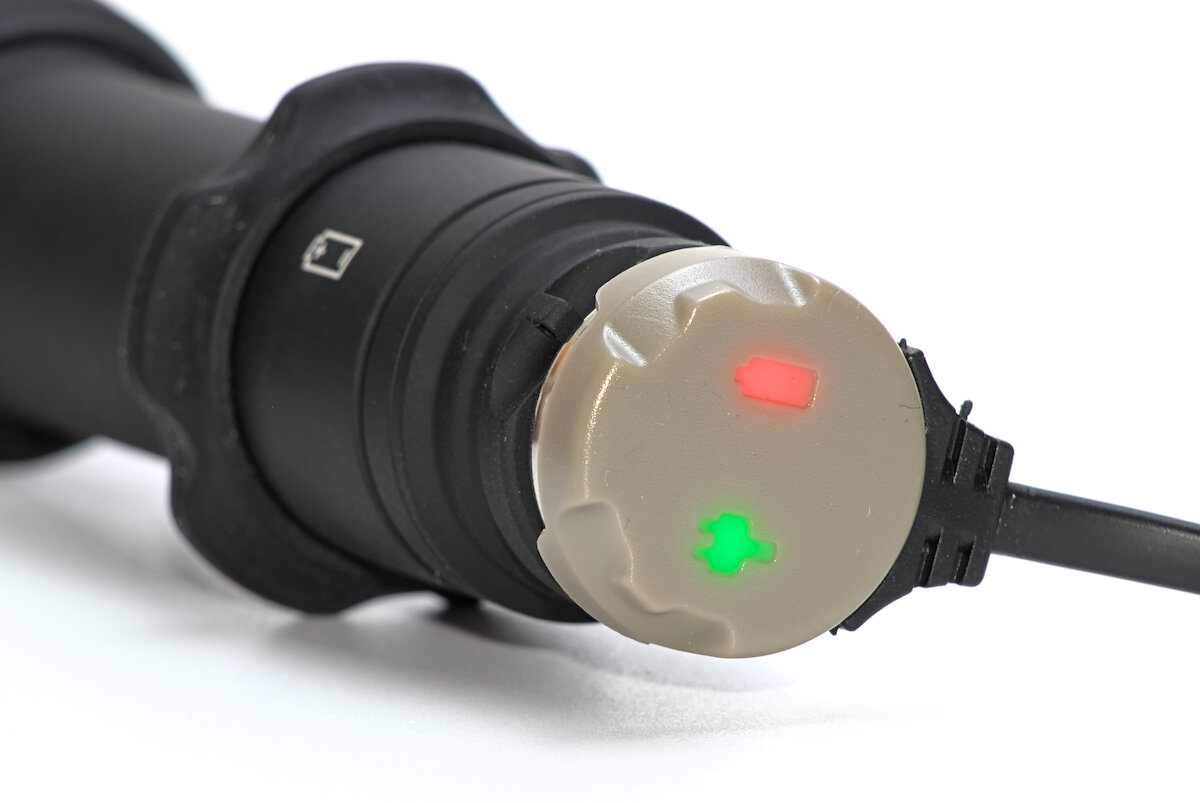
Two LEDs on the charging adapter indicate the current status: red means charging, green means finished (or no flashlight connected). In the photo, both LEDs are visible simultaneously due to a long-exposure shot for better illustration.
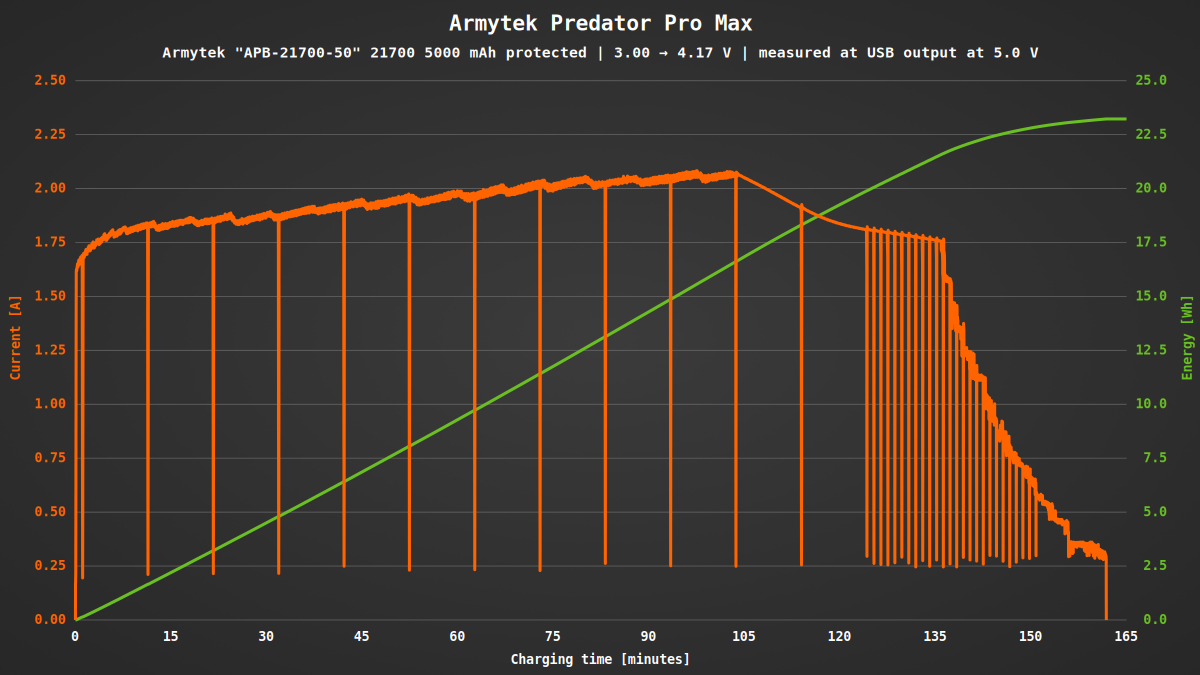
With the new, more powerful charging adapter, the battery is charged at up to 2 A, so the process is completed in about two and a half hours. The charging process is somewhat unusual, as it is briefly interrupted every ten minutes – and later even more frequently. I have only observed this behavior with Armytek so far.
An important aspect is durability: Armytek promises that the flashlights can withstand harsh conditions. The Predator Pro Max is rated IP68, making it waterproof to a depth of 25 meters for at least five hours. It is also said to survive drops from heights of up to 25 meters. The build quality is excellent, although there are a few sharp edges on the cooling fins and the silver contact ring on the tailcap.
User interface
The Predator Pro Max is controlled via a switch on the tailcap, which functions like a forward-clicky. Pressed halfway, it activates the momentary light, which stays on only as long as the switch is held. Pressed fully, the light remains on continuously until the next press.
This is not a mechanical switch, but a two-stage button with its own circuitry in the tailcap. When pressed, there is no loud click. This allows the flashlight to be operated almost silently. The button feels pleasant to press and its prominent position makes it easy and quick to locate. Unfortunately, this also makes it very easy to turn the flashlight on unintentionally.
The flashlight now has a separate side button for adjusting the brightness. In the previous model, the entire head had to be loosened and retightened multiple times for this purpose. In principle, the additional button could be a useful improvement, as it allows one-handed operation. However, its shape and position are poorly chosen, making it difficult to locate even without gloves. Visually, the black button hardly stands out from the also-black body. In the dark, adjusting the brightness quickly becomes a test of patience.
A short press of the side button cycles through the Main 1, Main 2 and Turbo levels when the flashlight is on. Holding the side button while turning the light on activates Firefly mode. A quick double-click of the tail switch activates the strobe mode (with a fixed frequency of 15 Hz).
There are two settings to customize the UI to your personal preferences. The strobe mode can be enabled or disabled by holding the side button for five seconds while the flashlight is on, until the light blinks once. Holding the button for a total of ten seconds allows the mode memory to be turned on or off. With mode memory enabled, the flashlight turns on at the last-used brightness; otherwise, it always turns on in Turbo.
The less tactical Armytek models have a battery indicator built into the button. Behind the yellow cover, a status LED shows the charge level with a brief blink in green, orange or red. Unfortunately, Armytek has omitted this practical feature on the Predator Pro Max. You never know how much charge is left. Only when the battery is nearly empty, the flashlight briefly blinks once with the main light after being turned on.
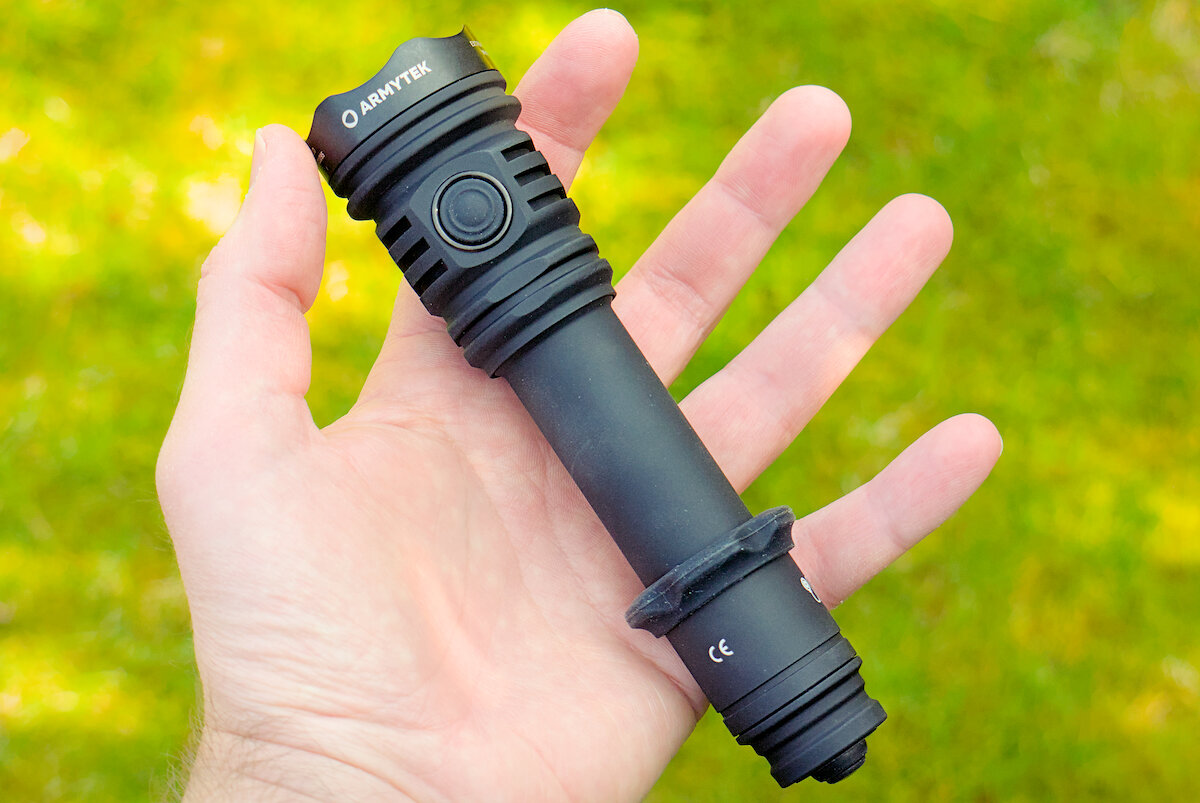
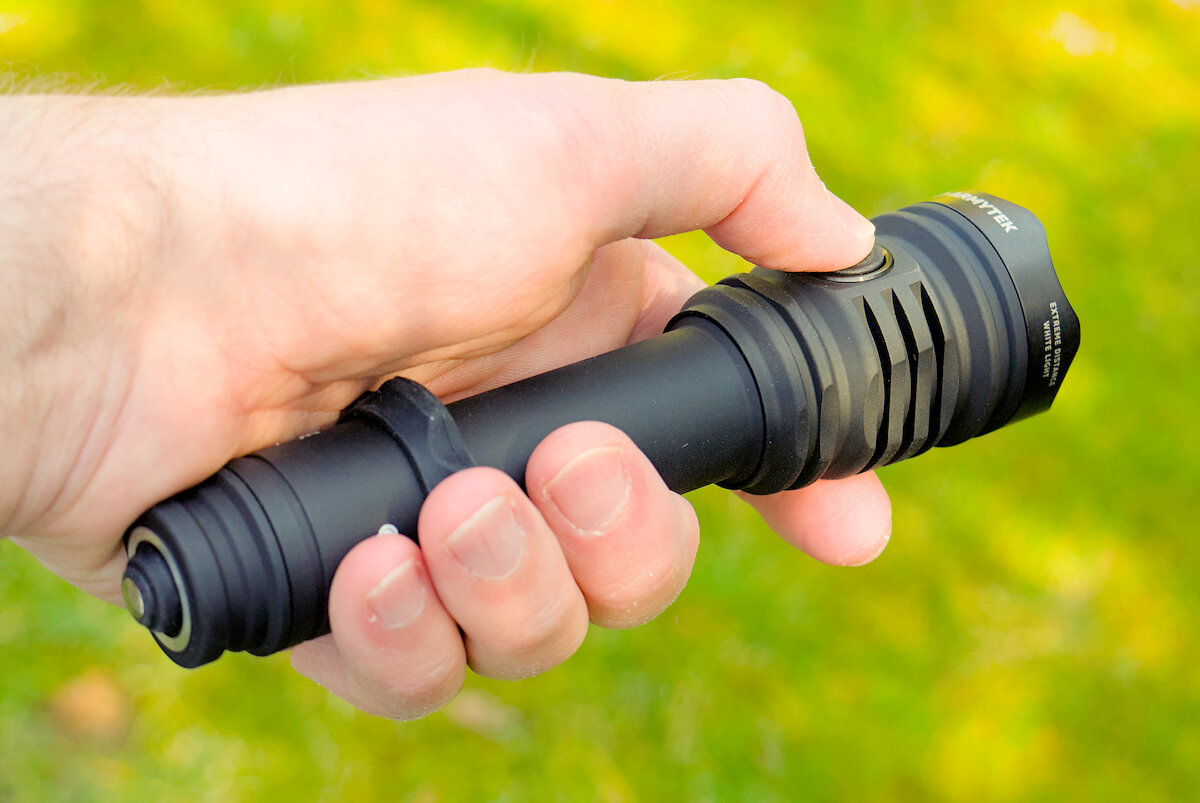
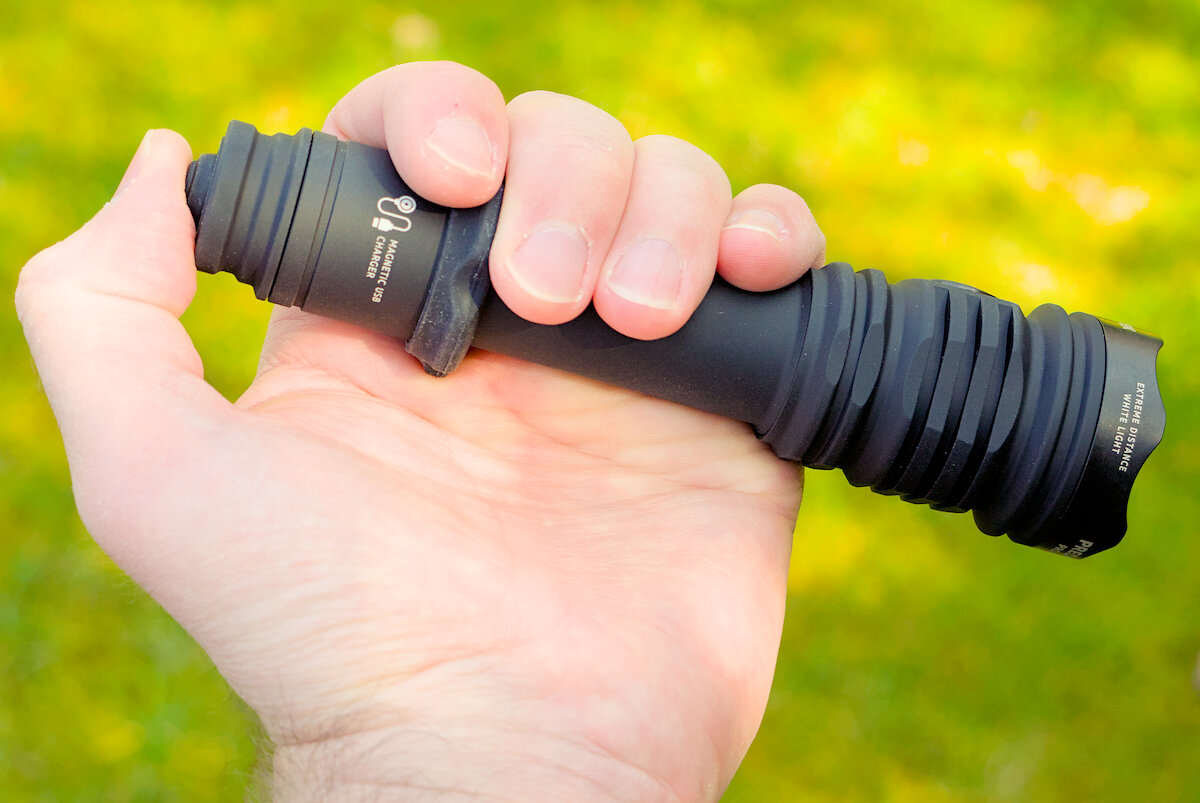
The buttons are spaced far apart, which has the disadvantage that you need to change your grip to turn on the flashlight and change the brightness. As long as you only use the light at maximum brightness and the other modes are rarely needed, it can be operated very conveniently via the easily accessible tail switch. Otherwise, it would be advantageous if the buttons were closer together.
Illumination
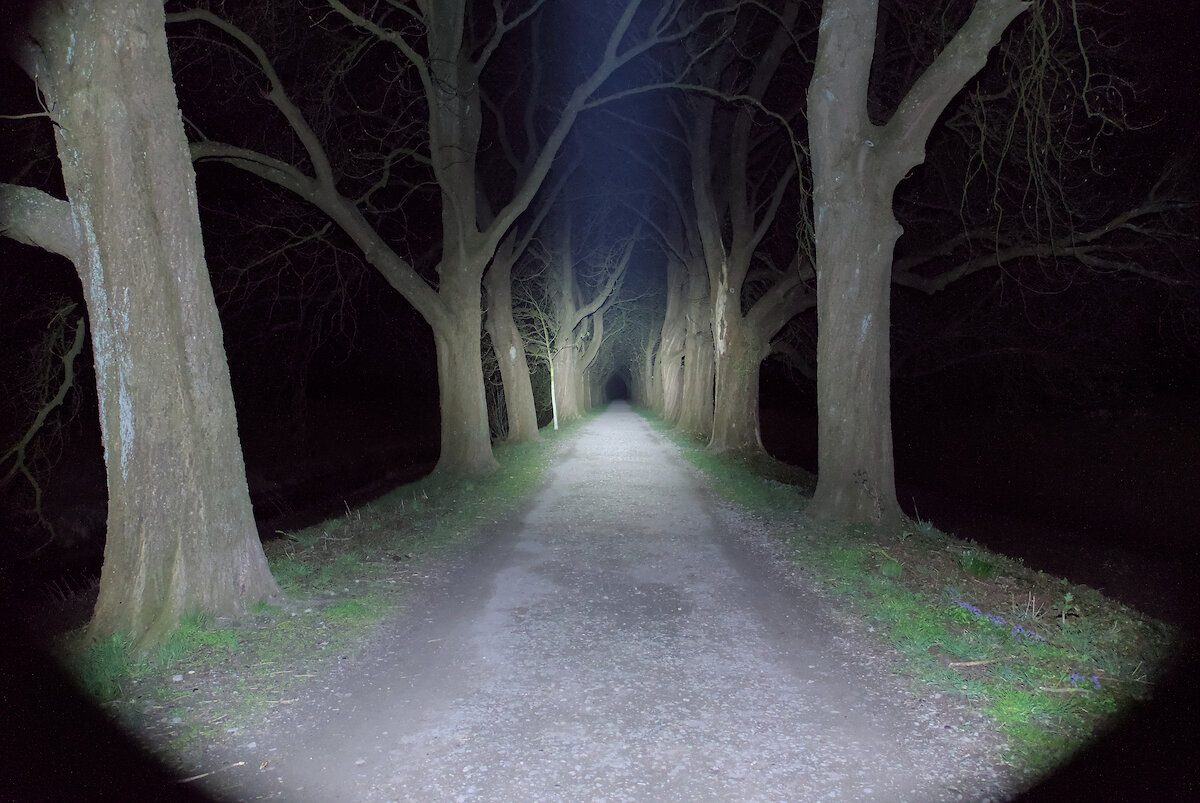
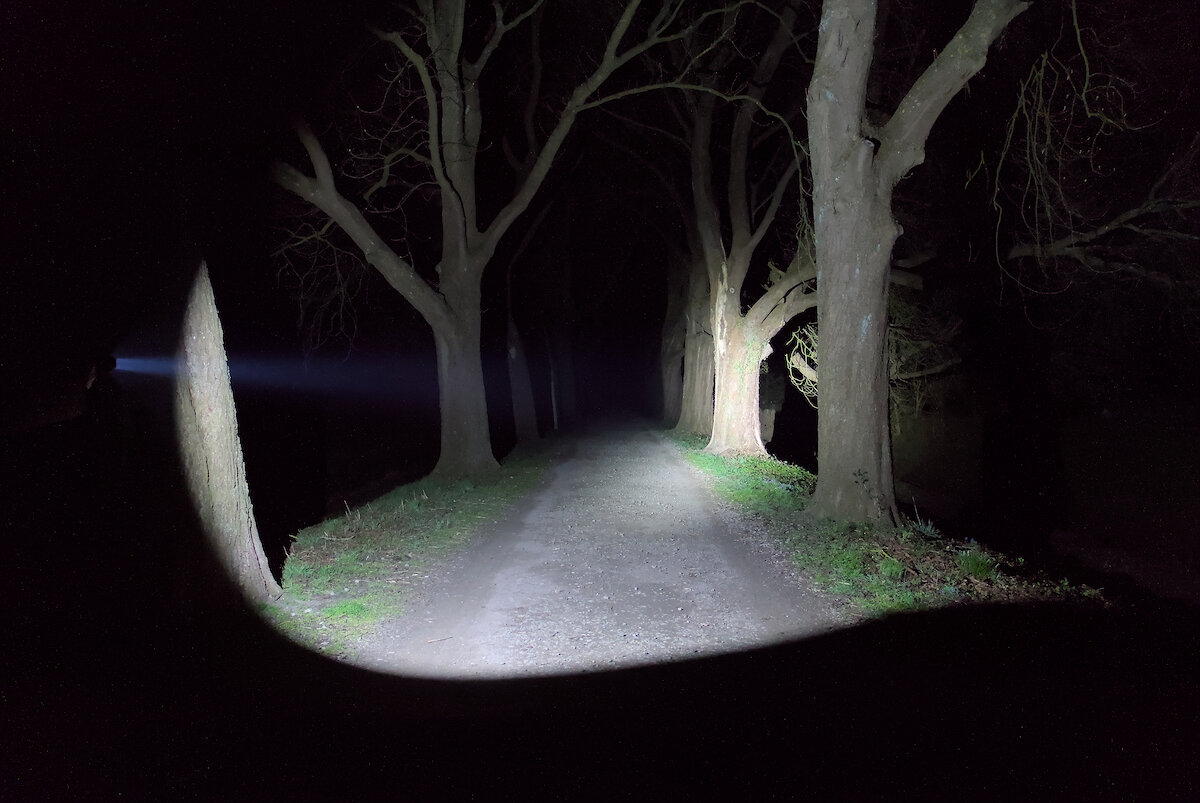
The Predator Pro Max is equipped with a cool white Luminus SFT-70. The color rendering is – as expected – mediocre and the spot has a very slight green tint at low levels. However, neither of these aspects is particularly relevant for a tactical flashlight. The glass lens features a green anti-reflective coating.
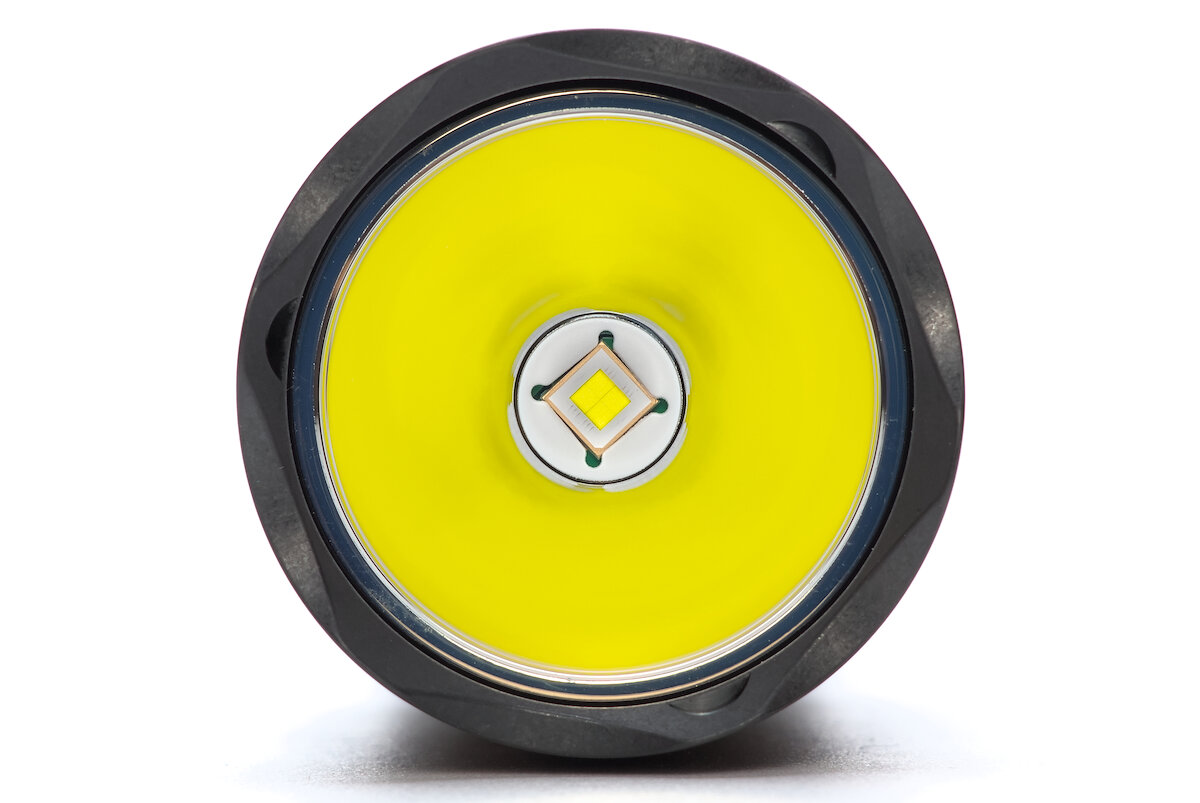
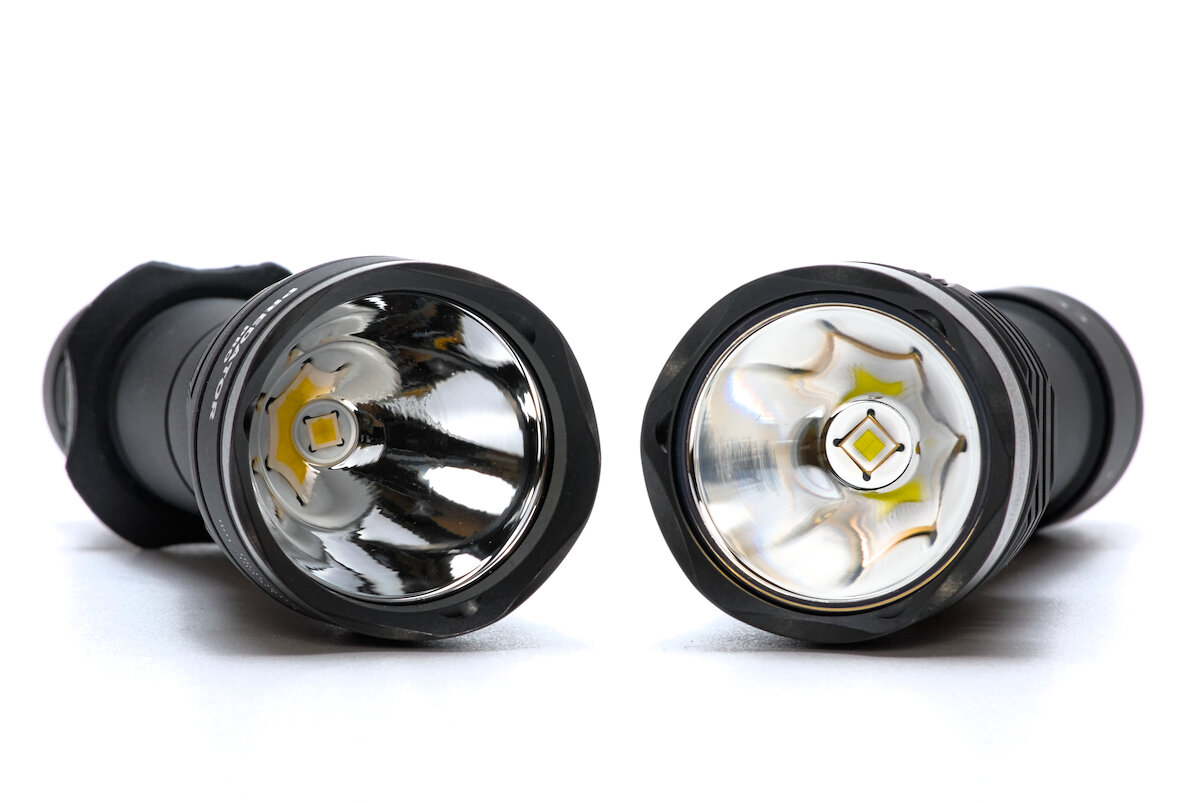
The smooth reflector is almost a third shorter compared to the previous model, resulting in a slightly floodier beam. I have skipped direct comparison photos, as my older Predator Pro uses a warm white Cree XHP35.2 HI with high CRI, which makes the appearance noticeably different anyway.
The beam has a very tight spot surrounded by a bright corona. The spill is even and cleanly cut off at the edges.

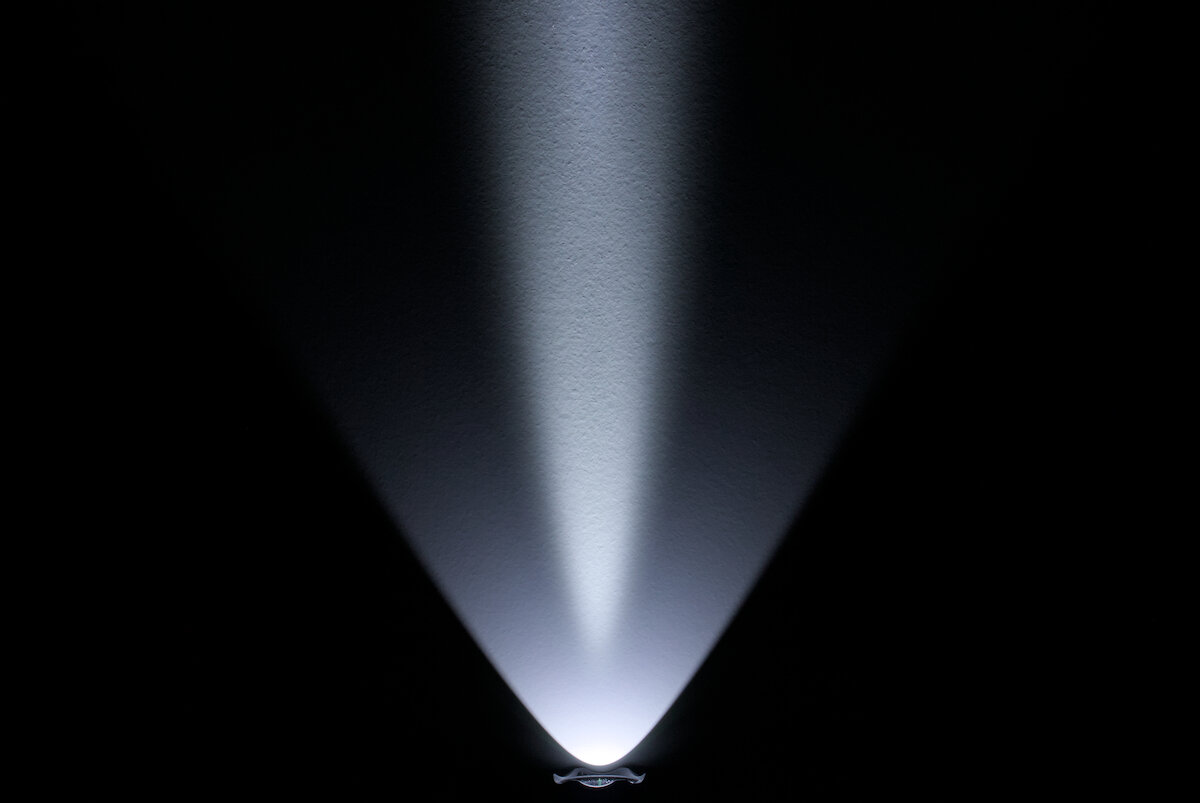
With its beam shape, the Predator Pro Max is therefore only of limited use for indoor applications. Outdoors, however, it shows its full potential – especially when illuminating distant targets without losing the overview of your surroundings. In this context, the optional remote switch and Picatinny mount make sense.
Driver and runtime
The manufacturer does not provide specific details about the type of driver but promotes it as having “powerful electronics” and “full brightness stabilization”.
| Mode | Brightness¹ | Runtime¹ | Intensity¹ (Throw²) |
|---|---|---|---|
| Turbo | 3000 / 920 lm | 1.5 min + 1:54 h | 87 025 cd (590 m) |
| Main 2 | 660 / 230 lm | 3:10 h + 25 min | |
| Main 1 | 230 lm | 12 h | |
| Firefly | 9 lm | 10 d |
¹ According to manufacturer ² ANSI FL1
The brightness regulation is excellent and remains constant for most of the runtime. When the brightness eventually starts to drop, there is still about an hour of reserve left.
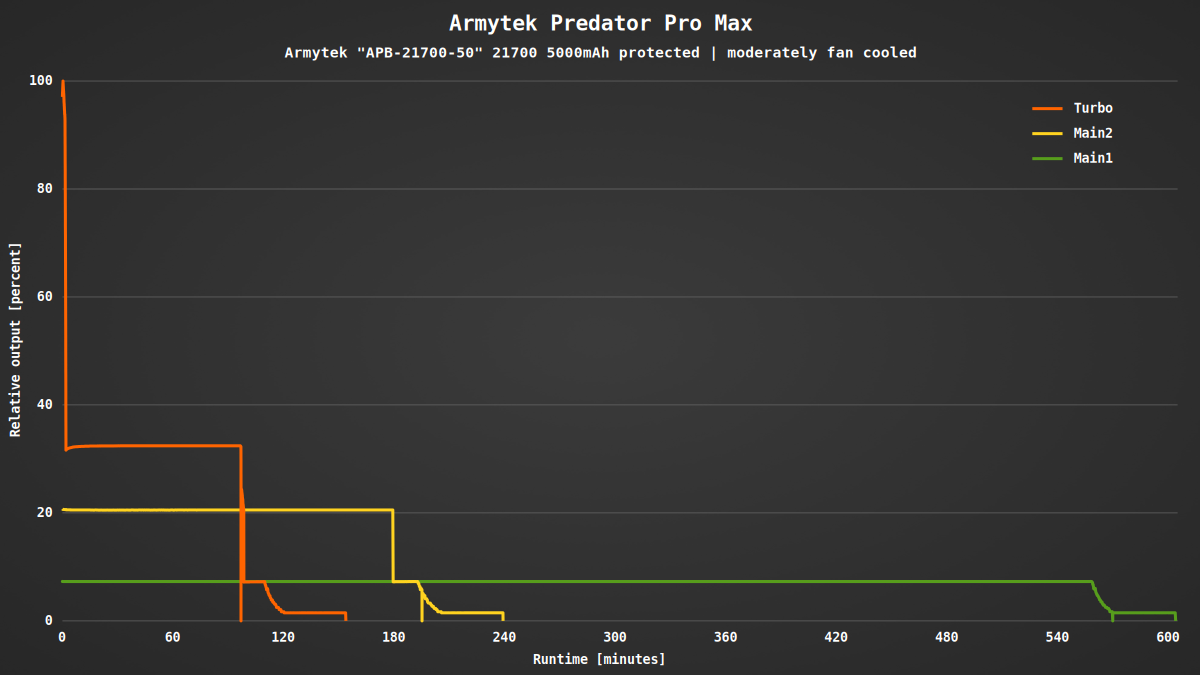
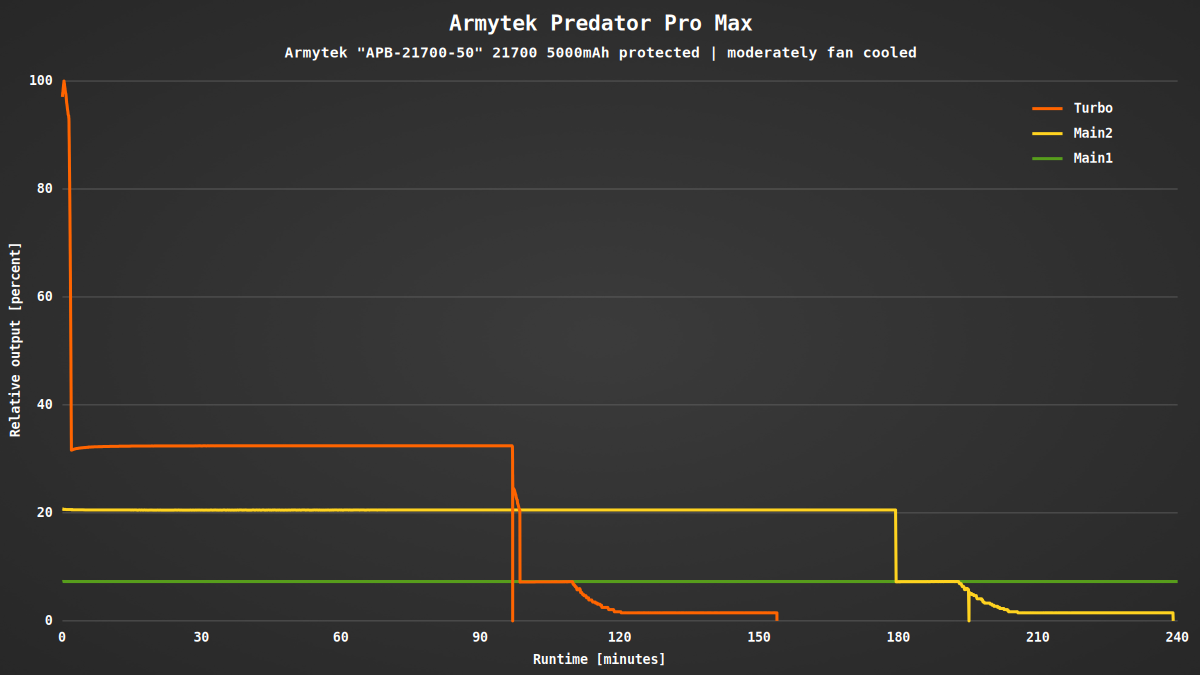
In Turbo mode, full brightness is maintained for about 90 seconds, after which it drops to roughly 30% for the remaining runtime. The temperature briefly rises to around 55 °C but then gradually decreases and stabilizes at approximately 35 °C. There appears to be temperature monitoring, but no true thermal regulation.
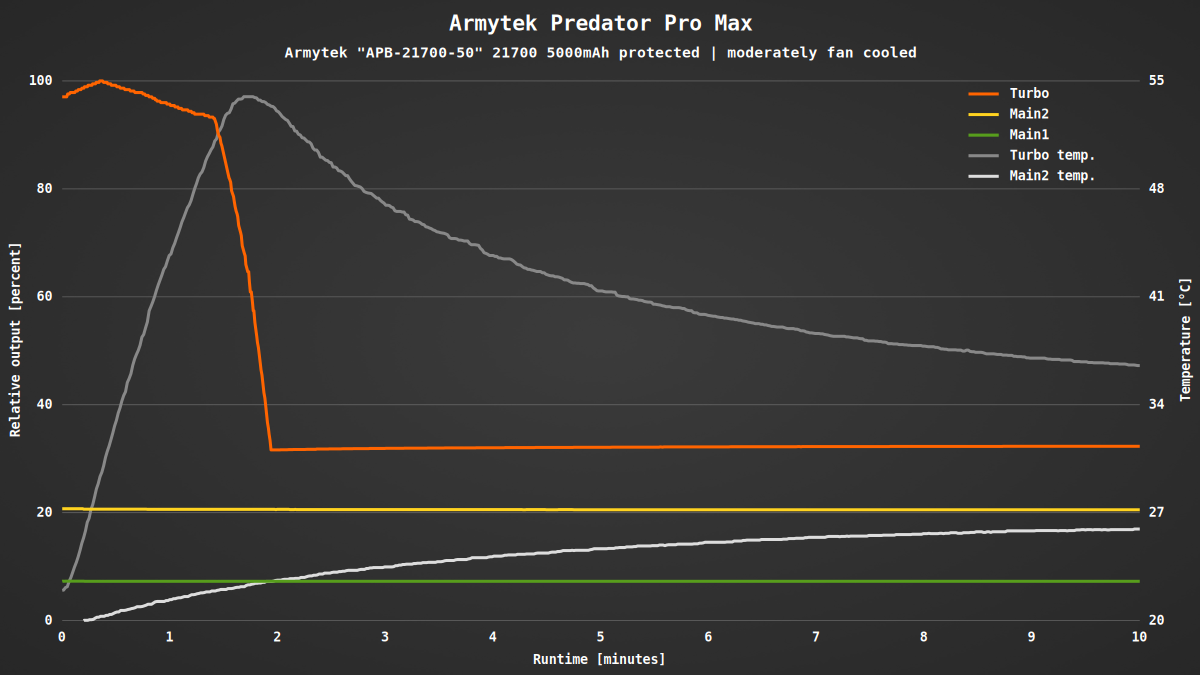
Without cooling, the head can even reach 60 °C for a short time. So be careful not to burn your hands. However, there is no risk to the flashlight or the battery.
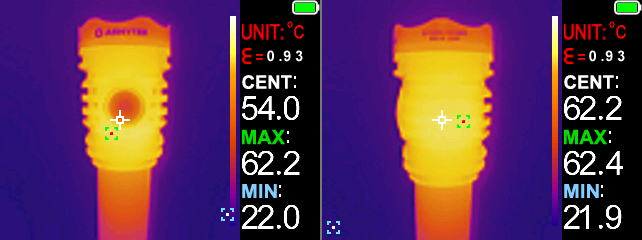
Thermal images with Zoyi ZT-R02
All brightness levels are regulated without PWM and no ripple could be detected with the oscilloscope. Unfortunately, due to the double battery tube, I was unable to establish a reliable connection to measure the current. For the same reason, I could not determine the exact voltage at which the flashlight shuts off to protect the battery from deep discharge. At the end of the runtime tests, however, the battery voltage was always just below 3 V.
Conclusion
The Armytek Predator Pro Max lives up to its name: compared to its predecessor, it is brighter, has a longer runtime and more throw – all while maintaining nearly the same size. It comes with a new side button, which eliminates the need to loosen or tighten the head to adjust the brightness. Other features like the electronic tail switch and the convenient magnetic charging system are still included.
However, if you don’t want to use the flashlight at full power all the time, it can quickly become a challenge to use: in the dark, the side button for adjusting the brightness is hard to find, as it neither stands out in color nor in shape.