My aversion to zoom flashlights is mainly due to the fact that their mechanical design often makes them inefficient and prone to water damage. Fortunately, there are alternatives for adjusting the beam pattern – like the new Nitecore EX7 with its four M515S LEDs.
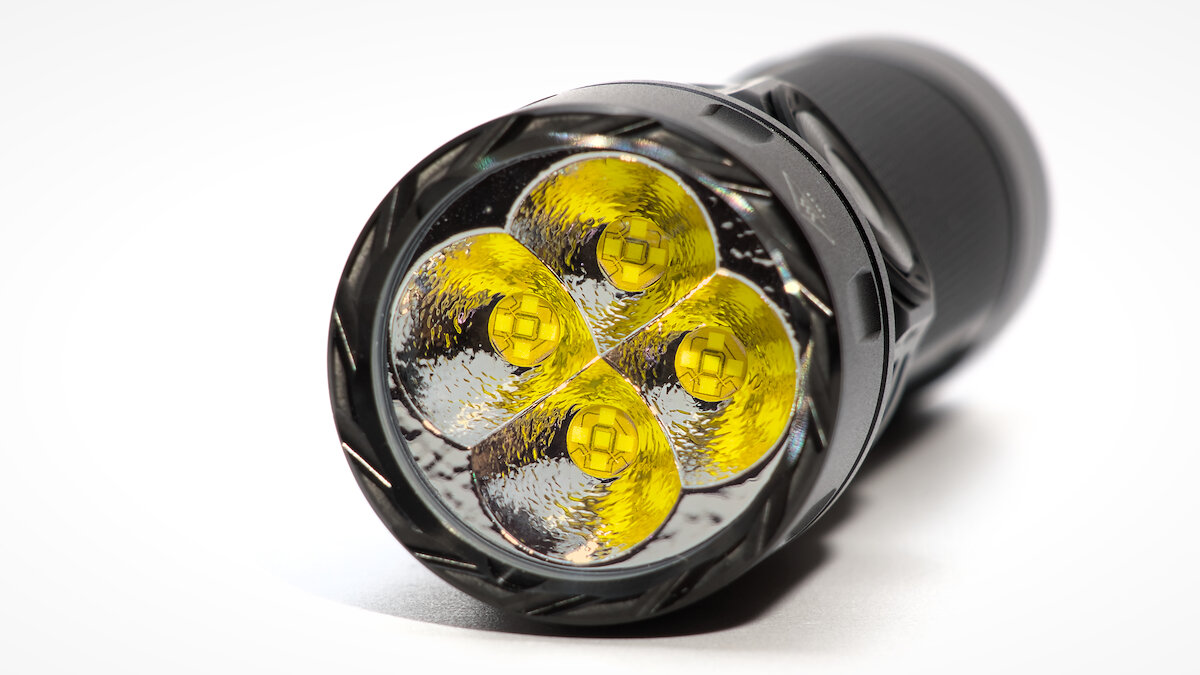
The LEDs used here are once again a proprietary development by Nitecore. Thanks to their special design, featuring five closely positioned light emitting surfaces that can be controlled in two separate groups, the effective LES – and thus the beam pattern – can be adjusted as needed.
You can find the German version of this review on my website: SammysHP Blog › Nitecore EX7
The flashlight was provided by the manufacturer for this review. Thank you very much!
Overview
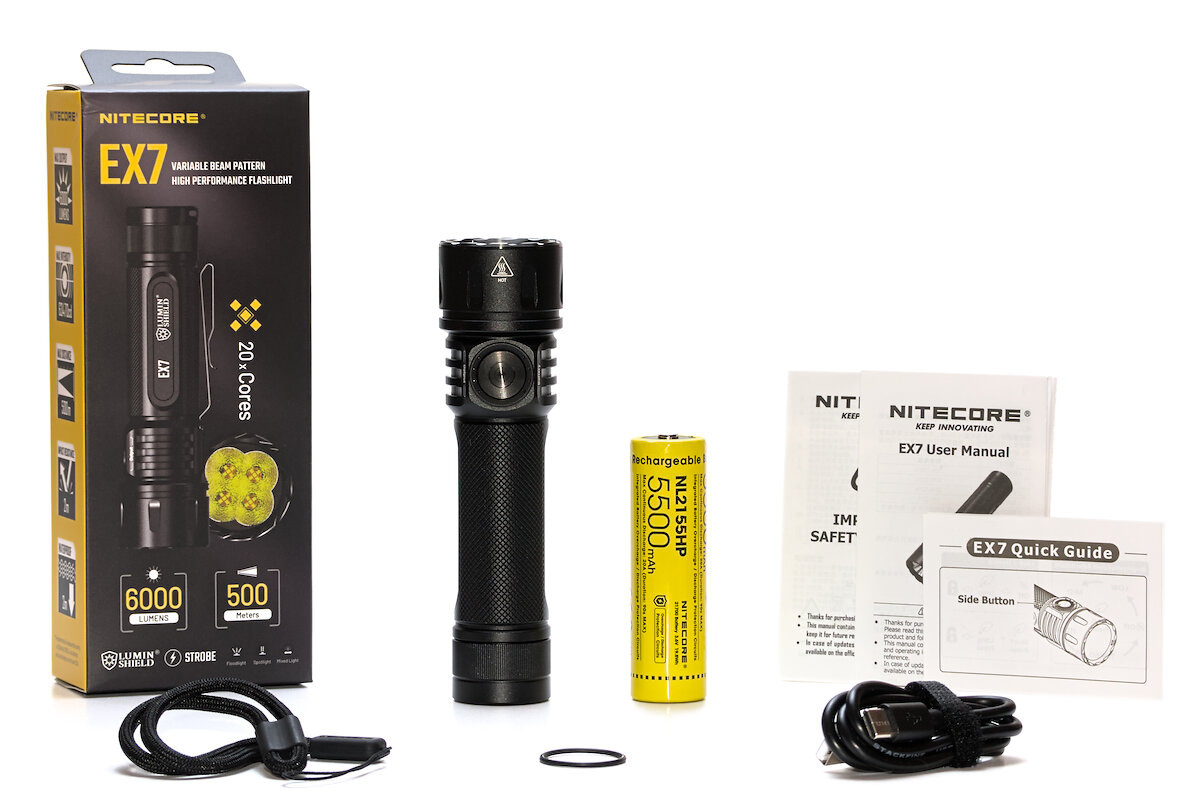
The flashlight comes with accessories in a black-and-yellow retail package.
- Nitecore “NL2155HP” 21700 Li-ion battery (5500 mAh, protected, button-top, 3.54 V at arrival)
- Clip (attached)
- Lanyard
- USB-C charging cable
- Replacement O-ring
- Quick start guide, manual (EN, DE, FR, RU, JA, IT, UK, PL, EL, CN), safety notes
In addition to the detailed user manual in ten languages, there’s also a quick-start guide that clearly summarizes the key operating instructions using graphics. A separate safety data sheet provides information on potential hazards associated with using the flashlight. It also includes a note stating that the flashlight is intended for use by adults aged 18 and over only.
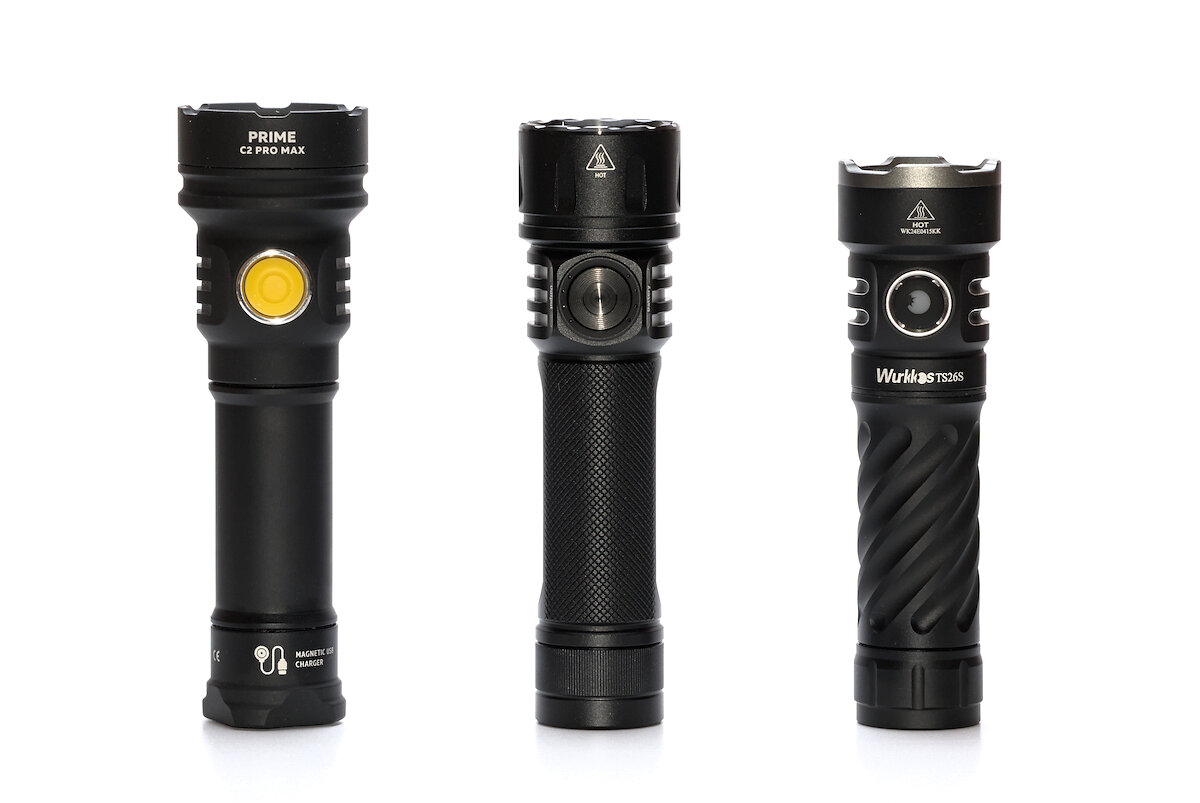
At 130 mm in length and with a weight of around 200 g, the EX7 is less suited as an EDC flashlight for your pants pocket, but it fits well in a jacket pocket.
Length: 130.0 mm
Diameter (head): 35.0 mm
Diameter (battery tube): 28.0 mm
Diameter (tailcap): 28.0 mm
Weight (without battery): 134 g
Weight (21700 battery): 74 g
Weight (total): 208 g
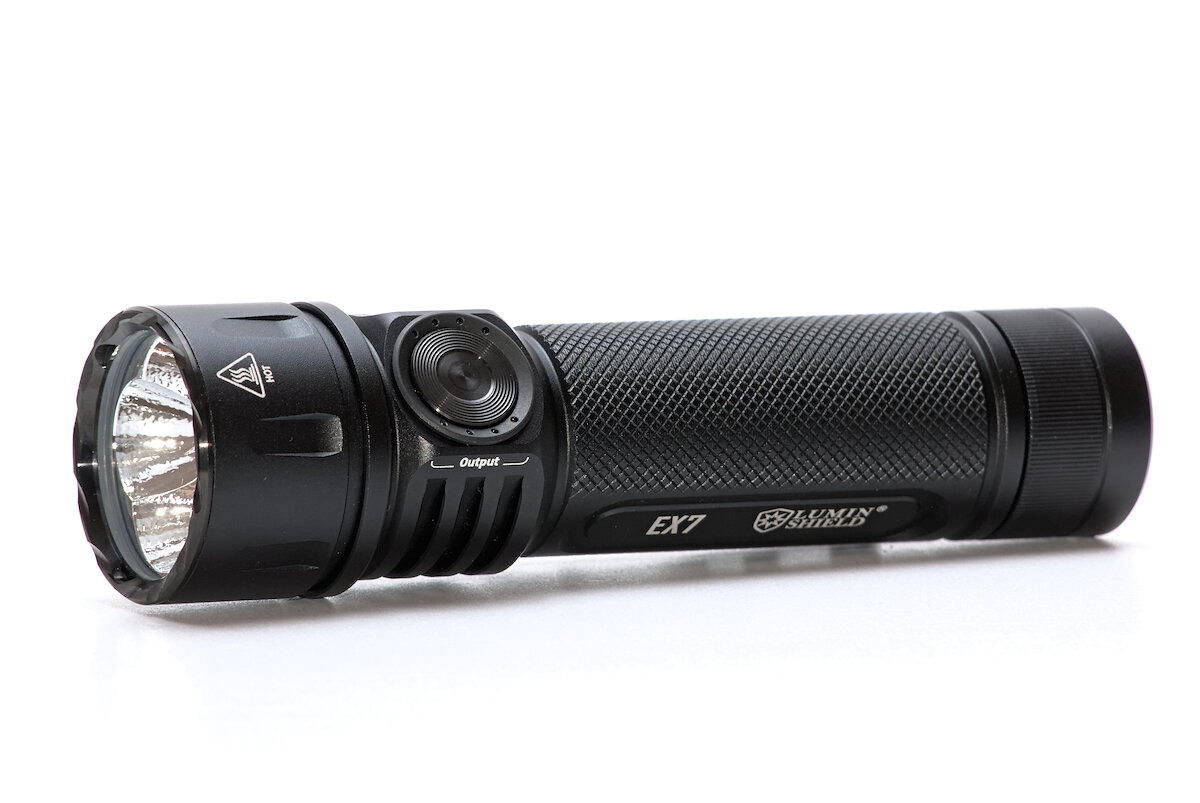
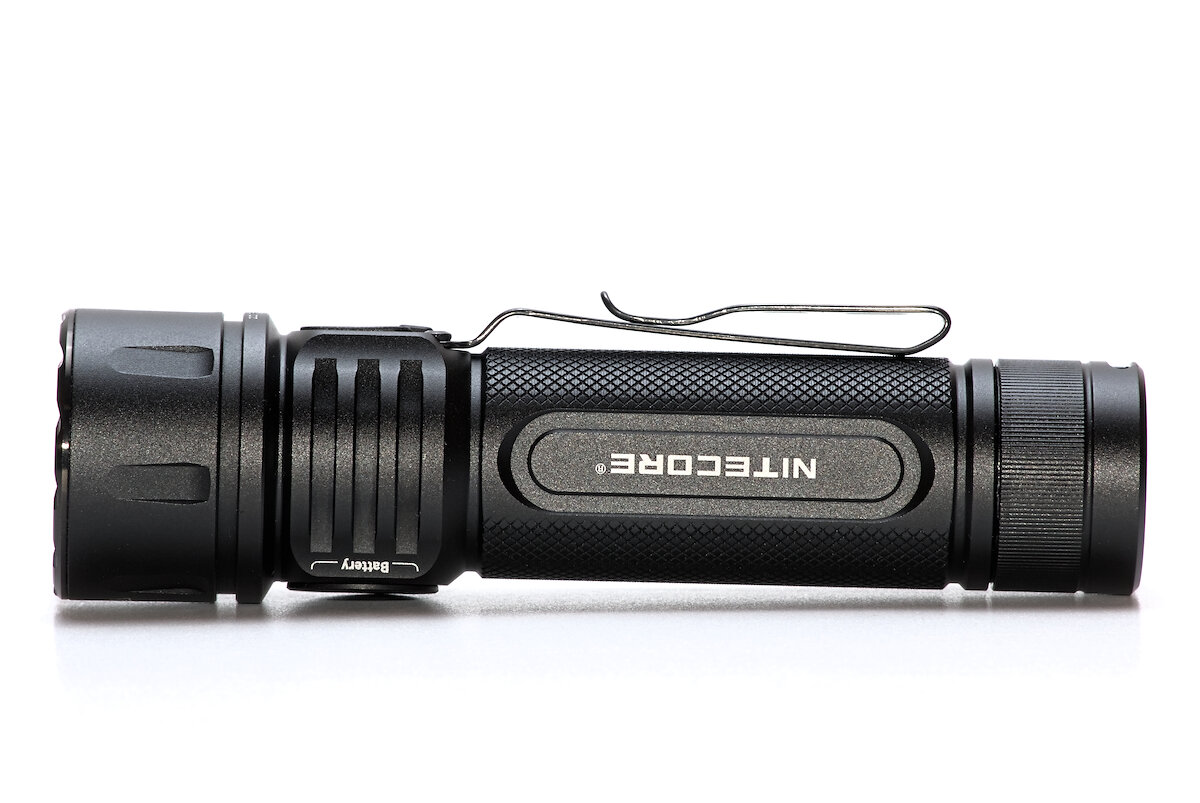
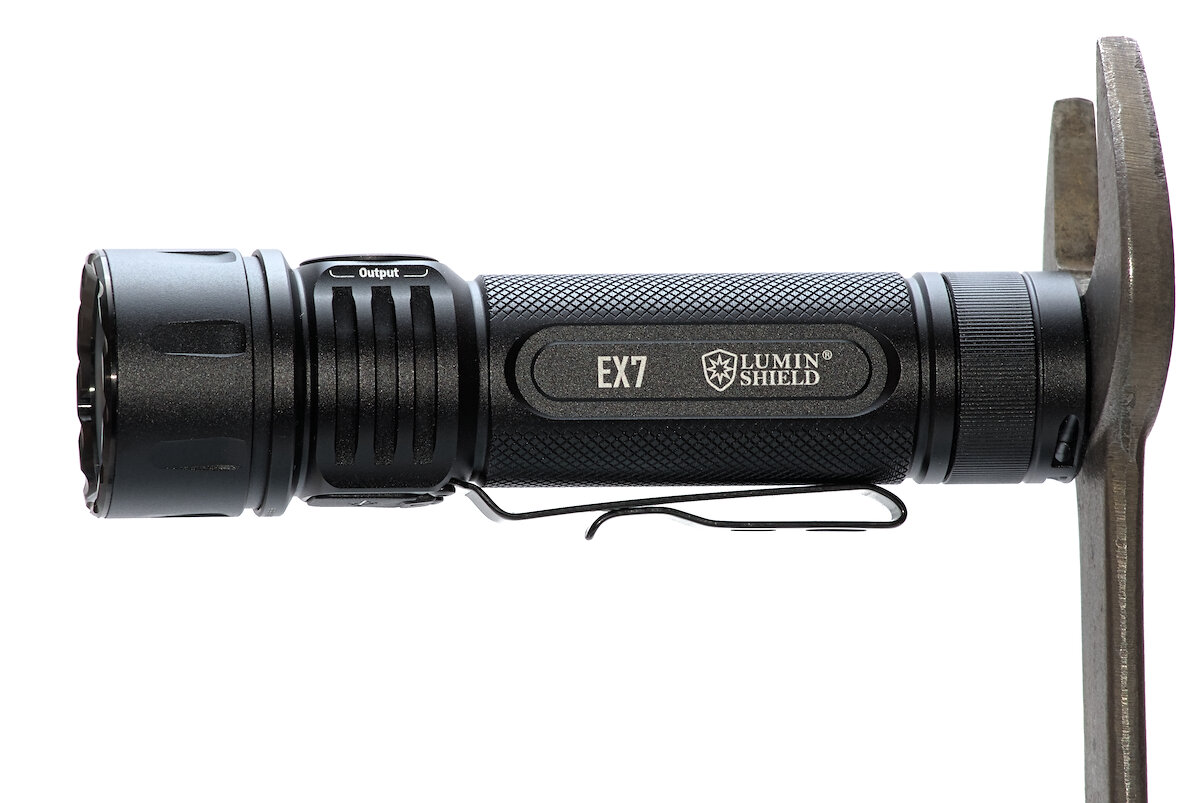
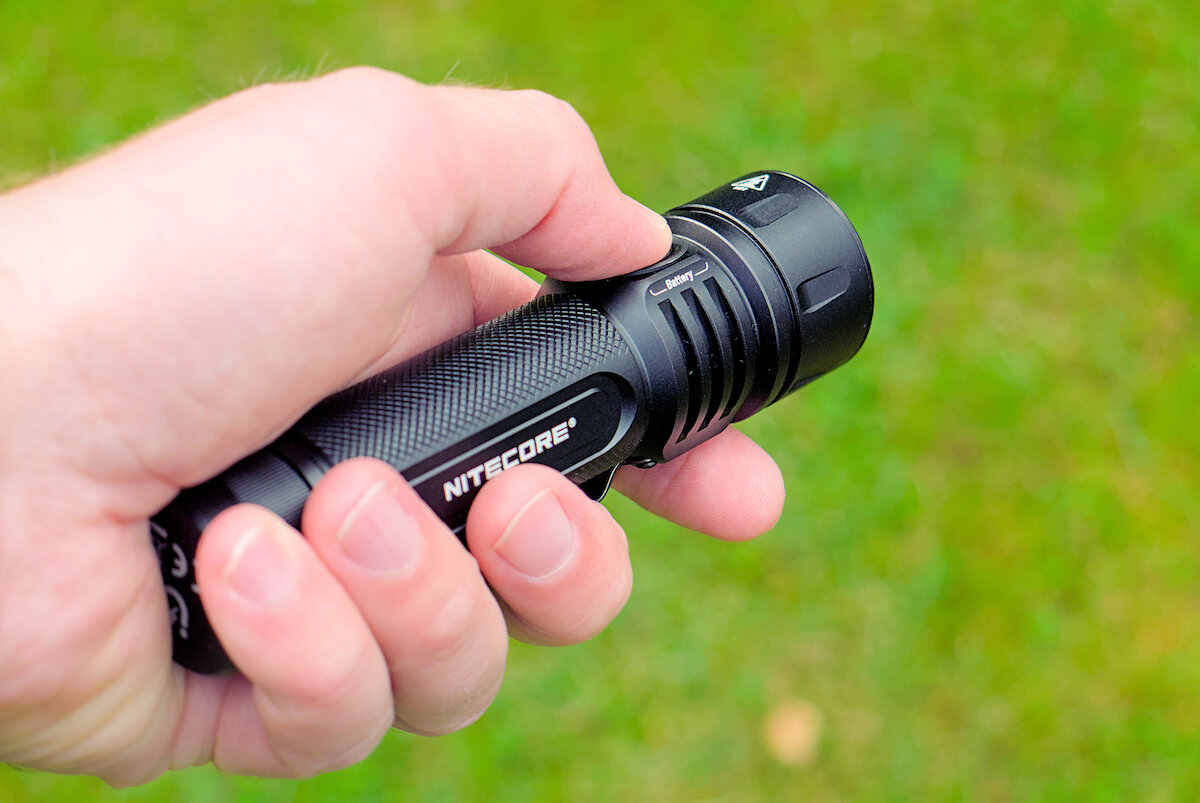
The simple design, featuring diamond-pattern knurling on the battery tube, gives the flashlight a timeless, classic look. The sides of the battery tube are flattened and include the name of the manufacturer and model.
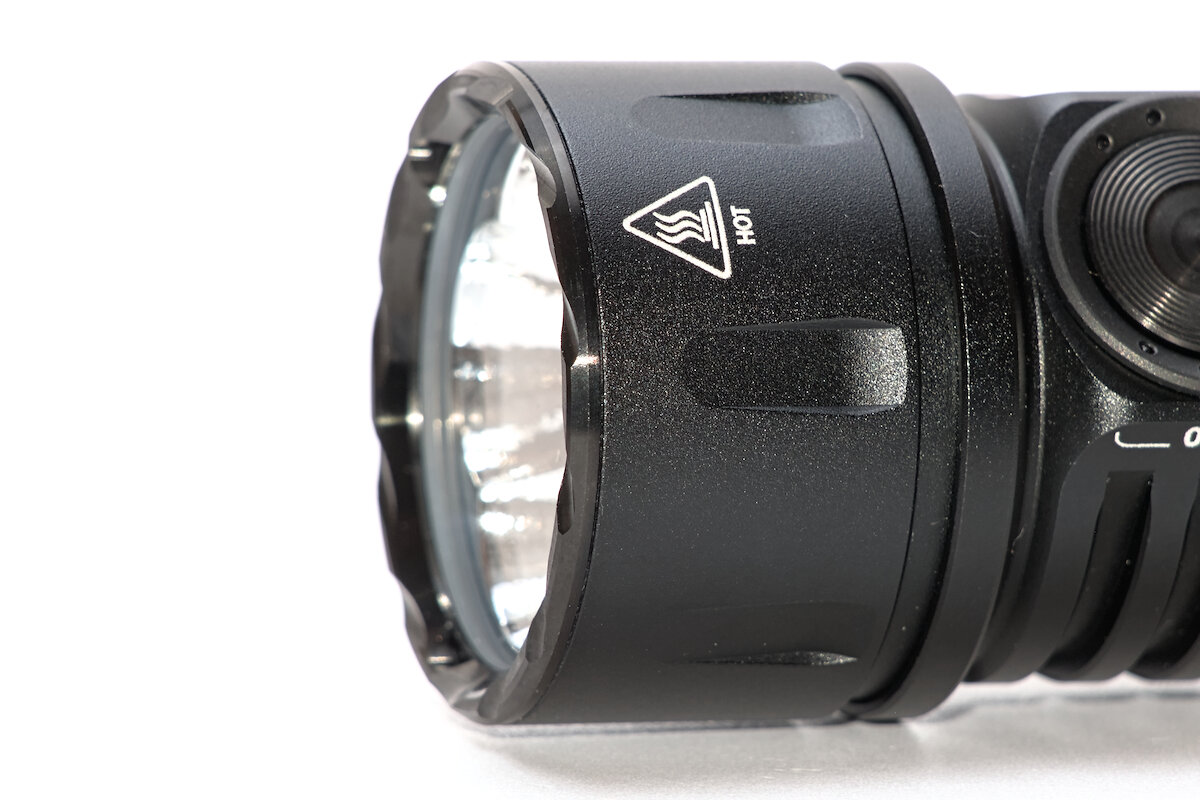
A black stainless steel bezel protects the lens from impacts. It features small notches that allow you to see whether the flashlight is on, even when it’s standing on its head.
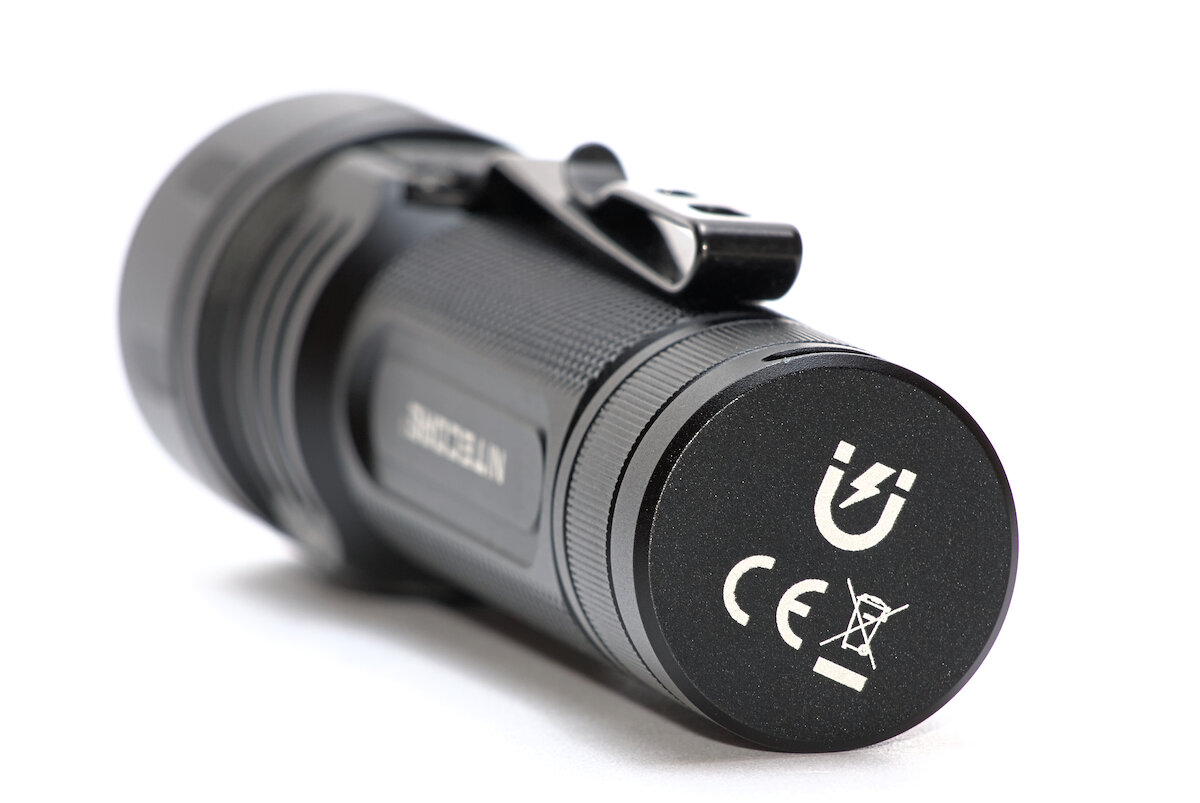
The tailcap has various warning symbols that slightly detract from the overall appearance, but are likely required.
The EX7 comes with a factory-installed dual-way clip that allows it to be attached to a belt or vest. However, neither orientation allows for particularly deep carry in a pocket. In my opinion, the flashlight would be better suited for use with a holster.
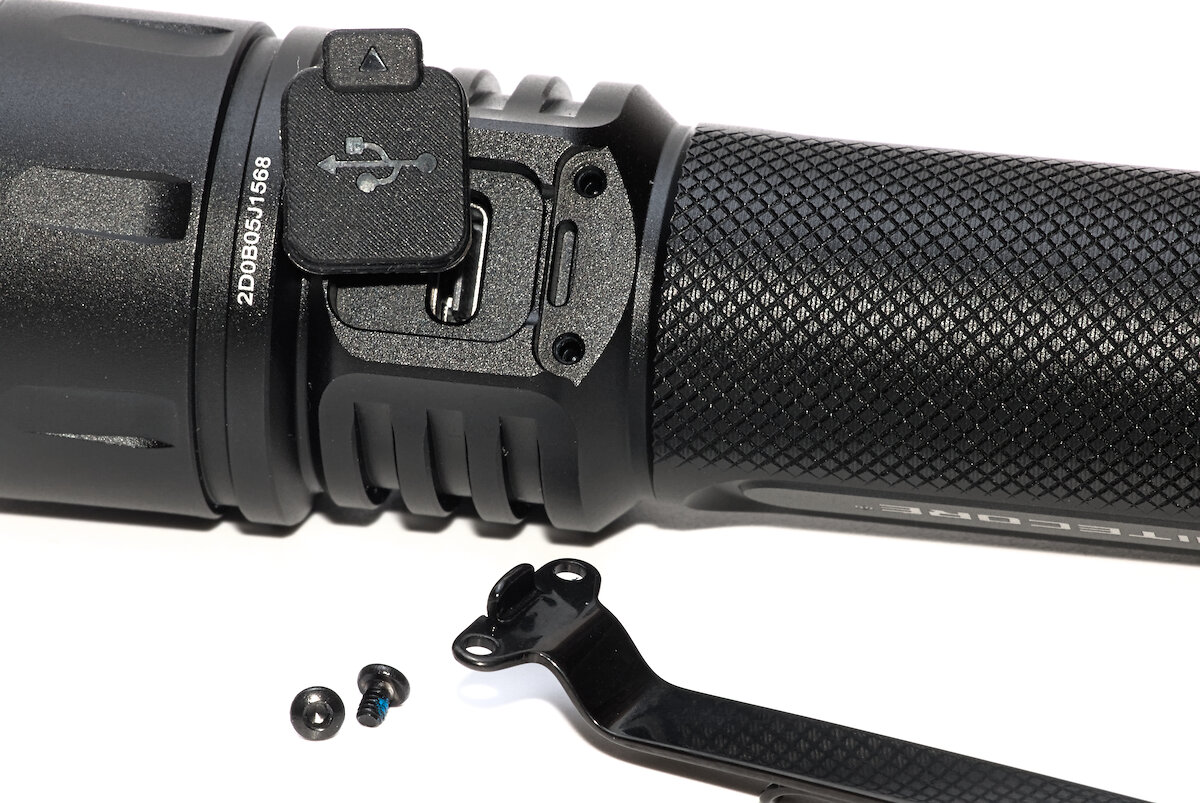
The clip is held in place by two small T6 screws. To reduce stress on the screws, a tab on the clip fits into a corresponding recess on the flashlight. I much prefer this type of attachment over a simple press-fit clip — it’s more secure and doesn’t shift around, yet it’s still easy to remove when needed.
The tailcap includes a hole for attaching a lanyard. Thanks to the design of the hole, there are no sharp edges that could dig uncomfortably into your hand. The edges are nicely chamfered, but I still recommend using a small keyring to help protect the lanyard material from wear.
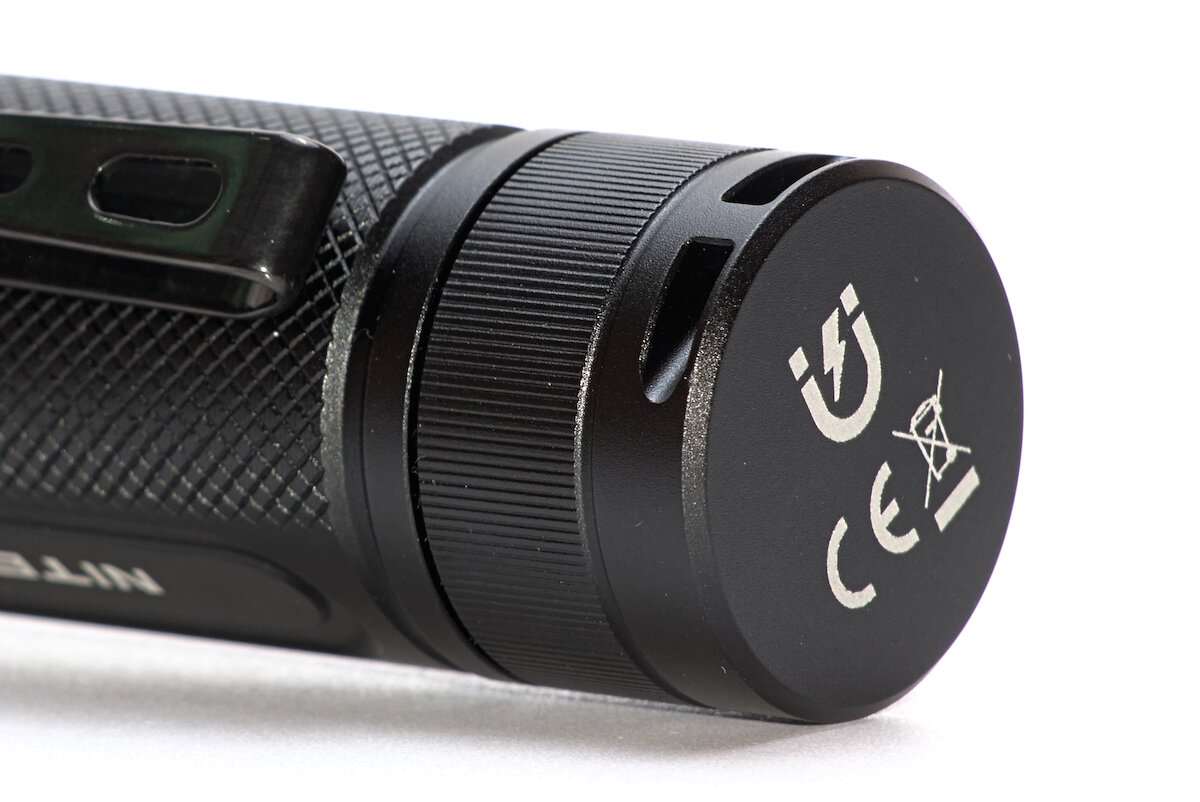
The tailcap also contains a built-in magnet that allows the flashlight to be attached to magnetic surfaces. It’s glued in place and cannot be removed. The magnet is strong enough to hold the flashlight in a horizontal position, as long as there are no significant vibrations.
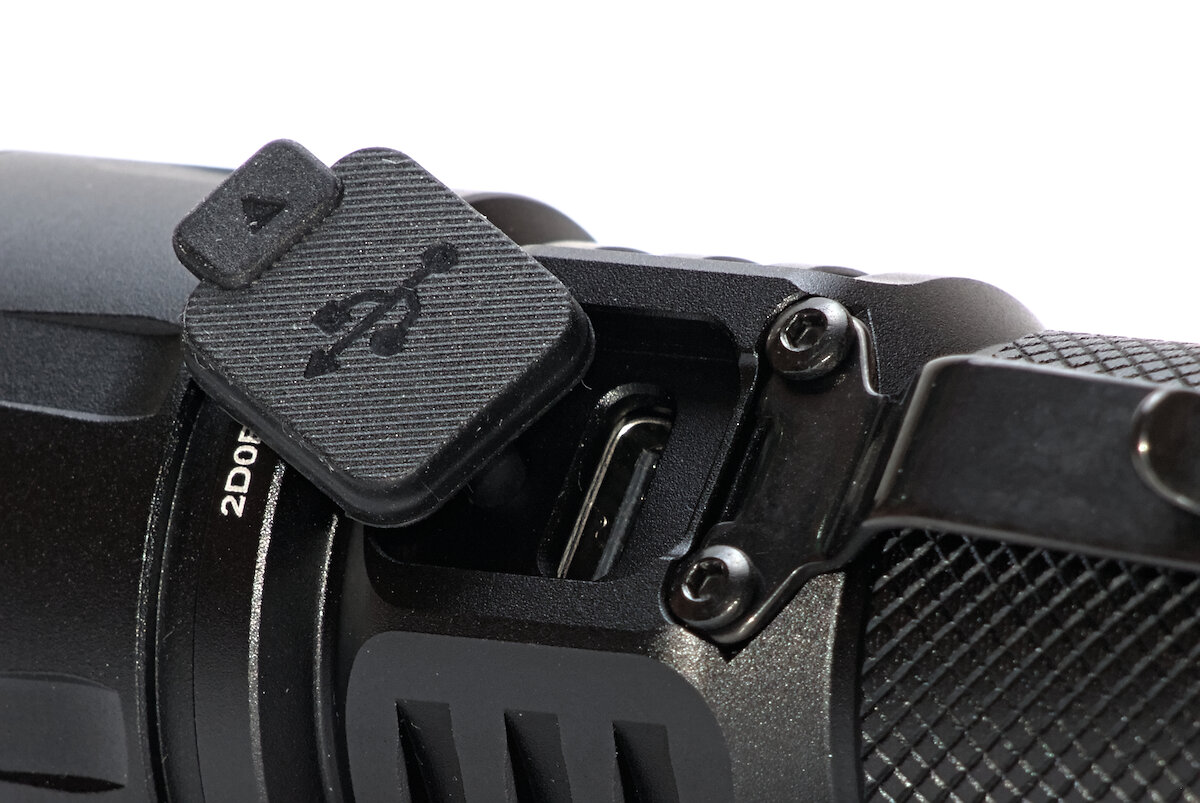
The USB-C port on the head of the flashlight allows the battery to be charged directly inside the light. A silicone cover protects the port from water and dirt. It’s a bit of a shame that they didn’t use a dual-component cover with a rigid plastic outer shell like often found in their EDC series.
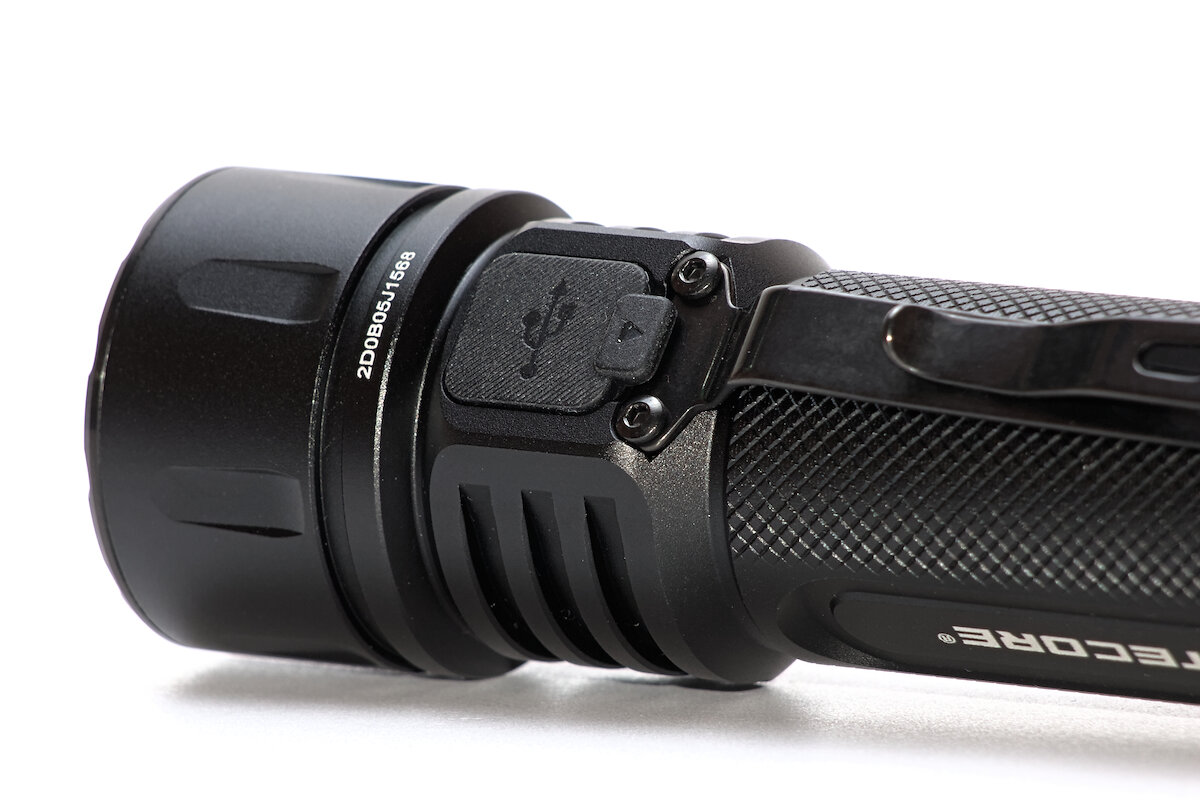
The cover fits securely, making accidental openings unlikely. There’s plenty of space for the USB plug to fit comfortably.
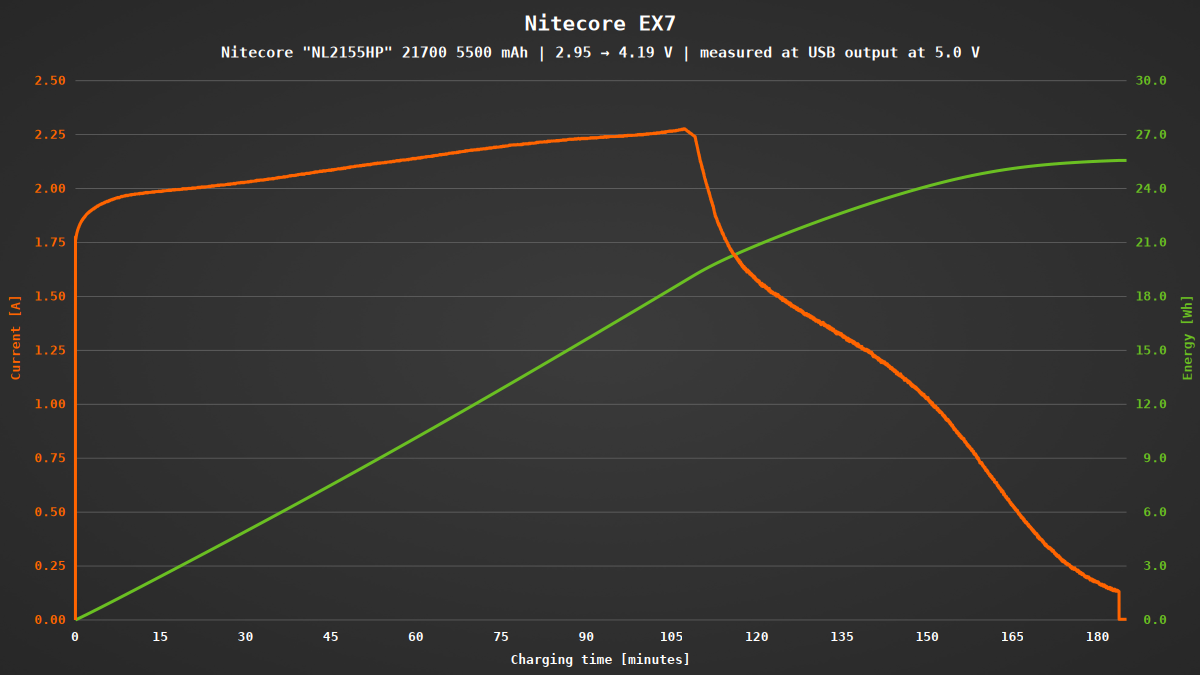
A full charge takes about three hours. You can monitor the progress at any time via the four green status LEDs next to the button. During charging, the flashlight can still be used at normal brightness levels — only the “Lumin Shield” and “Search” modes are unavailable.
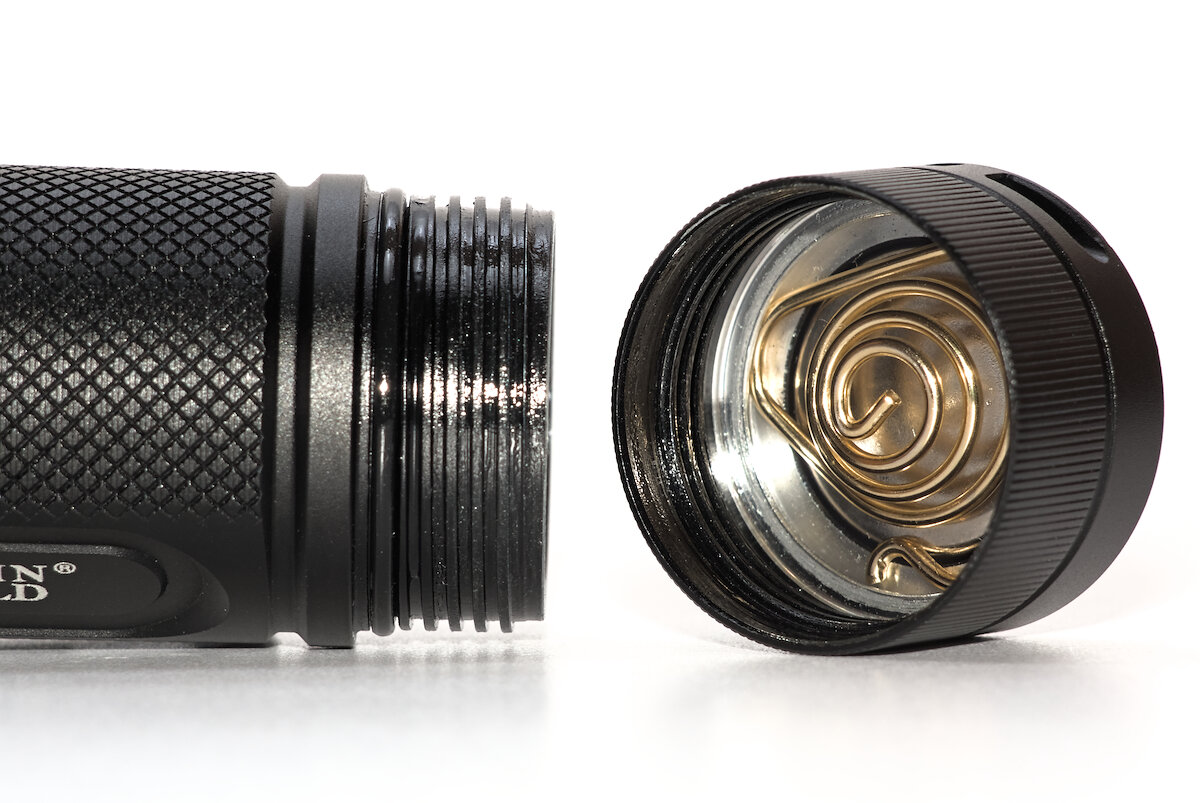
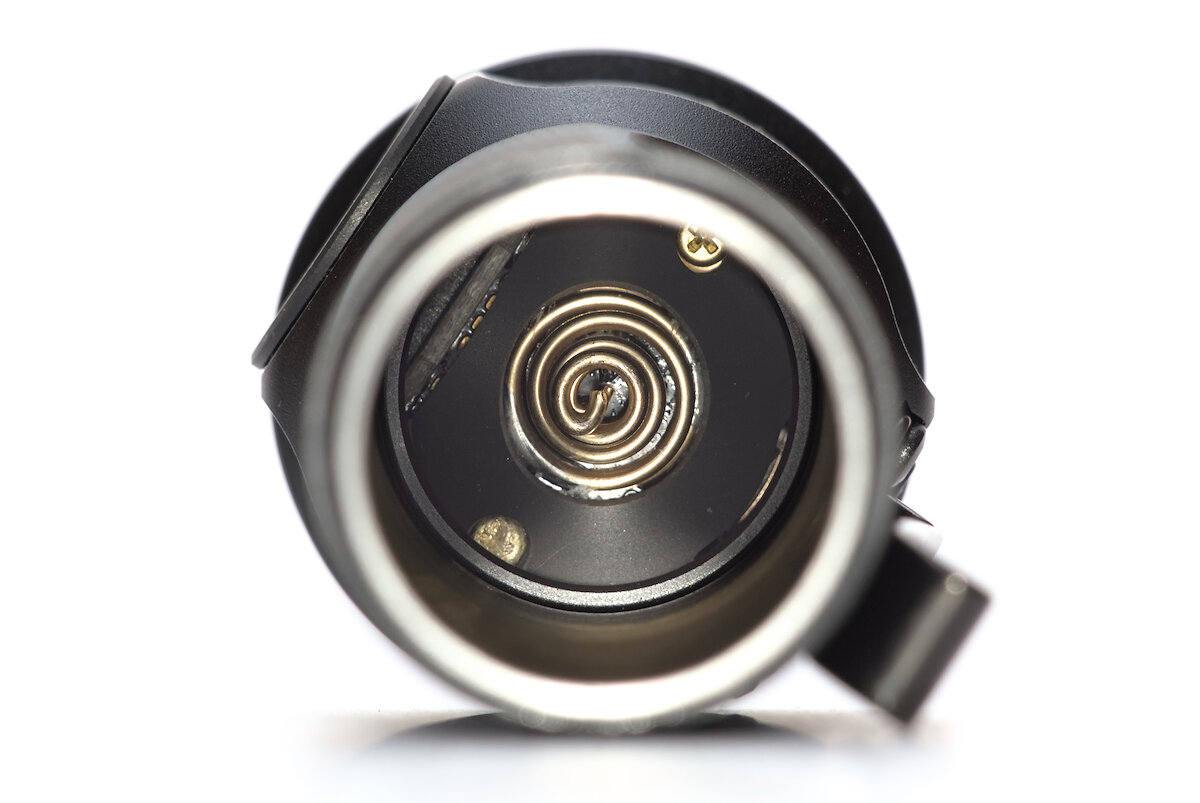
Both the head and the tailcap use springs to maintain contact with the battery. Standard 21700 batteries can be used, both flat-top and button-top styles. A special battery isn’t required. However, the battery should be rated for discharges up to 20 A. The included battery comes with built-in protection circuitry.
According to the specifications, the EX7 is water-resistant to IP68 standards, meaning it’s protected against continuous immersion (up to two meters deep). It’s also designed to withstand drops from up to two meters. The build quality is excellent.
User interface
The large button on the head of the flashlight is just under 14 mm in diameter and made of metal. It has a short travel and responds with a subtle click.
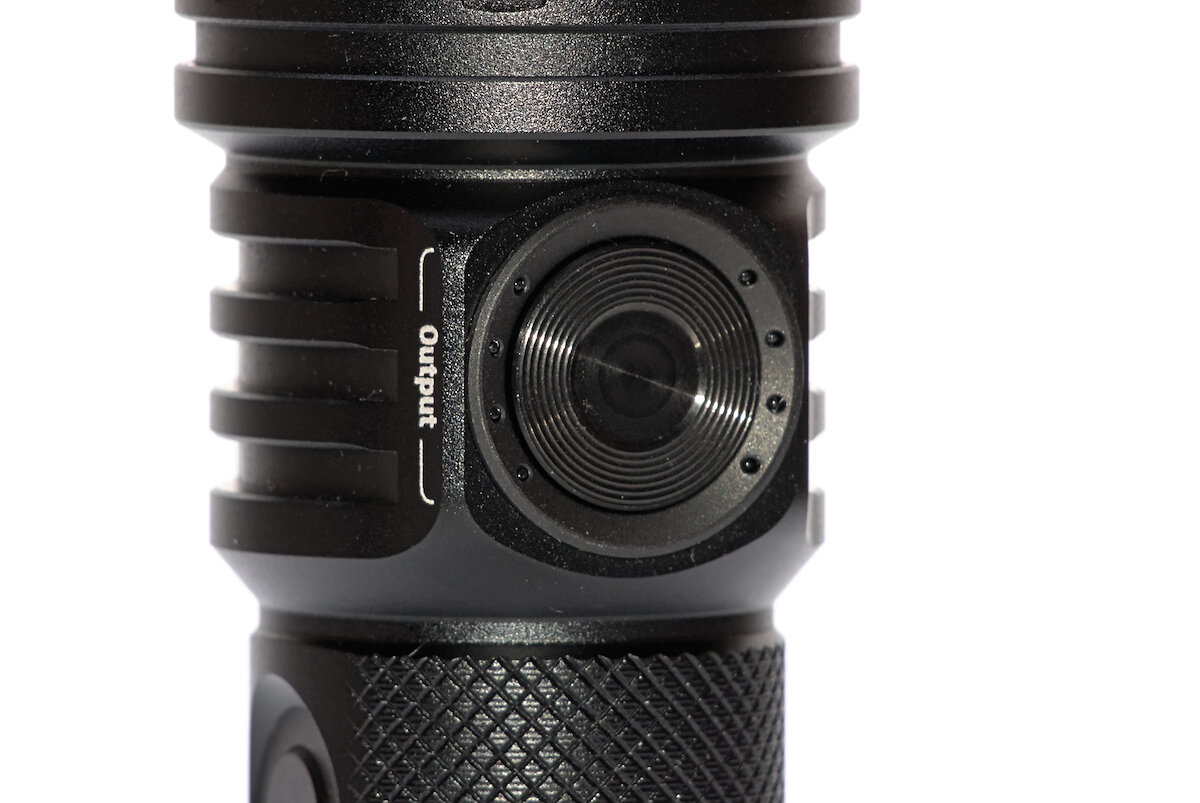
The UI is unusual and – even after extended use – still feels frustrating to me. Of course, everyone has their preferences, but I can’t find any justification for this one.
| State | Action | Function |
|---|---|---|
| Off | 1 click | Low |
| Off | 2 clicks | Lumin Shield / Search |
| Off | 3 clicks | Strobe |
| Off | hold | Ultralow |
| Off | hold (4 s) | Lockout |
| On | 1 click (< 3 s on) | Change brightness (Low → Mid → High → Turbo → Off) |
| On | 1 click (> 3 s on) | Turn off |
| On | 2 clicks | Lumin Shield / Search |
| On | 3 clicks | Strobe |
| On | hold | Change channel (Spot → Mix → Flood) |
| Lumin Shield / Search | 1 click | Turn off |
| Lumin Shield / Search | 2 clicks | Previous brightness or off |
| Lumin Shield / Search | 3 clicks | Strobe |
| Lumin Shield / Search | hold | Switch between Lumin Shield and Search |
| Lockout | click + 3 s hold | Unlock and turn on in Ultralow |
Here’s the issue: The flashlight can’t be turned on for a short burst. After switching it on, you either have to wait three seconds or cycle through all the brightness levels. Also, you can’t change the brightness once the light has been on for more than three seconds. Every time you press the button, the three-second timer resets. This actually allows a little trick: if you press the button for about half a second, the timer resets, letting you adjust the brightness again.
It’s also easy to accidentally press the button too quickly when increasing brightness, which can unintentionally activate the Lumin Shield, Search or even the Strobe mode. There’s no mode memory – the flashlight always starts on Low. At least there is direct access to the Ultralow mode.
To lock the button, you have to press and hold it for a long time. This might lead to people skipping the lockout, out of convenience, increasing the chance the flashlight accidentally turns on in a pocket. In that case, slightly loosening the tailcap is a quicker and easier way to prevent that.
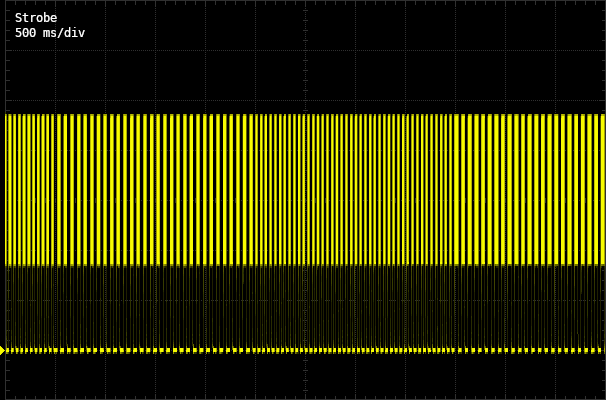
The strobe operates at a variable frequency between about 15 and 20 Hz, intended to increase its disorienting effect. In my opinion, though, the frequency is a bit too high and would work better starting around 7 Hz.
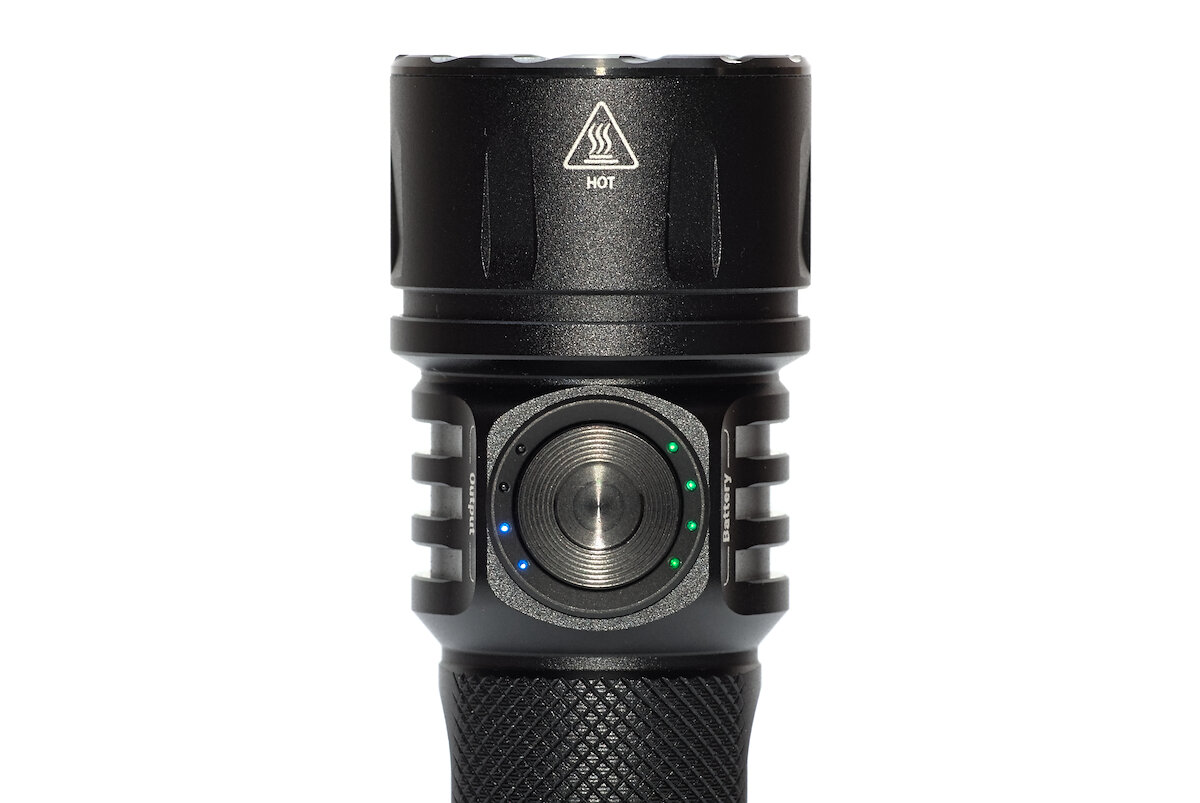
Four green LEDs to the right of the button show the battery level for three seconds after switching on the flashlight. When the battery voltage is low, the bottom LED sometimes blinks red. On the left side, there are four blue LEDs indicating the current brightness level (Low, Mid, High, Turbo). The status LEDs are driven using multiplexing, which causes noticeable flickering, mostly when moving the flashlight.
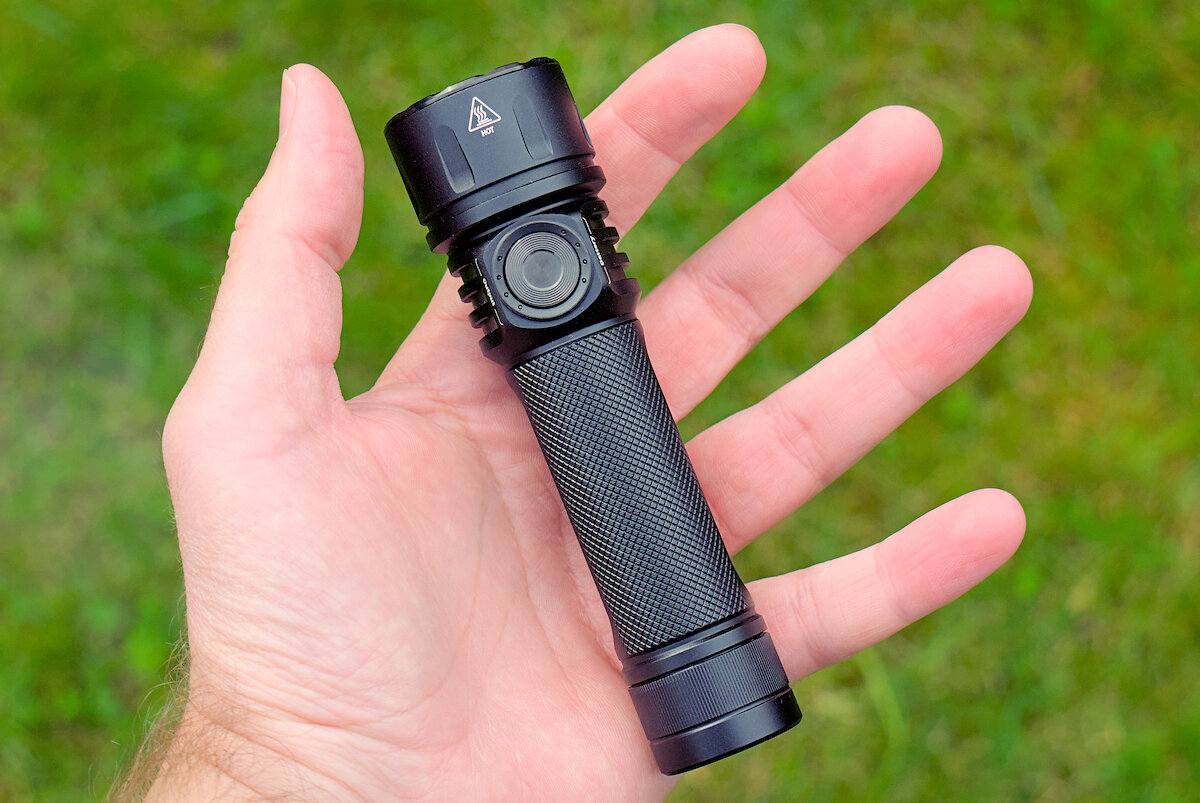
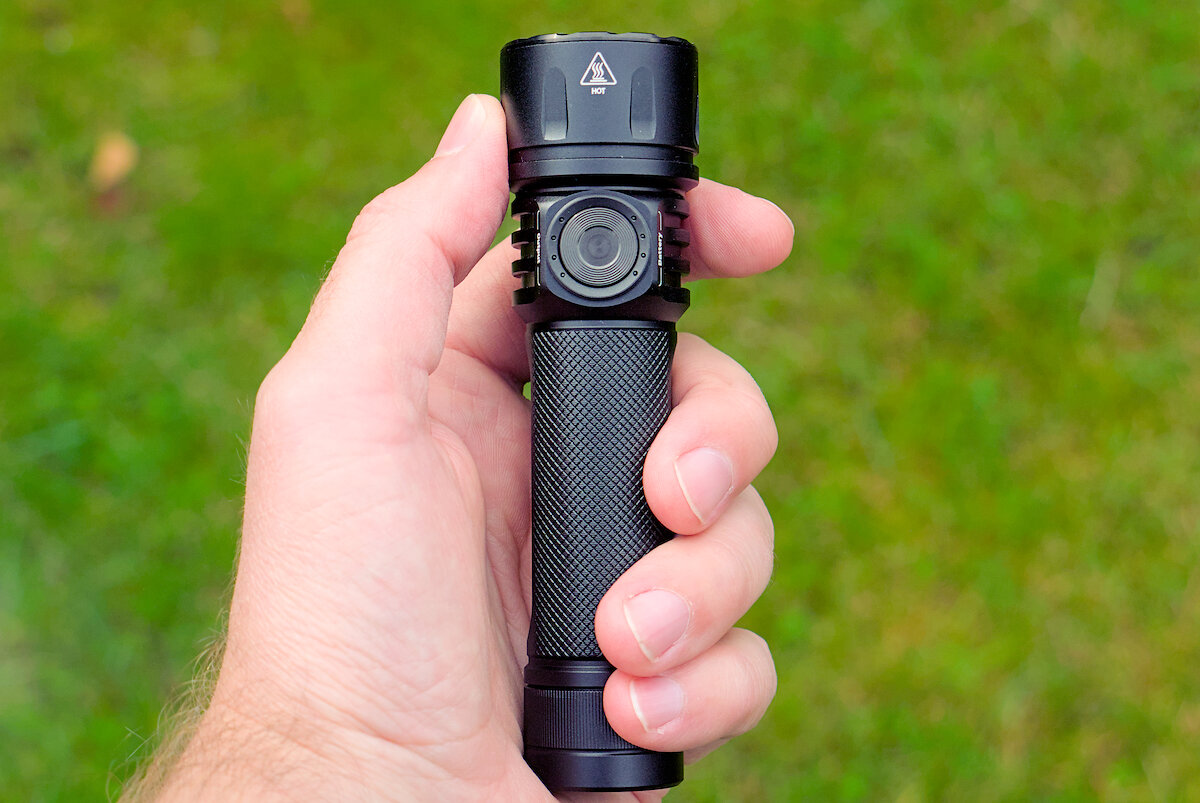
The EX7 feels comfortable in the hand and the large button is easy to operate even while wearing gloves. Thanks to the clip, the button is easy to locate; otherwise, it can easily be mistaken for the charging port.
Illumination
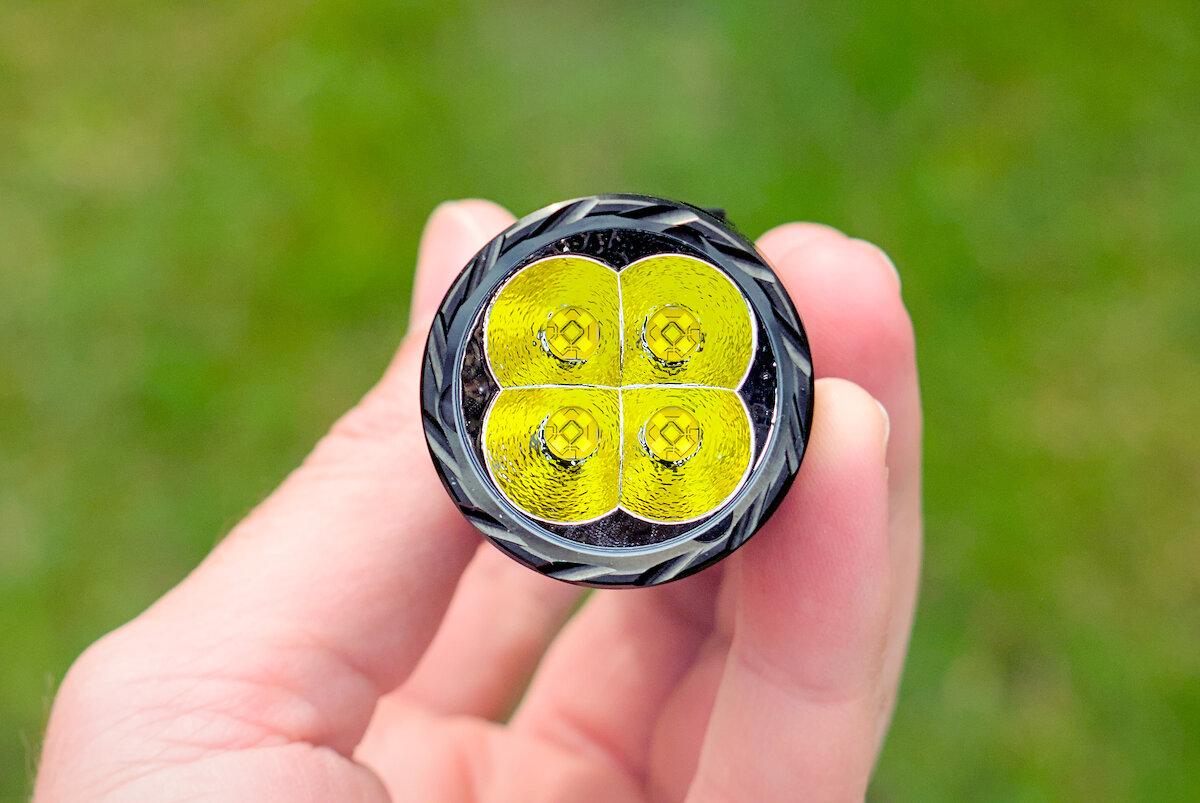
The LEDs are a proprietary development by Nitecore called “M515S”, meaning they aren’t available from any other manufacturer. What makes them special is that they consist of five closely spaced light emitting surfaces, which can be controlled separately in two groups. This allows the effective LES – and therefore the beam pattern – to be adjusted as needed.
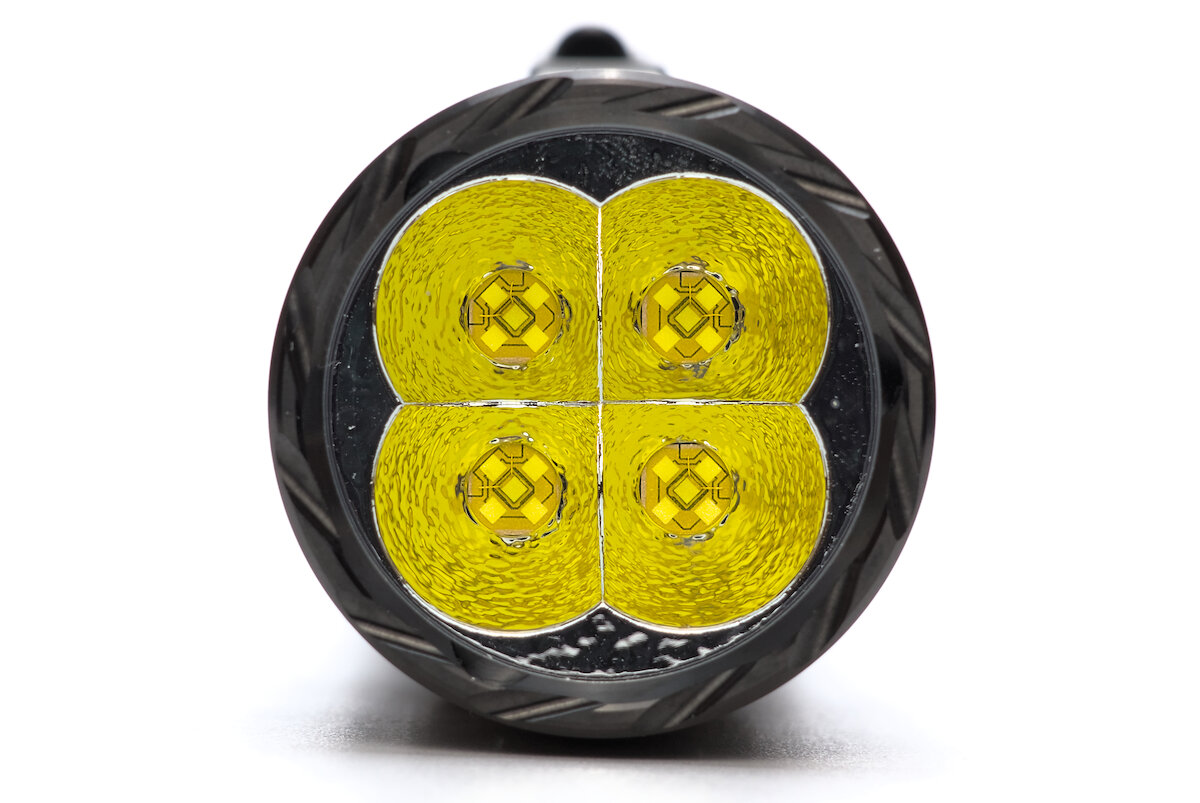
The EX7 uses four of these M515S LEDs within a lightly textured quad reflector, protected by a glass lens with a magenta anti-reflective coating. In the past, setups with two channels using differently sized LEDs have proven effective. I would have expected an LED with an adjustable light-emitting surface more in a single-reflector design. Examples of this are the Nitecore EDC33 and EDC35, which successfully use the UHi 20 MAX and UHi 40 MAX.
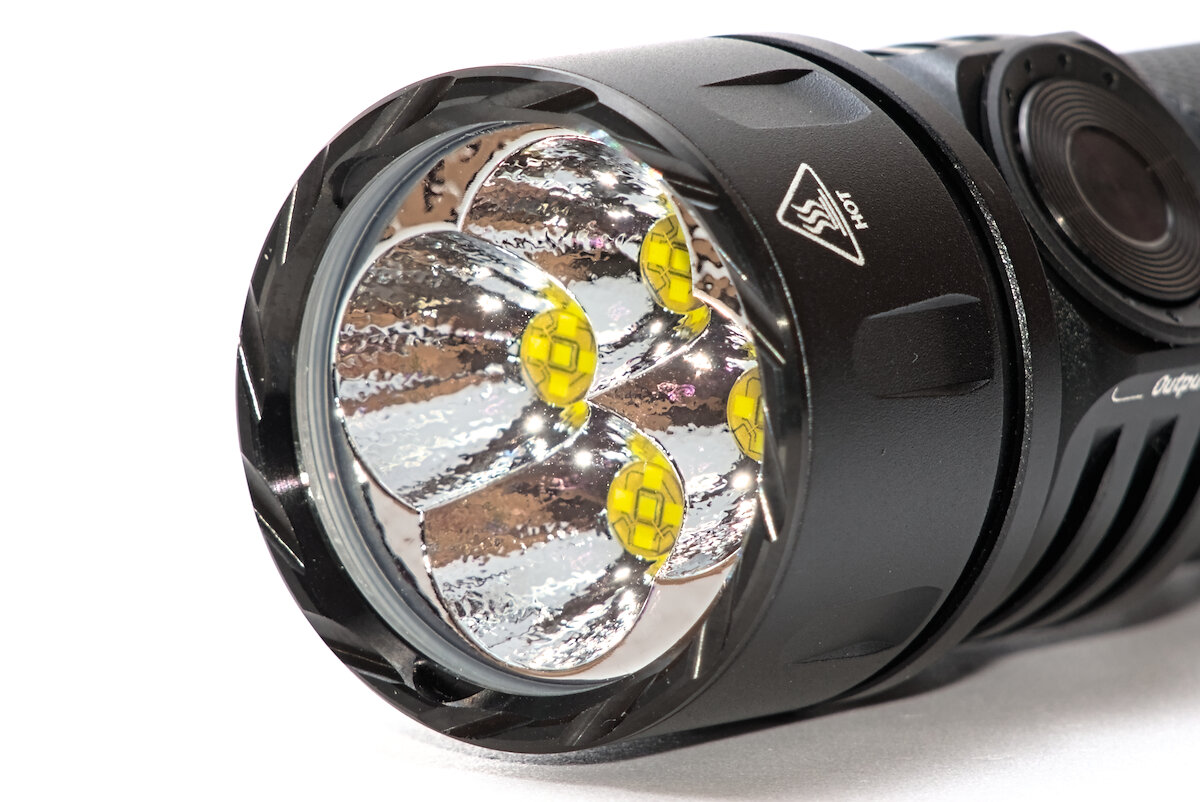

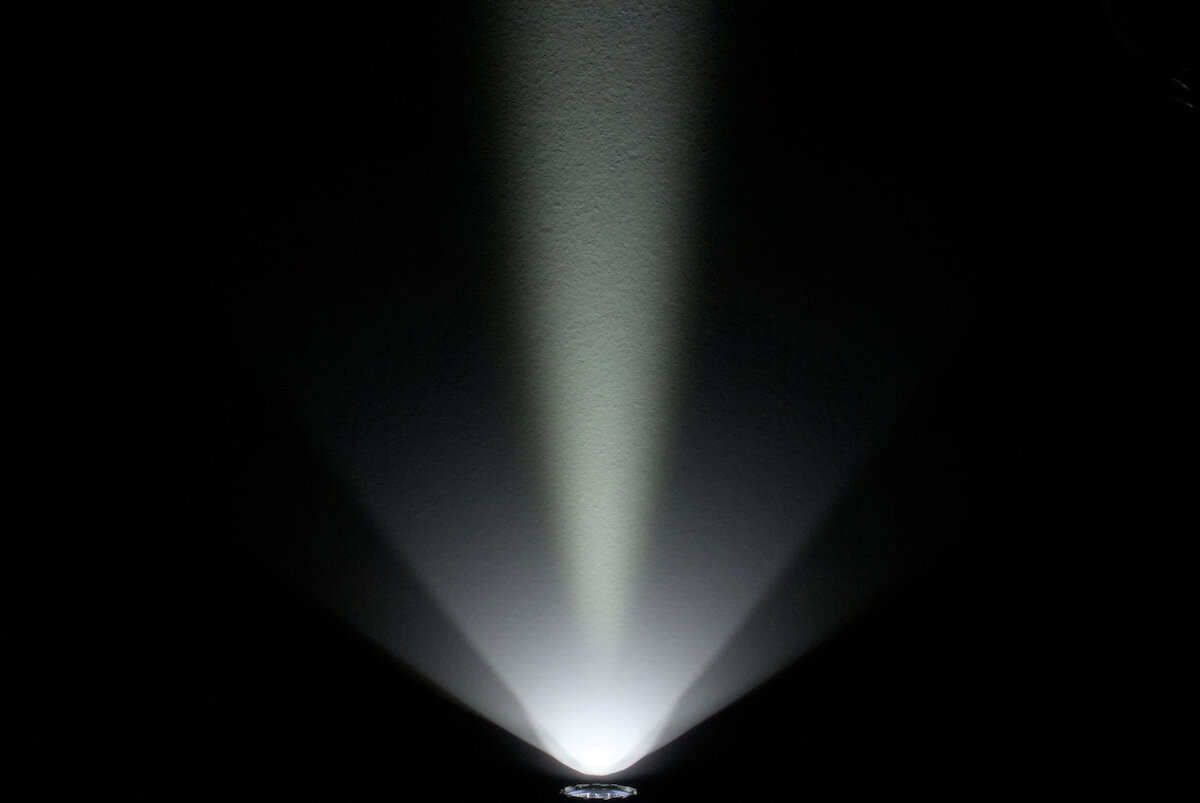
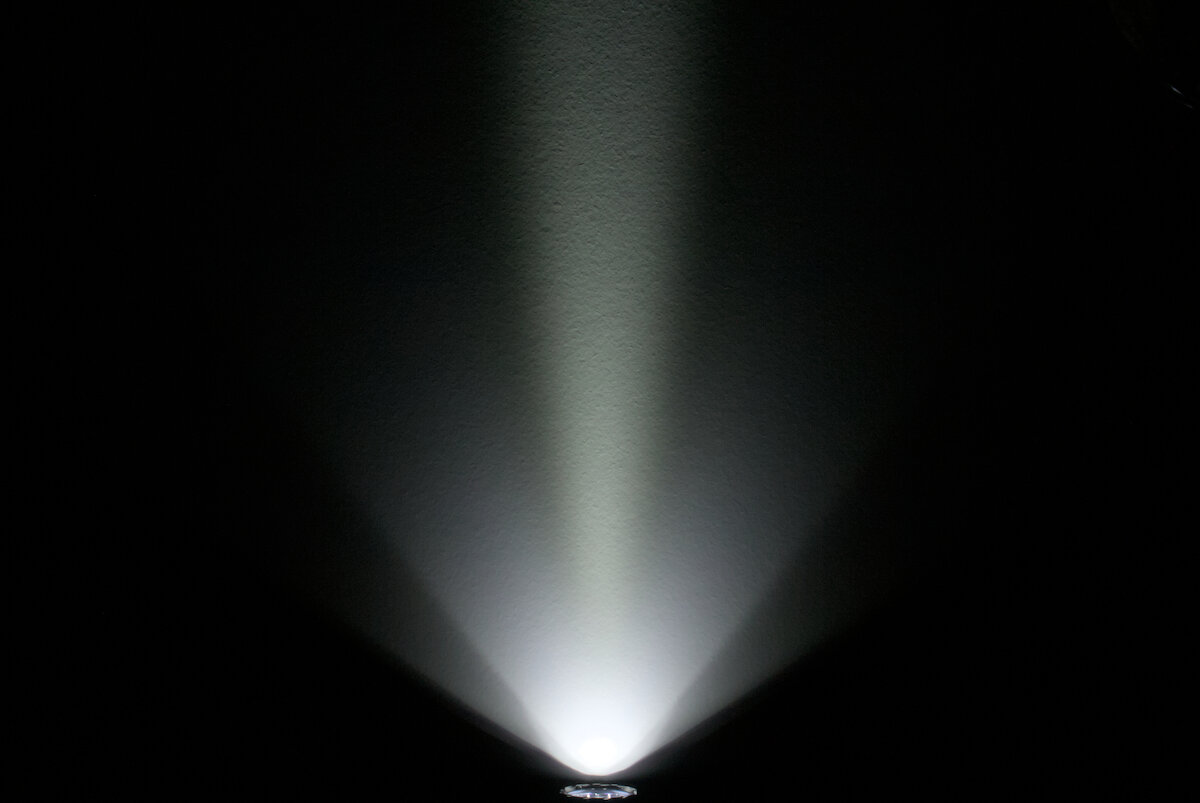
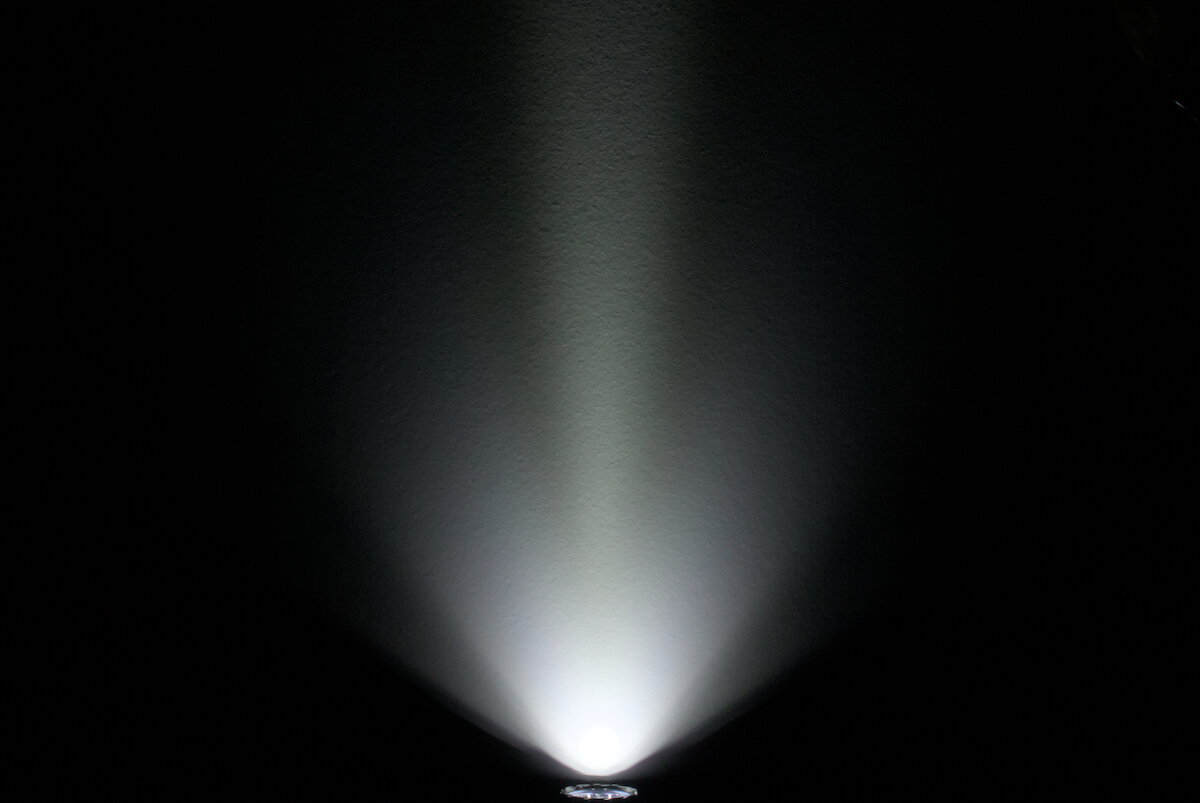
The light has a color temperature of around 5500 K with a fairly neutral tint. There’s a slight color difference between the spot and spill, but it’s not distracting. There are three settings: Spot, Mix and Flood, which differ in the balance between the spot and spill.


In practice, the mechanism works quite well, but you shouldn’t expect miracles. The difference between the modes is less pronounced than initially thought. You can see a noticeable change in throw, but both the spot and spill are visible in all settings. A more pronounced effect – ideally with a stepless adjustment – would have been nice.

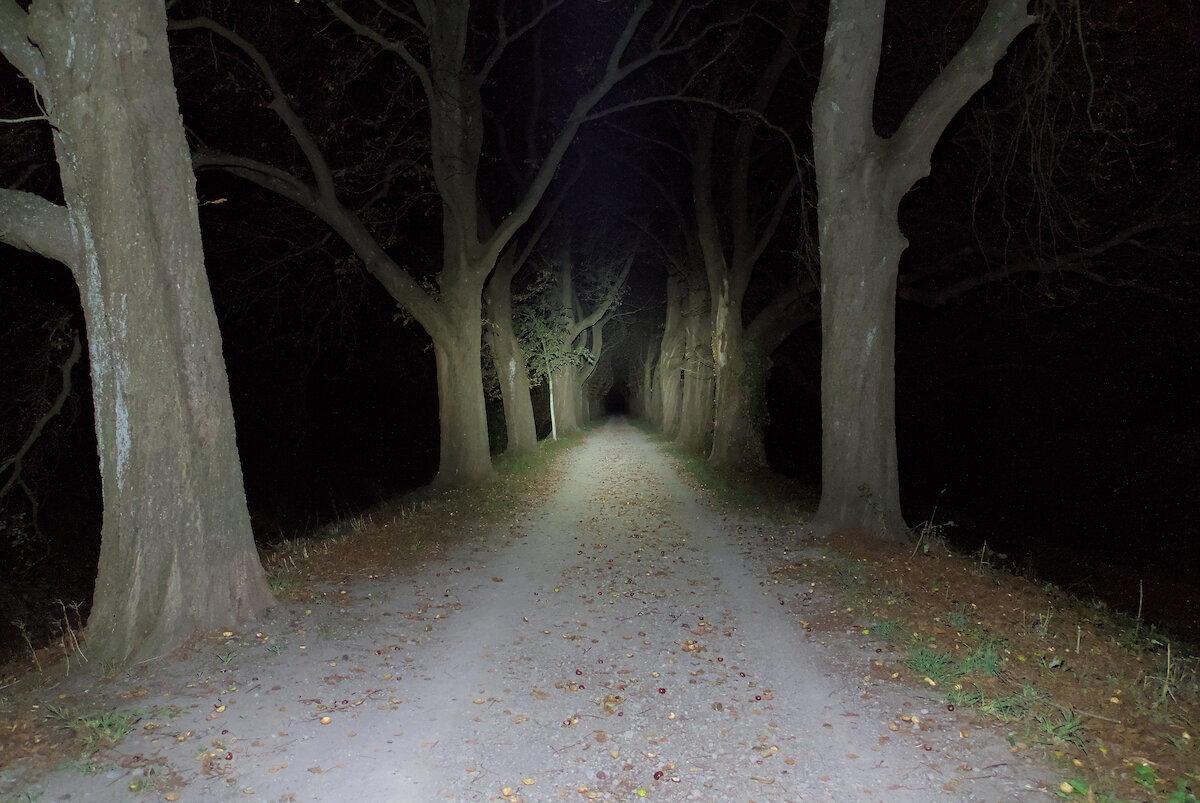
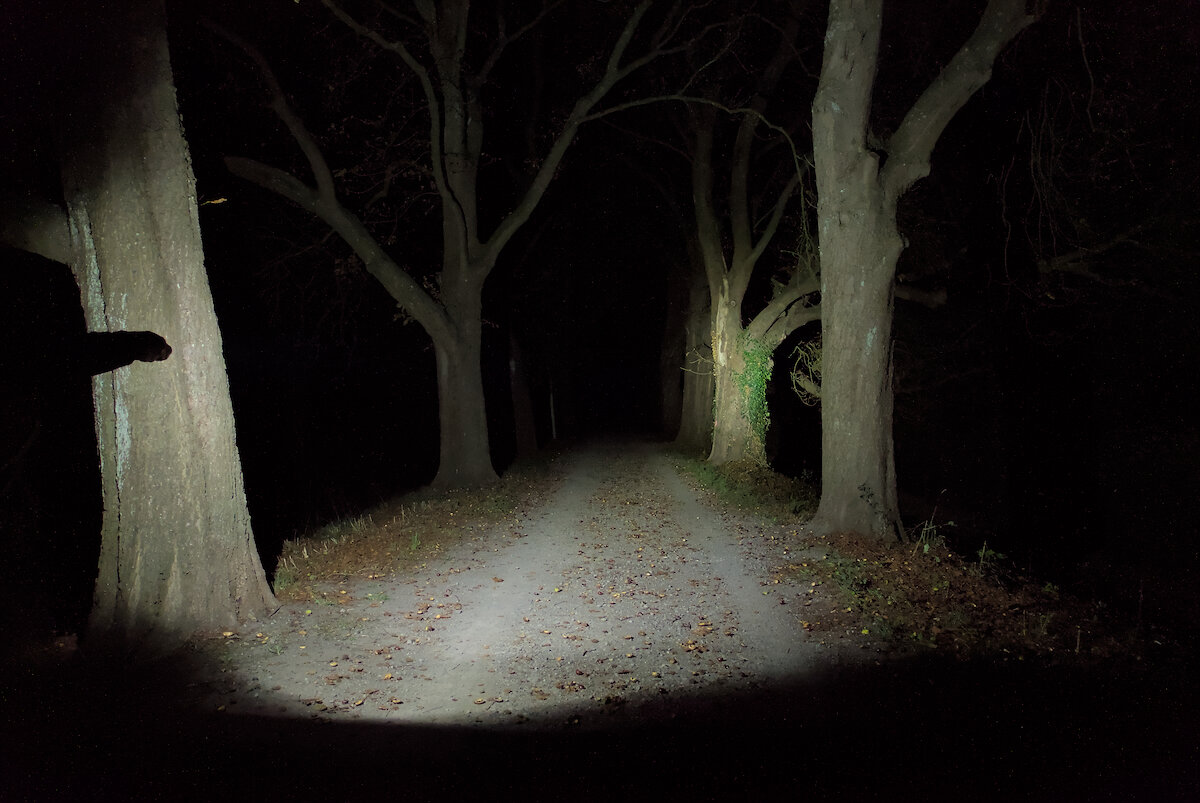
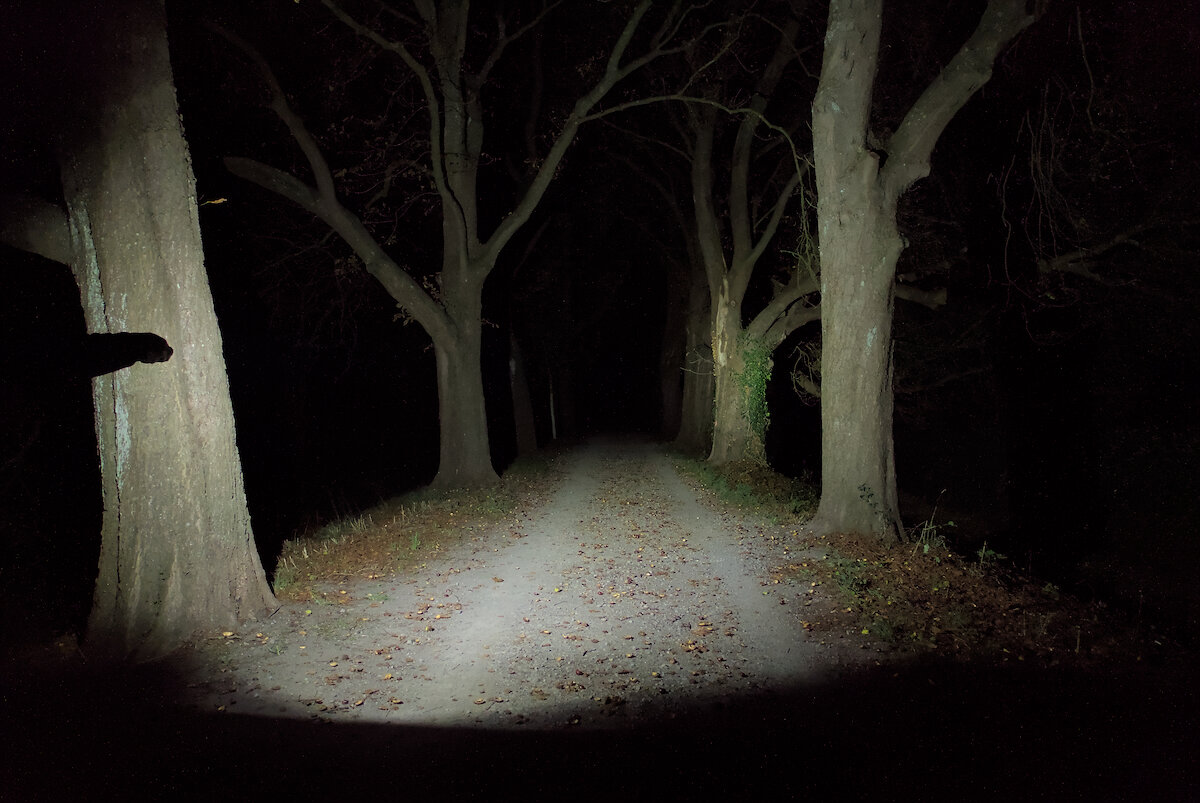
The most impressive modes are “Search” and “Lumin Shield”. Search corresponds to the maximum output in Spot mode and, according to the manufacturer, can reach distances of up to 500 meters. In Lumin Shield mode, the flashlight operates at its maximum total output, producing a bright and wide light with up to 6,000 lumens.
Search:
Lumin Shield:

Links to individual beamshot images:
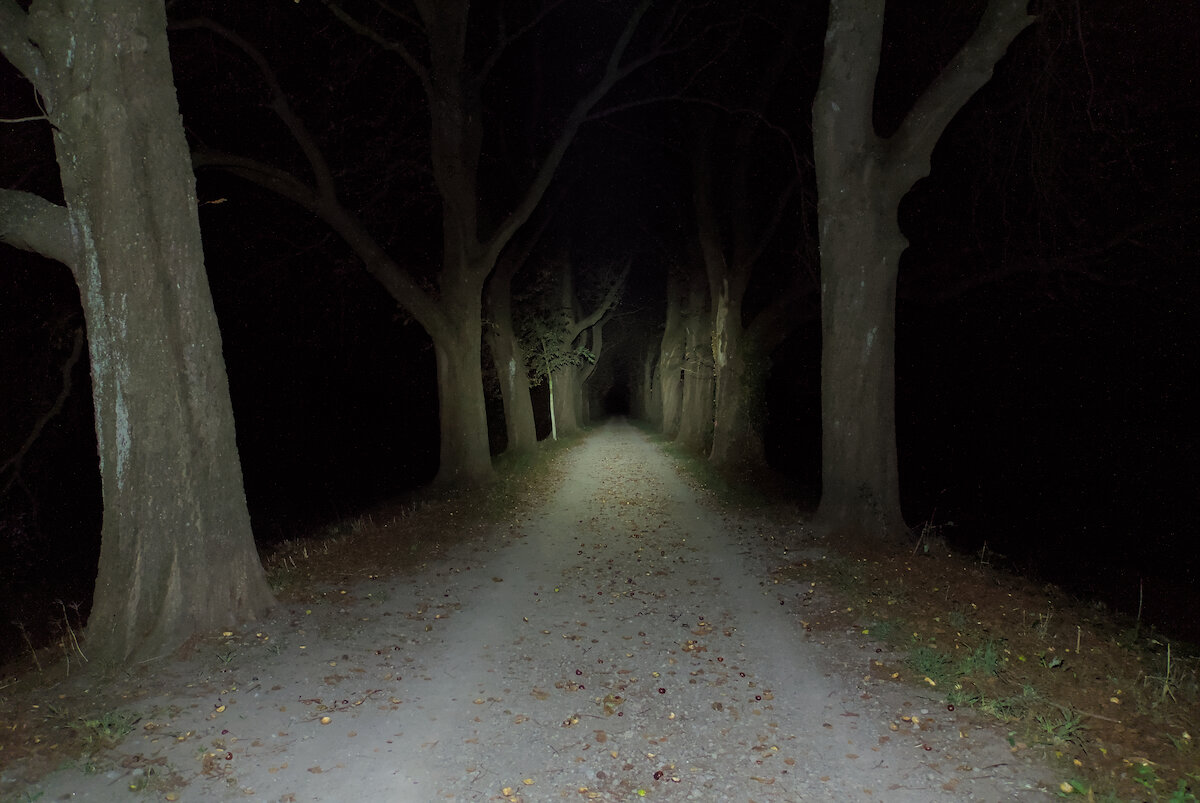
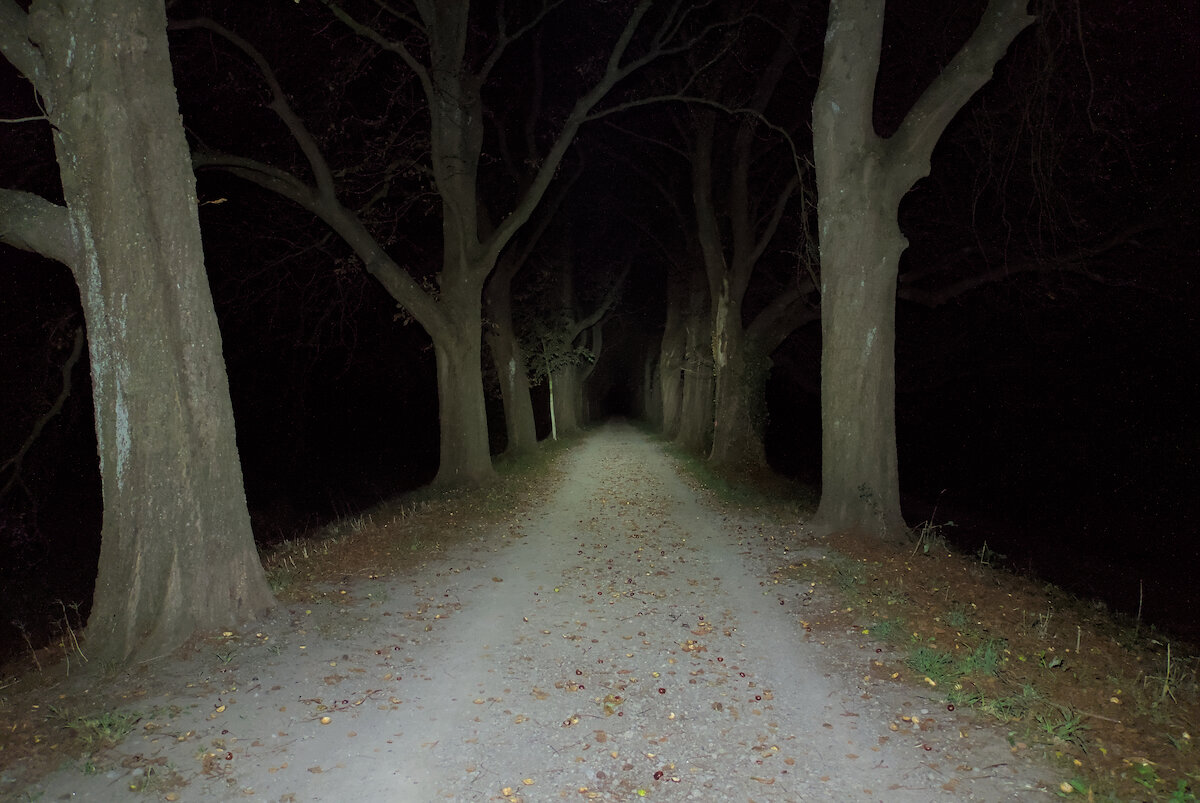
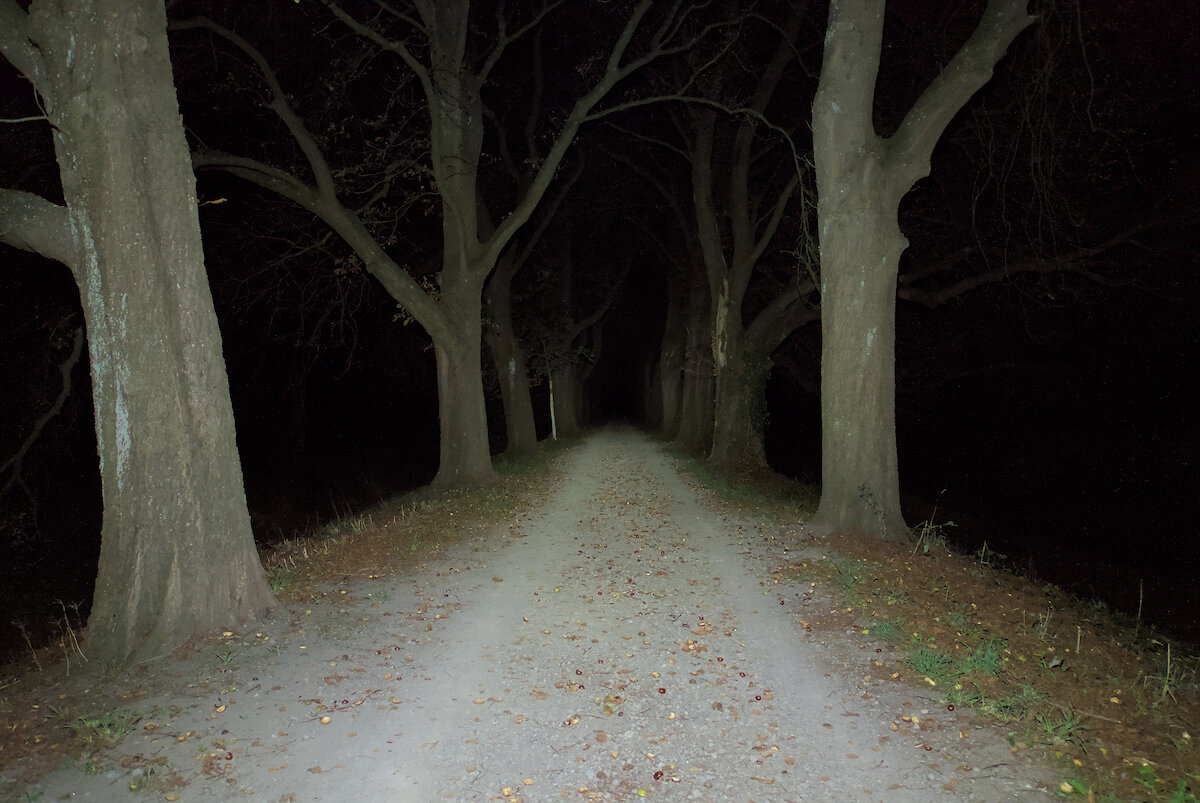
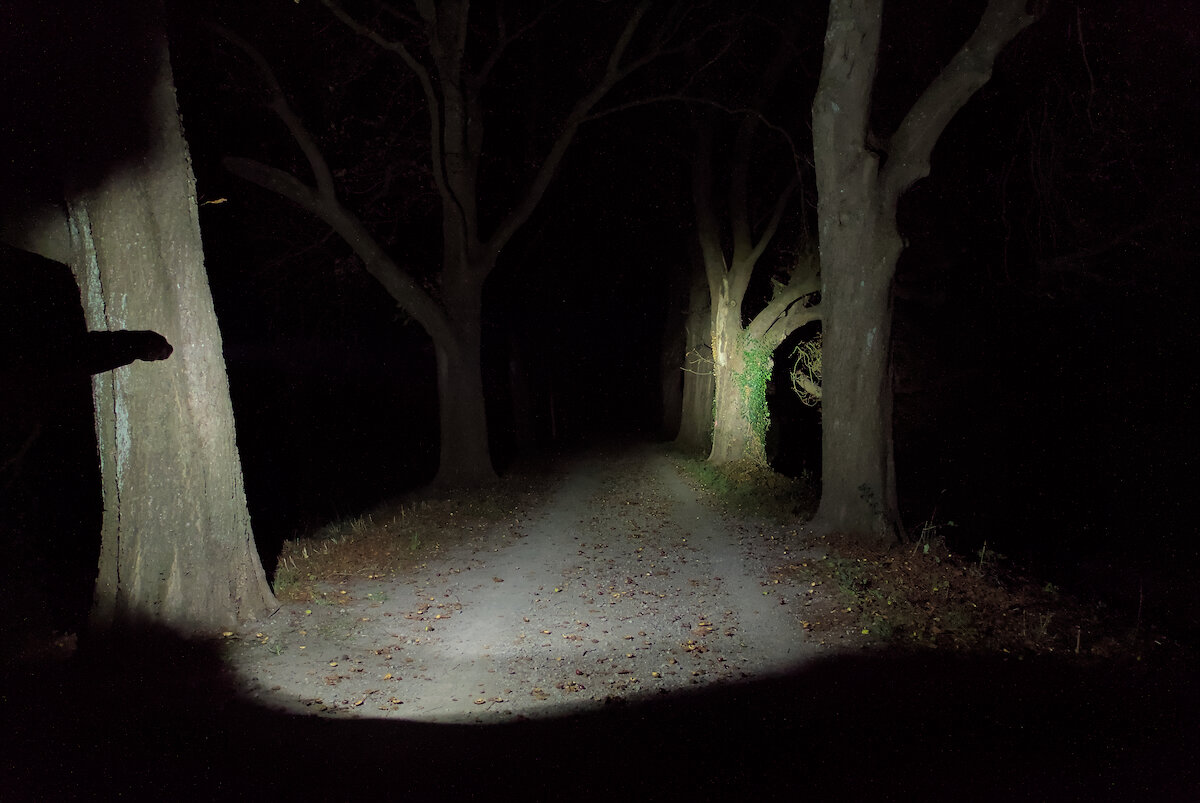



Driver and runtime
Nitecore describes the driver as a “highly efficient constant current circuit”, without providing much detail. Based on my observations, I believe it’s a buck driver. The brightness and runtime numbers provided by the manufacturer refer to maximum output at startup and explicitly do not account for thermal regulation, so actual performance may vary in practice.
| Mode | Brightness¹ | Runtime¹ | Intensity¹ (Throw²) | Current³ |
|---|---|---|---|---|
| Lumin Shield | 6000 lm | 2 h | 40300 cd (400 m) | 19.80 A |
| Search | 3000 lm | 2:15 h | 63470 cd (500 m) | 13.20 A |
| Spot » Turbo | 1500 lm | 2:30 h | 30746 cd (350 m) | 4.20 A |
| Spot » High | 600 lm | 5:30 h | 13288 cd (230 m) | 1.30 A |
| Spot » Mid | 180 lm | 15 h | 4570 cd (130 m) | 0.41 A |
| Spot » Low | 30 lm | 80 h | 636 cd (50 m) | 0.07 A |
| Mix » Turbo | 1500 lm | 2:30 h | 20270 cd (280 m) | 3.90 A |
| Mix » High | 600 lm | 5:30 h | 7580 cd (170 m) | 1.30 A |
| Mix » Mid | 180 lm | 15 h | 2510 cd (100 m) | 0.39 A |
| Mix » Low | 30 lm | 80 h | 370 cd (38 m) | 0.07 A |
| Flood » Turbo | 1500 lm | 2:30 h | 10200 cd (200 m) | 3.70 A |
| Flood » High | 600 lm | 5:30 h | 3240 cd (115 m) | 1.30 A |
| Flood » Mid | 180 lm | 15 h | 950 cd (60 m) | 0.40 A |
| Flood » Low | 30 lm | 80 h | 130 cd (22 m) | 0.07 A |
| Ultralow | 1 lm | 570 h | 6 cd (5 m) | < 0.01 A |
| Off | 67 µA |
¹ According to manufacturer ² ANSI FL1 ³ Measured
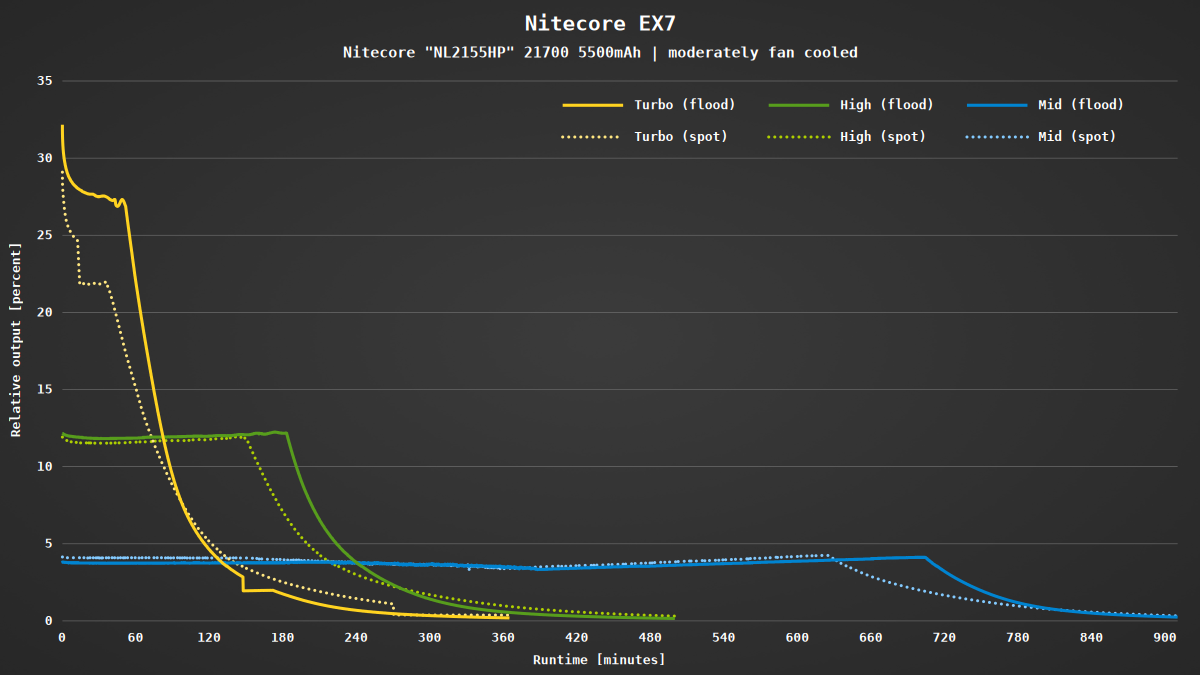
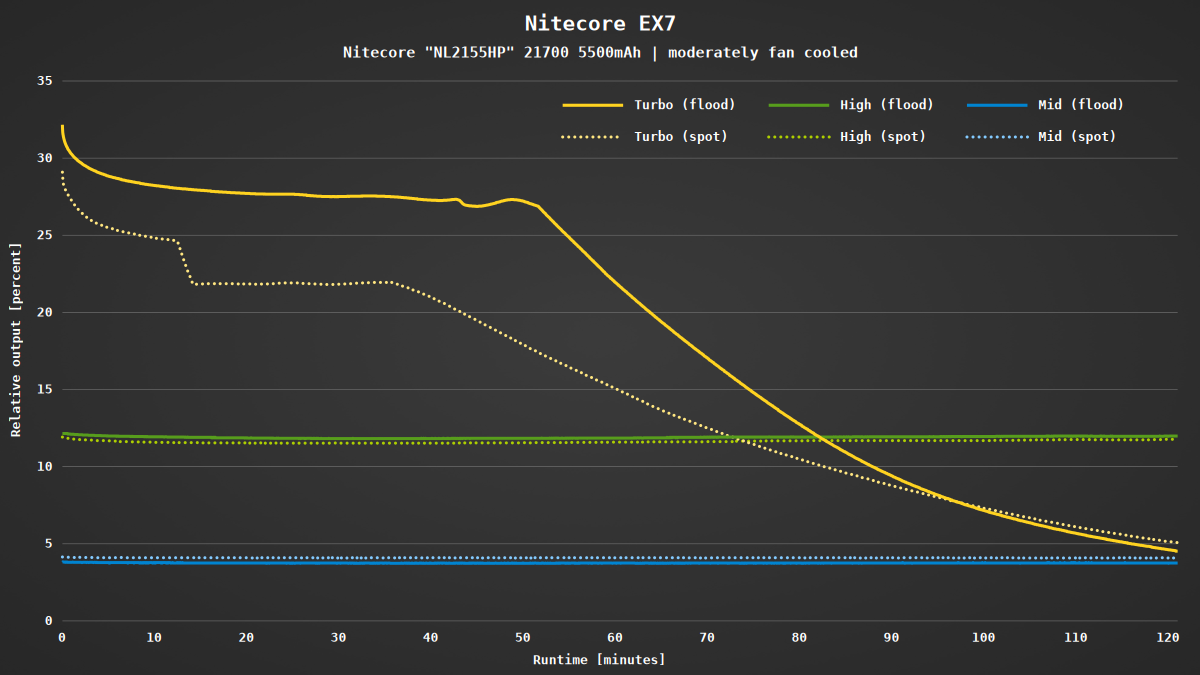
The 20 A reached in Lumin Shield mode is impressive, as is 13 A in Search mode. A high-performance battery is definitely recommended for this flashlight. The other modes draw significantly less current, which is also reflected in the runtime. After a long period of nearly constant brightness, the light begins to gradually dim. When the tests were stopped, the battery voltage was still above 2.9 V, meaning the flashlight could have continued working at that brightness for a long time. The differences between Spot and Flood modes are minimal and can mostly be ignored in practical use.
In Lumin Shield and Search modes, thermal regulation kicks in after a short time and automatically reduces the brightness. During this, the flashlight can reach temperatures of up to 55 °C. Reactivating these modes is only possible once the light has sufficiently cooled down. However, “short” is relative here: both modes run at full power for nearly a minute at the start, which is quite impressive.
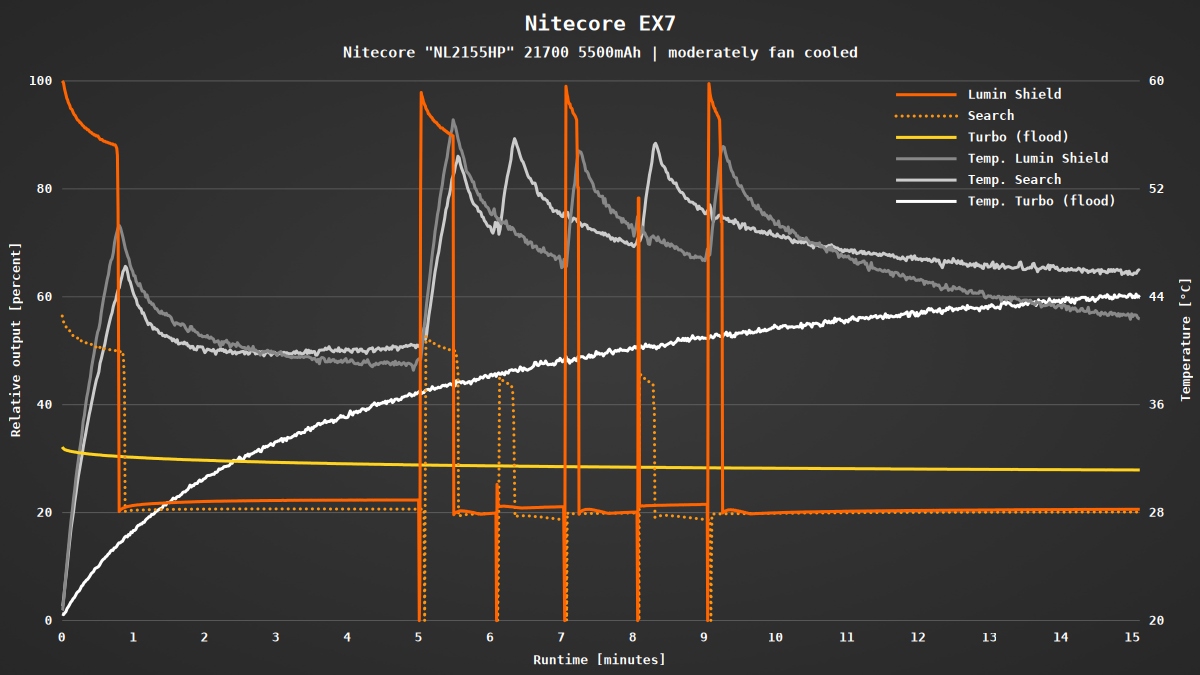
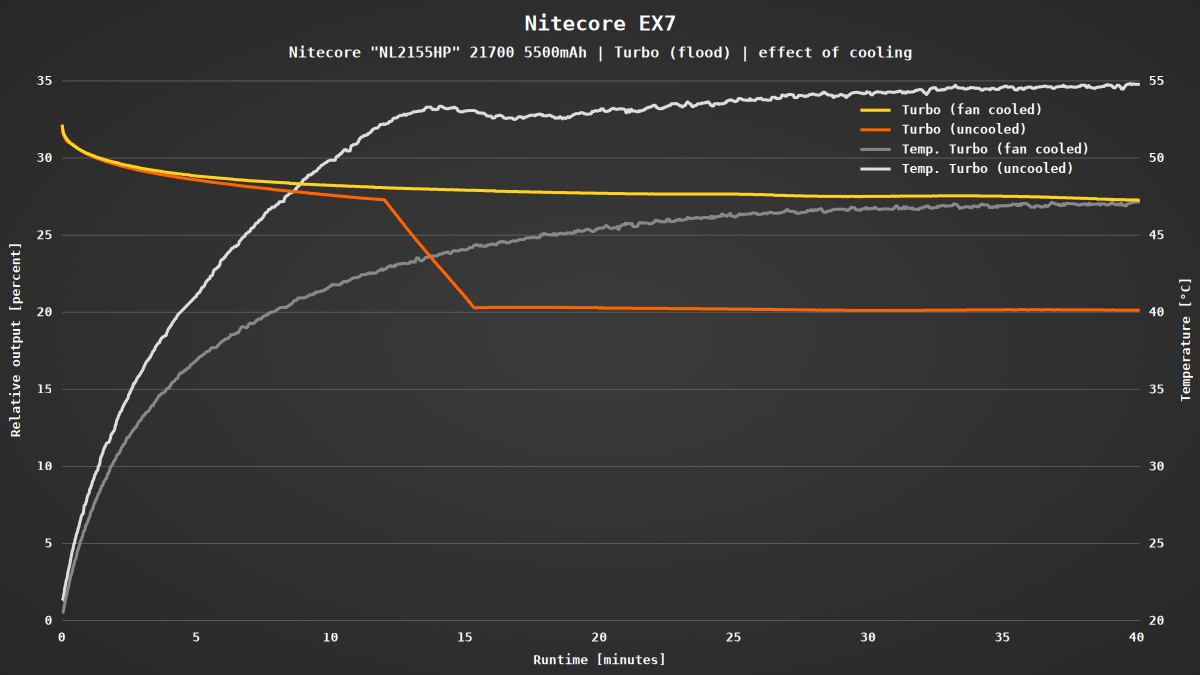
In Turbo mode, the temperature stabilizes at around 47 °C with some cooling and maintains a constant brightness. Without cooling, the temperature rises further to about 55 °C, causing the output to be reduced.
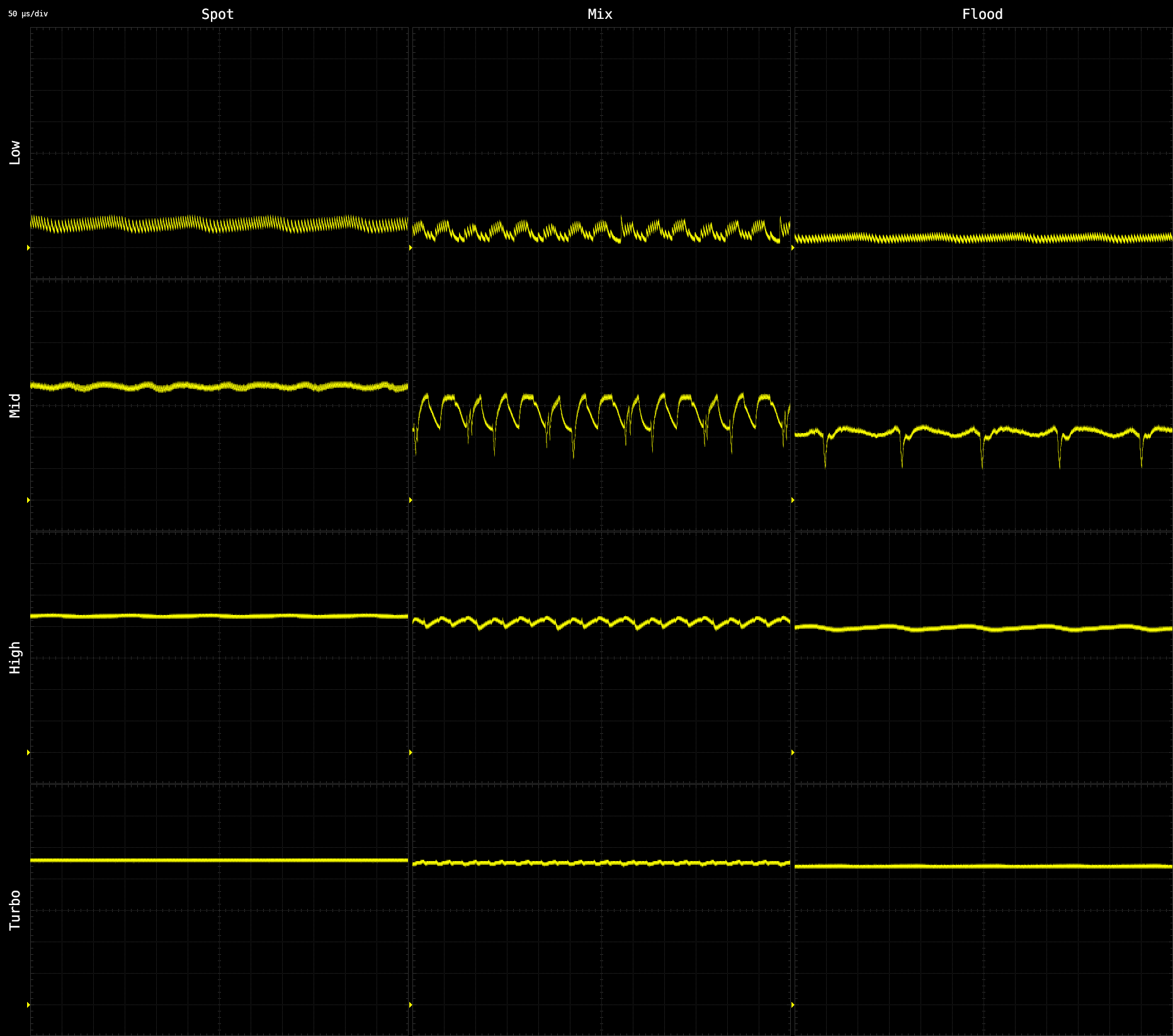
All brightness levels are regulated by the driver without PWM. Using an oscilloscope, a slight ripple can be detected depending on the mode, but it remains completely invisible to the human eye. The only exception is in Strobe mode, where a very fast pulse-width modulation at around 24 kHz can be measured with the scope.
The EX7 has a low-voltage protection – at least sometimes. When it’s working correctly, the battery indicator starts blinking red every 30 seconds at low voltage. The flashlight then shuts off when the voltage drops to around 2.85 V.
However, this protection doesn’t always work reliably and I wasn’t able to identify a clear trigger. In such cases, the status LED remains green even below 2.5 V and the flashlight never shuts off. Nitecore replaced the flashlight for me, but the second unit showed the exact same behavior.
Conclusion
Plenty of light with up to 6,000 lumens and an adjustable beam reaching up to 500 meters – the Nitecore EX7 has a lot to offer! Its four M515S LEDs, a proprietary design by Nitecore, each consists of five closely grouped light-emitting surfaces that can be controlled separately in two groups. This allows the effective LES – and thus the beam – to be adjusted as needed. Additionally, the flashlight is powered by a standard 21700 battery and features a USB-C charging port.
But you’ll only enjoy this flashlight if you can get used to its UI. In my view, it’s confusing and not very practical: during the first three seconds after turning it on, you can’t switch it off, and after that, the brightness can no longer be changed. There’s no mode memory at all and when trying to adjust the brightness, it’s easy to accidentally activate Turbo or even Strobe.
With a better UI, I would definitely recommend the Nitecore EX7, as it combines plenty of power with a compact design and offers an adjustable beam. But before buying, it’s important to take a look at the UI and decide whether it works well for you.