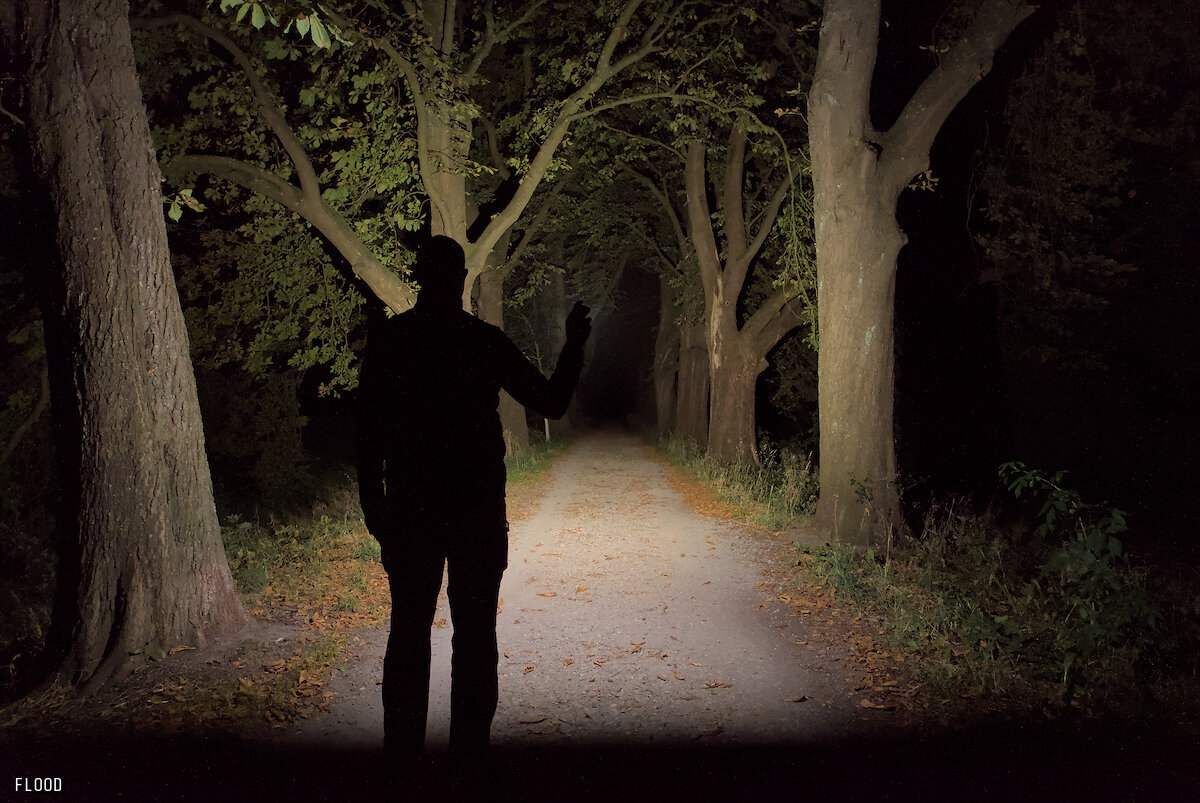
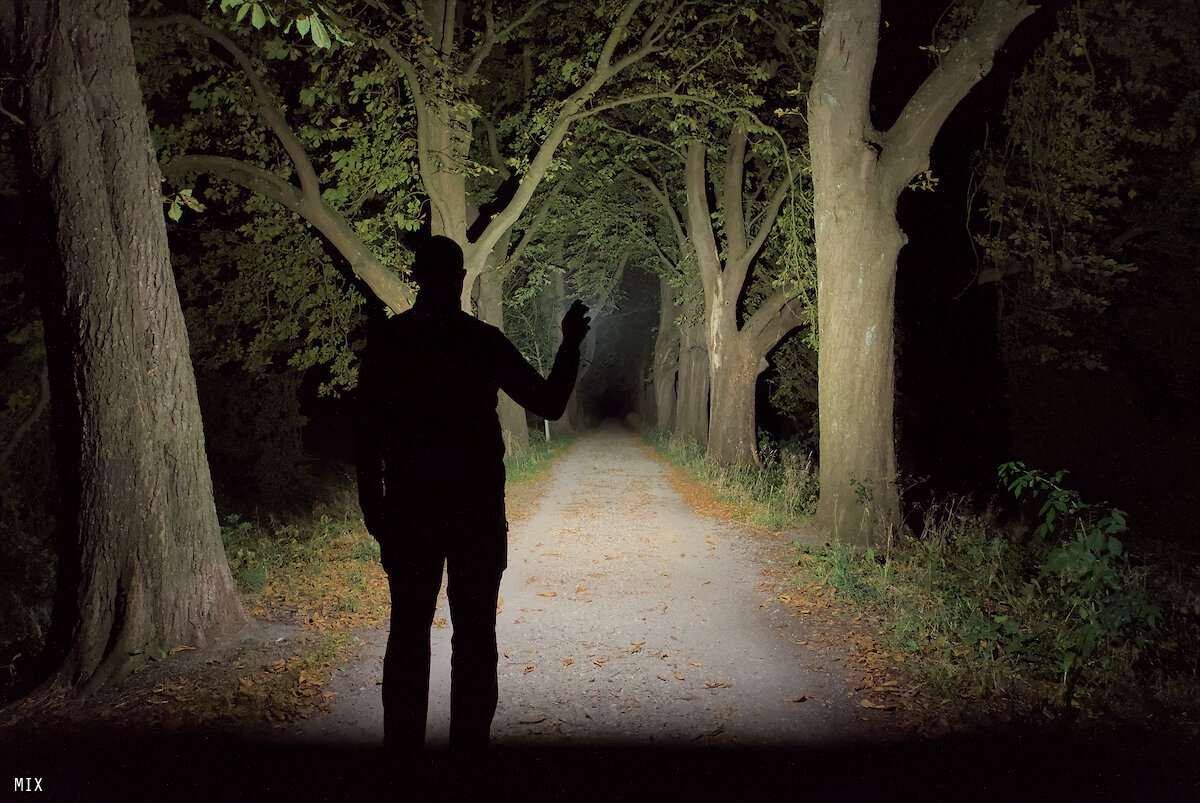
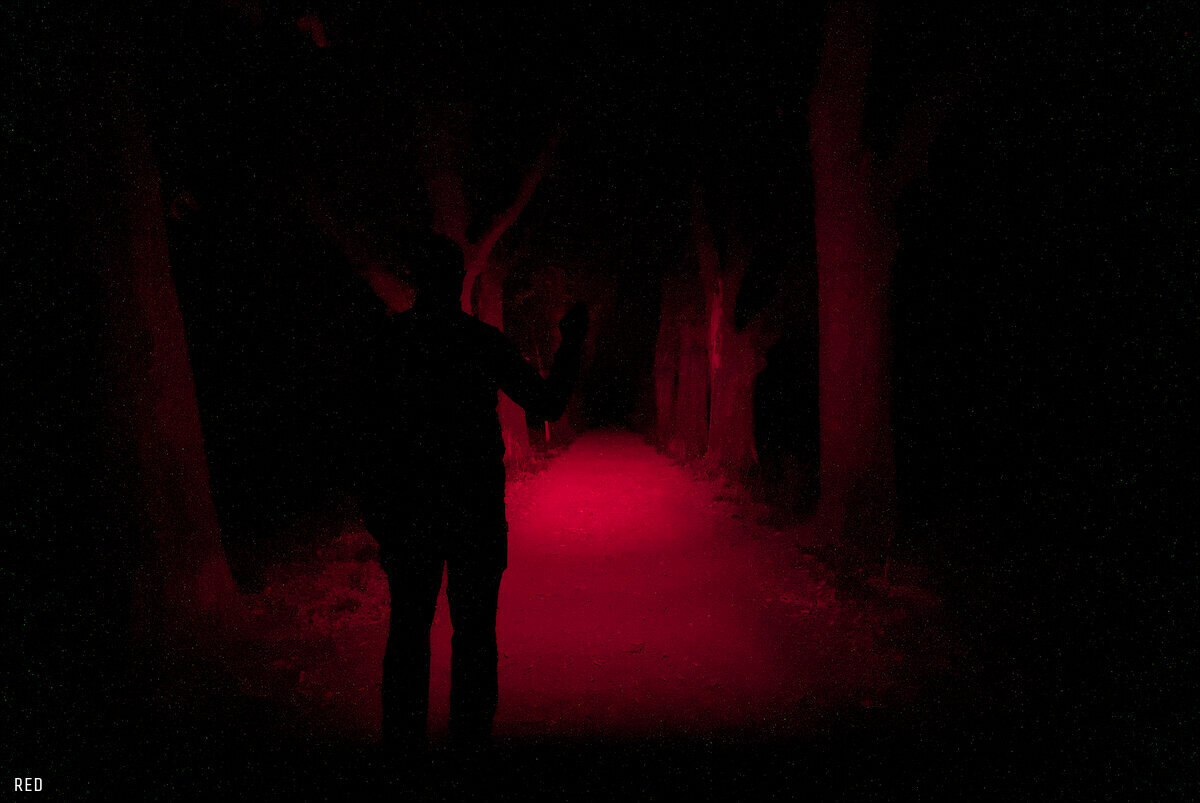
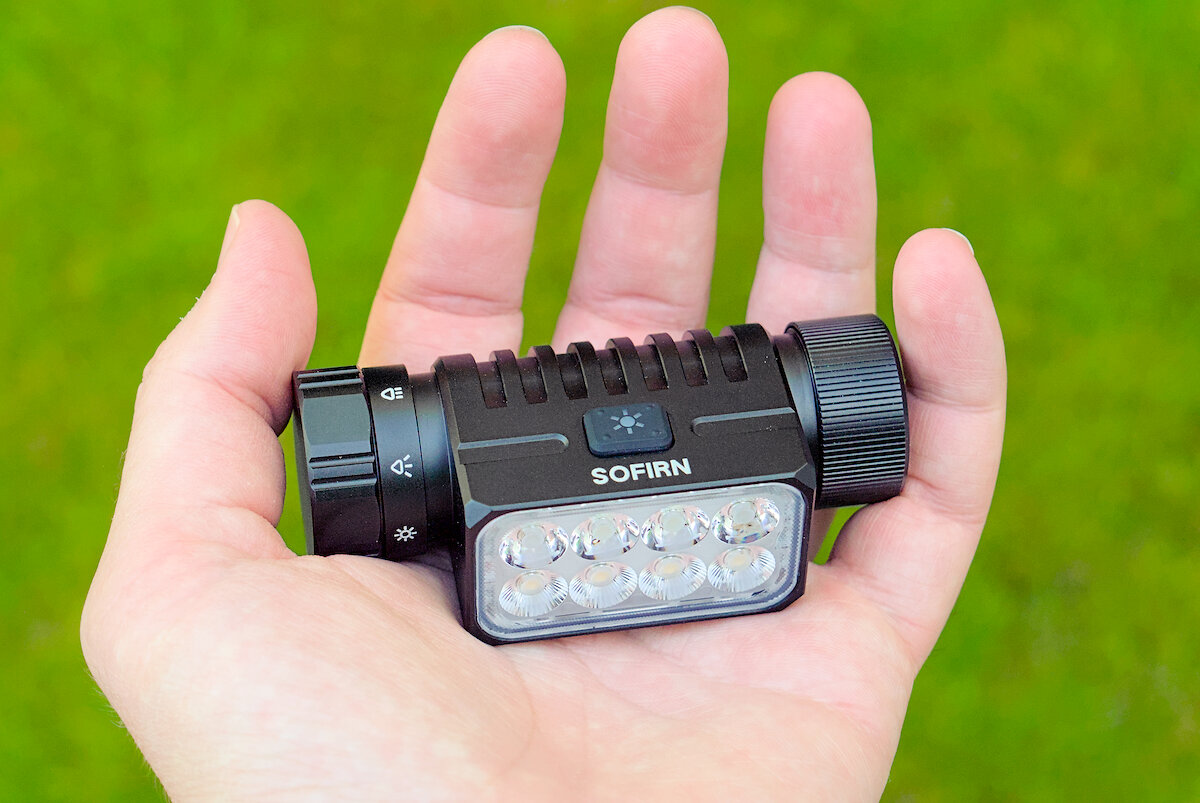
With the HS23, Sofirn is taking an unusual approach: A large 21700 battery is intended to provide high brightness and long runtimes. For flexible use, three channels are available with spotlight, floodlight and red light, which can be conveniently switched between using a rotary switch.
But how does the HS23 perform in practice? How useful is the red light and is the extra weight of the large battery noticeable when using it?
You can find the German version of this review on my website:
The flashlight was provided by the manufacturer for this review. Thank you very much!
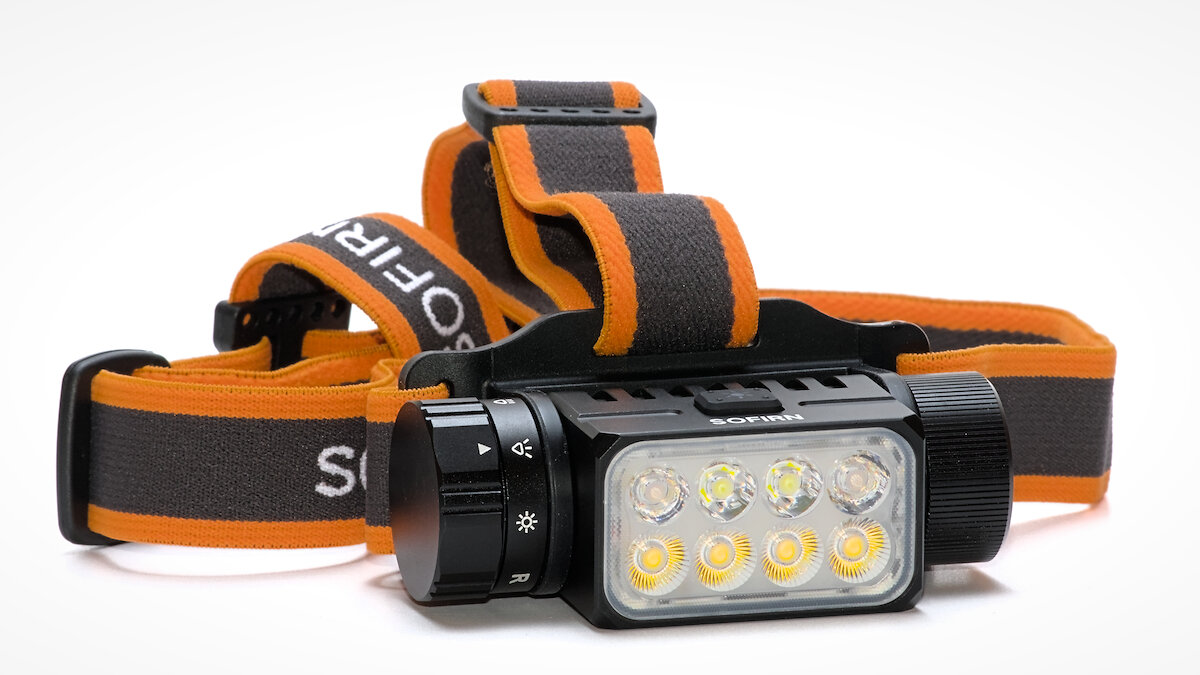
Overview
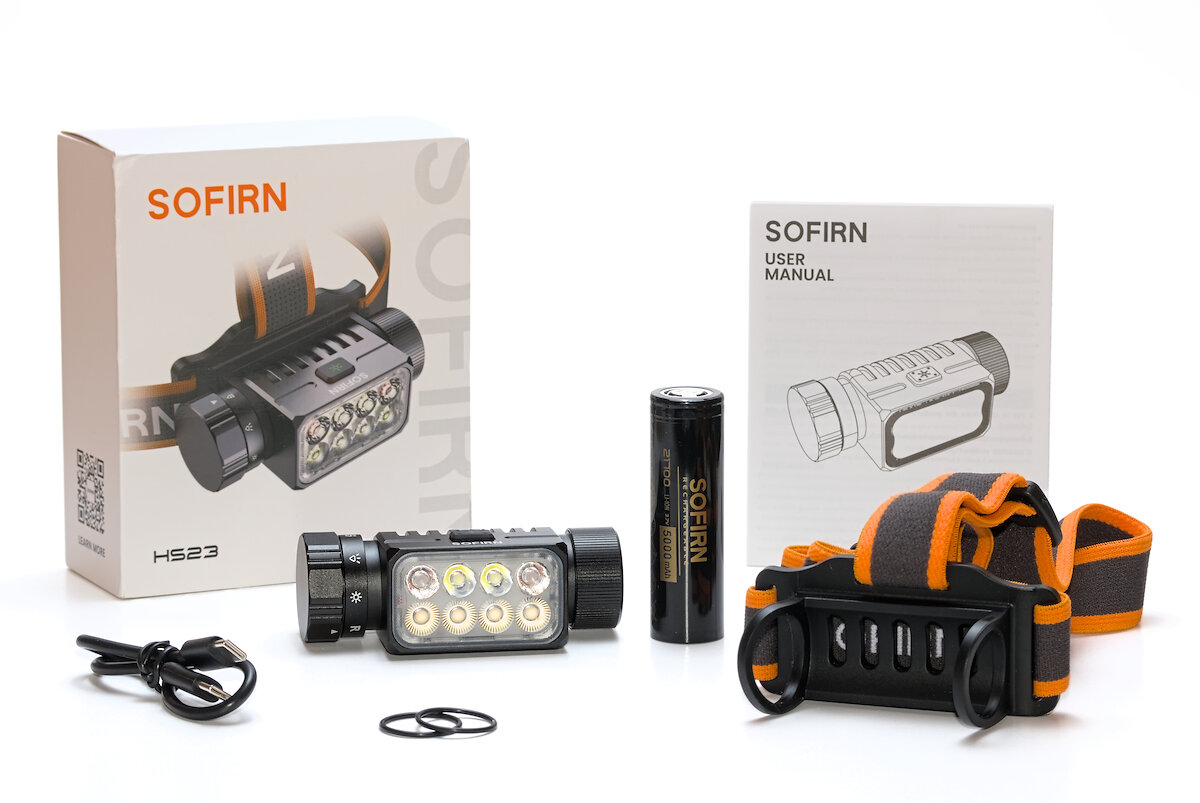
The flashlight comes in retail packaging with a vacuum-formed insert. The accessories are located on the back of the insert.
- Sofirn 21700 Li-ion battery (5000 mAh, unprotected, flat-top, 3.77 V at arrival)
- Head mount
- USB-C charging cable
- 2x replacement O-ring
- Manual (EN, CN, RU, DE, FR, ES, IT, JP, PT)
The manual consists of a 63 × 22 cm sheet of paper printed on both sides. In addition to the text, the user interface is also explained using pictograms. However, some of these are somewhat confusing.
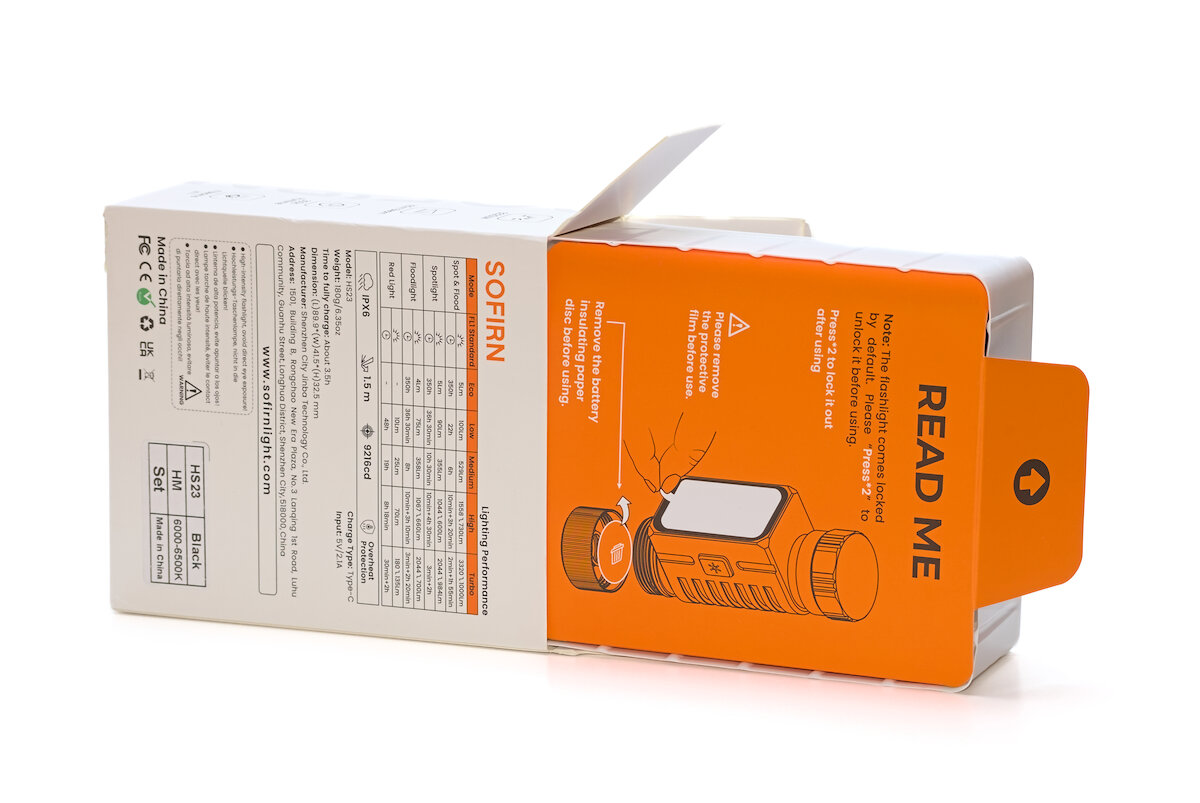
Important steps for initial setup are clearly highlighted when opening the box: Before first use, both the battery transport protection and the protective film on the lens must be removed.
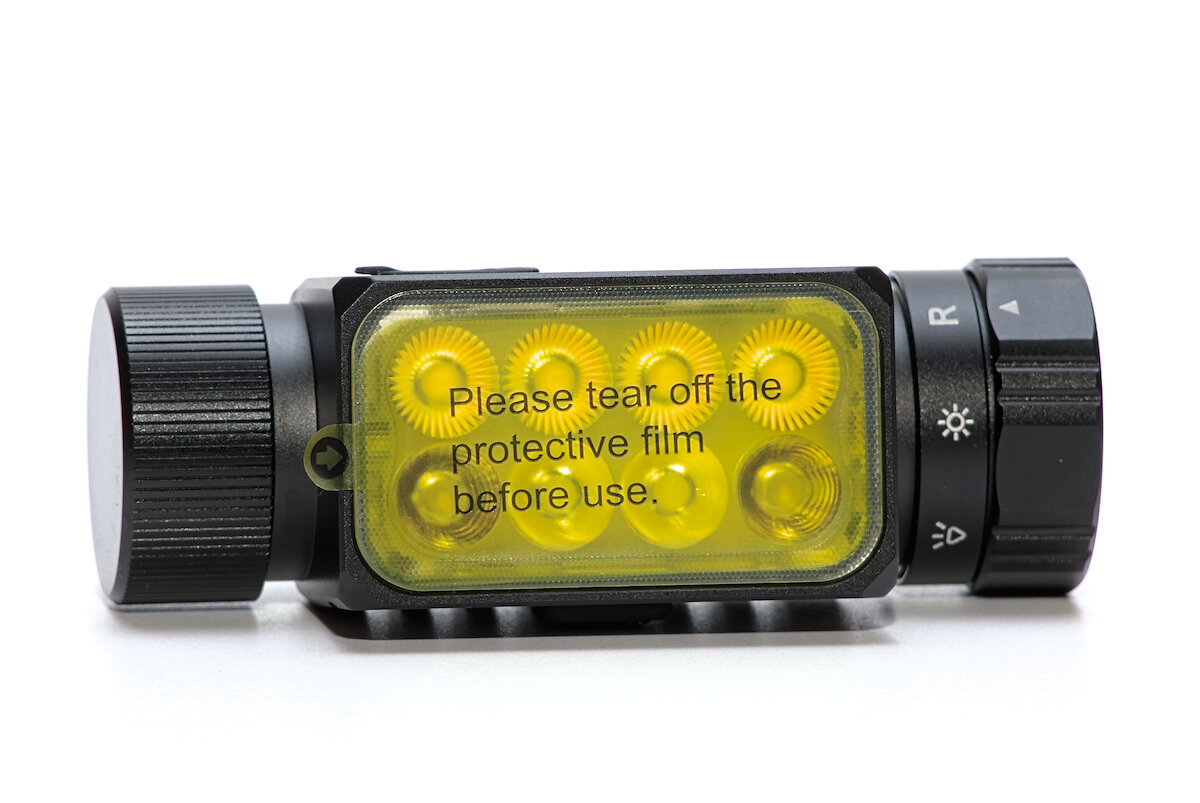
The latter is also clearly noted on the protective film itself. Otherwise, you will be wondering about the yellow light when you turn the flashlight on.
With a headlamp, size and weight play a crucial role. After all, you may be wearing it on your head for extended periods and don’t want to be restricted either in your freedom of movement or in comfort. With this in mind, there’s the question whether a large and relatively heavy 21700 battery is really a suitable choice for a headlamp. At a total weight of 217 g including the battery and head mount, the HS23 is almost twice as heavy as most other headlamps in my collection.
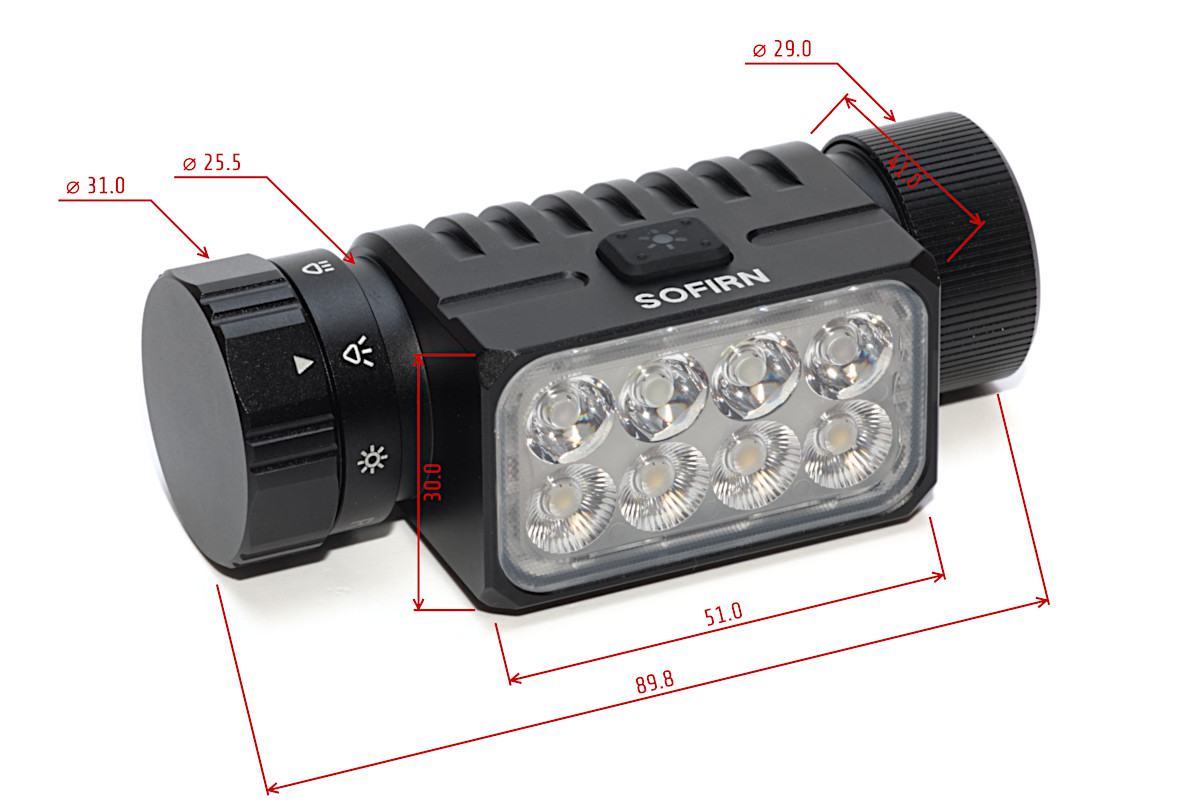
Width (total): 89.8 mm
Width (head): 51.0 mm
Height: 30.0 mm
Depth: 41.0 mm
Diameter (rotary switch): 31.0 mm
Diameter (battery cap): 29.0 mm
Diameter (mounting slot): 25.5 mm
Weight (without battery): 108 g
Weight (21700 battery): 69 g
Weight (head mount): 40 g
Weight (total): 217 g
For better illustration, the dimensions are shown graphically in the following picture:
Even when compared directly with other headlamps, the HS23 looks relatively compact – especially considering that all the other lights shown use a smaller 18650 battery.
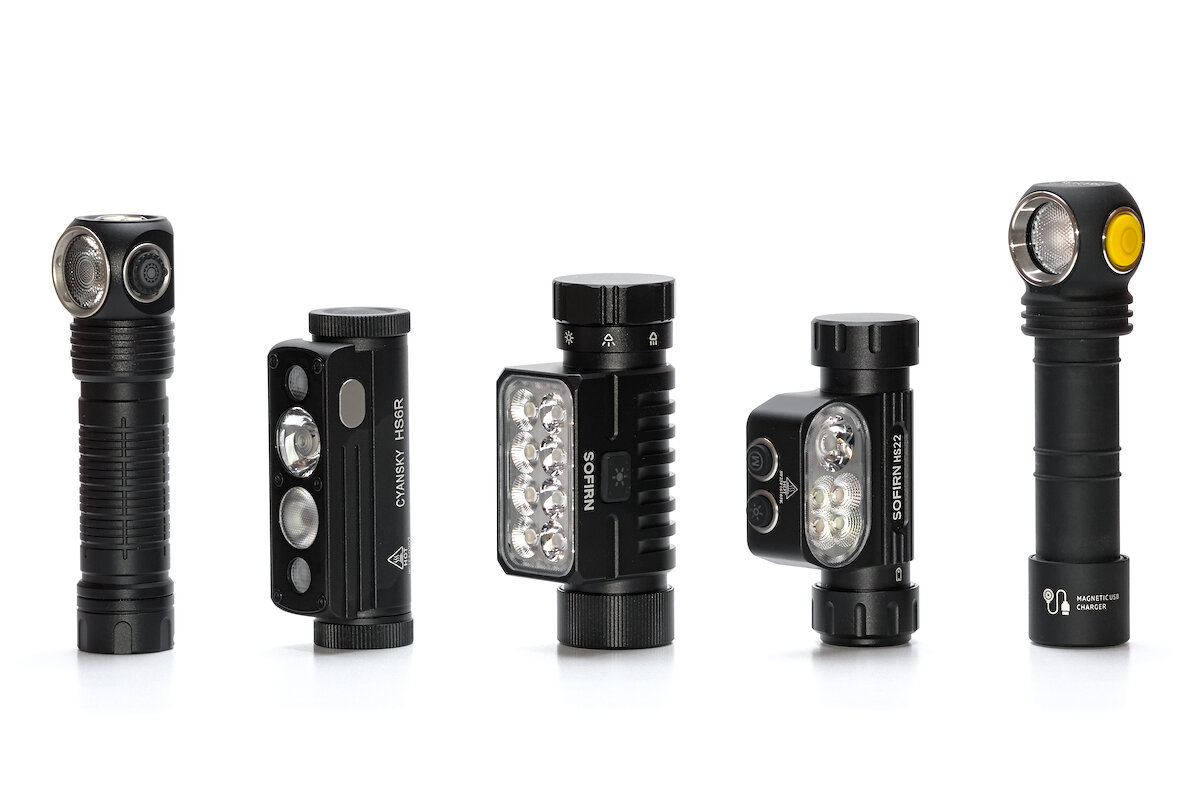
Skilhunt H300 | Cyansky HS6R | Sofirn HS23 | Sofirn HS22 | Armytek Wizard C2 Pro
On the HS23, the LEDs are not located at the end of the battery tube as they are on an angled headlamp, but in a block on the side of the tube. This makes the flashlight shorter overall but also somewhat wider.
The body is made entirely of aluminum and finished with a matte black anodization. On the back, subtle cooling fins add some visual details. Otherwise, the design is fairly simple.
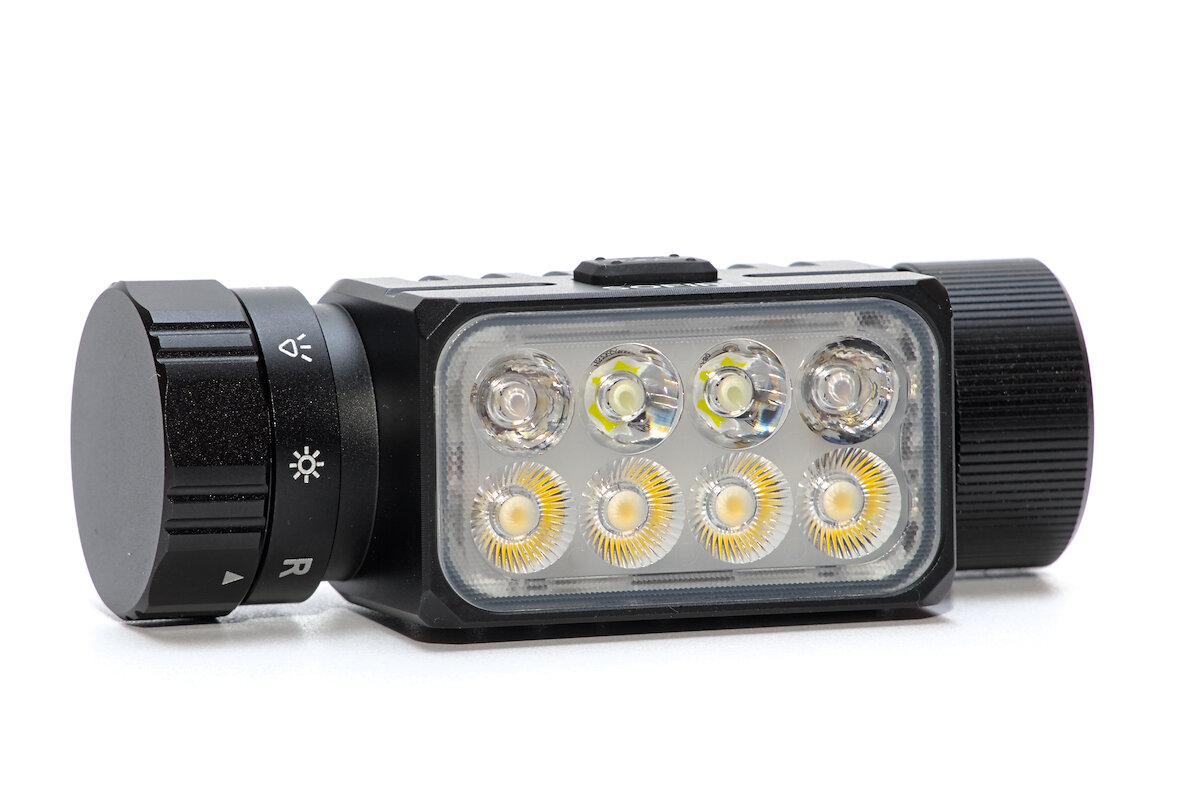
The integrated USB-C port on the bottom allows the battery to be charged directly in the flashlight, eliminating the need for an external charger.
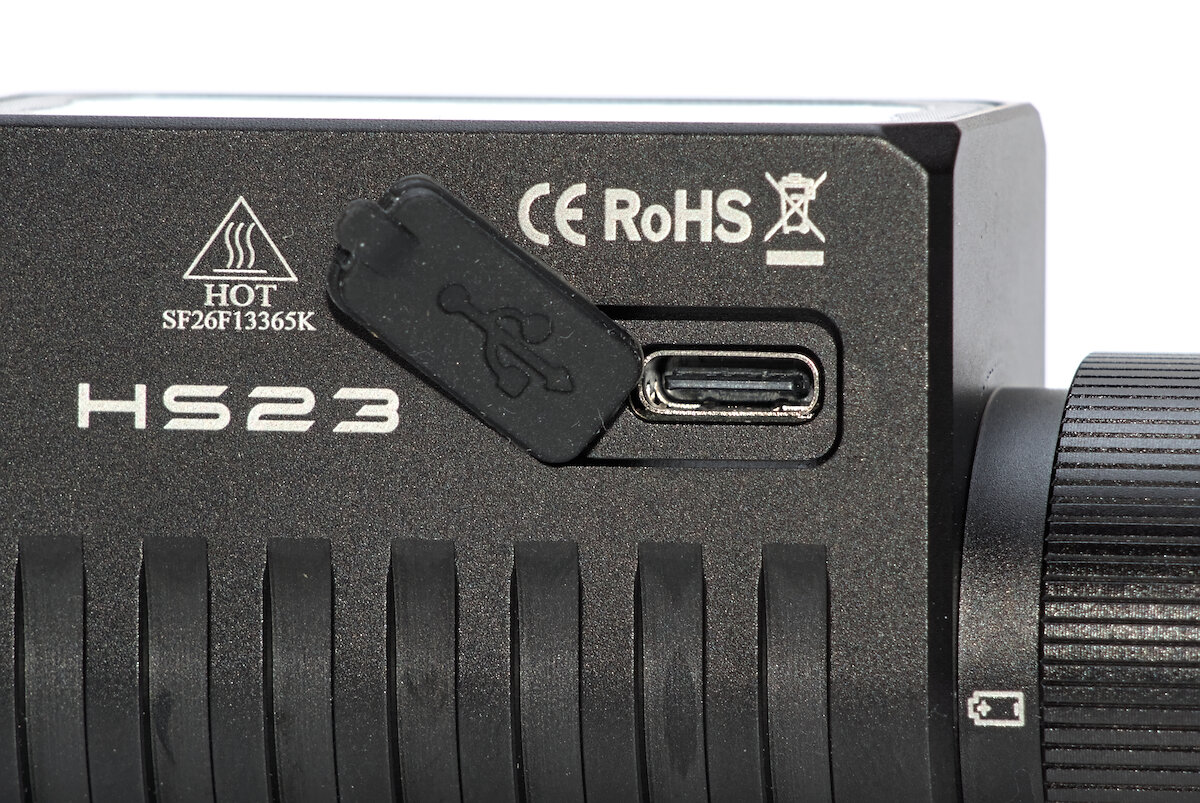
A silicone cover protects the charging port from water and dirt. Although a small tab makes it easier to open, the cover is difficult to open without using your fingernails.
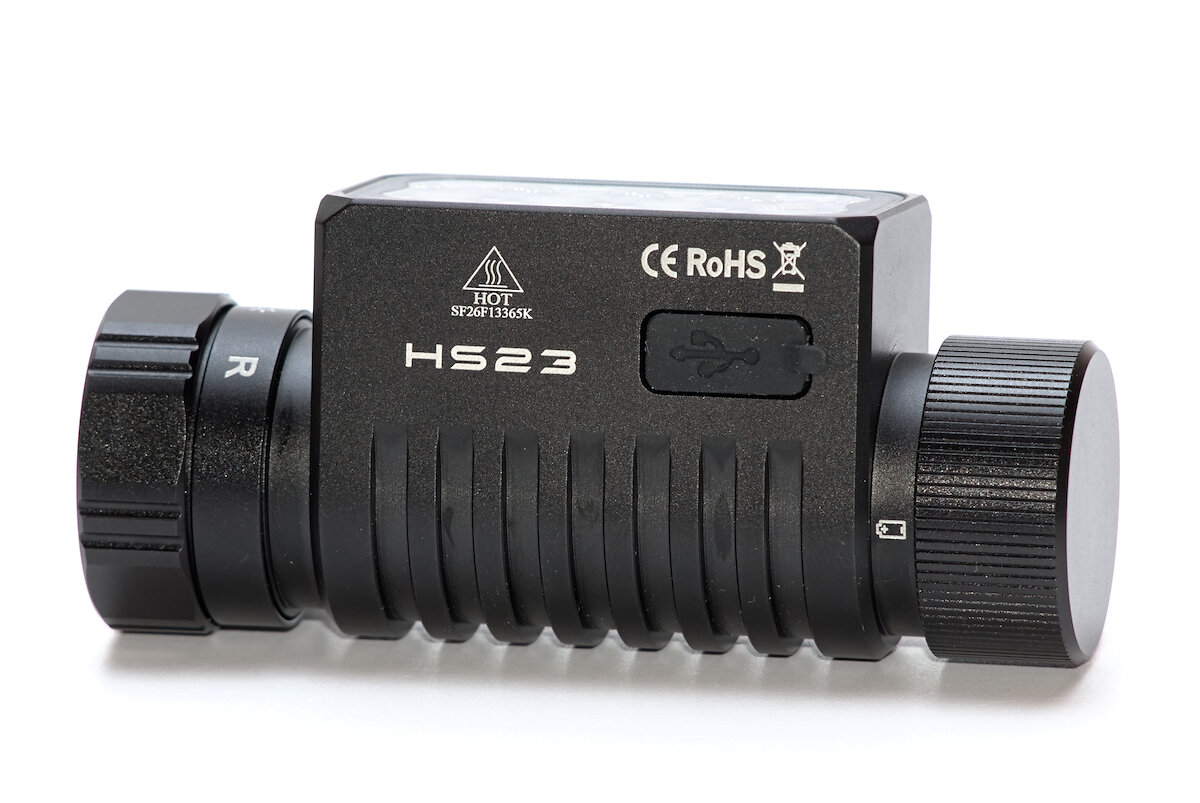
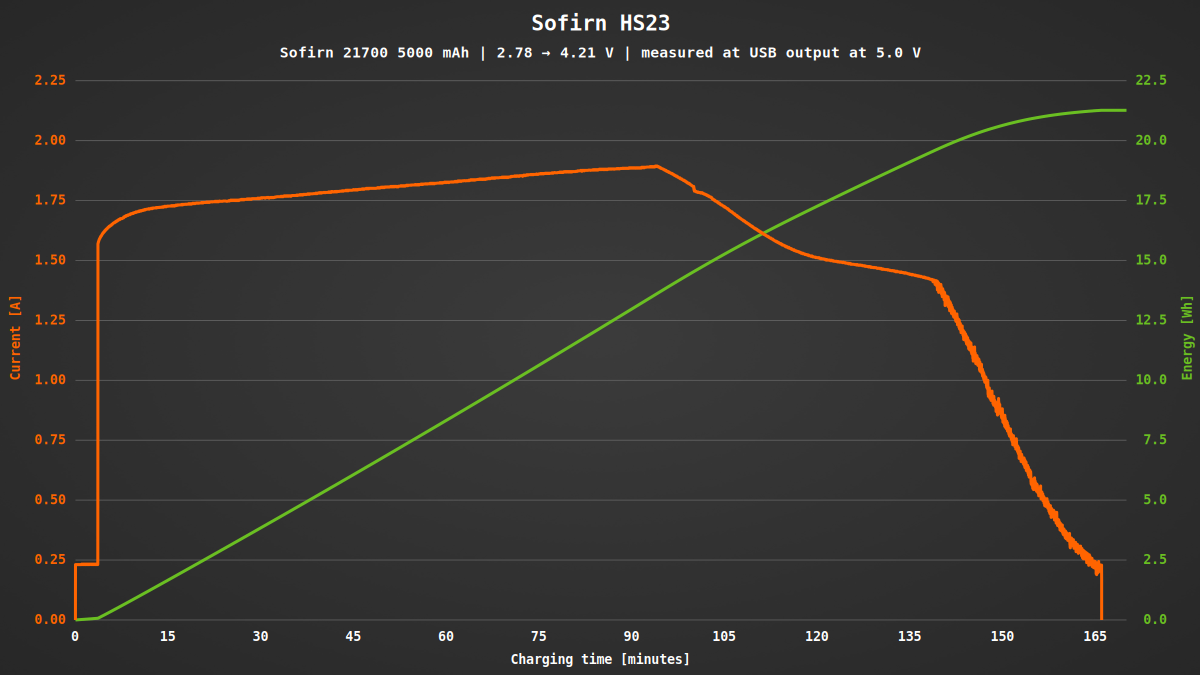
The battery charges at 5 V at up to nearly 2 A. This means the flashlight is fully charged and ready to use again after around two and a half hours. Charging progress is indicated by an LED in the button, which changes from red to green when the battery is fully charged. The flashlight can be used normally while charging.
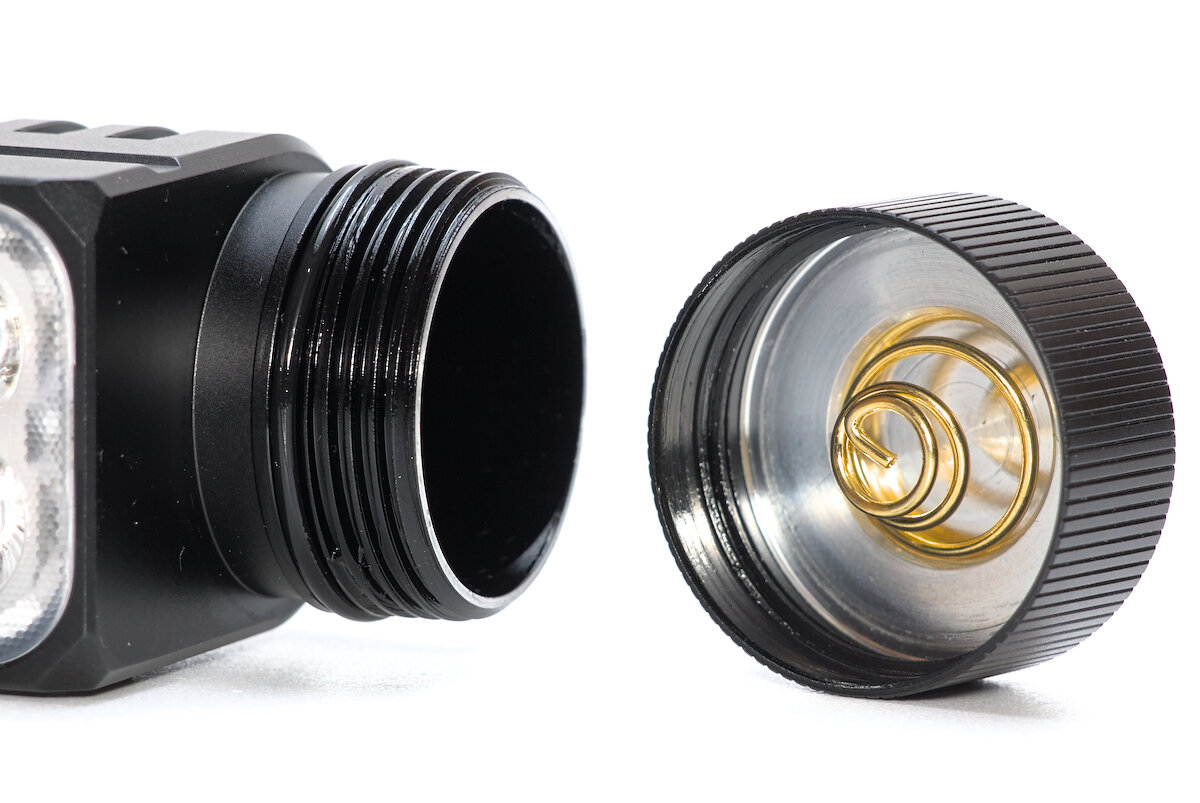
The HS23 is powered by a single 21700 Li-ion battery. Springs on both ends ensure reliable contact and also allow the use of some protected batteries, provided they do not exceed 75 mm in length.
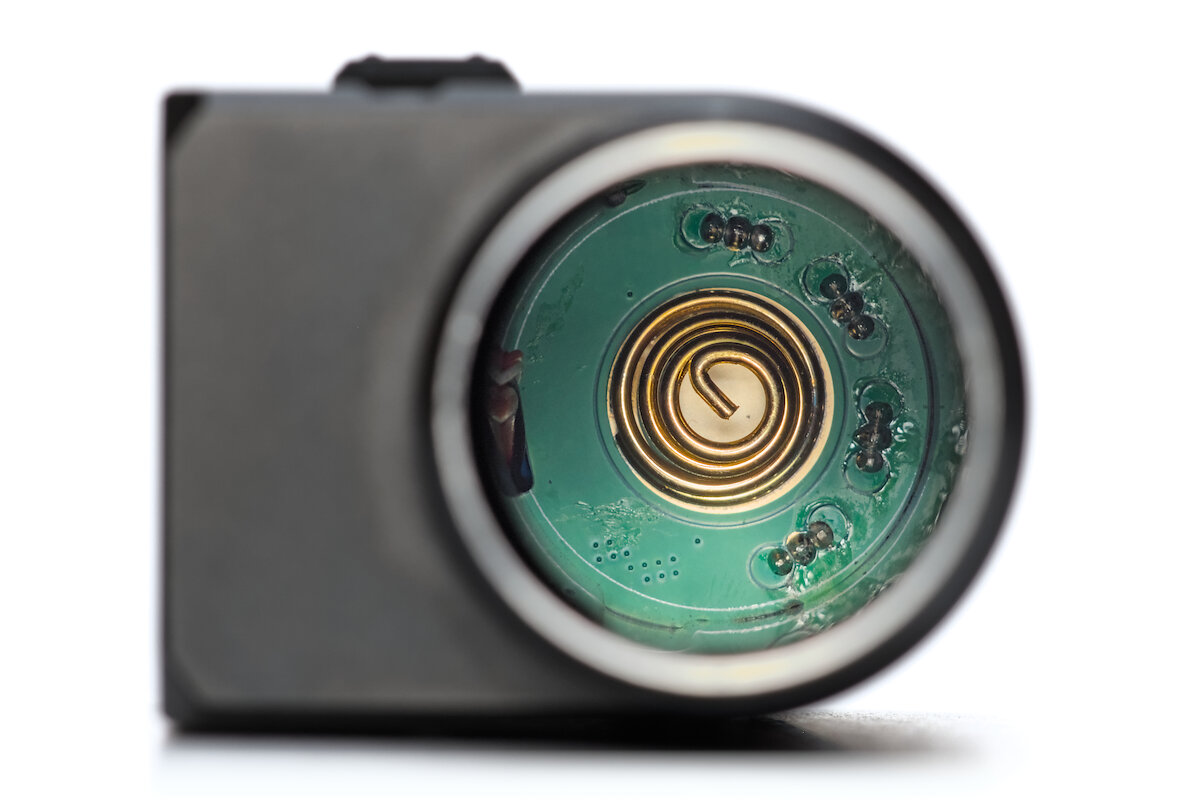
On the circuit board inside the battery tube, contacts of Hall sensor can be seen around the spring. They are used to detect the switch position.
According to the manufacturer, the HS23 has an IPX6 rating. This means it is “protected against powerful water jets”, which in practice usually translates to “can also be used in the rain”. So it is better not to submerge the flashlight in water. The rotary switch may be a potential weak point, but the button also does not seal completely if you press it slightly to the side. The flashlight is also designed to withstand drops from heights of up to 1.5 meters.
User interface
A button on top of the flashlight is used to turn the light on and off and adjust the brightness. It also contains a status LED for the charging indicator. It requires a force of around 800 cN to actuate. The actuation point is clearly defined and accompanied by a distinct click.
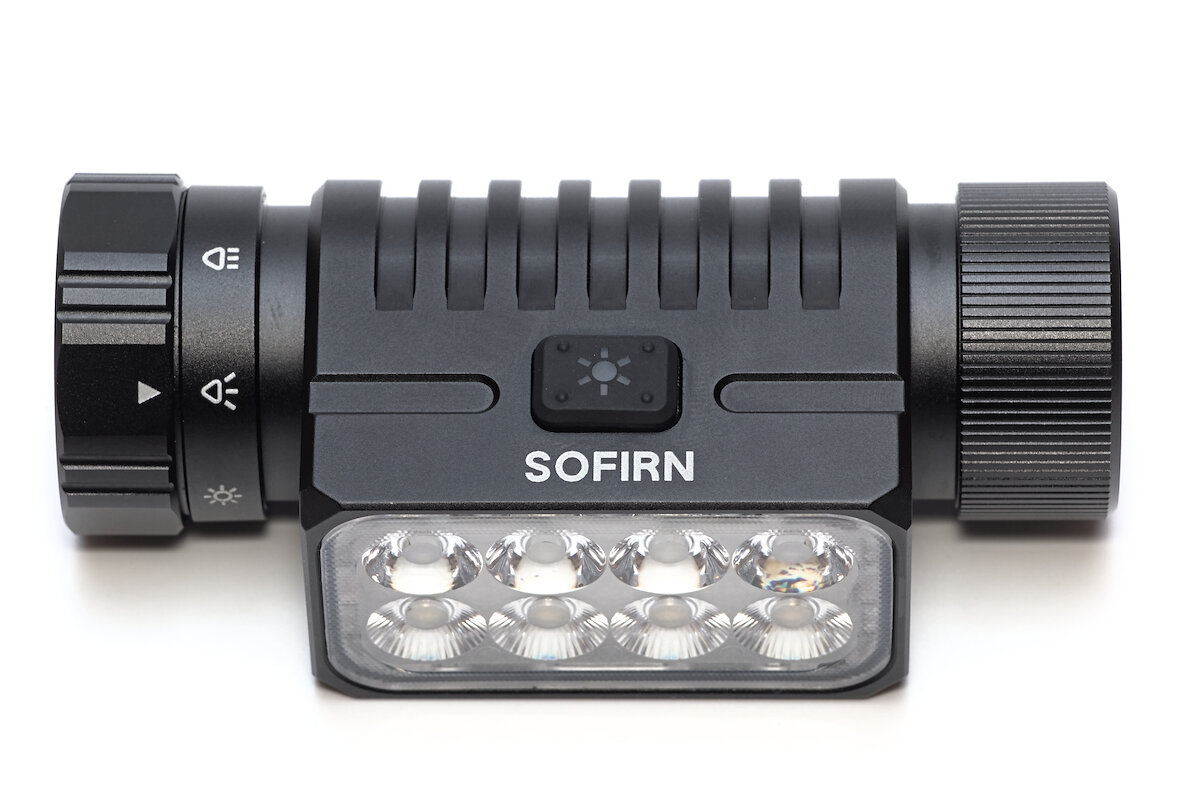
A rotary switch on the side allows you to select the channel. Turning it cycles through Spot, Flood, Mix and Red, with each setting clicking gently into place. In principle, a rotary switch is a practical and intuitive method, but I would have preferred the order Spot/Mix/Flood/Red to make it easier to switch between Red and Flood.
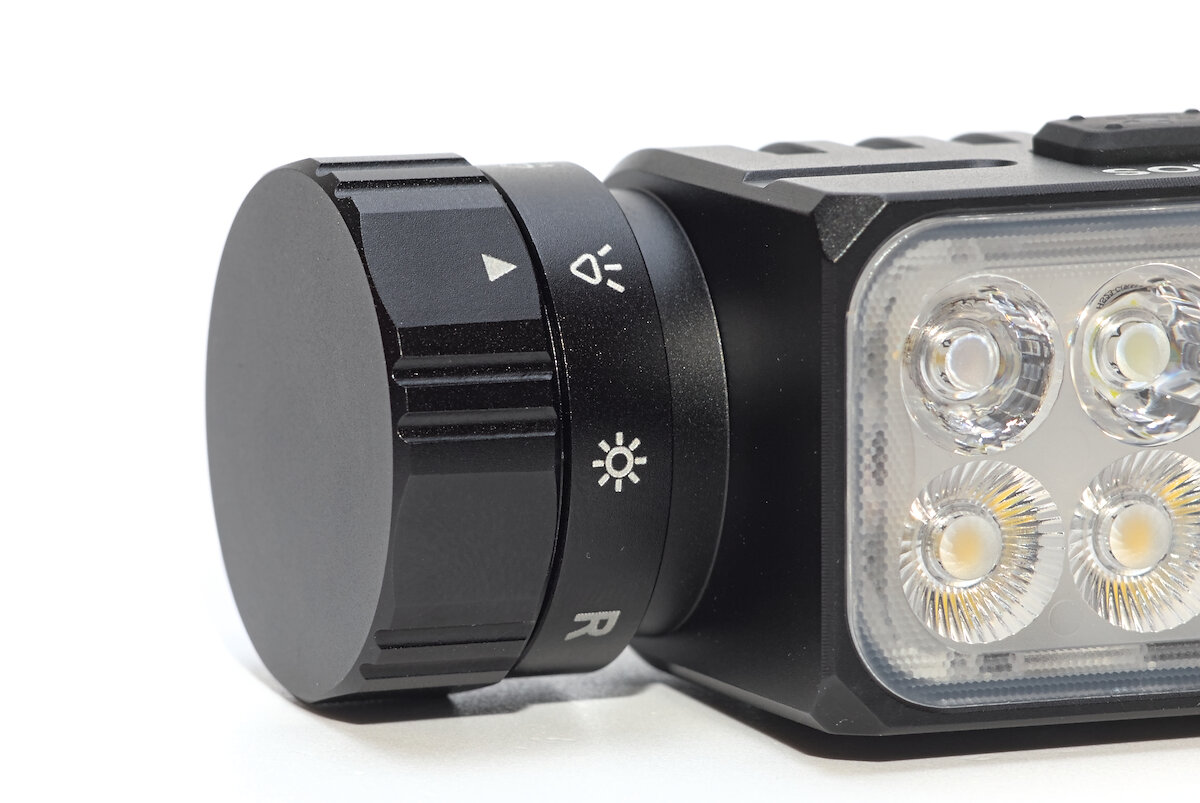
The operation is really straightforward, so you should be able to get the hang of it quickly. A short press of the button turns the flashlight on and off, while a long press changes the brightness. There are also additional modes for the lowest and highest brightness levels as well as a lockout function.
| State | Action | Function |
|---|---|---|
| Off | 1 click | Turn on in previously used brightness (except Eco and Turbo) |
| Off | 2 clicks | Lockout |
| Off | Hold | Turn on in lowest brightness |
| On | 1 click | Turn off |
| On | 2 clicks | White: Turbo Red: Blinking |
| On | Hold | Change brightness White: Low → Medium → High Red: Medium → High → Turbo |
| Turbo | 1 click | Previously used brightness |
| Lockout | 2 clicks | Unlock and tun on in previously used brightness |
| Lockout | Hold | Momentary lowest brightness (selected channel) |
I particularly like how easy it is to switch between the individual channels using the rotary switch. The brightness level is memorized separately for each channel. This means, for example, that you can switch directly from a low brightness level in Flood mode to a high brightness level in Spot mode. Eco and Turbo are not memorized, however, which is particularly noticeable and annoying at low brightness levels. The channel order is also not ideal: If you want to switch from red light to white floodlight while the flashlight is on, you inevitably have to briefly activate both white channels. I therefore would have preferred the flood channel to come directly after the red channel.
To activate Turbo, the flashlight must first be turned on. In the red channel, a double-click does not activate Turbo but instead activates a flashing mode. A double-click when the flashlight is off activates the lockout function, preventing accidental activation. When the flashlight is locked, holding down the button temporarily turns the light on at the lowest level of the selected channel. The flashlight can also be mechanically locked out by loosening the tailcap.
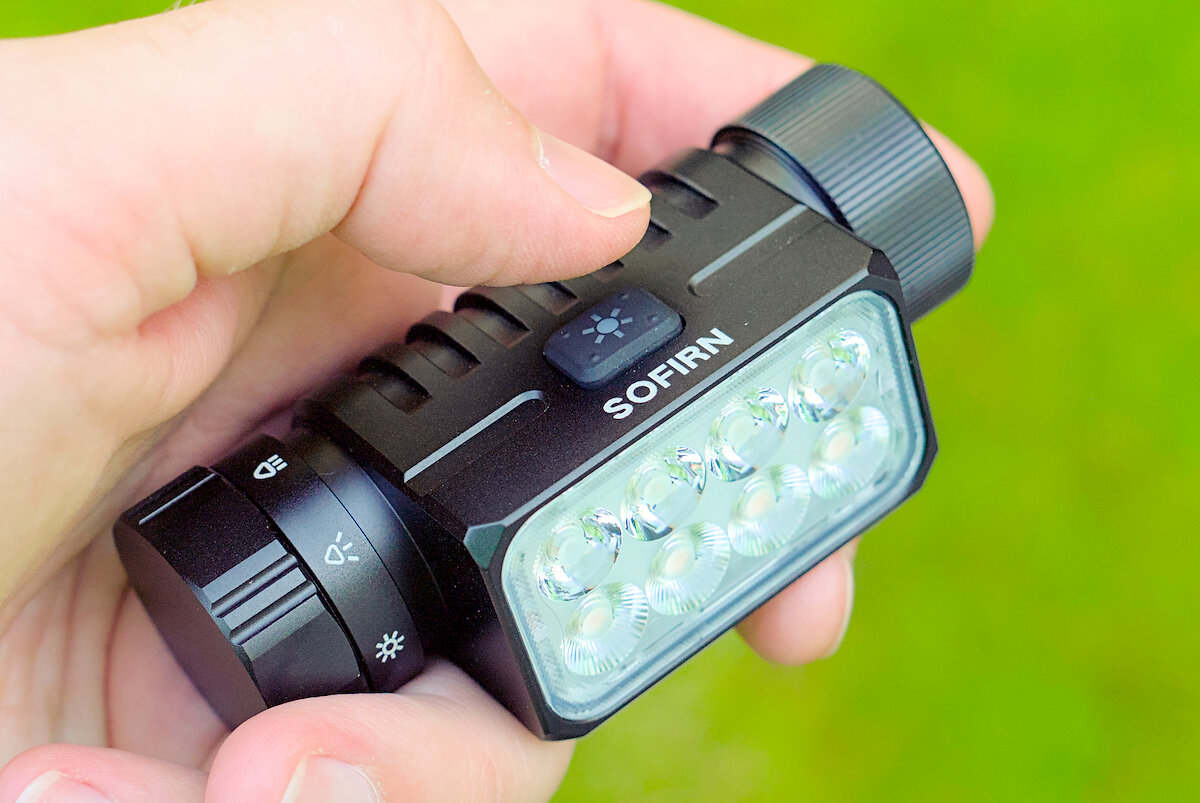
After switching on, a status LED in the button indicates the approximate battery level for five seconds. When the battery voltage is critically low, the LED continuously flashes red while the flashlight is on. When wearing the flashlight on your head, this helpful information is of course not visible.
| Color | Battery level |
|---|---|
| Green | 75% – 100% |
| Green blinking | 50% – 75% |
| Red | 25% – 50% |
| Red blinking | < 25% |
The included head mount is simple but functional. The flashlight is threaded through two loops in the silicone mount, which can sometimes be a bit tedious. Once in place, however, it stays securely mounted and does not rotate on its own, even when moving.
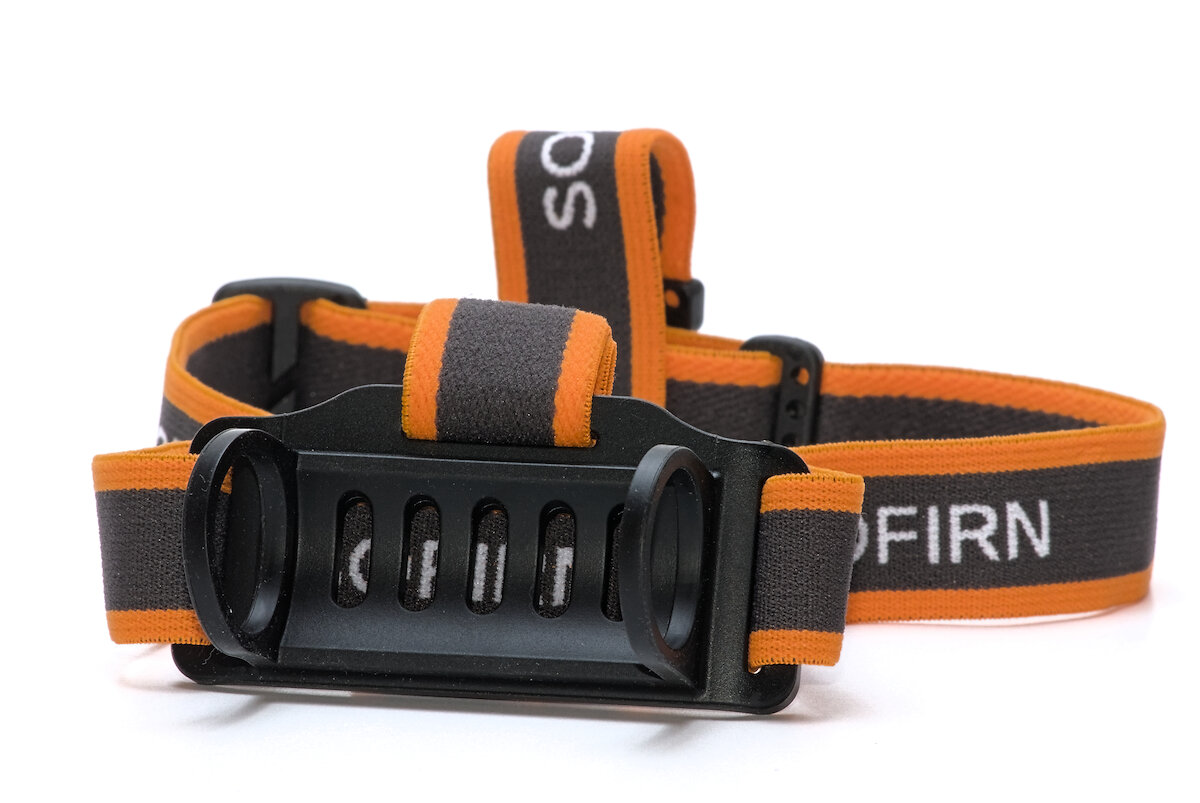
An additional elastic strap that runs over the top of the head provides extra stability and prevents the flashlight from bouncing around too much while walking. The mount itself is quite comfortable, but the relatively high weight of the flashlight is still very noticeable. It is therefore better suited for mounting on a hard hat.
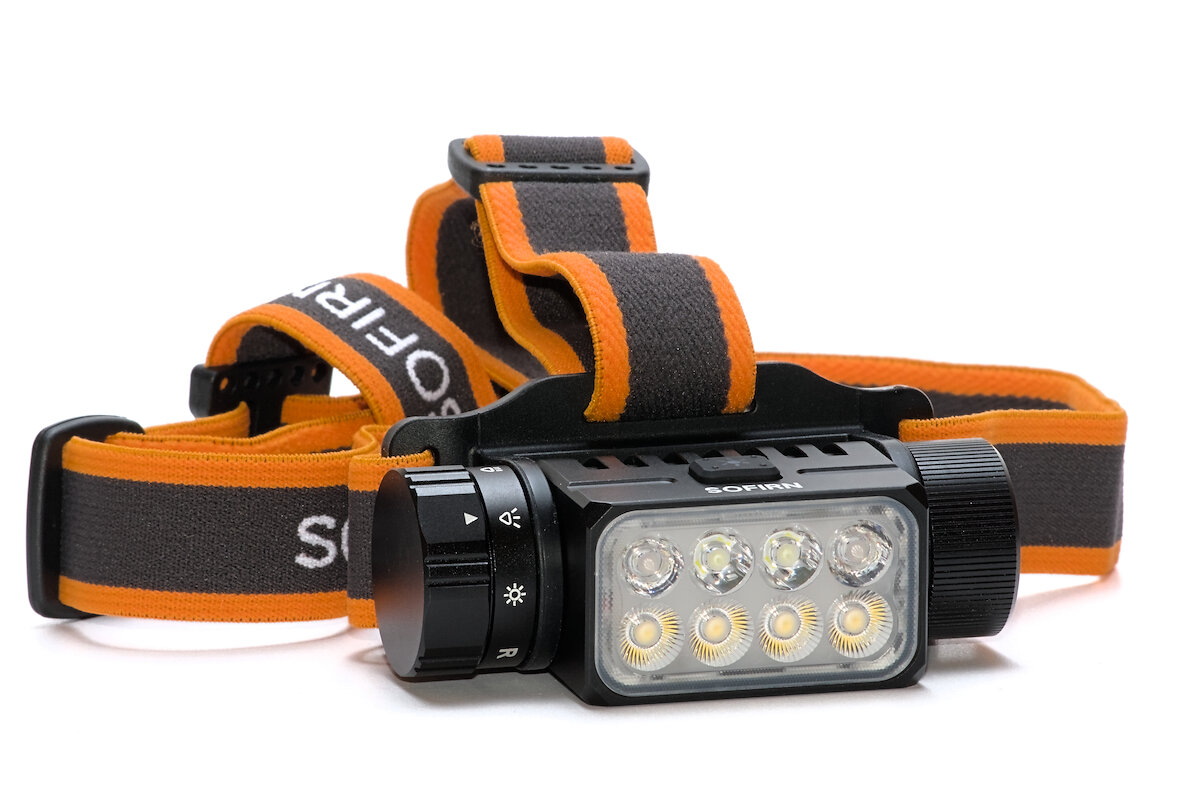
Apart from the head mount, the flashlight can of course also be used as a handheld light without issues. With a magnet in the battery cap, it could also have been used well as a stationary work light.
Illumination
The exact LEDs used in the HS23 are unfortunately not disclosed by the manufacturer. For the red LEDs, it seems likely that they are Luminus SST-20-DR, as these have also been used in other models from the manufacturer. The following information can be found on the website (but not in the manual or on the packaging):
- Spot: 2x 6500 K
- Flood: 4x 5000 K, CRI 90
- Red: 2x 660 nm
All of the LEDs are located behind a single TIR optic specially developed for this model. It is glued in place and therefore cannot be easily removed, for example to replace the LEDs. An additional glass lens for protecting the optic has been omitted. This makes the surface more susceptible to scratches, but the plastic is more resistant to impacts and does not break as easily as glass. There is no anti-reflective coating.
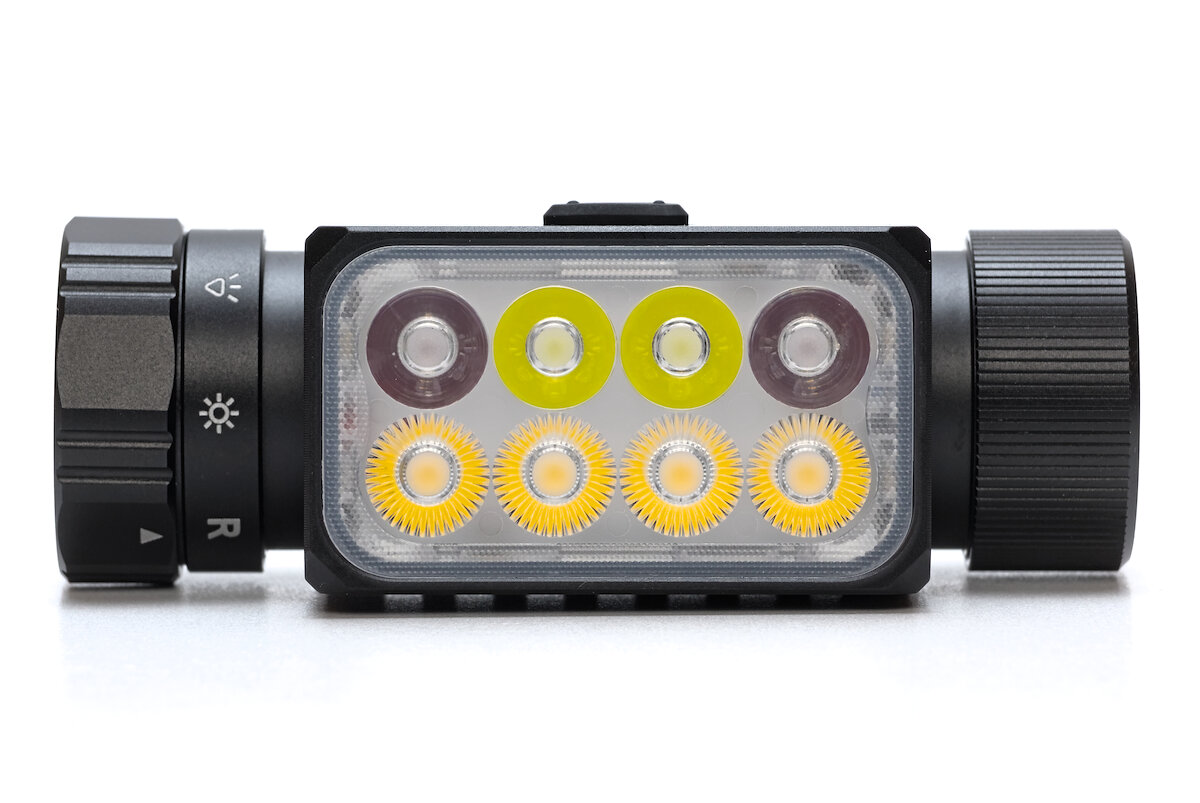
The cool-white spotlight has a neutral tint, while the floodlight is not only warmer but also has a slight greenish tint. However, this cannot be specified more precisely without an exact measurement.
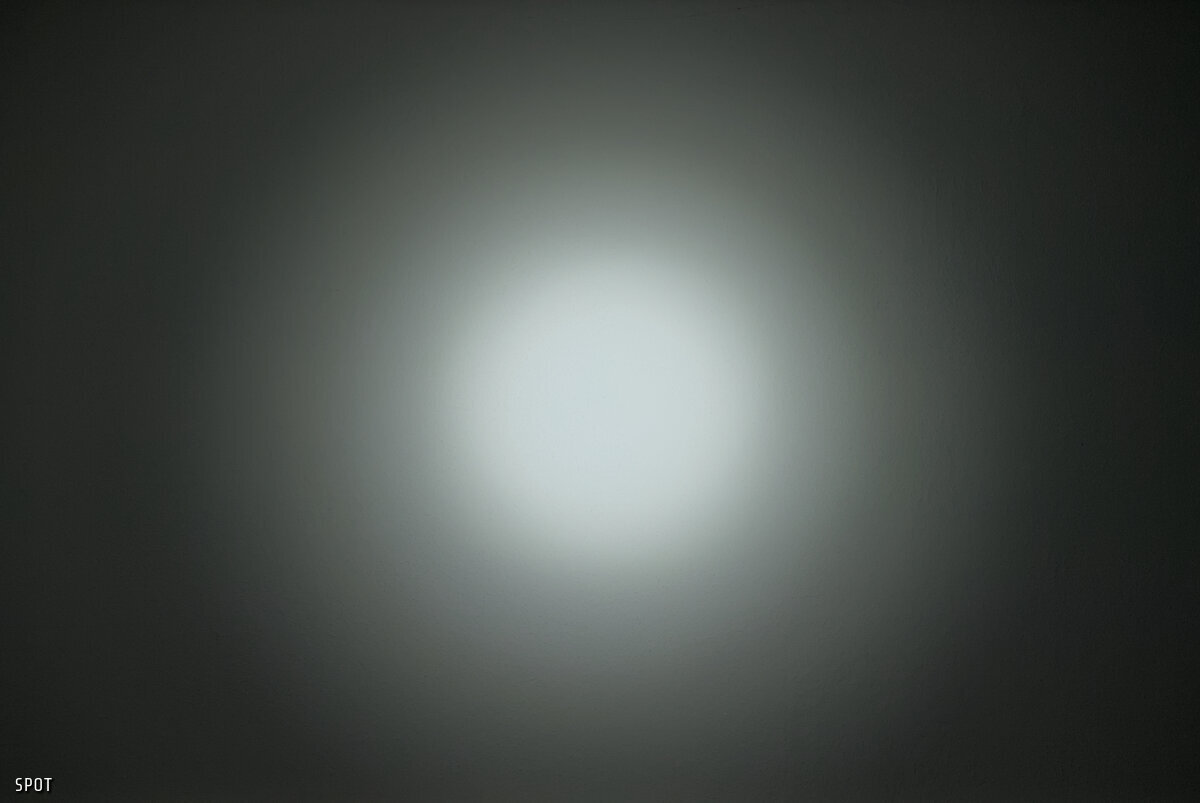
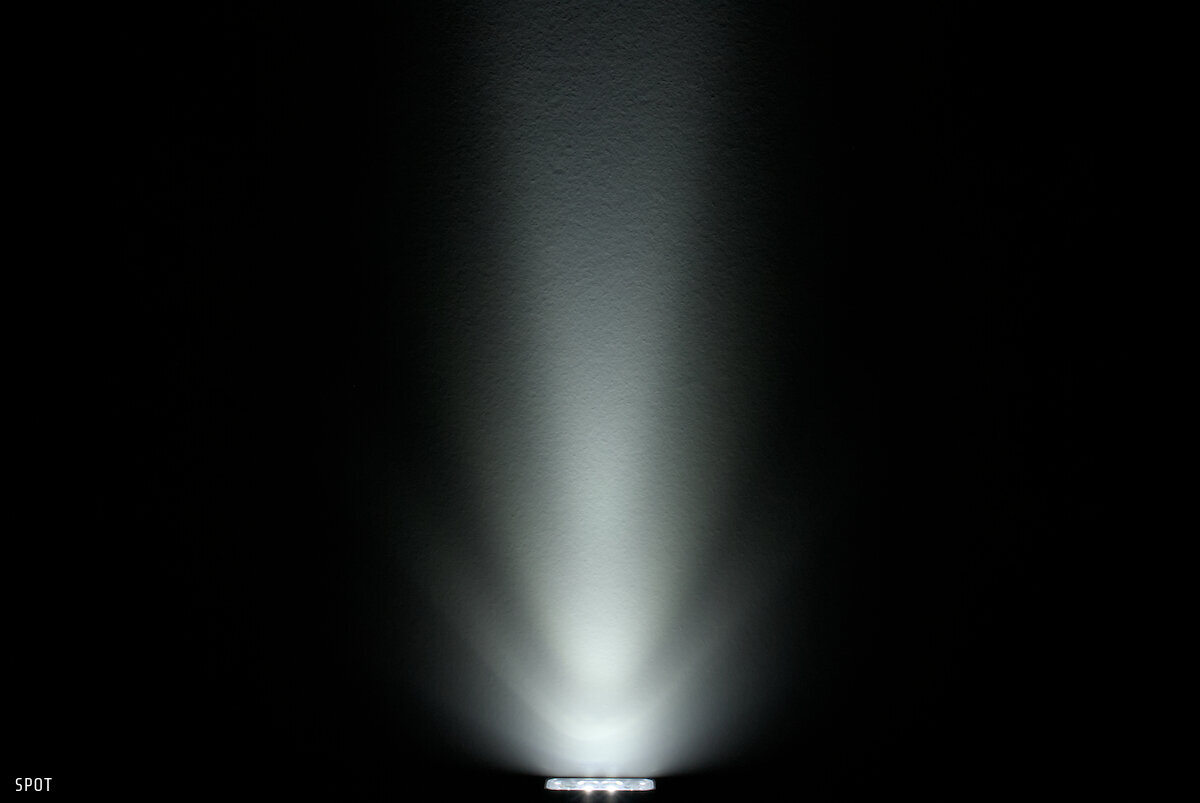
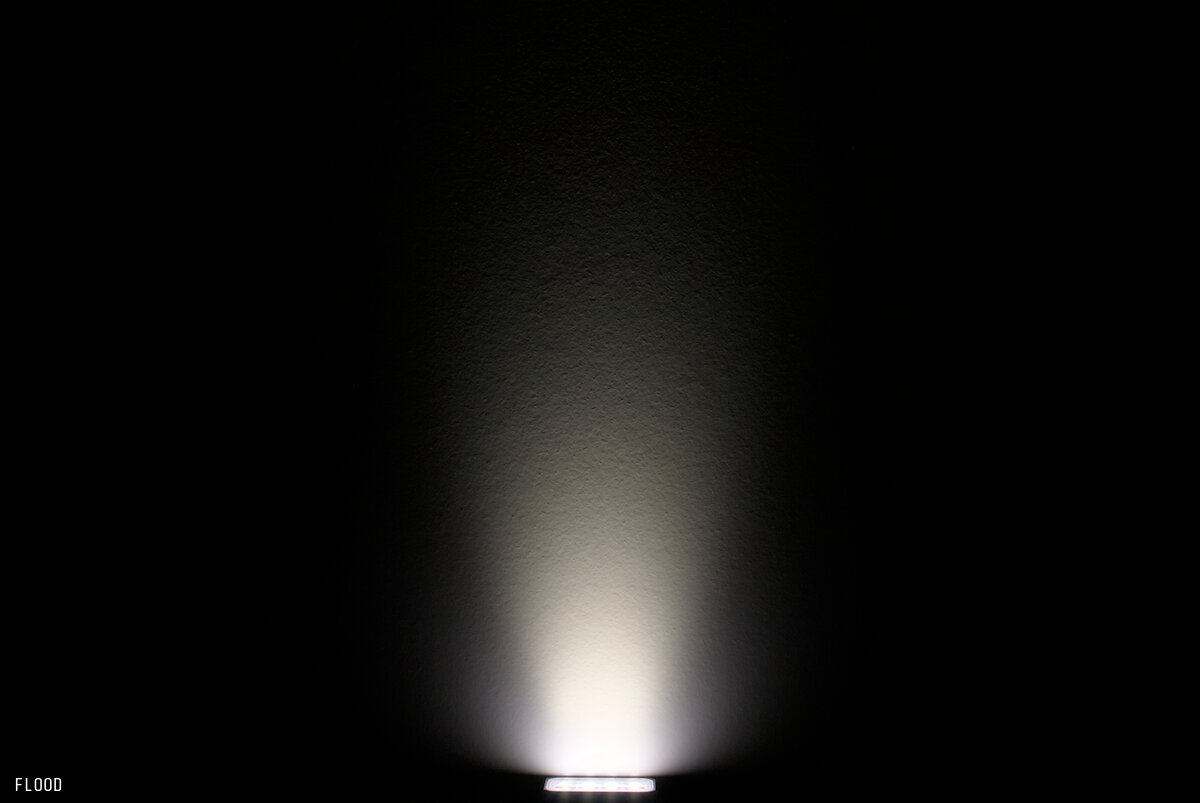
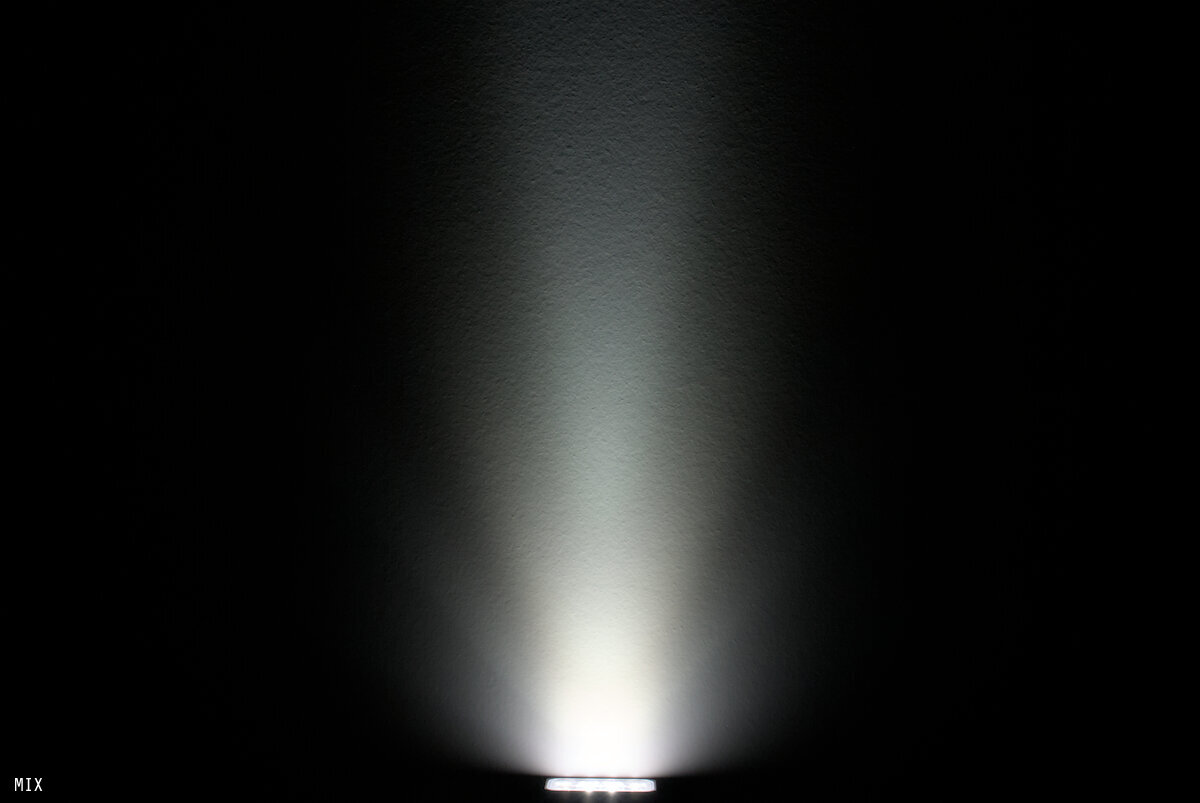
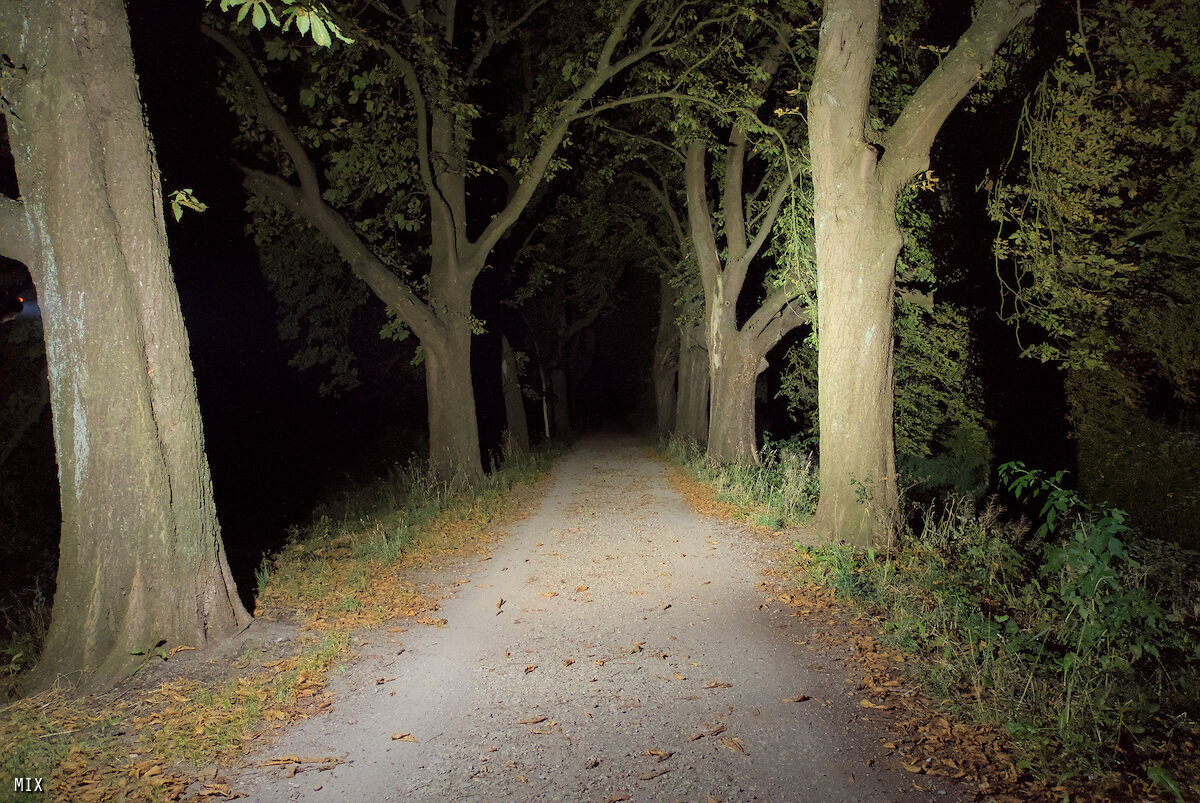
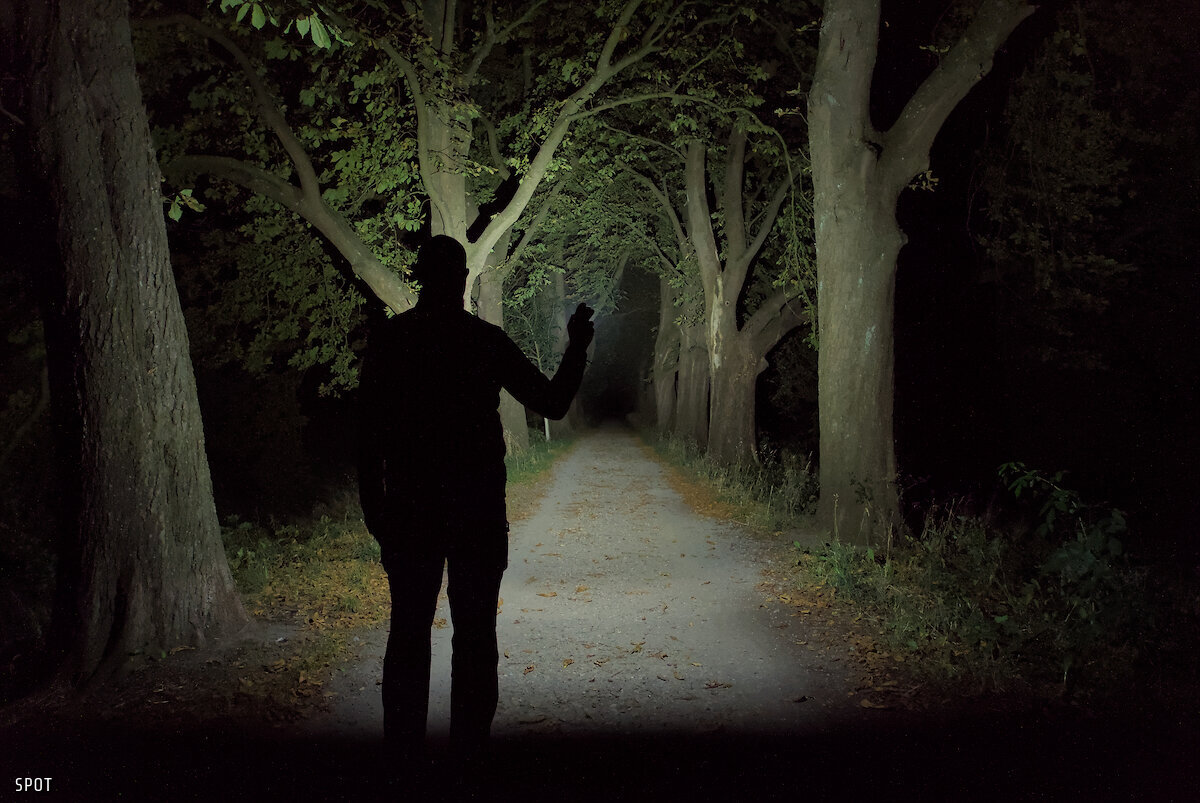
There is a noticeable difference between the beam patterns of the spotlight and floodlight, but it is less pronounced than I would have liked. The spotlight produces a relatively large spot that transitions softly into the spill. The small TIR optic probably cannot do much more. The floodlight is center-weighted without producing a clearly defined spot. Due to the different colors of the light, the spotlight and floodlight do not harmonize particularly well, so using both channels together is not entirely convincing.
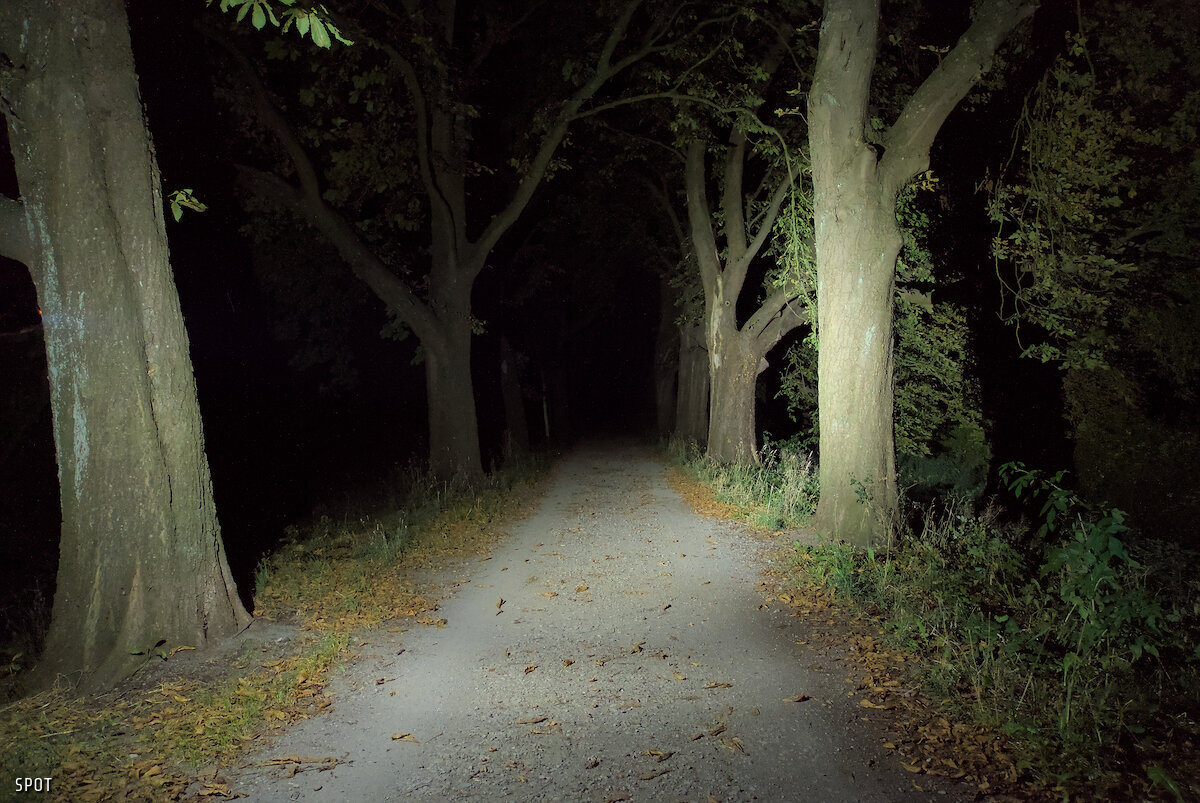
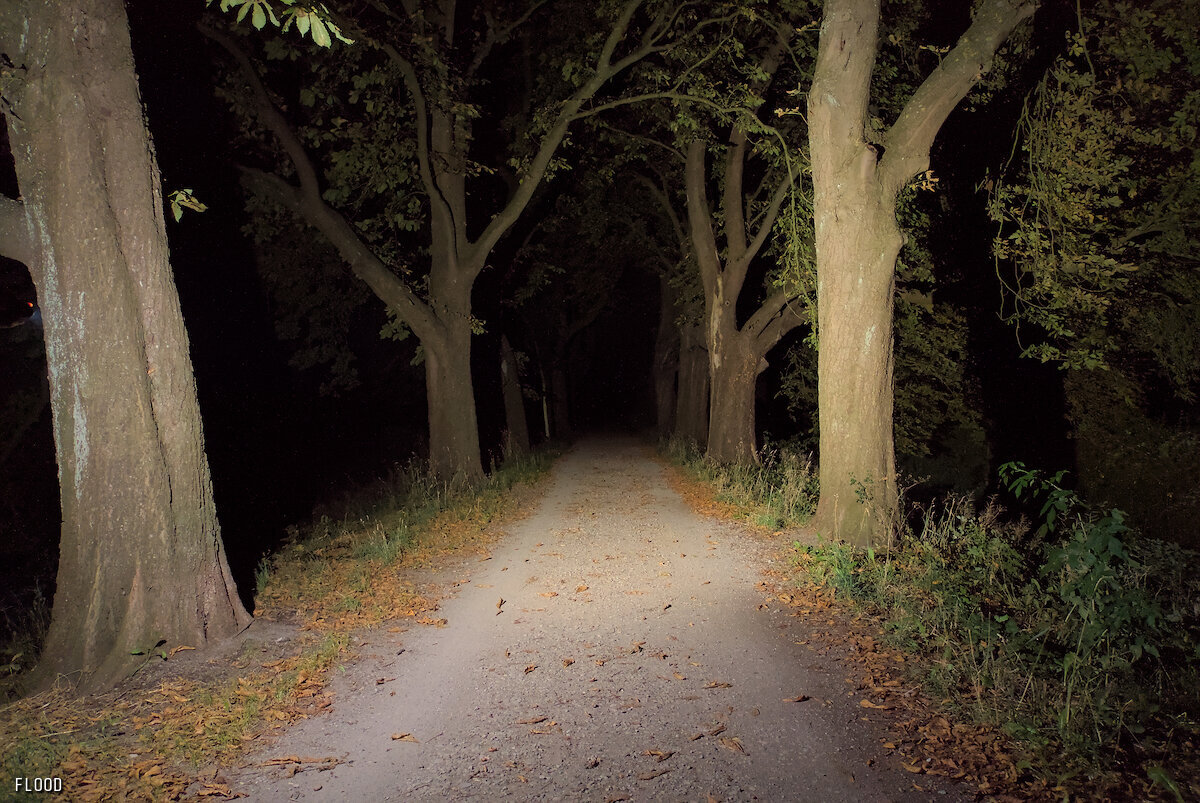
Although the spotlight still has room for improvement, the throw advantage is clearly visible in the following images. The floodlight is spread wide enough to prevent a “tunnel vision” effect.
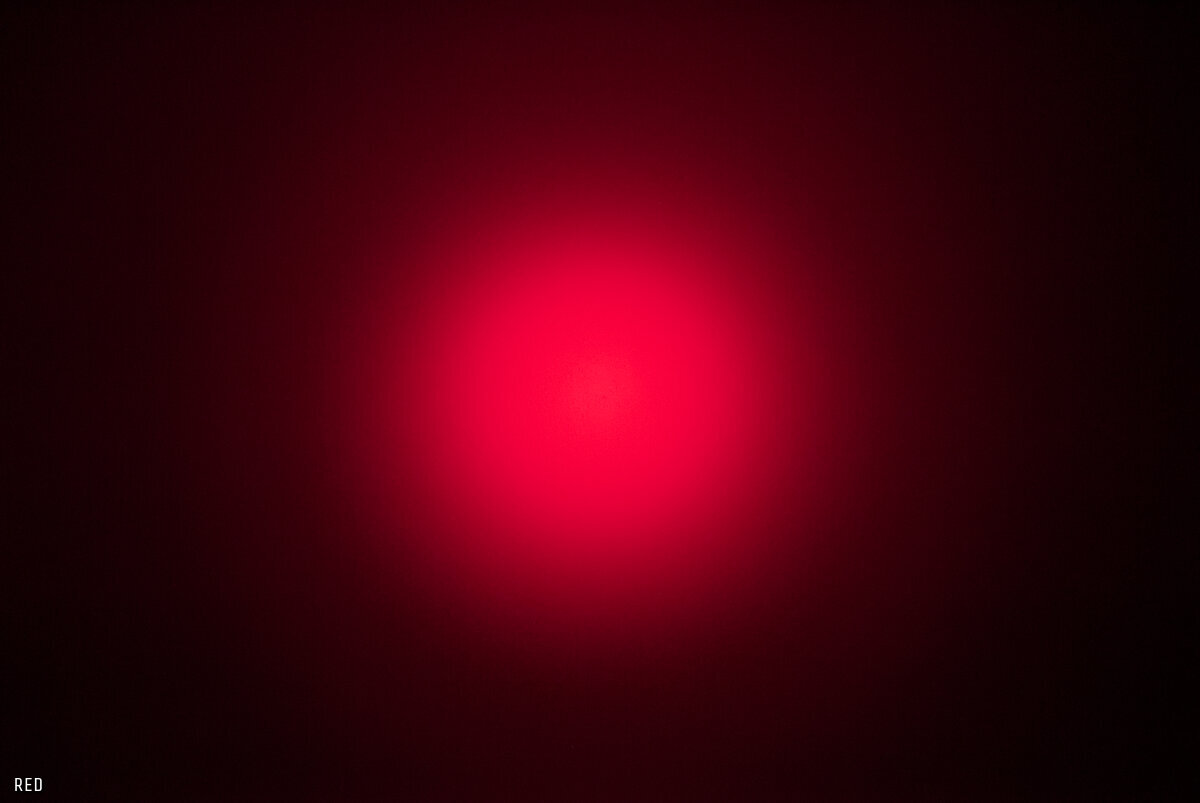
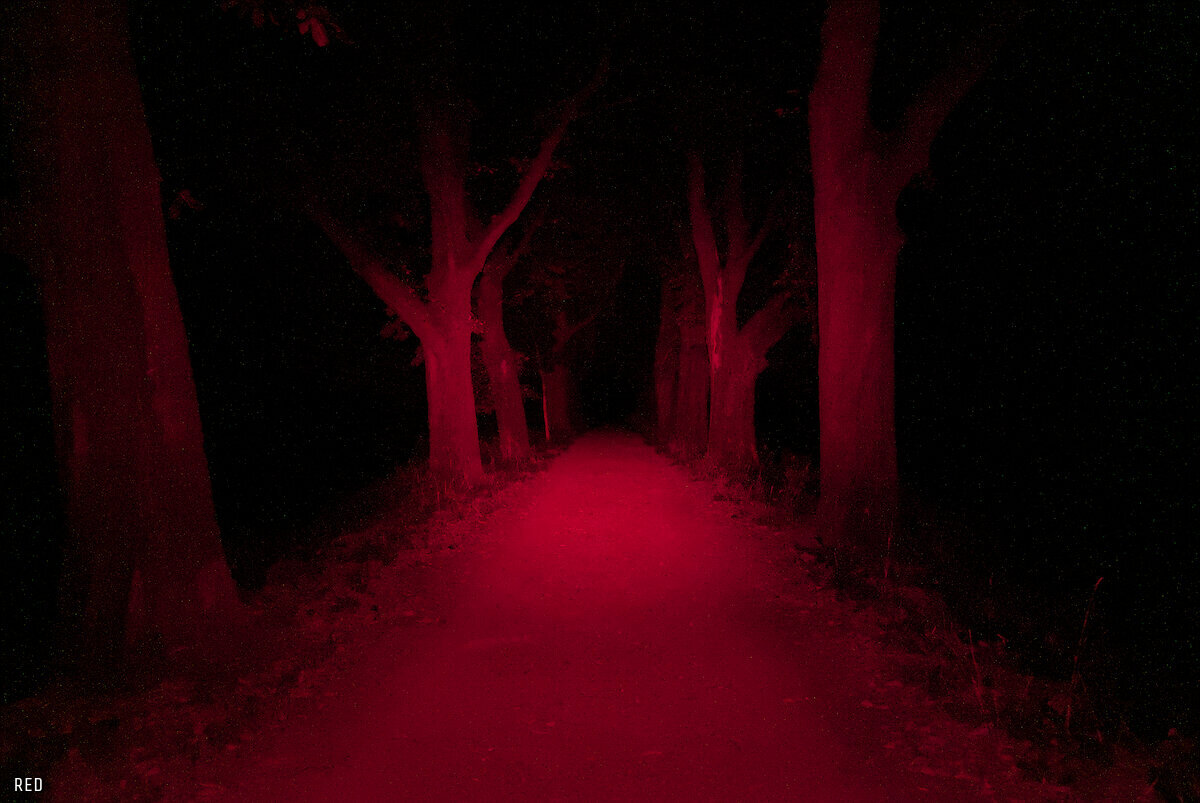
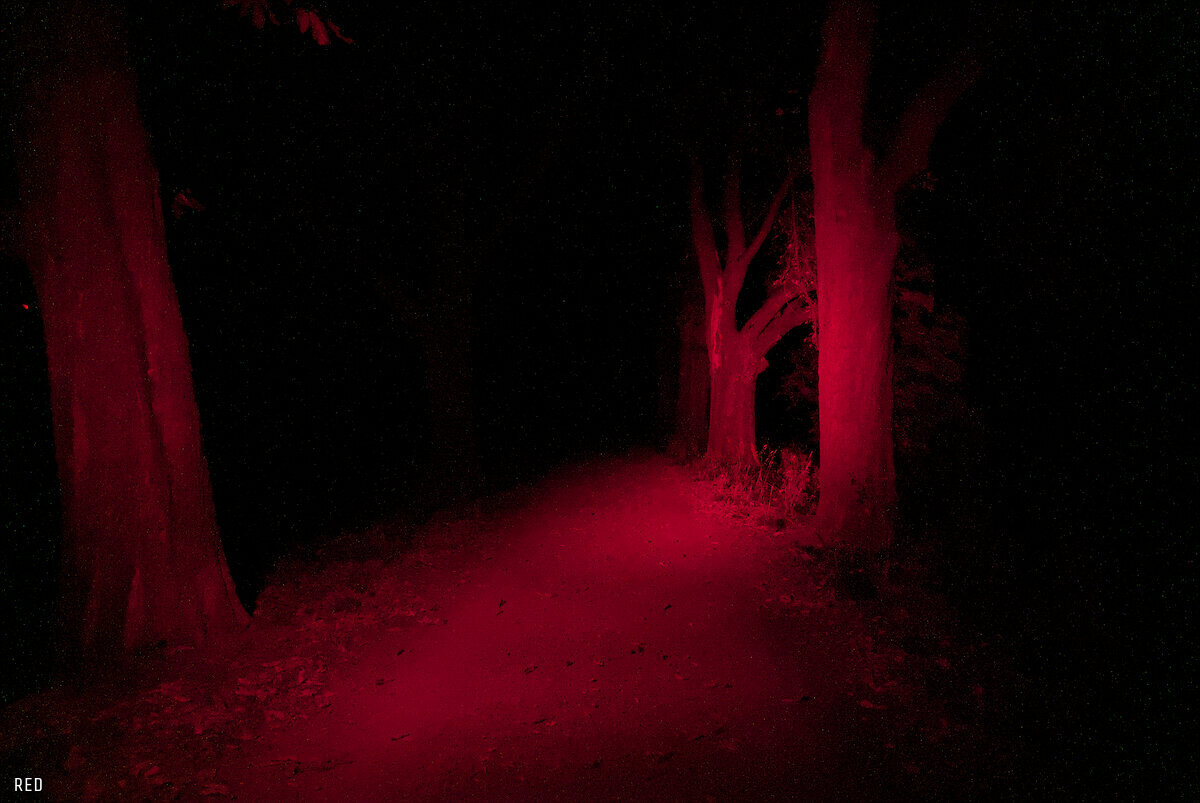
Red light is supposed to have a reduced impact on the dark adaptation than white light. This is because the rods, responsible for vision in low-light conditions, are less sensitive to long-wavelength red light. The cones responsible for color vision, on the other hand, respond more strongly to red light, so the eye’s adaptation to darkness is less disrupted.
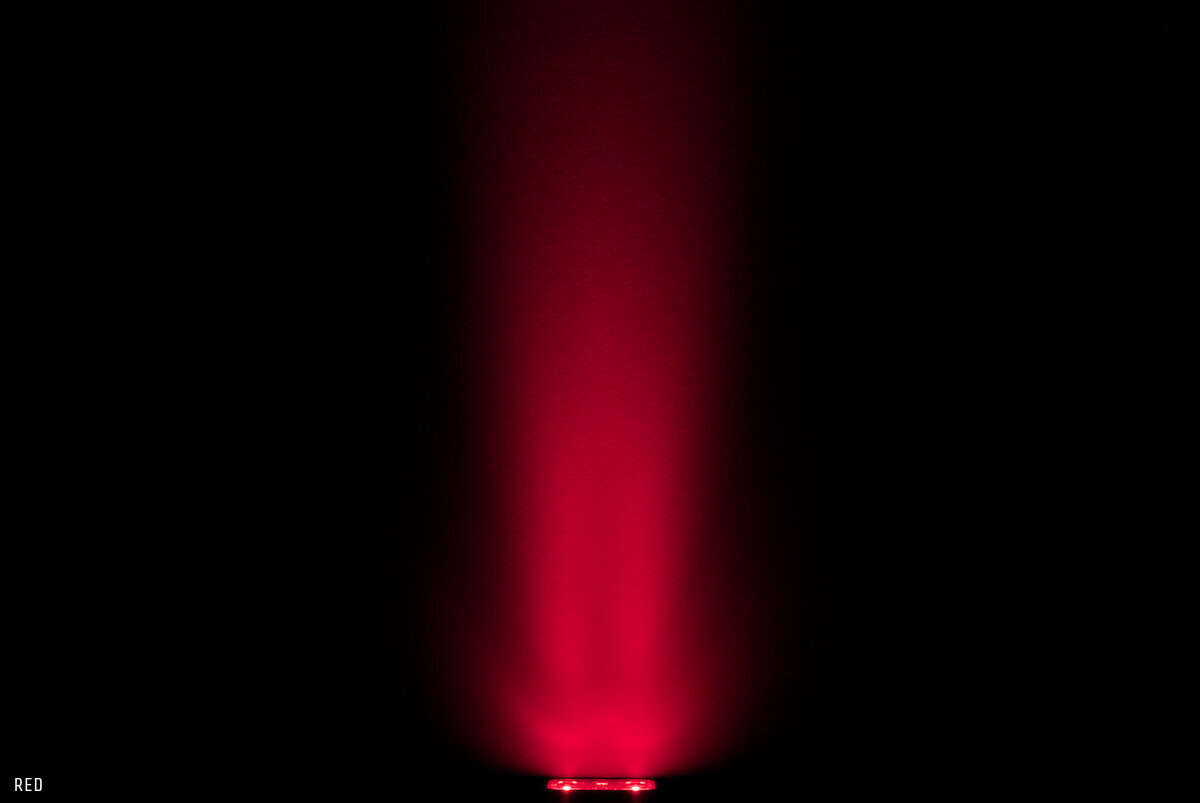
However, this only works as long as the red light is not too bright. On the HS23, even the lowest level is relatively bright. The three higher levels are even bright enough to significantly impair the eyes’ dark adaptation. In addition, the red light is relatively tightly focused, making it only somewhat suitable for illuminating the close area.
Driver and runtime
The manufacturer does not provide any further information about the type of driver. However, it can be determined that a constant-current driver is used, as indicated by the constant brightness.
| Mode | Brightness¹ | Runtime¹ | Intensity¹ (Throw²) | Current³ |
|---|---|---|---|---|
| Mix » Turbo | 3320 / 1000 lm | 2 min + 1:55 h | 9216 cd (192 m) | 7.35 A |
| Mix » High | 1558 / 730 lm | 10 min + 3:20 h | 2.70 A | |
| Mix » Medium | 529 lm | 6 h | 0.84 A | |
| Mix » Low | 100 lm | 22 h | 0.20 A | |
| Mix » Eco | 5 lm | 350 h | 0.05 A | |
| Spot » Turbo | 2044 / 984 lm | 3 min + 2 h | 3.96 A | |
| Spot » High | 1044 / 600 lm | 10 min + 4:30 h | 1.68 A | |
| Spot » Medium | 355 lm | 10:30 h | 0.54 A | |
| Spot » Low | 90 lm | 36:30 h | 0.19 A | |
| Spot » Eco | 5 lm | 350 h | 0.06 A | |
| Flood » Turbo | 2044 / 700 lm | 3 min + 2:20 h | 5.45 A | |
| Flood » High | 1067 / 660 lm | 10 min + 3:10 h | 2.23 A | |
| Flood » Medium | 358 lm | 8 h | 0.66 A | |
| Flood » Low | 75 lm | 36:30 h | 0.18 A | |
| Flood » Eco | 4 lm | 350 h | 0.05 A | |
| Red » Turbo | 180 / 135 lm | 30 min + 2 h | 1.66 A | |
| Red » High | 70 lm | 8:18 h | 0.55 A | |
| Red » Medium | 25 lm | 19 h | 0.25 A | |
| Red » Low | 10 lm | 48 h | 0.15 A | |
| Off | 48 µA |
¹ According to manufacturer ² ANSI FL1 ³ Measured
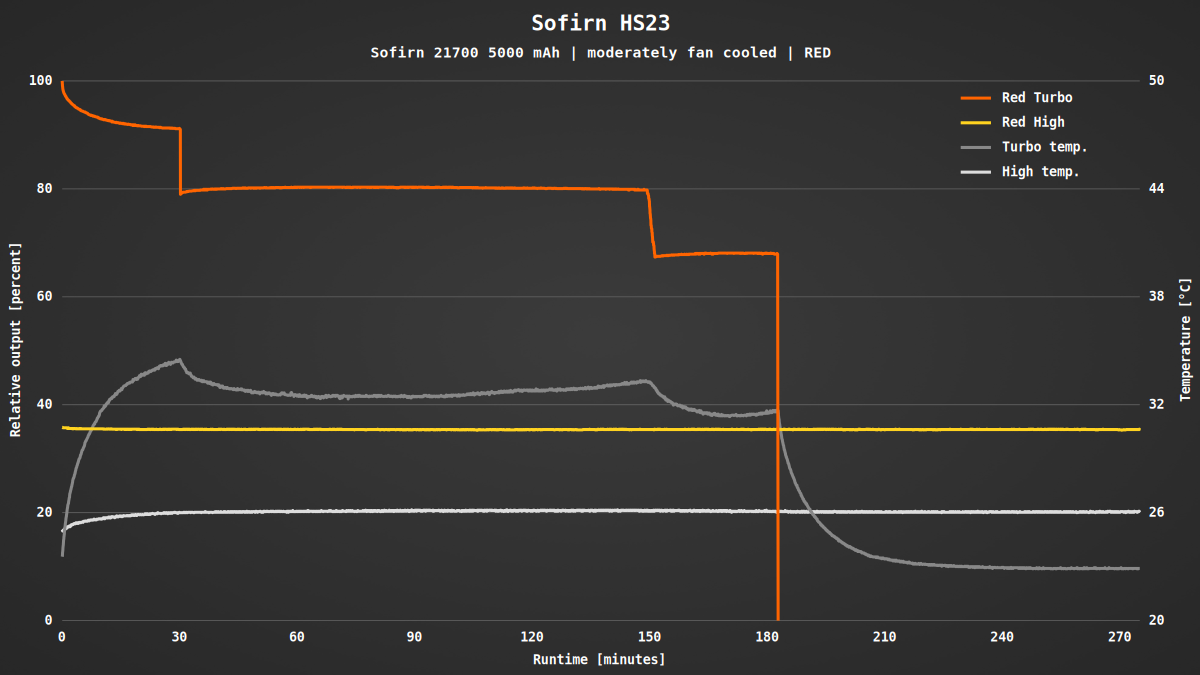
In Turbo mode, the brightness is reduced after two or three minutes, depending on the channel. At the High level the initial brightness is maintained for ten minutes. Since these times correspond exactly to the manufacturer’s specifications, it seems likely that the stepdown is time controlled rather than being based solely on temperature.
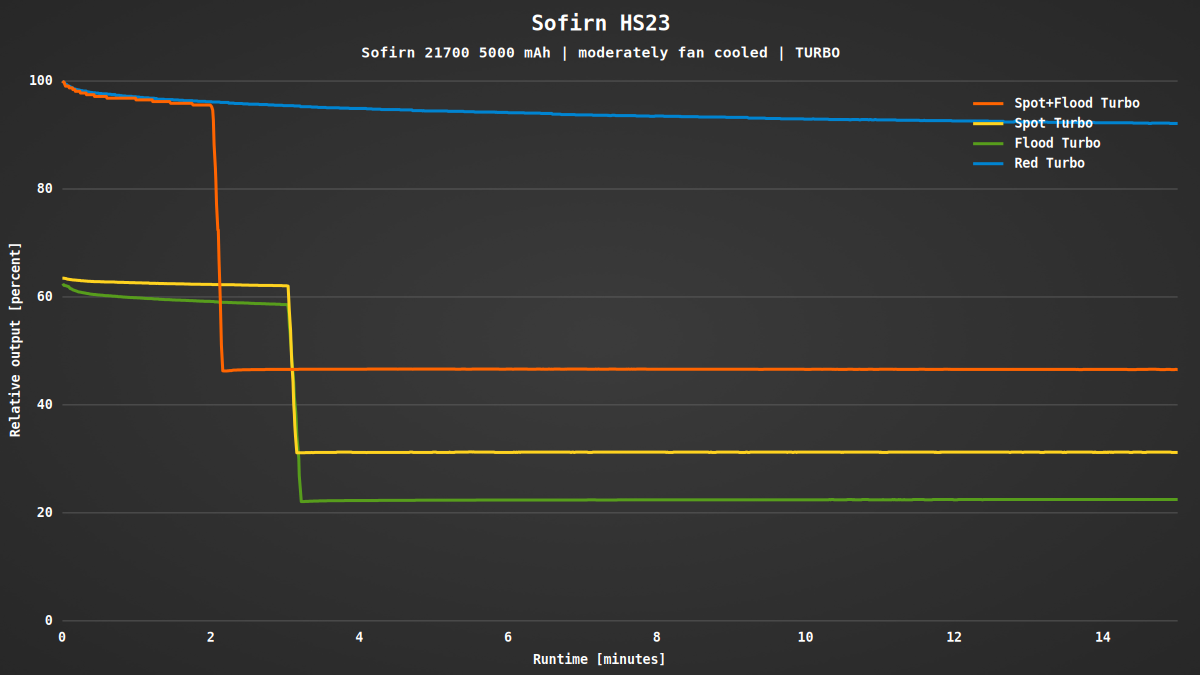
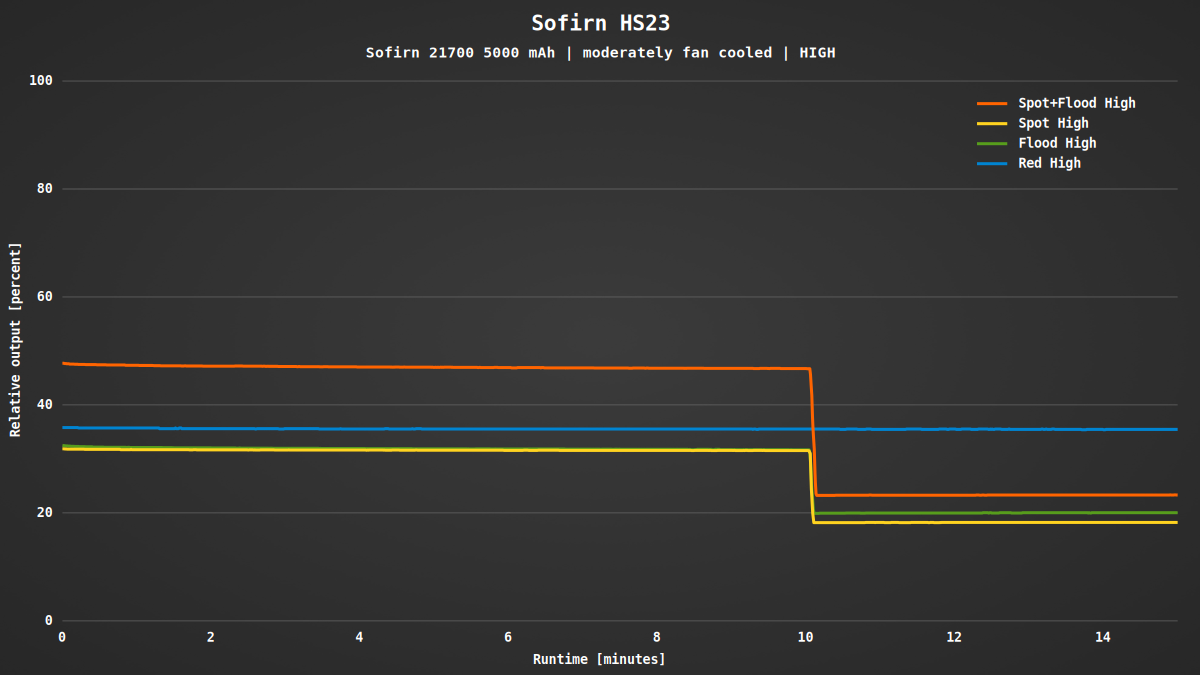
This assumption is also supported by the measured temperatures. There is still some headroom at certain brightness levels, while at others the flashlight can get quite warm depending on the cooling.
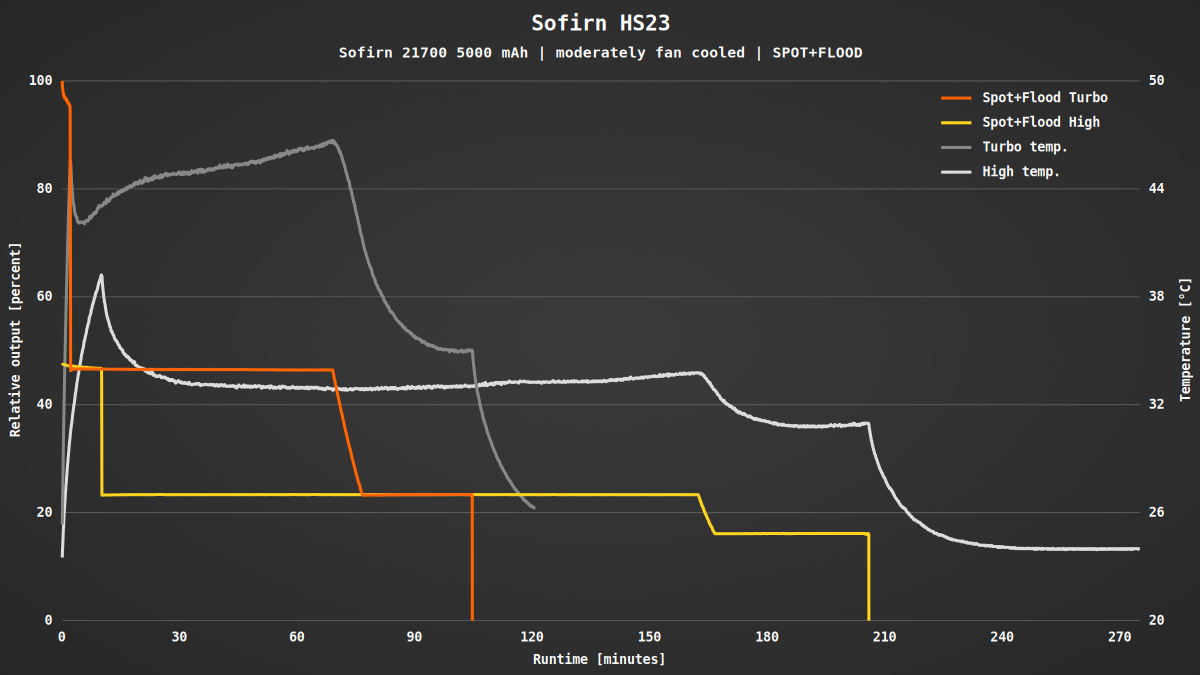
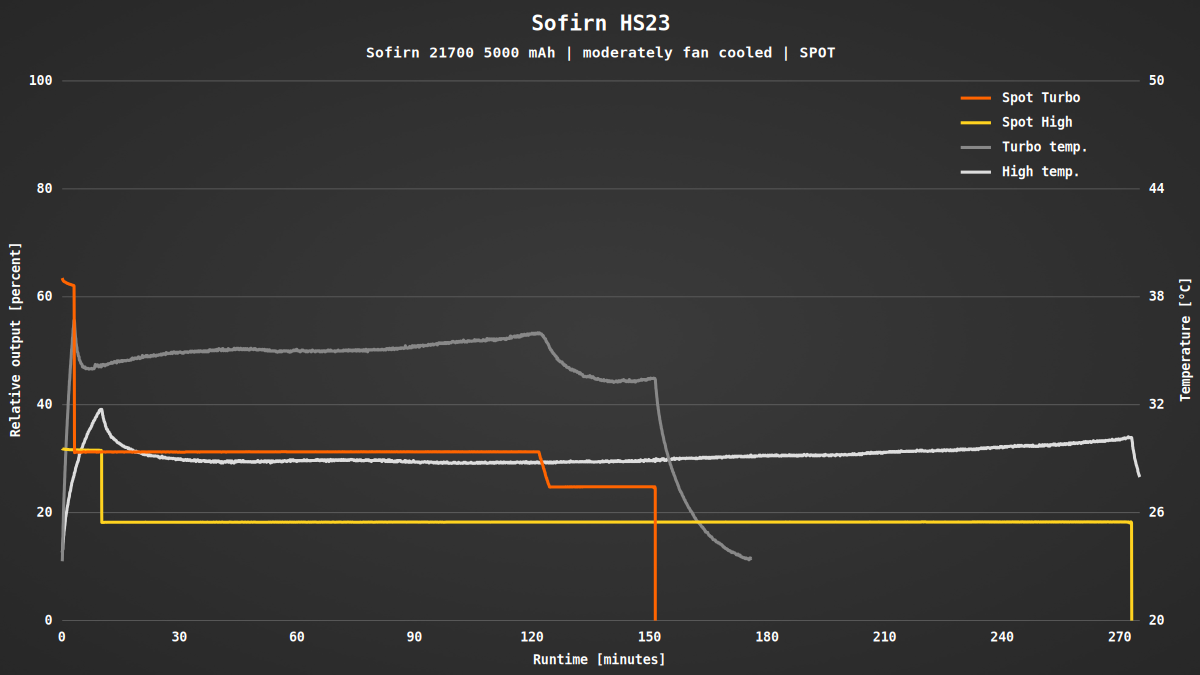
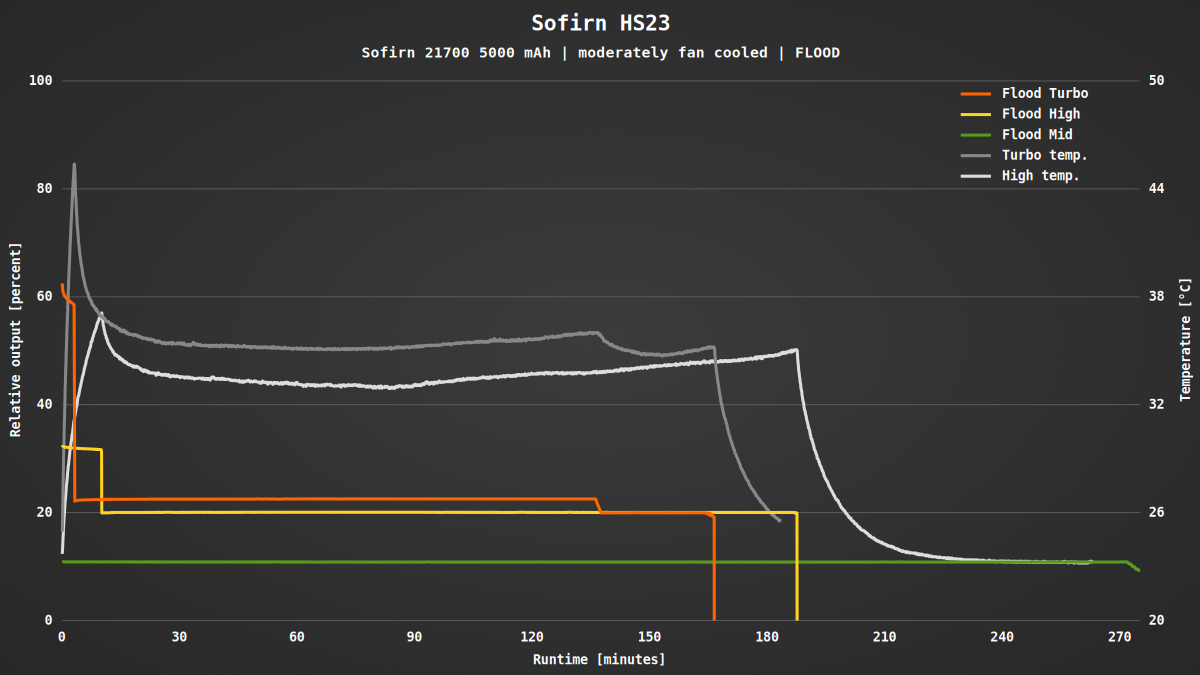
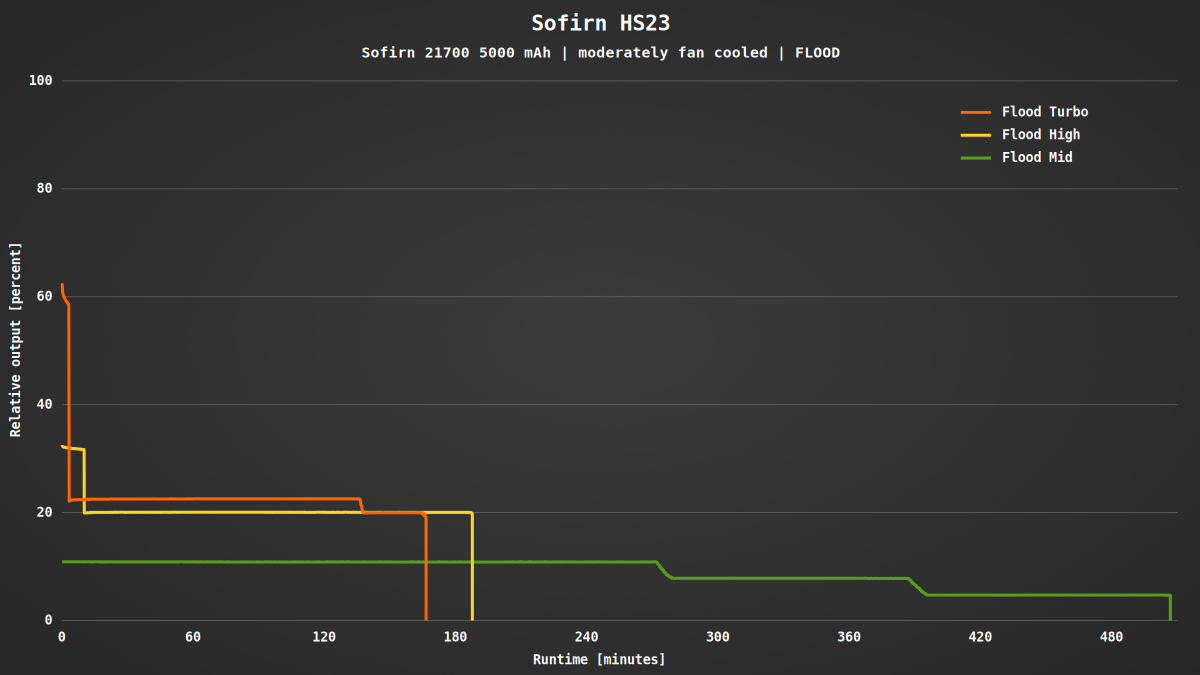
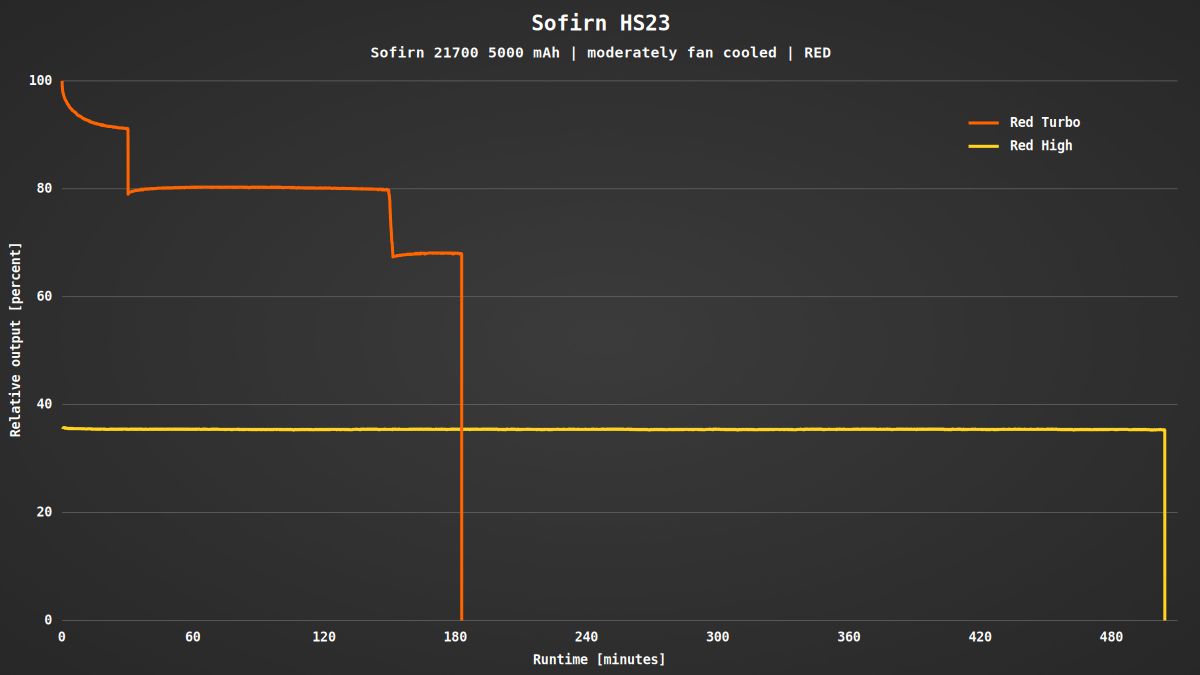
For the lower brightness levels, I measured the runtime of the floodlight as an example. There are some minor stepdowns later in the runtime. With the red light, on the other hand, even the High level is maintained at a constant brightness throughout the entire runtime.
Without additional cooling, the flashlight reaches a temperature of over 50 °C after only a short time. If it is not being held in your hand, you may not notice the significant heat buildup until quite late. Caution is advised when using Turbo to avoid burns. According to the product description, the HS23 features temperature monitoring that automatically reduces the output when necessary.
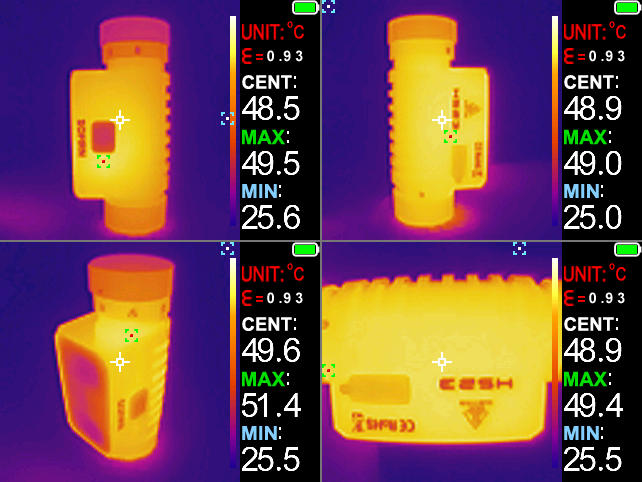
Thermal images with Zoyi ZT-R02
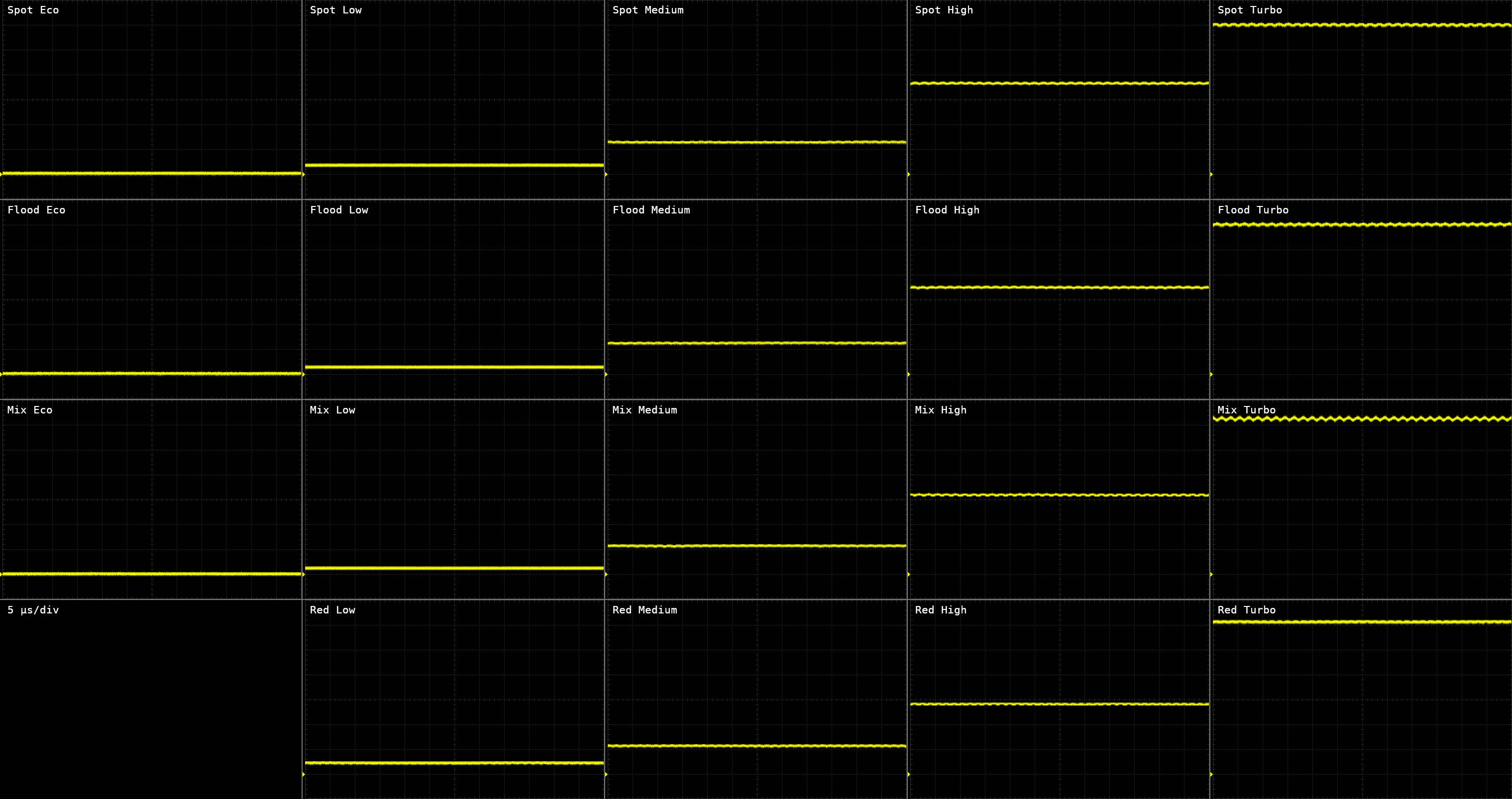
All brightness levels are regulated without PWM. However, a slight amount of ripple can be detected with an oscilloscope. The frequency is around 500 kHz, making it imperceptible to the human eye.
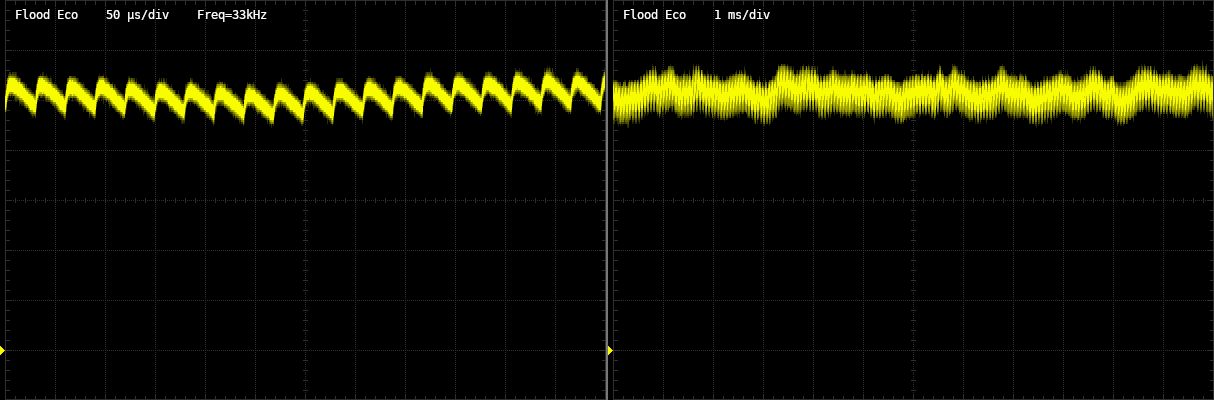
At the lowest brightness level a faint, irregular flickering is noticeable. With the oscilloscope, I could only measure a somewhat more pronounced ripple at a frequency of around 33 kHz. However, no significant brightness fluctuations were detectable even with a longer time base.
If the battery voltage drops below 2.7 V, the flashlight automatically switches off to protect the battery from deep discharge. At 3.2 V the status LED in the button starts flashing red. An additional warning by flashing the main light (that can be disabled) would be a practical addition, since the status LED is normally not visible when the flashlight is worn as a headlamp.
Conclusion
The Sofirn HS23 has a lot to offer: The headlamp features three channels with spotlight, floodlight and 660 nm red light, which can be conveniently switched between using a rotary switch. It also has an integrated USB-C charging function.
Despite its simple operation and practical features, I have one major criticism of the HS23: It is simply too heavy for a headlamp. Even an 18650 battery feels borderline to me in a headlamp, so a large 21700 battery is all the more unsuitable for this application. Personally, I would prefer a shorter runtime and more frequent battery changes rather than having to wear a relatively heavy flashlight on my forehead for extended periods.
However, the HS23 can make sense when high brightness is required for extended periods. If a helmet is already being worn for work, the additional weight is less of an issue. The good regulation is also an advantage in this case, as it keeps the brightness constant for a long time.