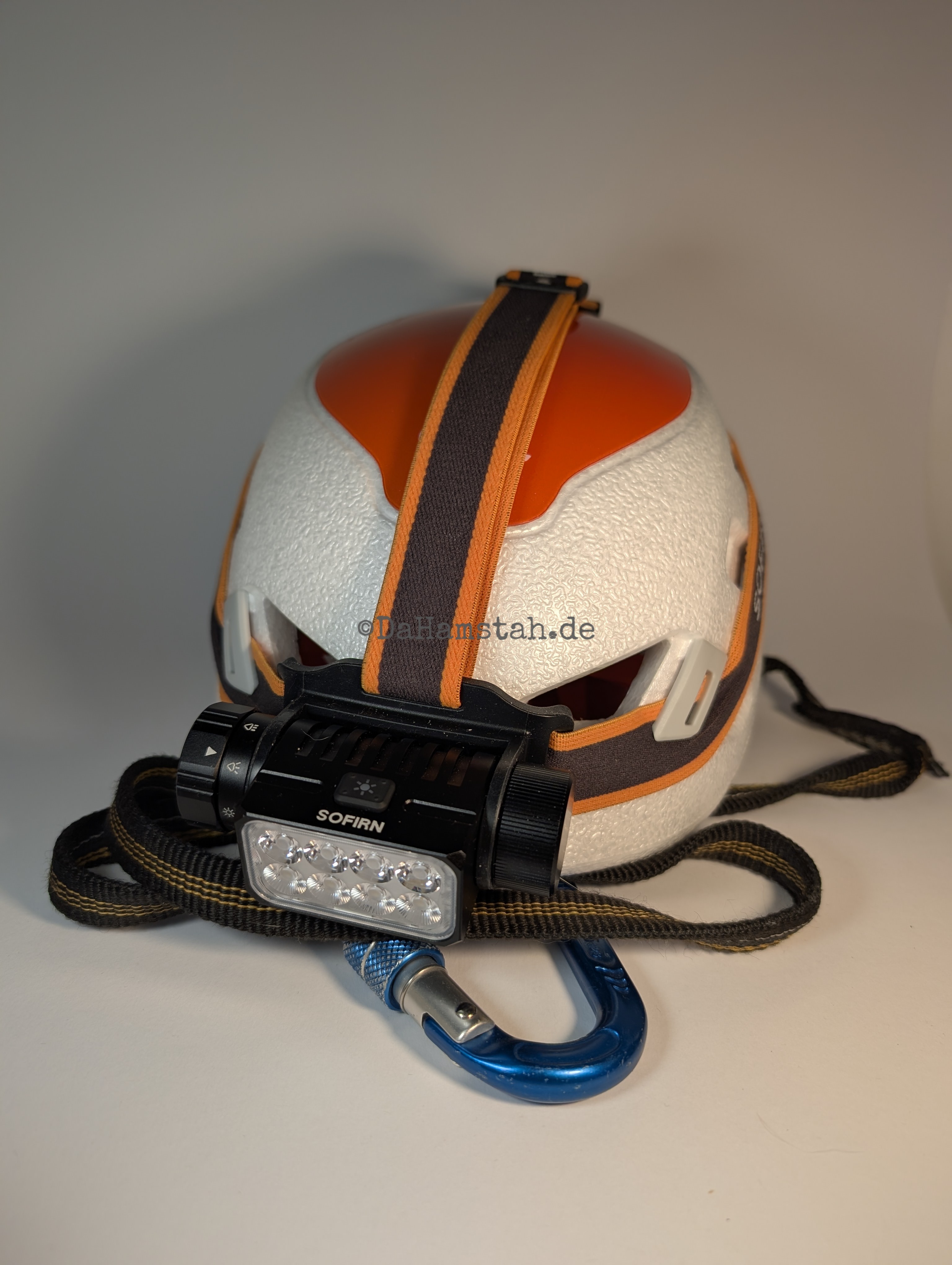
When I saw this light, I was immediately interested in doing a review. Sofirn has released some very good headlamps lately, and the UI on the HS23 looked promising once again. Combine all that with a large 21700 battery - hopefully it’s not too heavy, but other than that, it obviously promises great runtimes!
All my reviews can be found on my website.
Disclaimer: Sofirn provided this light to me free of charge. This had no influence on the review.
All measurements were done using hobby-grade equipment, inaccuracies and deviations are therefore possible.

There is only one version of the HS23, which can be seen here. You can purchase it directly from Sofirn.

The light arrives in a typical white Sofirn box printed with an image of the headlamp and its key specs. Included alongside the headlamp (with battery and pre-installed headband) are a short USB-C-to-C cable, two spare O-rings, and a manual.

The light is very clearly a dedicated headlamp / helmet light. Not a hybrid for quick unclipping. A switch with an integrated battery indicator is located centrally on the light, while a rotary switch for the light source is on the side. Both have a good, distinct tactile feel.


The HS23 is certainly no lightweight, but rather one of the heavier models of its kind. The included 5000mAh 21700 battery definitely contributes its share to this. While we are on the topic of the battery: of course, there is LVP (low voltage protection) in the light, as well as reverse polarity protection. The battery is dual-spring loaded, and the tailcap threads are anodized, allowing for a mechanical lockout.


Opposite the switch sits the USB-C port, which accepted all of my cables without complaint. Unfortunately, it is only sealed by a rubber flap, but it sits reassuringly tight.


On the front, there are 8 LEDs behind a large 8-port TIR optic. In the top row, the red LEDs sit on the outside, and the spotlight LEDs are on the inside. In the bottom row, there are 4 LEDs responsible for the floodlight. The TIR is not covered by glass. As a result, minor scratches cannot be avoided, but they do not affect performance. On the plus side, there is no glass that can shatter.
As you can see clearly from the previous pictures, the build quality is flawless. The anodization is smooth and slightly semi-gloss, but it survived my testing (including transport in a backpack with other metal objects) without damage.

Wurkkos HD17, Sofirn HS45, Sofirn HS23, Sofirn HS43, Sofirn HS21
The tube length of the HS23 is 90mm, and the diameter at the switch is 31mm. The thickest part is 41mm deep.
Including the headband and battery, the light tips the scales at a hefty 237g.


Headband: It would be nice if Sofirn updated the headband a bit. Ventilation holes and a silicone strip would be a great addition. However, I can’t really fault the headband as it is. It holds the light securely on the head / helmet, feels sufficiently robust, and is surprisingly comfortable. Additionally, it insulates the heat well from the head. Whether the rubber mount is more durable than plastic ones is something I obviously cannot say, but everything is thickly executed and feels quite rugged.
Furthermore, it is adjustable over a wide range; it easily fits my small head (helmet size S…) but also my climbing helmet (size S…) - and there is still plenty of room left for larger helmets!
Lanyard: No lanyard is included
Clip: No clip is included
Magnet: No magnet is integrated
Pocket carry: Whether in a jacket pocket or a backpack, both mechanical and electronic lockout are available. The light is not small and light, but it fits well into most pockets and remains unobtrusive there.


Explanation 1C, 1H...
1C: short click, 2C: double click, …
1H: press and hold without letting go
2H: short click, followed by 1H
The UI is simple and intuitive, yet it offers all important functions. Each mode memorizes settings individually. Mode selection works simply, but really great with the lateral rotary wheel. There you can choose between Red, Combined Floodlight and Spotlight, Floodlight only, or Spotlight only.
The UI for all white modes is identical, there is a small deviation for red.
| State of the light | Action | Result |
|---|---|---|
| off | 1C | on in last used mode |
| on | 1C | off (except in Turbo, then back to the last used mode) |
| off | 1H | moon |
| on | 1H | Cycle modes |
| on | 2C | Turbo / Beacon for Red |
| off | 2C | Lock |
| Lock | 2C or more | Unlock and turn on |
All measurements were performed in my 30cm integrating sphere. The temperature ranged from 24 - 29°C due to the heatwave. Additionally, an Opple Light Master III and a TASi TA636B luxmeter were used. Please note that this is hobby equipment, so inaccuracies and deviations are possible!

The “HOT” lettering should be taken seriously!
If you really torture the light (29°C ambient temperature, no airflow, upside down in the sphere), it gets quite hot. I measured just under 70°C at the peak. This is not critical and will probably never happen in real-world use, but I think it is worth mentioning. Most lights step down before that. If you wear the light on your head and move around (or at least do not lock it into a sphere with the LEDs facing down), the light gets warm but stays below the pain threshold - even if you reactivate Turbo multiple times
What can I say, I really like the beam profile of the light. Spot is a distinct, yet large and not too sharp hotspot. Flood is floody, but still directional, though completely without a hotspot. Red corresponds roughly to the spot beam. The combined mode works surprisingly harmoniously despite the different color temperatures, much more pleasant than, for example, on the HS21. For my use cases, it couldn’t have been more fitting.
To put it briefly: the performance is good. The light really squeezes the maximum out of its size and emitters, as can also be seen from the temperatures. For flood and spot, I omitted the low mode, and for all of them, the eco mode. 36h and 350h can no longer be cleanly displayed in the diagram.
The light delivers approx. 950 lumens for nearly 2 hours. I really like that. Almost every mode has a small stepdown, which I am used to from other Sofirn models. As always, that is a matter of taste. I prefer constant regulation until shutoff, but I have also heard many voices that prefer this type of regulation.

All runtimes

the first 200 minutes

Turbo runtimes including temperatures

The first 15 minutes of the highest output levels
| mode | Output (30S) | Runtime (until shutoff) | Spec |
|---|---|---|---|
| Spot + Flood Turbo | 3094 (2982)lm | 2h 25min | 3320 – 1000lm → 2min + 1h 55min |
| Spot + Flood High | 1414 (1402)lm | 3h 24min | 1558 – 740lm → 10min + 3h 20min |
| Spot + Flood Mid | 485 (485)lm | 7h 31min | 529lm → 6h |
| Spot + Flood Low | 97 (97)lm | 26h | 100lm ->22h |
| Spot + Flood Eco | 4lm | – | 5lm → 350h |
| Spot Turbo | 1812 (1782)lm | 2h 31min | 2044 – 984lm → 3min + 2h |
| Spot High | 932 (928)lm | 4h 22min | 1044 – 660lm → 10min + 4h 30min |
| Spot Mid | 319 (319)lm | 10h 25min | 355lm ->10h 30min |
| Spot Low | 84 (84)lm | – | 90lm → 36h 30min |
| Spot Eco | 5 lm | – | 5lm ->350h |
| Flood Turbo | 1949 (1881)lm | 2h 52min | 2044 – 700lm → 3min + 2h 20min |
| Flood High | 1005 (995)lm | 3h 6min | 1067 – 660lm → 10min + 3h 10min |
| Flood Mid | 334 (331)lm | 8h 24min | 358lm → 8h |
| Flood Low | 72 (72)lm | – | 75lm → 36h 30min |
| Flood Eco | 4lm | – | 4lm ->350h |
At maximum (at turn-on, full battery, measured at 1m), I measured 13780cd for the light. This corresponds to a throw of 235m.

A short comparison to some other Headlamps shouldn’t be missing!

| Combo low / turbo | Flood low / turbo | Spot low / turbo | |
|---|---|---|---|
| CCT | 5000 / 5250 | 4900 / 4900 | 5900 / 6250K |
| CRI | 89 / 85 | 97 / 94 | 73 / 73 |
| DUV | 0,005/ 0,003 | 0,006 / 0,005 | 0,002 / 0,000 |
More details regarding the measurements can be found here.


Flicker is within the green zone, PWM is not visible (even with a camera). Below you will find exemplary screenshots of the measurement for Flood.


I hope you can see from the beamshots how well the light performs in comparison. All shots were taken with full batteries, identical settings, and within a timeframe of just a few minutes. Two remarks regarding the HS21: mine has an SFT40 5000K as the spot LED - so don’t be surprised by the neutral white spot and keep in mind that the original will have a few more lumens. And the photo of the red light unfortunately turned out blurry, which I only noticed back home. However, it is enough to show how much stronger the red light of the other headlamps is. A direct comparison of the red light HS21 vs HS23 is also included.

HS21 left, HS23 right


The light is usable while charging, though not at full brightness. On the head, you would probably have the USB cable in your field of vision, so this type of use lends itself more to illumination away from the head. Unfortunately, it does not support reverse charging, so other devices cannot be charged.

The charging behavior itself looks exemplary. The CC/CV process is implemented very well. Even the rising voltage of the battery is taken into account, which you rarely see. The termination close to zero also pleases me. Overall, the charging profile is very gentle on the battery, which aligns with the conservatively chosen roughly 9W charging power - slightly below 0.5C. While that might not be the fastest, it is definitely gentle on the battery and, in my eyes, a good choice for the small housing.
Sofirn currently has a knack for headlamps. The HS21 is very frequently recommended for good reason, and the HS22 is a great alternative. The HS45 is technically very interesting. So where does the HS23 rank? In my eyes, if weight is not the main priority or you don’t want to go running with it, it takes the number 1 spot on my personal headlamp ranking list.
The biggest disadvantage of the light is probably, as with any 21700 headlamp, the weight. The headband does work, and is surprisingly comfortable even, but it could still be a bit more modern. The sealing of the light is not optimal, but more than sufficient for IPx6. With that, the negative points I could find have been mentioned.
On the other hand, it offers a great, balanced beam in all modes. The light is surprisingly comfortable to wear for its weight and is less noticeable on my head than the HS21. In return, you get more output and more runtime. Combined with an equally great interface - I like the lateral rotary control even better than the one on the HS21, as I no longer run the risk of blinding myself by shining light into my own hand. The switch is easy to find and can be operated even with gloves. And the red light of the lamp is clearly superior to the competition.
Whether for long mountain tours that start and end in the dark, in the workshop, on vacation, or just for walking the dog - the light is quite an all-round talent.
