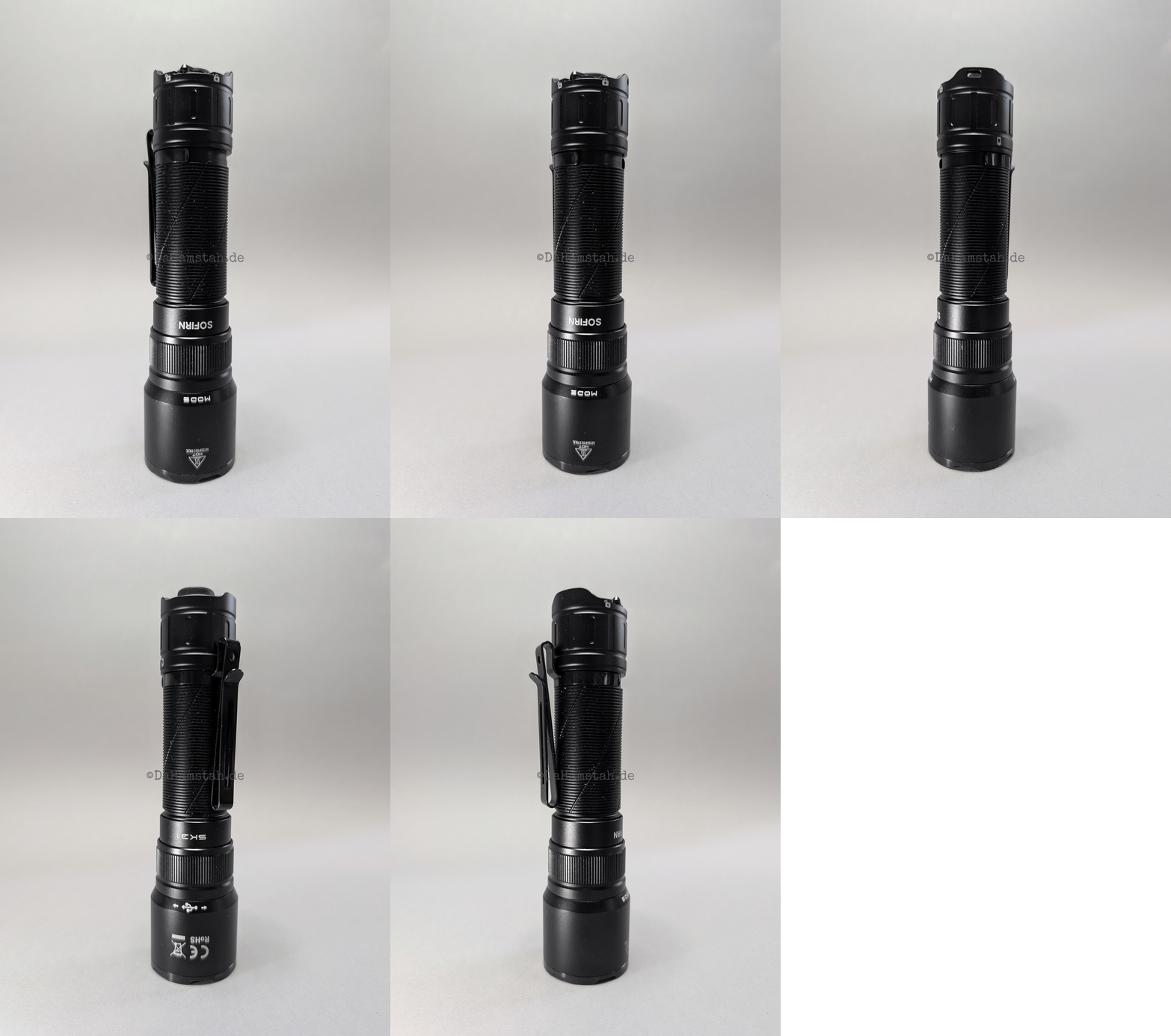
Despite the LHP73B, the SK31 wasn’t really a light that appealed to me at first. When Sofirn reached out for a review, I said yes anyway – sometimes you just have to give something a try and prove yourself wrong. Below you will read how the SK31 performed in my testing.
By the way, Sofirn is also on Discord , and everyone on the server would love to see more members join! You’ll also always get the latest product updates there.
All my reviews can be found on my website.
Sofirn provided me with this flashlight for free. This had no influence on the review.

The flashlight is only available in the single version presented here.


As usual with Sofirn, the light comes in a white box adorned with a print of the flashlight and all relevant specs. Besides the light with the battery included, it comes with a charging cable (USB-C on both ends), a lanyard, 2 O-rings, a manual, and a holster.
At first glance, the light looks quite unspectacular. Black, slightly glossy, with a few nicely executed white engravings. The initial impression of build quality is solid; there is nothing to complain about.

At the tail end, there are two switches. A small toggle switch on the side that locks out the light, and a classic-looking tailswitch. While it feels a bit like a forward clicky, it is actually a two-stage e-switch. Upon first use, I thought it would take some time getting used to it, but it didn’t – I never gave it another thought! The small lockout switch is easy to operate with bare hands and offers little surface area to snag on anything.With gloves, depending on their thickness, it can be a bit hard to feel out.


The tailcap cannot be removed from the main tube with its inner tube. The battery is dual-spring loaded, and the springs are thick enough to handle the expected current draw.

At the head, there is a collar that can be unscrewed down. It is sealed with O-rings and conceals a USB-C port on one side and a switch on the other. The switch doubles as the battery indicator. On the one hand, this is great because it completely prevents unwanted visibility or blinding, but on the other hand, you have to unscrew the collar just to check the battery status. The switch can toggle between Tactical UI (blue) and Outdoor UI (yellow).
Three glass-breaker beads are embedded into the bezel. Whether the bezel itself is aluminum or stainless steel, I cannot determine. Looking into the head from the front, you can see a smooth reflector (SMO) under the AR-coated glass lens. At its center sits a novelty in Sofirn’s LED lineup: the LHP73B. A 7070 footprint LED known for high output paired with relatively good tint. In the SK31, it is rated at 6500K.


In hand, the ergonomics are good, and the buttons are easily reachable. The only time you need to change your grip is when switching between Outdoor Mode and Tactical Mode – but using two hands makes sense then anyway, since unscrewing the collar and pressing the button single-handedly is possible, but awkward.

Wurkkos TS28, Sofirn SK31, Wurkkos T1, Sofirn SR23

Sofirn SK31, Wurkkos T1, Convoy M21b
My scale showed 233g for the light.
The light has a diameter of 36 mm at its thickest point, the bezel. Overall length is 149 mm.
Lanyard: A basic lanyard is included and can be attached to the tailcap.
Clip: The clip is snapped onto the tail side of the light. It is a two-way clip. It feels robust and sturdy, with good tension and a comfortably wide ramp so even thick pocket edges slide all the way up. The tailcap still protrudes a bit when the light is pocketed, which favors a fast draw. Why a two-way clip was chosen isn’t entirely clear to me, as you will hardly clip a light this size to a cap brim, and head-up carry would leave the light sticking out way too far. As a result, the clip stands off slightly further than a standard clip would, presenting a slightly higher snag risk.

Magnet: There is no magnet.
Holster: A holster is included, and the light fits well. The hook-and-loop flap holds securely. On the back, there is a fixed belt loop with a second loop over it secured by velcro and a snap button. There is also a D-ring. In short, the holster makes a very good impression!


(Jacket)pocket: For pants pockets, the light is just a bit too large for my taste, but in a jacket pocket it is no more or less noticeable than any other cylindrical light – though it holds a big advantage with its mechanical lock switch.

The small switch beneath the collar toggles between Outdoor Mode and Tactical Mode. I will briefly present both in the usual table format, starting with Outdoor Mode:
Outdoor Mode:
| State of the light | Action | Result |
|---|---|---|
| off | full press | on, last used mode |
| on | full press | off |
| on | half press | Mode change |
Tactical Mode:
| State of the light | Action | Result |
|---|---|---|
| off | half press | Turbo, momentary |
| off | half press and hold 5s | Turbo, constant on |
| off | full press | Strobe, momentary |
| off | full press and hold 5s | strobe, constant on |
| strobe, constant on | half press | Cycle between Strobe, SOS, and Beacon |
| constant on | full press | off |
The UI works as intended (with one exception, see below) – but it is a bit of a shame that Sofirn didn’t make better use of the two-stage e-switch. A complete lack of shortcuts is something you usually expect from lights with a mechanical switch. Why Sofirn decided on this UI, I don’t know, but I hope they release a revision with improved operation later on. With this switch design, various shortcuts could be implemented, even while the light is turned on!
There is one bug, however: If you turn the light off in Outdoor Mode Turbo and then turn it back on, the light starts in High first and only steps up to Turbo after roughly 0.7 minutes. That is quite confusing!
All measurements were done in my 30cm integrating sphere. The temperature was between 20 and 24°C. Additionally, an Opple Light Master III and a TASi TA636B lux meter were used. Please note that this is hobby equipment, so inaccuracies and deviations are possible!
As a side note, the test unit had a bug that Sofirn intends to investigate further. If you turn the light off while in Turbo and turn it back on, the light starts in High and suddenly jumps up to Turbo after 0.7 minutes.
Outdoors, the beam profile works fantastically. The wide hotspot smoothly transitions into a broad spill; the light is a genuine all-rounder. Against a white wall, if you look very closely, you can see that the spot has its highest intensity at the outer edge rather than the center. Not a true donut hole, but noticeable. In the spill, a subtle flower pattern and an outer ring can be seen – but you really have to hunt for them.
I do have one open criticism for Sofirn, though: The stock battery severely chokes the maximum output of this light. That is a shame, because high-drain batteries capable of delivering the required current wouldn’t have pushed the price through the roof, but would have fully exploited the LED’s potential. To be fair, this exclusively impacts the maximum Turbo output - for everything else, it is irrelevant.

For better clarity, here it is again without Eco:

| mode | Max. Lumen | Lumen@30s | runtime |
|---|---|---|---|
| Sofirn SK31 Turbo RS50 | 8645 lm | 1876 lm | 2h 9min |
| Sofirn SK31 Turbo cooled | 6035 lm | 5531 lm | 2h 1min |
| Sofirn SK31 Turbo | 6077 lm | 2580 lm | 2h 3min |
| Sofirn SK31 high | 2598 lm | 2579 lm | 2h 16min |
| Sofirn SK31 mid | 1170 lm | 1170 lm | 3h 3min |
| Sofirn SK31 low | 345 lm | 344 lm | 10h 33min |
| Sofirn SK31 Eco | 42 lm | 42 lm | 71h 55min |
| Sofirn SK31 Moon | 1,5 lm | 1,5 lm | n/a |
According to my measurements, throw was 430 m at turn-on.
The light’s strange behavior when switching to Turbo can be seen in the following graph. The green curve shows the behavior when turning the light off in Turbo and switching it back on.

As soon as the light’s battery indicator starts blinking red, it shows up in the runtime graph as well. To the naked eye, it is imperceptible, even though it looks quite dramatic in the chart. Shown below using the medium mode as an example. After the second stepdown, the curve stays flat briefly, then the zigzag begins.

| Moon | High | |
|---|---|---|
| CCT | 6063 | 6762 |
| CRI | 69 | 71 |
| DUV | 0.006 | 0.001 |
Flicker is always in the green, PWM is not detectable with the eye or camera.
All raw test data can be found here.


All beamshots were taken back-to-back with locked, identical camera settings. The batteries were fully charged. The reflective barrier in the center of the path is roughly 260 m away.


The USB-C charging electronics charge the 21700 cell safely, gently, and terminate cleanly at around 73 mA.
Whether the current ramp-up and the slight dip before the CV phase are intentional, or whether, for example, the charging chip is pushed to its limits and thermal-throttling, I cannot tell - it certainly won’t do any harm. In the worst case, charging takes about 15 minutes longer than it would with a standard CC-CV profile; in the best case, it was designed this way on purpose. The latter is entirely possible, as some charging ICs adjust the current to the rising cell voltage during the charge cycle. Many current Sofirn and Wurkkos models show a similar curve, so I would bet on it being a quirk of the chip.
The light can be operated while charging, though not at full brightness.
Reverse polarity protection and low-voltage protection (LVP) are built into the light.

My Vapcell S4+ measured the included cell at 5066 mAh. That hits the rated 5000 mAh target almost perfectly. As mentioned earlier, the cell still limits the light – it simply cannot keep up with the LED’s power hunger. A modern tabless high-drain cell would have been the far more suitable choice in my eyes.
The SK31 is a rather unique flashlight. On one hand, you get two distinct UIs with a dedicated toggle switch, a hidden sleeve over the USB port, a physical lockout switch, and a two-stage e-switch, on the other hand, there are no direct shortcuts whatsoever.
The Tactical UI works well and intuitively. To what extent it is truly “tactical” is not for me to judge, but you do get momentary Turbo, allowing for signaling/morsing during activities like geocaching. The Outdoor UI features 6 brightness levels, spanning from ultra-low output up to a massive wall of light. Mode cycling feels fast and smooth, and I like the mode spacing.
So, the UI is relatively simple. This makes the light easy to operate, whether for high-stress situations or non-enthusiasts, but it also leaves some potential on the table. Whether for enthusiasts looking for a classic layout, duty personnel who suit the tactical UI, or – which surprised me quite a bit – as a simple yet impressively bright light to give as a gift or recommend to someone looking for a modern flashlight, it can be a great fit. Sofirn definitely needs to fix that Outdoor Mode Turbo bug either way, though!
Even inside the SK31, the LHP73B impresses with its overall qualities, and Sofirn executed the integration well. I hope Sofirn applies a similar concept geared specifically toward us enthusiasts in the future. As an entry point for the broader market, it is a success.
You can purchase the SK31 directly from Sofirn.If you always want the latest news on upcoming Sofirn products, be sure to drop by the Sofirn-Discord!


